Werewolf Trials in Europe
Explore four European werewolf trials through a map and the surviving evidence, from Gilles Garnier and Peter Stumpp to Jean Grenier and Old Thiess.
In this article
Map of four werewolf trial records
Follow four places through a printed judgment, a pamphlet, a later history and a court transcript.

Dole
Printed judgment. The Sens edition of 1574 presents the court’s sentence against Gilles Garnier and includes a separate commentary.
Bedburg
Contemporary pamphlet. A London reader could encounter the story of Stubbe Peeter in print in 1590.
Bordeaux
Later retelling. Hamel summarises the 1603 proceedings against Jean Grenier more than three centuries later.
Cēsis (Venden)
Court transcript. The record of the 1691 hearing preserves the judges’ questions and Thiess’s replies in translation.
What were werewolf trials?
Werewolf trials were legal proceedings in which people were accused of becoming wolves or committing attacks in wolf form. The records can show what witnesses and judges alleged and how they dealt with the accused. [1][2][3][4]
Early modern Europeans sometimes encountered the werewolf as a person accused of harming neighbours, as a creature in a story, or as a figure in a printed image. In a court setting the same word could be used by an accused person, a witness or a judge. Each speaker had a different role. The sources below let you ask whose claim survived and who had the power to put it on record. [15][16][18]
Dole and Bordeaux appear as places where a court dealt with a case. Bedburg is the place named by the London account. Cēsis marks the hearing at Venden. The map uses present-day coastlines and names to orient the reader. The four pins are a set of surviving examples, so their spread tells us little about how often accusations arose elsewhere. [15][16][8][18]
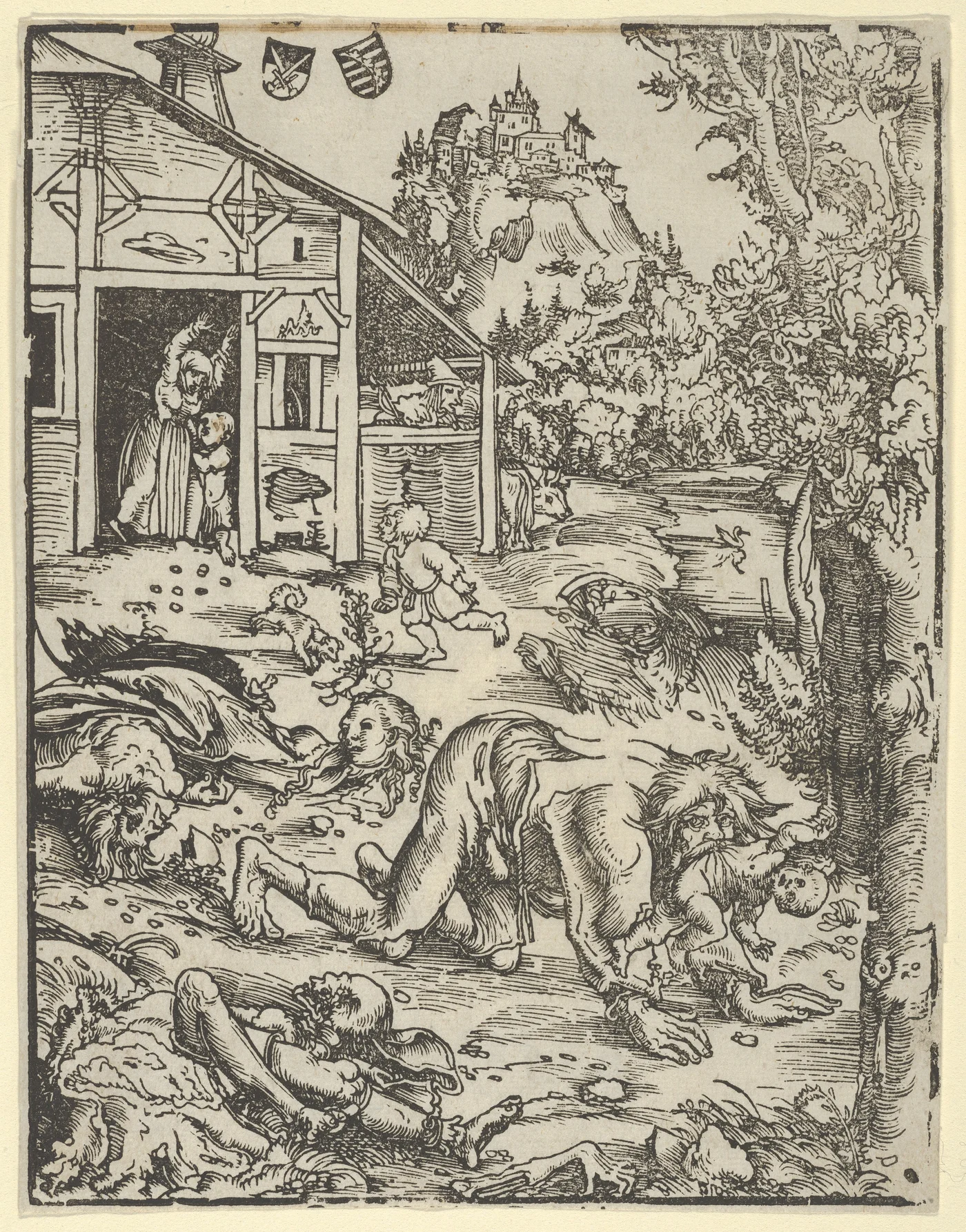
Lucas Cranach the Elder, The Werewolf or the Cannibal, woodcut. A figure with a human body attacks on all fours.
The Metropolitan Museum of Art. Harris Brisbane Dick Fund, 1942. 42.45.1. Open Access; Public Domain. · Image source ↗ · Public Domain
See references (8)
- Human Animals, printed p. 54, Reader page 63
- Human Animals, printed p. 55, Reader page 64
- Human Animals, printed p. 57, Reader page 66
- Human Animals, printed p. 60, Reader page 69
- Human Animals, printed p. 64, Reader page 73
- Arrest de la Cour de Parlement de Dole contre Gilles Garnier, 1574
- A True Discourse, London, 1590
- Hearings at Venden on 28 April 1691, English translation
Dole · Gilles Garnier and the printed judgment
A 1574 pamphlet catalogued by the Bibliothèque nationale de France presents the Dole court’s sentence against Gilles Garnier. Its title describes the alleged attacks as acts committed in wolf form. The edition also gathers material from other authors about transformation. The pamphlet therefore presents a legal case alongside a broader argument about what the charge meant. [15]
The surviving edition was printed in Sens. Its title dates the judgment to 18 January 1574, and the catalogue identifies an accompanying letter by Daniel d’Auge dated 31 August that year. The court’s sentence and the learned explanation are different parts of the same object. Read the title first for the charge the publisher puts before the public, then ask who is responsible for the comments about transformation. [15]
Hamel tells the Garnier story again in Human Animals, alongside other cases. The older printed object demonstrates that a reader could already encounter a sentence wrapped in an explanation. Hamel’s arrangement performs a different task. It puts Garnier in a series of cases assembled for readers interested in human and animal transformation. [15][9][3]
Bedburg · Peter Stumpp in a London pamphlet
The 1590 pamphlet calls him Stubbe Peeter and names Bedburg, near Cologne. Its title says he was executed on 31 October of the preceding year and advertises an English version of a printed German account. That statement gives us a claimed route by which this story reached London. The English title works as an advertisement as well as an identification of the case. [16]
The frontispiece puts several moments around one page. A reader can take in the publication’s arc from accusation to punishment before reaching the written account. Compare that with the Venden transcript, which makes the reader work through individual questions and answers. The two formats give very different access to what the accused purportedly said. [16][17][18]
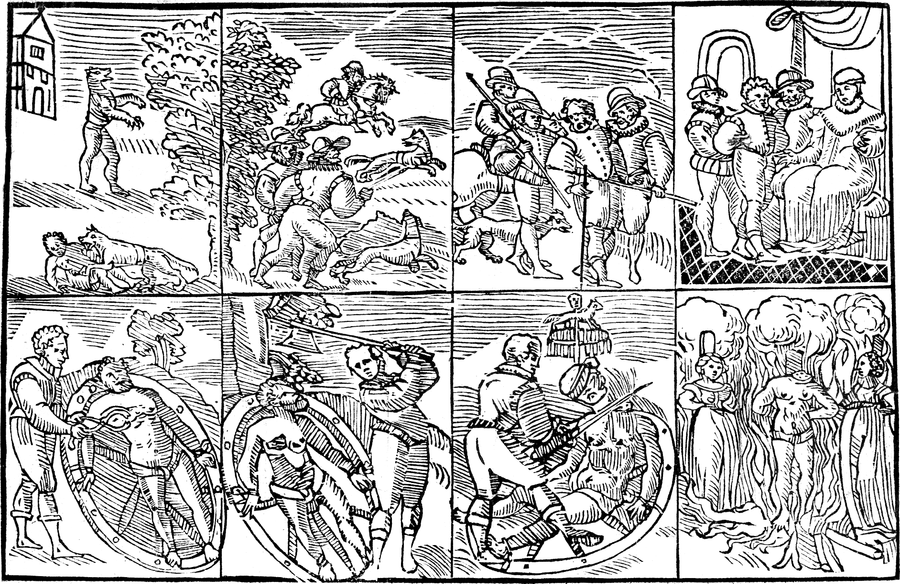
The frontispiece to the London pamphlet puts scenes from the accusation and punishment on a single page. The woodcut is evidence of how the story was presented to readers.
Anonymous woodcut in A True Discourse, London, 1590. Public-domain scan via Wikimedia Commons. · Image source ↗ · Public Domain
Bordeaux · Jean Grenier in Hamel’s later account
Hamel follows the young Jean Grenier from his claims to other children into a series of questions about his supposed transformations. Different accounts of the animals or people involved appear as the questioning continues. Hamel supplies a narrative sequence and offers judgments along the way. Keep the narrator’s voice distinct from the statements attributed to Grenier and other people. [4][5][6][7]
Hamel says the proceedings concluded at Bordeaux in September 1603 with lifelong confinement. His account attributes the treatment to Grenier’s youth and the view taken of his mental capacity. Printed pp. 61–64 put the shifting claims and the outcome close together. The account offers a useful comparison with the punishment advertised on the title page of the Bedburg pamphlet. [5][6][7][8][16]
Cēsis · Old Thiess in a court transcript
The transcript of the hearing at Venden on 28 April 1691 records an examination of a man from Kaltenbrunn known as Old Thiess. In Bruce Lincoln’s translation, Thiess describes werewolves going to hell and fighting over the crops. He presents the werewolves as enemies of the Devil. The court’s questions reveal a much less favourable assessment of his claims. [18]
Read the exchanges in order. The judges ask about Thiess’s conduct and his account of changing form. Look at how he defends the purpose of the journeys and how the court presses him about the obligations of baptism. The publisher lists the High Court of Dorpat verdict separately, dated 31 October 1692. The date beside the map pin identifies the hearing. [18][19]
Read Frank Hamel’s Human Animals
Frank Hamel’s Human Animals brings several prosecutions together, including those of Pierre Bourgot and Michel Verdung, Gilles Garnier, the Gandillon family, Jacques Roulet and Jean Grenier. It is a later compilation. The charges, explanations and outcomes differ from case to case. [1][2][9][3][10][4]
In the Bourgot and Verdung account, ointment and a relationship with a supernatural master explain the change within the testimony. The Garnier narrative joins alleged attacks to an animal appearance. Hamel recounts these as historical cases, but his compilation is a later narrative source rather than a fresh examination of the original trial records. [1][2][9][3][11]
Grenier’s case receives a longer treatment. Hamel notes contradictions, revised statements and the effects of confinement and questioning. The account also includes a judgment favouring confinement rather than execution. These details show that contemporaries themselves could dispute what the allegations meant. [4][5][6][7][8]
See references (11)
- Human Animals, printed p. 54, Reader page 63
- Human Animals, printed p. 55, Reader page 64
- Human Animals, printed p. 57, Reader page 66
- Human Animals, printed p. 60, Reader page 69
- Human Animals, printed p. 61, Reader page 70
- Human Animals, printed p. 62, Reader page 71
- Human Animals, printed p. 63, Reader page 72
- Human Animals, printed p. 64, Reader page 73
- Human Animals, printed p. 56, Reader page 65
- Human Animals, printed p. 59, Reader page 68
- Human Animals, printed p. 58, Reader page 67
Four dates and what each date identifies
A date can mark a judgment, a publication, a hearing, or a moment reported in a later book. Keep those dates alongside the types of evidence. The Bedburg pamphlet appeared in London in 1590, for example, while its title puts the reported execution in the preceding October. [15][16][8][18]
- 1574
Dole · printed judgment
The Sens edition names a January judgment in its title and includes a commentary dated August. [15]
- 1589–1590
Bedburg · contemporary pamphlet
Publication in London follows the execution date reported on its title page. [16]
- 1603
Bordeaux · later retelling
Hamel dates the resolution of the case to September 1603. [8]
- 1691
Venden · court transcript
The hearing on 28 April preserves both questions and answers in the published translation. [18]
What the sources can establish
Romances such as Bisclavret invite the audience to accept transformation inside a fictional world. A trial narrative instead concerns real people exposed to legal power. Reading both as werewolf material is useful only if that difference remains explicit. [4][5][12][13]
Hamel sometimes interprets these cases through medical language used in his own time. That vocabulary tells us how a later writer tried to make sense of the testimony. In the case of Grenier, the disagreements and revised statements are themselves part of what the book records. [11][10][7][8]
For any other case, start with three details. Who gave the account? When was it written or printed? Can you see the wording of the allegation, the questions put to the accused, or only a later summary? The Garnier, Stumpp, Grenier and Thiess sources each bring one of those questions sharply into view. [15][16][7][18]
See references (11)
- Human Animals, printed p. 60, Reader page 69
- Human Animals, printed p. 61, Reader page 70
- Human Animals, printed p. 63, Reader page 72
- Human Animals, printed p. 64, Reader page 73
- Human Animals, printed p. 59, Reader page 68
- Human Animals, printed p. 58, Reader page 67
- Human Animals, printed p. 72, Reader page 81
- Human Animals, printed p. 73, Reader page 82
- Arrest de la Cour de Parlement de Dole contre Gilles Garnier, 1574
- A True Discourse, London, 1590
- Hearings at Venden on 28 April 1691, English translation
Read further in the library

Human Animals
Reading note
Frank Hamel collects the particular stories and interpretations discussed here; the account identifies exact printed and Library Reader pages.
Sources
See references (19)
- Human Animals, printed p. 54, Reader page 63Frank Hamel, Human Animals. Frederick A. Stokes Co., New York, undated title page; preface dated London, 1915. Exact printed pages refer to the retained Library scan.Read this page in Human Animals ↗Return to text ↑
- Human Animals, printed p. 55, Reader page 64Frank Hamel, Human Animals. Frederick A. Stokes Co., New York, undated title page; preface dated London, 1915. Exact printed pages refer to the retained Library scan.Read this page in Human Animals ↗Return to text ↑
- Human Animals, printed p. 57, Reader page 66Frank Hamel, Human Animals. Frederick A. Stokes Co., New York, undated title page; preface dated London, 1915. Exact printed pages refer to the retained Library scan.Read this page in Human Animals ↗Return to text ↑
- Human Animals, printed p. 60, Reader page 69Frank Hamel, Human Animals. Frederick A. Stokes Co., New York, undated title page; preface dated London, 1915. Exact printed pages refer to the retained Library scan.Read this page in Human Animals ↗Return to text ↑
- Human Animals, printed p. 61, Reader page 70Frank Hamel, Human Animals. Frederick A. Stokes Co., New York, undated title page; preface dated London, 1915. Exact printed pages refer to the retained Library scan.Read this page in Human Animals ↗Return to text ↑
- Human Animals, printed p. 62, Reader page 71Frank Hamel, Human Animals. Frederick A. Stokes Co., New York, undated title page; preface dated London, 1915. Exact printed pages refer to the retained Library scan.Read this page in Human Animals ↗Return to text ↑
- Human Animals, printed p. 63, Reader page 72Frank Hamel, Human Animals. Frederick A. Stokes Co., New York, undated title page; preface dated London, 1915. Exact printed pages refer to the retained Library scan.Read this page in Human Animals ↗Return to text ↑
- Human Animals, printed p. 64, Reader page 73Frank Hamel, Human Animals. Frederick A. Stokes Co., New York, undated title page; preface dated London, 1915. Exact printed pages refer to the retained Library scan.Read this page in Human Animals ↗Return to text ↑
- Human Animals, printed p. 56, Reader page 65Frank Hamel, Human Animals. Frederick A. Stokes Co., New York, undated title page; preface dated London, 1915. Exact printed pages refer to the retained Library scan.Read this page in Human Animals ↗Return to text ↑
- Human Animals, printed p. 59, Reader page 68Frank Hamel, Human Animals. Frederick A. Stokes Co., New York, undated title page; preface dated London, 1915. Exact printed pages refer to the retained Library scan.Read this page in Human Animals ↗Return to text ↑
- Human Animals, printed p. 58, Reader page 67Frank Hamel, Human Animals. Frederick A. Stokes Co., New York, undated title page; preface dated London, 1915. Exact printed pages refer to the retained Library scan.Read this page in Human Animals ↗Return to text ↑
- Human Animals, printed p. 72, Reader page 81Frank Hamel, Human Animals. Frederick A. Stokes Co., New York, undated title page; preface dated London, 1915. Exact printed pages refer to the retained Library scan.Read this page in Human Animals ↗Return to text ↑
- Human Animals, printed p. 73, Reader page 82Frank Hamel, Human Animals. Frederick A. Stokes Co., New York, undated title page; preface dated London, 1915. Exact printed pages refer to the retained Library scan.Read this page in Human Animals ↗Return to text ↑
- The Werewolf or the Cannibal ↗The Metropolitan Museum of Art, 42.45.1. Public-domain image and object metadata. Curatorial attribution retained.
- Arrest de la Cour de Parlement de Dole contre Gilles Garnier, 1574 ↗Bibliothèque nationale de France, catalogue notice for the 1574 printed account.Return to text ↑
- A True Discourse, London, 1590 ↗London, 1590, A True Discourse. Early English Books Online Text Creation Partnership, University of Chicago.Return to text ↑
- Frontispiece to the London account of Stubbe Peeter ↗Anonymous woodcut, London, 1590. Public-domain scan via Wikimedia Commons.Return to text ↑
- Hearings at Venden on 28 April 1691, English translation ↗Provincial Court of Venden, 28 April 1691, translated by Bruce Lincoln. University of Chicago Press.Return to text ↑
- 1691 hearing and 1692 verdict in the published edition ↗Carlo Ginzburg and Bruce Lincoln, Old Thiess, a Livonian Werewolf. University of Chicago Press, table of contents.Return to text ↑