The Salem Witch Trials: A Timeline with Original Documents
Follow the Salem witch trials from the first arrests in 1692 to the new court in 1693. Read original warrants, examinations, petitions and governor’s letters.
In this article
Read the manuscript
Samuel Parris recorded Bridget Bishop’s examination on 19 April 1692. Three details on the surviving sheet show what happened that day.
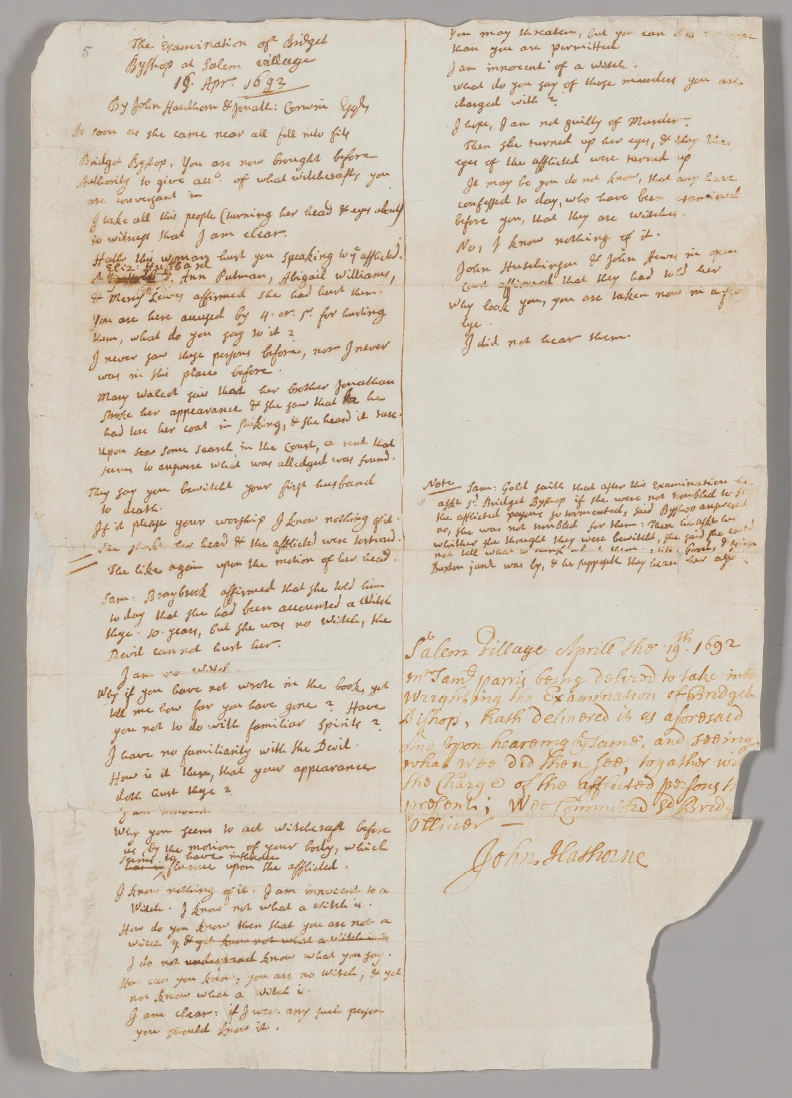
The heading
The opening lines name Bishop, Salem Village, 19 April and the examining magistrates John Hathorne and Jonathan Corwin.
Bishop’s denial
Near the top of the right column Parris records Bishop denying witchcraft. Read the questions around her answer to see what the magistrates expected her to explain.
The order to commit
Hathorne’s signed note records the decision to send Bishop to jail. The indictment, verdict and execution followed in June.
Salem witch trials timeline, 1692–93
The Salem witch trials began with arrests and examinations in early 1692. A special court began trying cases in June. Nineteen people were hanged, Giles Corey died under pressing, and others died in custody. The special court stopped hearing cases in October. In January 1693 a different court took up the remaining prosecutions, with much greater limits on what counted as evidence. [2][8][11][16]
The dates below describe different legal acts. A complaint started a case. A warrant authorised someone to bring the accused in. An examination recorded questions, answers and observations. An indictment put a charge before a court. Look for the officer’s return on a warrant to see what happened after it was issued. In early records, 1691/92 reflects the older convention that the legal year began on 25 March. The timeline uses January-based years. [1][4][7][10]
- 29 Feb 1692
- 1–2 Mar 1692
- 19 Apr 1692
- 27 May 1692
- 2–10 Jun 1692
- Jul–Sep 1692
- Oct 1692
- Jan 1693
See references (14)
- 29 February 1692 · Warrant for Sarah Good and officer’s return
- 29 February 1692 · Warrant for Sarah Osborne and Tituba
- March 1692 · Hathorne’s examinations and order to commit Good, Osborne and Tituba
- Tituba’s case papers · Warrant, examinations and depositions, SWP 125
- First and second examinations of Tituba · NYPL03A–04B
- 19 April 1692 · Bishop’s examination, recorded by Parris and endorsed by Hathorne
- Bishop’s case papers · Examinations, indictments, testimony and return, SWP 13
- Court of Oyer and Terminer · Scope and dates of the court’s records
- Warrant for jurors for the Court of Oyer and Terminer
- 8–10 June 1692 · Execution warrant and George Corwin’s return
- The executions · Dates, victims and surviving warrants
- 9 September 1692 · Petition of Sarah Cloyce and Mary Easty
- Phips’s letters to the Privy Council and the Earl of Nottingham, SWP 163
- The trials · The special court and the new Superior Court in January 1693
Salem Village and Salem Town
The first examinations grew out of accusations in Salem Village, the parish around Samuel Parris’s meetinghouse. The formal prosecutions that followed are associated with the town of Salem and involved people from a wider area. In the 1866 reconstruction, find the heavy boundary around the village and the town near the water. The map dates the ground it represents to 1692. Its lines and labels reflect a later historian’s reconstruction of that ground. [19][8][21]
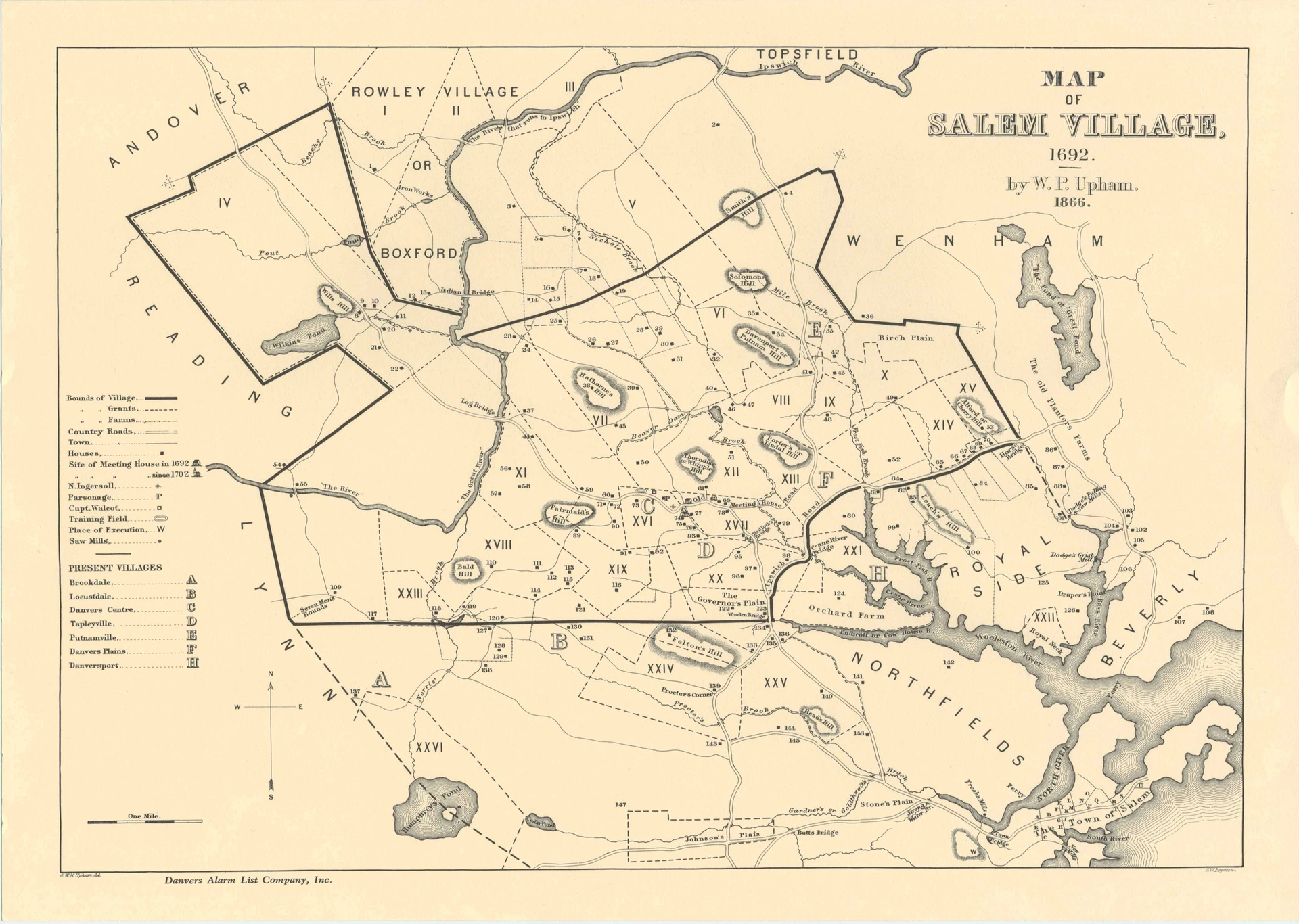
Upham drew this map in 1866 to reconstruct Salem Village as it was in 1692. The heavy line marks the village boundary, and Salem Town appears at the lower right.
William Phineas Upham, Map of Salem Village 1692, drawn in 1866 and published in Charles W. Upham’s Salem Witchcraft (1867). Reproduction via Project Gutenberg and Wikimedia Commons. · Image source ↗ · Public Domain
Tituba, Sarah Good and Sarah Osborne
The two warrants of 29 February name different defendants. The warrant for Osborne and Tituba directs the constable to bring them before the magistrates and names people whose evidence is to be heard. On the reverse, Joseph Herrick records the arrests and reports finding no objects of the kind he searched for. These entries tell us who was compelled to appear and what the constable said he did. [1][2][4]
Compare Hathorne’s summary with the examination recorded by Jonathan Corwin. A summary reduces the exchange to the outcomes and the names of the other accused. The longer account exposes the way the questions directed the answers, including questions about what shape the Devil took and who allegedly accompanied him. Tituba was enslaved in the Parris household. That fact matters to how we read an official record made by men with authority over her. The papers preserve competing accounts through their recorders, and they leave the details of Tituba’s origins uncertain. [3][4][5][18]
See references (6)
- 29 February 1692 · Warrant for Sarah Good and officer’s return
- 29 February 1692 · Warrant for Sarah Osborne and Tituba
- March 1692 · Hathorne’s examinations and order to commit Good, Osborne and Tituba
- Tituba’s case papers · Warrant, examinations and depositions, SWP 125
- First and second examinations of Tituba · NYPL03A–04B
- Power and Persecution · Tituba and other enslaved people in the trial records
Bridget Bishop’s examination, trial and execution
Read the sheet dated 19 April as two related records. Parris writes out the examination and Bishop’s denials. The handwriting below the exchange states that the magistrates ordered her committed. Cheever made a separate record of the same examination. Comparing the two shows how the recorder could shape what a reader sees, even where the witnesses and accused were in the same room. [6][7]
The June documents do different work. Indictments name particular people Bishop was alleged to have afflicted, and the warrant says she pleaded not guilty and was convicted. The warrant orders the execution on a stated date. The sheriff’s return on 10 June says what action he carried out. Reading those papers in order shows how an allegation became a penalty through recorded official decisions. [7][10]
What counted as spectral evidence?
Spectral evidence was testimony about an apparition said to take the shape of the accused. In Bishop’s case, Susannah Sheldon gave testimony about seeing an apparition. John and William Bly gave evidence about objects they claimed to have found in a wall. The two kinds of claim appear in the same case file. A report about a physical object also requires scrutiny of who found it, when, and how the person on trial was linked to it. [7][16]
The colonists’ own disagreement helps explain why the evidence mattered. Increase Mather wrote in August that an apparition alone was insufficient to convict, although he still saw a role for it in an investigation. Phips later described the possibility that the Devil could use the form of an innocent person. Within their own religious assumptions, the appearance of a recognisable face could fail to identify a culprit. Phips’s letters are an account written by the governor to officials in England, including an explanation of decisions he had made. [15][14][16]
Petitions, the last hangings and the new court
In September Mary Easty and Sarah Cloyce asked the court to hear what could be said in their defence and to consider how evidence was being accepted. Read the joint petition beside Easty’s separate plea after conviction. The latter asks officials to consider the risk of shedding innocent blood and focuses on the people still in danger. The petitions show defendants using the written process to challenge the way the case against them had been made. [12][13]
Easty was hanged with seven others on 22 September, the final hanging date. Giles Corey died three days earlier after refusing to enter a plea. Nineteen is the number hanged. A count of deaths must also account for Corey and those who died in custody. The end of the special court in October did not release everyone. Cases went on under the Superior Court in 1693, and later apologies and reparations unfolded over years. The archive documents a public day of fasting in 1697 and reparations authorised in 1711. [13][11][8][16][17]
See references (6)
- Court of Oyer and Terminer · Scope and dates of the court’s records
- The executions · Dates, victims and surviving warrants
- 9 September 1692 · Petition of Sarah Cloyce and Mary Easty
- Mary Easty’s case papers · Examination and petitions, SWP 45
- The trials · The special court and the new Superior Court in January 1693
- The aftermath · Public apologies and 1711 reparations
Read the nineteenth-century retelling in the Library
Henrietta D. Kimball retold the Salem trials in Witchcraft Illustrated in 1892. Open her account of the first examinations beside Hathorne’s summary. The narrative gives the magistrates an entrance into the village and compresses events into a continuous story. The transcript has a narrower task: it records what its author thought worth preserving about the proceedings. [23][3]
Next compare Kimball’s written account of Corey’s death with the earlier plate depicting it. The artist uses the crowd and the buildings to make a scene readers can imagine. The archive supplies the procedure, the date and the distinction between Corey’s death and the hangings. These sources tell us about both 1692 and the ways later generations pictured it. [24][22][11]
Read further in the library
Witchcraft Illustrated
Reading note
Compare Henrietta D. Kimball’s nineteenth-century retelling and its illustration with the original proceedings.
Sources
See references (24)
- 29 February 1692 · Warrant for Sarah Good and officer’s return ↗Massachusetts Archives Digital Repository, Salem Witch Trials Papers.Return to text ↑
- 29 February 1692 · Warrant for Sarah Osborne and Tituba ↗Massachusetts Archives Digital Repository, Salem Witch Trials Papers.Return to text ↑
- March 1692 · Hathorne’s examinations and order to commit Good, Osborne and Tituba ↗Massachusetts Archives Digital Repository, Salem Witch Trials Papers.Return to text ↑
- Tituba’s case papers · Warrant, examinations and depositions, SWP 125 ↗University of Virginia Library, Salem Witch Trials Documentary Archive and Transcription Project.Return to text ↑
- First and second examinations of Tituba · NYPL03A–04B ↗University of Virginia Library, Salem Witch Trials Documentary Archive and Transcription Project. New York Public Library manuscripts.Return to text ↑
- 19 April 1692 · Bishop’s examination, recorded by Parris and endorsed by Hathorne ↗Massachusetts Archives Digital Repository, Salem Witch Trials Papers.Return to text ↑
- Bishop’s case papers · Examinations, indictments, testimony and return, SWP 13 ↗University of Virginia Library, Salem Witch Trials Documentary Archive and Transcription Project.Return to text ↑
- Court of Oyer and Terminer · Scope and dates of the court’s records ↗Massachusetts Archives Digital Repository, Salem Witch Trials Papers.Return to text ↑
- Warrant for jurors for the Court of Oyer and Terminer ↗Massachusetts Archives Digital Repository, Salem Witch Trials Papers.
- 8–10 June 1692 · Execution warrant and George Corwin’s return ↗Massachusetts Archives Digital Repository, Salem Witch Trials Papers.Return to text ↑
- The executions · Dates, victims and surviving warrants ↗Massachusetts Archives Digital Repository, Salem Witch Trials exhibition.Return to text ↑
- 9 September 1692 · Petition of Sarah Cloyce and Mary Easty ↗Massachusetts Archives Digital Repository, Salem Witch Trials Papers.Return to text ↑
- Mary Easty’s case papers · Examination and petitions, SWP 45 ↗University of Virginia Library, Salem Witch Trials Documentary Archive and Transcription Project.Return to text ↑
- Phips’s letters to the Privy Council and the Earl of Nottingham, SWP 163 ↗University of Virginia Library, Salem Witch Trials Documentary Archive and Transcription Project.Return to text ↑
- 17 August 1692 · Increase Mather to John Foster ↗University of Virginia Library, Salem Witch Trials Documentary Archive and Transcription Project.Return to text ↑
- The trials · The special court and the new Superior Court in January 1693 ↗Massachusetts Archives Digital Repository, Salem Witch Trials exhibition.Return to text ↑
- The aftermath · Public apologies and 1711 reparations ↗Massachusetts Archives Digital Repository, Salem Witch Trials exhibition.Return to text ↑
- Power and Persecution · Tituba and other enslaved people in the trial records ↗Massachusetts Archives Digital Repository, Salem Witch Trials exhibition.Return to text ↑
- Salem Village · The March examinations in their local setting ↗University of Virginia Library, Salem Witch Trials Documentary Archive and Transcription Project.Return to text ↑
- Parris’s handwritten account · Image and rights record ↗Samuel Parris and John Hathorne, Examination of Bridget Bishop, 19 April 1692. Massachusetts Archives, Essex County Court Archives, Salem Witchcraft, vol. 1, no. 125. Scan via Wikimedia Commons.
- W. P. Upham’s 1866 map of Salem Village · Image and rights record ↗William Phineas Upham, Map of Salem Village 1692, drawn in 1866 and published in Charles W. Upham’s Salem Witchcraft (1867). Reproduction via Project Gutenberg and Wikimedia Commons.Return to text ↑
- The plate depicting Giles Corey’s deathHenrietta D. Kimball, Witchcraft Illustrated, Boston, 1892. Lumitheca Reader edition IMJ-0207-E001.Read this page in Witchcraft Illustrated ↗Return to text ↑
- Kimball’s account of the first examinationsHenrietta D. Kimball, Witchcraft Illustrated, Boston, 1892. Lumitheca Reader edition IMJ-0207-E001.Read this page in Witchcraft Illustrated ↗Return to text ↑
- Kimball’s written account of Giles CoreyHenrietta D. Kimball, Witchcraft Illustrated, Boston, 1892. Lumitheca Reader edition IMJ-0207-E001.Read this page in Witchcraft Illustrated ↗Return to text ↑