The Mahabharata Family Tree
Trace the Pandavas, Kauravas, Karna and Krishna through a clickable Mahabharata family tree. See how their kinship shapes the Bhagavad Gita.
In this article
Follow the branches of the Kuru family
Open a branch for its sources and relationships. The chart focuses on the generations you need to follow the dispute and the Gita.
The older Kuru household
Two branches of the dynasty
- Dhritarashtra and GandhariChildren: Duryodhana, his brothers and Duhshala
- Dhritarashtra and a woman outside Gandhari’s branchChildren: Yuyutsu
- Pandu’s household through KuntiChildren: Yudhishthira (Dharma), Bhima (Vayu), Arjuna (Indra)
- Pandu’s household through MadriChildren: Nakula and Sahadeva (the Ashvins)
- Kunti and Surya, before Kunti’s marriageChildren: Karna, raised by Adhiratha and Radha
Kinship through Kunti and Subhadra
How the two branches of the Kuru family begin
The Pandavas and the Kauravas are cousins in the house of Kuru. Start with Shantanu. His son by Ganga is Bhishma. His sons by Satyavati include Vichitravirya, whose death leaves the family in need of heirs. Satyavati’s son Vyasa fathers Dhritarashtra and Pandu by Vichitravirya’s widows Ambika and Ambalika. Vyasa also fathers Vidura by an attendant. The birth story and the household the children belong to are both important for understanding why the cousins later compete over rule. [1]
Dhritarashtra and Pandu are therefore brothers, and Bhishma belongs to the generation of their household’s elders. He matters to both sides when the war begins. Track his place on the chart before reading the battlefield list. The elder whom Arjuna sees is part of the family history he has been asked to fight through. [1][11]
Who are the five Pandavas and their divine fathers?
Yudhishthira, Bhima and Arjuna are Kunti’s sons. In the birth account she invokes Dharma, Vayu and Indra respectively. Madri invokes the twin Ashvins and bears Nakula and Sahadeva. The five belong to Pandu’s branch of the dynasty, which gives them their collective name. Ganguli’s birth narrative distinguishes the line through which they belong to the royal house from the divine figures named in the invocations. [1][3][4]
Read the two mothers as part of the genealogy. Kunti’s three sons and Madri’s twins are raised within the same family and act as a group. The diagram names both mothers so the label ‘sons of Pandu’ does not flatten that distinction. [3][4]
Who are the Kauravas?
In accounts of the war, ‘Kauravas’ usually identifies Duryodhana and the branch led by the sons of Dhritarashtra. ‘Kuru’ is also the wider family name and can include the Pandavas. Dhritarashtra and Gandhari’s children include their eldest son Duryodhana and their daughter Duhshala. Yuyutsu, also a son of Dhritarashtra, has a different mother. That detail becomes easy to miss if all of Dhritarashtra’s children are put into a single box under Gandhari. [1][5][10]
Where does Karna belong in the family tree?
Karna is Kunti’s son by Surya, born before she marries Pandu. He is raised in the household of Adhiratha and Radha. He is a maternal half-brother of the Pandavas, but his place in the battle belongs to Duryodhana’s side. The family tree makes room for both kinship and allegiance. You need each to understand why Karna facing Arjuna is such a charged scene. [2][14]
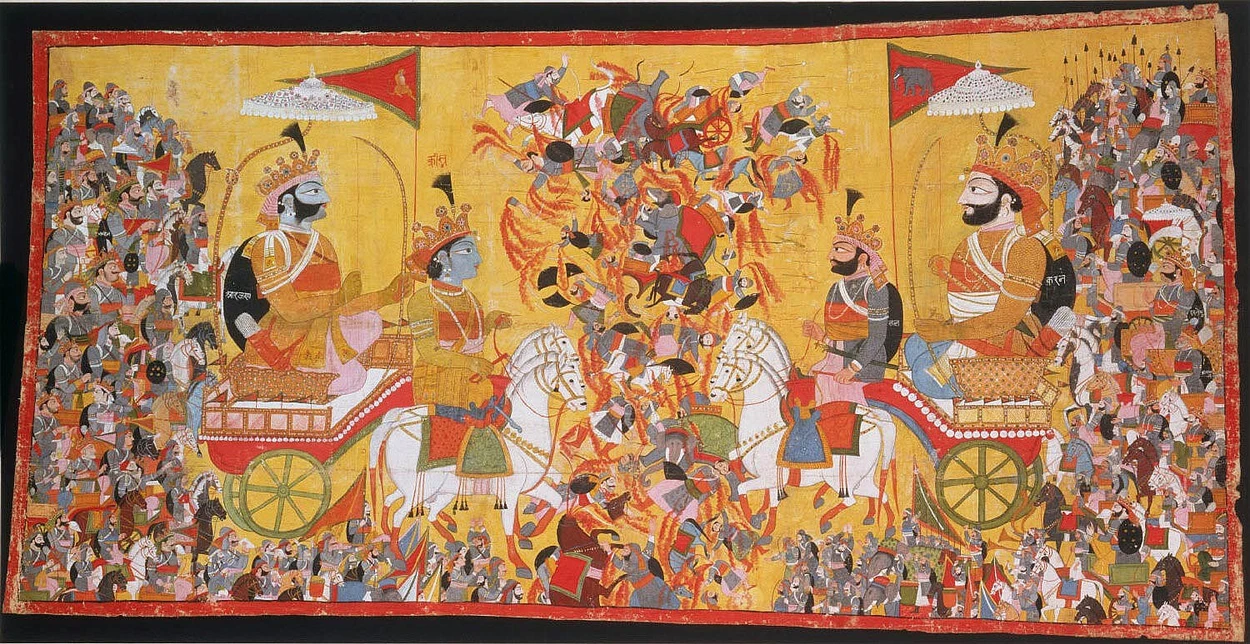
The painter sets the half-brothers Arjuna and Karna on facing chariots. This is a later encounter in the war, after the conversation in the Gita.
Artist unknown, northern India, circa 1820. Philadelphia Museum of Art. Public-domain reproduction via Wikimedia Commons. · Image source ↗ · Public Domain
How are Krishna and Arjuna related?
Kunti, also called Pritha, is the sister of Krishna’s father Vasudeva. That makes Krishna and Arjuna first cousins through their parents. Their relationship has another family connection: Arjuna marries Krishna’s sister Subhadra, and their son is Abhimanyu. The resemblance between the names Vasudeva and Vāsudeva can confuse a first reading because the latter is also used for Krishna. [2][6][7]
The print shows Subhadra holding the reins as the chariot leaves Dwarka. It gives a woman in the family chart a visibly active place in the departure. The museum identifies the print’s subject, while the linked episode lets readers see where this pictured telling and the written account put their emphasis. [6][13]
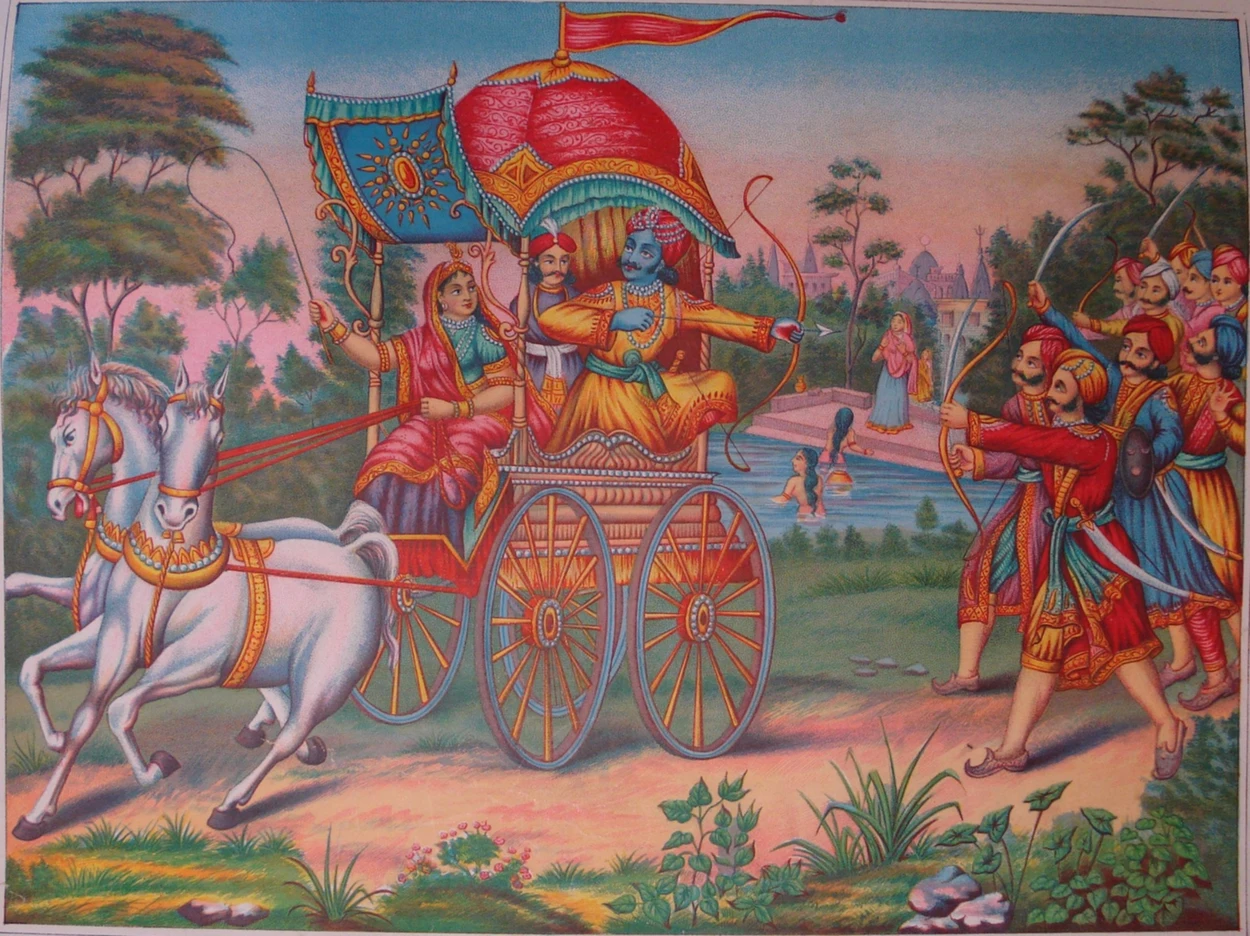
Subhadra takes the reins in this print. Compare her conspicuous role in the picture with the different emphasis of Ganguli’s account of the departure.
Indian colour print, circa 1895. British Museum, 2003,1022,0.60. Public-domain reproduction via Wikimedia Commons. · Image source ↗ · Public Domain
How the succession dispute reaches the battlefield
The rivals’ dispute over rule passes through the dice hall. Yudhishthira stakes his brothers, himself and then Draupadi, the wife of the five brothers. Draupadi asks whether he had any standing left to stake her after he had lost himself. Her question changes what the reader is being asked to judge. A dispute about who rules becomes a question about what power the winner could rightly claim. [8][7]
Before battle, Duryodhana and Arjuna both ask Krishna for help. Krishna offers his forces on one side and his own unarmed presence on the other. Arjuna chooses Krishna and asks him to drive his chariot. That choice puts Krishna in the position to take Arjuna between the armies at the beginning of the Gita. [9][11]
Read the family tree into the Bhagavad Gita
The Gita opens with Dhritarashtra asking what his sons and the sons of Pandu did at Kurukshetra. Sanjaya narrates the answer. When Krishna positions the chariot between the armies, Arjuna sees relatives and teachers in both ranks. Keep those three roles distinct as you read: Dhritarashtra asks, Sanjaya reports, and Krishna speaks with Arjuna on the field. [10][11][12]
In the Library retelling, printed page 186 introduces the Gita scene and page 188 gives Arjuna’s speech about the people he sees. The following scan shows Krishna instructing Arjuna. Open them alongside the Sanskrit text to compare the retelling’s selection and framing with the verses themselves. [15][16][17][12]
See references (6)
- Bhagavad Gita 1.1 · Dhritarashtra’s opening question
- Bhagavad Gita 1.20–26 · the chariot and the assembled kin
- Bhagavad Gita 1.26 · Arjuna sees his kin
- The Bhagavad Gita begins in the retelling · printed page 186
- Arjuna sees the people he must fight · printed page 188
- Krishna instructing Arjuna · plate after page 188
Read further in the library
Myths of the Hindus and Buddhists
Reading note
Read the family crisis and the Gita scene in Nivedita and Coomaraswamy’s illustrated retelling.
Sources
See references (17)
- Adi Parva · the Kuru family from Shantanu to the rival branches ↗Kisari Mohan Ganguli’s English translation, section numbering for that edition.Return to text ↑
- Adi Parva CXI · Kunti’s birth family and Karna’s birth ↗Kisari Mohan Ganguli’s English translation, section numbering for that edition.Return to text ↑
- Adi Parva CXXIII · Kunti calls on Dharma, Vayu and Indra ↗Kisari Mohan Ganguli’s English translation, section numbering for that edition.Return to text ↑
- Adi Parva CXXIV · Madri calls on the Ashvins ↗Kisari Mohan Ganguli’s English translation, section numbering for that edition.Return to text ↑
- Adi Parva CXV · Gandhari’s children and Yuyutsu ↗Kisari Mohan Ganguli’s English translation, section numbering for that edition.Return to text ↑
- Adi Parva CCXXI · Arjuna and Subhadra ↗Kisari Mohan Ganguli’s English translation, section numbering for that edition.Return to text ↑
- Adi Parva LXI · Subhadra, Abhimanyu and Draupadi’s children ↗Kisari Mohan Ganguli’s English translation, section numbering for that edition.Return to text ↑
- Sabha Parva LXVI · Draupadi questions the wager ↗Kisari Mohan Ganguli’s English translation, section numbering for that edition.Return to text ↑
- Udyoga Parva VII · Arjuna chooses Krishna ↗Kisari Mohan Ganguli’s English translation, section numbering for that edition.Return to text ↑
- Bhagavad Gita 1.1 · Dhritarashtra’s opening question ↗IIT Kanpur Heritage, Sanskrit and translations.Return to text ↑
- Bhagavad Gita 1.20–26 · the chariot and the assembled kin ↗IIT Kanpur Heritage, Sanskrit and translations.Return to text ↑
- Bhagavad Gita 1.26 · Arjuna sees his kin ↗IIT Kanpur Heritage, Sanskrit and translations.Return to text ↑
- Subhadra drives the chariot ↗Indian colour print, circa 1895. British Museum, 2003,1022,0.60. Public-domain reproduction via Wikimedia Commons.Return to text ↑
- Arjuna and His Charioteer Krishna Confront Karna ↗Artist unknown, northern India, circa 1820. Philadelphia Museum of Art. Public-domain reproduction via Wikimedia Commons.Return to text ↑
- The Bhagavad Gita begins in the retelling · printed page 186Sister Nivedita and Ananda K. Coomaraswamy, Myths of the Hindus and Buddhists (1914).Read this page in Myths of the Hindus and Buddhists ↗Return to text ↑
- Arjuna sees the people he must fight · printed page 188Sister Nivedita and Ananda K. Coomaraswamy, Myths of the Hindus and Buddhists (1914).Read this page in Myths of the Hindus and Buddhists ↗Return to text ↑
- Krishna instructing Arjuna · plate after page 188Sister Nivedita and Ananda K. Coomaraswamy, Myths of the Hindus and Buddhists (1914).Read this page in Myths of the Hindus and Buddhists ↗Return to text ↑