The Ramayana in Order, from Exile to Ayodhya
Follow the Ramayana from Ayodhya to Lanka and back. An illustrated route connects Rama’s exile, Hanuman’s search for Sita, the bridge and the return.
In this article
Follow the journey from Ayodhya and back
Choose a stop to open its episode. This diagram shows story order and labels where the epic setting meets a present-day place or pilgrimage tradition.
- Departure
Ayodhya
A succession crisis sends Rama, Sita and Lakshmana into a fourteen-year exile.
Epic capital with a present-day namesake. - Forest exile
Chitrakuta
The travellers settle for a time. Bharata takes Rama’s sandals back as a sign of his authority.
Epic hill country with a living pilgrimage association at Chitrakoot. - Forest exile
Panchavati
Sita is taken from the forest home on the Godavari.
The river is named in the text. The route leaves the exact itinerary open. - Search
Kishkindha
Hanuman introduces Rama to Sugriva, and the search gains allies.
Kingdom within the epic. - Across the sea
Lanka · Hanuman’s search
Hanuman finds Sita and shows her Rama’s signet ring.
Island setting within the epic. - Across the sea
Lanka · the bridge and battle
Rama’s allies cross the bridge, Ravana falls, and Sita speaks before the return.
The bridge is an episode in the text. - Return
Ayodhya · the coronation
The travellers return in Pushpaka and Rama is crowned.
The route returns to its opening city.
Where does the journey fit in the seven books?
The Vālmīki Rāmāyaṇa’s departure-to-return arc starts in the second book, Ayodhyā Kāṇḍa, and reaches the coronation in the sixth, Yuddha Kāṇḍa. The first book introduces Rama and his marriage to Sita. The seventh continues beyond the coronation, so the return marks the end of the route here while the seven-book text continues. [1][4][19]
Names and chapter numbers can vary across editions. This guide uses the Sanskrit and English text at IIT Kanpur for its episode links. Its itinerary follows the order in which the text brings places into the story. Long routes, crossings and a journey in a flying vehicle belong to the narrative. The diagram gives their sequence and leaves distances open. [1][10][18]
Ayodhya · the planned coronation becomes an exile
Rama is about to be installed as heir when Kaikeyi claims two boons from Dasharatha. Bharata is to receive the throne and Rama must live in the forest for fourteen years. Rama takes the obligation seriously even as the people around him dispute its fairness. What begins as a family promise becomes a crisis over who can legitimately rule the kingdom. [2][4][6]
Sita insists on going with him, and Lakshmana joins them. Begin with the exchange about whether Sita should stay, then open the departure. Read in that order, her journey begins with an argument and a decision, and the departure is a consequence of both. [2][3][4]
Chitrakuta · a home in exile and a kingdom held in trust
At Chitrakuta, Lakshmana builds a cottage. The place gives the three travellers a home for a time. Bharata comes to urge Rama to return. When Rama holds to the exile, Bharata takes his sandals and treats them as the sign of whose authority he is exercising during the fourteen years. [5][6]
The Chitrakoot district records living pilgrimage traditions at places associated with the epic, including the Bharat Milap Temple. Those places show how a community keeps the story present. This route locates the meeting in the text’s Chitrakuta and gives the modern pilgrimage tradition its own attribution. [5][20]
Panchavati · the forest home and Sita’s abduction
The three settle at Panchavati by the Godavari. The golden deer draws Rama away and Lakshmana eventually follows. Ravana comes to Sita in disguise and carries her off. As she is taken, Sita calls on the things and creatures of the forest to tell Rama what happened. After the abduction, the journey changes from making a life in exile to following traces of a missing person. [7][8][1]
Kishkindha · Hanuman makes an introduction and Rama gains allies
Hanuman brings Rama and Lakshmana to Sugriva. Each side has lost something and can help the other. Rama helps Sugriva in his struggle with Vali, and Sugriva’s allies go in search of Sita. This is how a forest search becomes an undertaking with scouts, routes and leaders. [9][1][21]
In the Kangra painting, Vali’s funeral is the largest event. Smaller scenes set in the same landscape show what the change in kingship makes possible afterwards. Use the image to see the cost of the alliance before moving on to the successful search. [21][9]
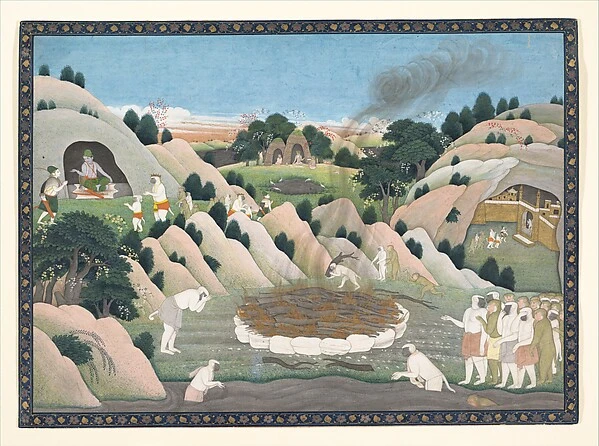
The Kangra painter puts the funeral and several other moments of the succession in one landscape. The episode follows Rama’s alliance with Sugriva.
Workshop active in the first generation after Nainsukh, Kangra, c. 1780. The Metropolitan Museum of Art, 2004.367. Public domain. · Image source ↗ · Public Domain
Across the sea · Hanuman meets Sita in Lanka
Hanuman leaps across the ocean, enters Lanka and finds Sita. The proof that he carries Rama’s message matters as much as the crossing. In the encounter he describes Rama, offers the signet ring and listens to Sita. She gives him a jewel and a story to take back. The exchange connects two people who cannot speak to one another directly. [10][11][12][13]
The leap is one person’s outward journey. The bridge in the next book solves a different problem: how an army can cross. Keep these episodes separate when finding an illustration. A figure in flight over the sea may be showing the search rather than the campaign. [10][14][22]
See references (6)
Lanka · the bridge, the battle and Sita’s return
The war book has Nala build the bridge that carries Rama’s allies over the sea. Rama eventually kills Ravana. The textile below brings the labour of carrying rocks and the violence of the battle into one field. The two events belong to different parts of the narrative, and the painting lets a viewer approach them side by side. [14][15][22]
The death of Ravana leaves a second confrontation. Rama addresses Sita in public, she answers him and enters the fire, and Agni brings her back. Treat her speech as part of the episode and read it before the return. A route that jumps directly from the duel to the coronation loses that exchange. [15][16][17]
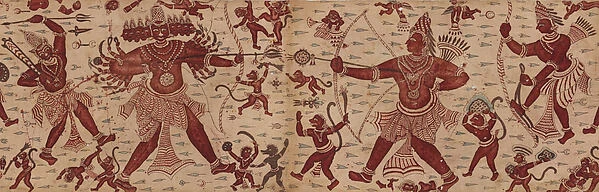
The cloth brings the rival armies and the making of the bridge into the same field. The visual grouping gives the viewer more than one moment of the campaign to notice.
Coromandel Coast, late eighteenth century, painted and mordant-dyed cotton. The Metropolitan Museum of Art, 2008.163. Public domain. · Image source ↗ · Public Domain
Ayodhya · the return and the coronation
Rama, Sita and Lakshmana travel back with allies in Pushpaka. The crowning resolves the succession crisis with which the route began. Compare the sandals Bharata held during the exile with the figures on the Kalighat painting’s platform. The objects and gestures make two kinds of authority visible: one exercised in Rama’s absence, and one celebrated at his return. [18][19][6][23]
The companion entries follow Rama, Sita and Hanuman beyond a single stop on the journey. Read one character across multiple scenes and notice who makes a decision, who bears a message, and what has changed by the time everyone returns. [1][12][19]
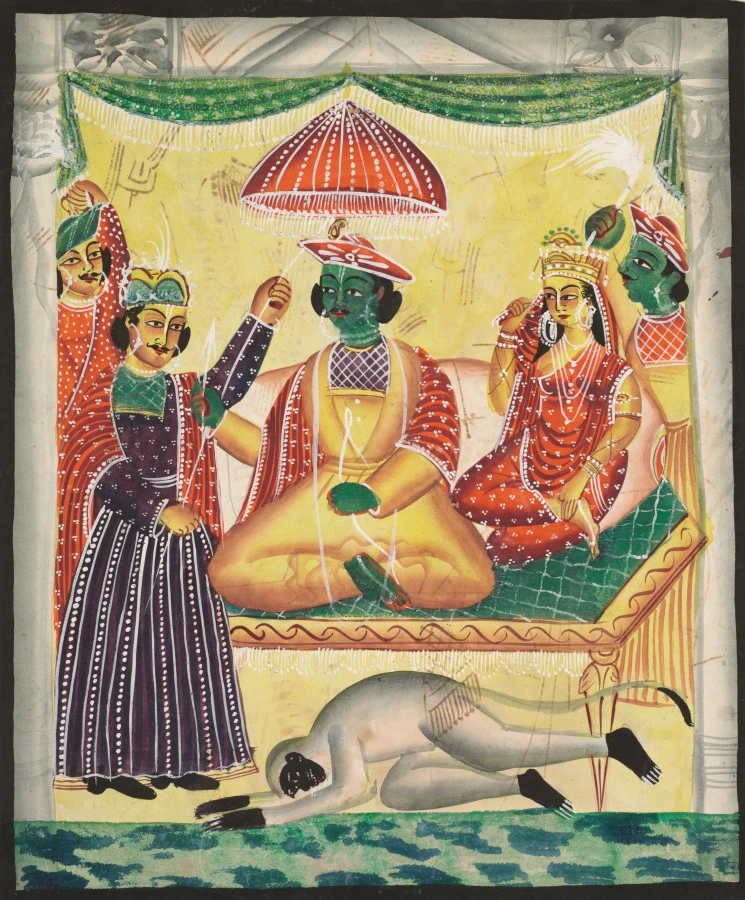
Rama and Sita share the platform in this Kalighat painting, with Hanuman prostrate below. The image presents the return as a ceremony and an act of devotion.
Kalighat, Kolkata, c. 1890. Cleveland Museum of Art, 2003.134.a. CC0. · Image source ↗ · CC0
Sources
See references (23)
- IIT Kanpur · Vālmīki Rāmāyaṇa, book and canto index ↗Digital edition distinguishing the seven kāṇḍas and their sargas.Return to text ↑
- Ayodhyā Kāṇḍa 2.26 · Rama tells Sita of his exile ↗IIT Kanpur Heritage, Sanskrit text with English translation.Return to text ↑
- Ayodhyā Kāṇḍa 2.27 · Sita asks to go with Rama ↗IIT Kanpur Heritage, Sanskrit text with English translation.Return to text ↑
- Ayodhyā Kāṇḍa 2.40.1 · Rama, Sita and Lakshmana depart ↗IIT Kanpur Heritage, Sanskrit text and verse-level translation.Return to text ↑
- Ayodhyā Kāṇḍa 2.56 · the cottage at Chitrakuta ↗IIT Kanpur Heritage, Sanskrit text with English translation.Return to text ↑
- Ayodhyā Kāṇḍa 2.112 · Bharata asks for Rama’s sandals ↗IIT Kanpur Valmiki Ramayanam, Sanskrit and translation.Return to text ↑
- Araṇya Kāṇḍa 3.15 · Panchavati on the Godavari ↗IIT Kanpur Heritage, Sanskrit text with English translation.Return to text ↑
- Araṇya Kāṇḍa 3.49 · Ravana carries Sita away ↗IIT Kanpur Heritage, Sanskrit text with English translation.Return to text ↑
- Kiṣkindhā Kāṇḍa 4.5 · Rama and Sugriva pledge mutual help ↗IIT Kanpur Heritage, Sanskrit text with English translation.Return to text ↑
- Sundara Kāṇḍa 5.1.141 · Hanuman crosses the ocean ↗IIT Kanpur Heritage, Sanskrit text and verse-level translation.Return to text ↑
- Sundara Kāṇḍa 5.35 · Hanuman describes Rama to Sita ↗IIT Kanpur Heritage, Sanskrit text with English translation.Return to text ↑
- Sundara Kāṇḍa 5.36.1 onward · Hanuman brings Rama’s signet ring ↗IIT Kanpur Heritage, Sanskrit text and verse-level translation.Return to text ↑
- Sundara Kāṇḍa 5.38 · Sita’s return token and message ↗IIT Kanpur Heritage, Sanskrit text with English translation.Return to text ↑
- Yuddha Kāṇḍa 6.22.74 · the bridge built by Nala ↗IIT Kanpur Heritage, Sanskrit text and verse-level translation.Return to text ↑
- Yuddha Kāṇḍa 6.111 · the defeat of Ravana ↗IIT Kanpur Heritage, Sanskrit text with English translation.Return to text ↑
- Yuddha Kāṇḍa 6.119 · Sita answers Rama ↗IIT Kanpur Heritage, Sanskrit text with English translation.Return to text ↑
- Yuddha Kāṇḍa 6.121 · the fire god restores Sita ↗IIT Kanpur Heritage, Sanskrit text with English translation.Return to text ↑
- Yuddha Kāṇḍa 6.125 · the journey back in Pushpaka ↗IIT Kanpur Heritage, Sanskrit text with English translation.Return to text ↑
- Yuddha Kāṇḍa 6.131 · Rama is crowned ↗IIT Kanpur Heritage, Sanskrit text with English translation.Return to text ↑
- District Chitrakoot · pilgrimage and the epic setting ↗The district’s account distinguishes existing pilgrimage sites and the traditions associated with them.Return to text ↑
- The Monkey King Vali’s Funeral Pyre ↗Workshop active in the first generation after Nainsukh, Kangra, c. 1780. The Metropolitan Museum of Art, 2004.367. Public domain.Return to text ↑
- The Combat of Rama and Ravana ↗Coromandel Coast, late eighteenth century, painted and mordant-dyed cotton. The Metropolitan Museum of Art, 2008.163. Public domain.Return to text ↑
- Rama and Sita enthroned ↗Kalighat, Kolkata, c. 1890. Cleveland Museum of Art, 2003.134.a. CC0.Return to text ↑