The Bhagavad Gita for Beginners: A Guide to All 18 Chapters
Read the Bhagavad Gita with an 18-chapter guide, exact verse links and an illustrated explanation of Arjuna’s dilemma, action, devotion and Krishna’s cosmic form.
In this article
Find your way through all 18 chapters
Each chapter has a starting verse. Read in order for the dialogue, or begin with the question you want to follow.
- Chapter 1
Arjuna’s crisis
Arjuna puts down his bow after seeing relatives and teachers on both sides.
Open starting verse - Chapter 2
Action and its fruits
Read the counsel about what is within Arjuna’s power and his relation to the outcome.
Open starting verse - Chapter 3
Acting without attachment
Krishna returns to why action can be necessary even when its rewards do not guide it.
Open starting verse - Chapter 4
Krishna’s manifestation
Read when Krishna says he manifests himself in response to a decline in dharma.
Open starting verse - Chapter 5
Renunciation and action
Arjuna asks about the two paths and hears which course Krishna favours here.
Open starting verse - Chapter 6
Training attention
Arjuna’s concern about the restless mind receives an answer about practice and detachment.
Open starting verse - Chapter 7
What holds things together
Look for the image of a thread supporting its beads.
Open starting verse - Chapter 8
Remembering at death
Follow the reply about the last moment of life and what the person remembers.
Open starting verse - Chapter 9
A simple offering
Notice how an ordinary leaf, flower, fruit or water can be offered.
Open starting verse - Chapter 10
The divine in living beings
Begin with Krishna’s identification with the self within beings, then read the examples that follow.
Open starting verse - Chapter 11
The universal form
Krishna tells Arjuna why the vision requires a different kind of sight.
Open starting verse - Chapter 12
What devotion looks like
Read the qualities of the devotee as a description of how they treat other beings.
Open starting verse - Chapter 13
The field and its knower
Distinguish the body as a field from the one who knows it.
Open starting verse - Chapter 14
The three guṇas
See how the text introduces the three qualities associated with material nature.
Open starting verse - Chapter 15
The tree with roots above
Start with the inverted tree and follow what must be understood about its roots.
Open starting verse - Chapter 16
Qualities of character
Begin with the qualities the chapter associates with a divine disposition.
Open starting verse - Chapter 17
The character of faith
Read the connection between a person’s disposition and the shape of their faith.
Open starting verse - Chapter 18
Reflection and choice
Read the invitation to think over the teaching, then follow it to Arjuna’s reply in 18.73.
Open starting verse
Why Krishna and Arjuna are talking
The Bhagavad Gītā is a dialogue within the Mahābhārata. With battle imminent at Kurukṣetra, Arjuna asks his charioteer Krishna to take him between the two armies. He sees relatives, teachers and friends on the other side. By the end of Chapter 1, grief has overtaken him and his bow is down. [2][3]
That is the situation behind the long conversation. Arjuna sees several obligations at once. He faces war and also sees the damage it will do to people and relationships he values. Read Chapter 1 before the best-known teachings. The links use Heritage IIT Kanpur’s Sanskrit text and its English translations, including Sivananda and Gambhirananda. Keep the family tree alongside you if the two sides are unfamiliar. [2][3][1]
Action, its fruits and the question of renouncing it
Verse 2.47 distinguishes action from its fruits. It also warns against attachment to inaction. Read both parts before taking the verse as advice about the outcome of a task. Krishna is asking how Arjuna can act without making the reward the ground of his action. [4]
Chapter 3 returns to the need to act and Chapter 5 asks how disciplined action relates to renunciation. In 5.2, Krishna acknowledges both approaches and favours action with discipline in the comparison Arjuna has put to him. Reading the passages together shows why the Gītā keeps returning to the motives of the person acting. [5][7]
Attention, the knowing self and the three guṇas
In Chapter 6, Arjuna says that controlling the mind seems exceedingly difficult. Krishna acknowledges the difficulty. Verse 6.35 answers with repeated practice and detachment. The answer is part of their exchange and gives the reader a way to understand the discipline behind the instructions. [8][1]
Use 13.2 to start a later question. What is the body as the field of experience, and who knows that field? Then go to 14.5 for the three guṇas, qualities of material nature. Neither passage needs to be read in isolation. Chapters 13 and 14 help explain the distinctions that the final chapter will use when it describes kinds of knowledge and action. [15][16][1]
What devotion and remembrance look like
The offering in 9.26 can be as ordinary as a leaf or water. The passage directs attention to the devotion of the person who offers it. Chapter 12 describes the devotee through qualities such as a disposition of friendship and compassion towards other beings. One verse concentrates on a small action and the other opens out onto a way of treating living beings. [11][14]
If you are reading for the question of death, start at 8.5. Krishna makes remembrance at the end of life matter. Read that verse before 12.13 to see how a concern with the last moment belongs to a dialogue that also spends time on how devotees live. [10][14]
What Arjuna sees in Chapter 11
Krishna says in 11.8 that Arjuna needs a different kind of sight to behold the universal form. The vision that follows includes immensity and fear. By 11.45, Arjuna speaks of delight and trembling, and asks to see a form he can recognise. Use those verses to follow what he can bear to see. [13][21][22]
The Bilaspur painting gives the cosmic form a shape a viewer can inspect. Inside the large figure are smaller forms and worlds. The many faces and arms above them make scale part of the composition. The Smithsonian describes the image within the wider devotional context of the Gītā. The text can be read alongside the painting, with each medium drawing attention to different details. [21][25]
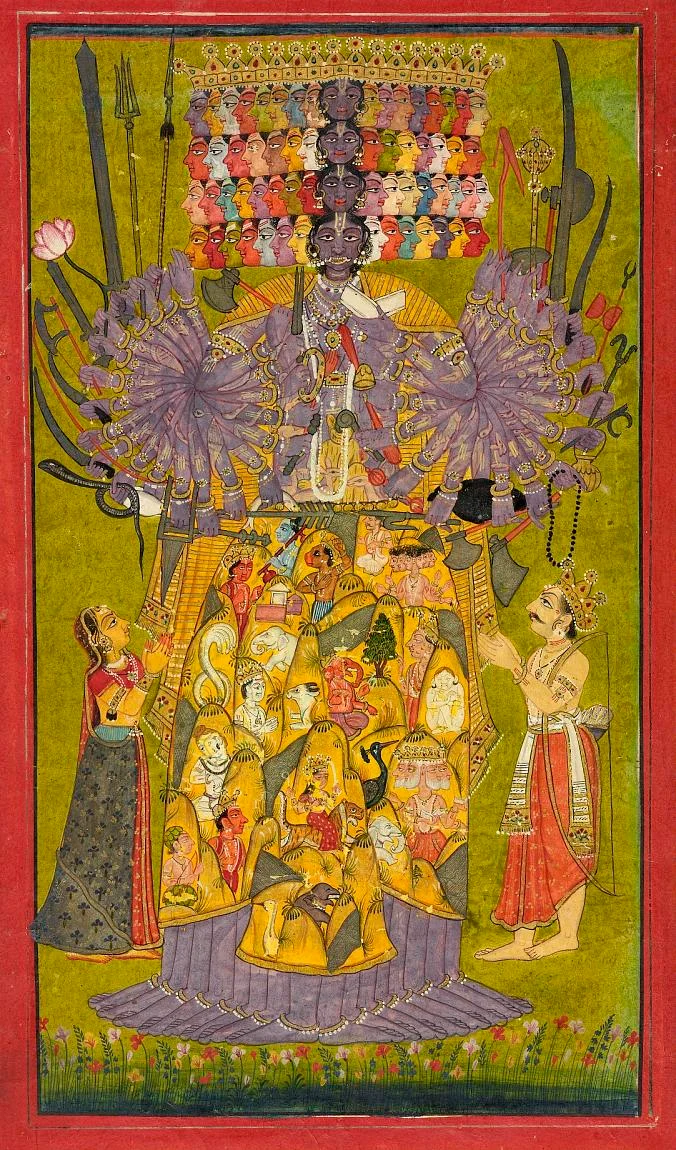
Follow the faces and hands down to the smaller worlds inside the figure. The National Museum of Asian Art identifies this painting as Krishna’s cosmic form. Bilaspur, ca. 1740.
Smithsonian National Museum of Asian Art, S2018.1.3. Purchase and partial gift from the Catherine and Ralph Benkaim Collection, funded by the Friends of the National Museum of Asian Art. · Image source ↗ · CC0
How Arjuna answers at the end
In 18.63 Krishna invites Arjuna to reflect on what he has heard and then act as he wishes. In 18.66 Krishna calls him to take refuge. The two statements come close together. Keep them in sequence before reading Arjuna’s answer in 18.73, when he declares that his confusion has cleared and that he will act. [20][23][24]
The last scene returns the conversation to the decision that opened Chapter 1. Read 1.47 and 18.73 together. One ends with Arjuna laying down his weapon, the other records what he says after hearing Krishna. Between the two stands a long examination of what it means to know, act and devote oneself. [3][24][1]
Sources
See references (25)
- Bhagavad Gītā · All 18 chapters ↗Heritage IIT Kanpur, Gītā Supersite continuation, Sanskrit text and translations.Return to text ↑
- Bhīṣma Parva XXV · The Gītā begins in the Mahābhārata ↗Kisari Mohan Ganguli’s English translation of the Mahābhārata, Book VI, section XXV.Return to text ↑
- Bhagavad Gītā 1.47 · Arjuna’s crisis ↗Śrīmad Bhagavad Gītā, Heritage IIT Kanpur. Sanskrit and English translations including Swami Sivananda and Swami Gambhirananda.Return to text ↑
- Bhagavad Gītā 2.47 · Action and its fruits ↗Śrīmad Bhagavad Gītā, Heritage IIT Kanpur. Sanskrit and English translations including Swami Sivananda and Swami Gambhirananda.Return to text ↑
- Bhagavad Gītā 3.19 · Acting without attachment ↗Śrīmad Bhagavad Gītā, Heritage IIT Kanpur. Sanskrit and English translations including Swami Sivananda and Swami Gambhirananda.Return to text ↑
- Bhagavad Gītā 4.7 · Krishna’s manifestation ↗Śrīmad Bhagavad Gītā, Heritage IIT Kanpur. Sanskrit and English translations including Swami Sivananda and Swami Gambhirananda.
- Bhagavad Gītā 5.2 · Renunciation and action ↗Śrīmad Bhagavad Gītā, Heritage IIT Kanpur. Sanskrit and English translations including Swami Sivananda and Swami Gambhirananda.Return to text ↑
- Bhagavad Gītā 6.35 · Training attention ↗Śrīmad Bhagavad Gītā, Heritage IIT Kanpur. Sanskrit and English translations including Swami Sivananda and Swami Gambhirananda.Return to text ↑
- Bhagavad Gītā 7.7 · What holds things together ↗Śrīmad Bhagavad Gītā, Heritage IIT Kanpur. Sanskrit and English translations including Swami Sivananda and Swami Gambhirananda.
- Bhagavad Gītā 8.5 · Remembering at death ↗Śrīmad Bhagavad Gītā, Heritage IIT Kanpur. Sanskrit and English translations including Swami Sivananda and Swami Gambhirananda.Return to text ↑
- Bhagavad Gītā 9.26 · A simple offering ↗Śrīmad Bhagavad Gītā, Heritage IIT Kanpur. Sanskrit and English translations including Swami Sivananda and Swami Gambhirananda.Return to text ↑
- Bhagavad Gītā 10.20 · The divine in living beings ↗Śrīmad Bhagavad Gītā, Heritage IIT Kanpur. Sanskrit and English translations including Swami Sivananda and Swami Gambhirananda.
- Bhagavad Gītā 11.8 · The universal form ↗Śrīmad Bhagavad Gītā, Heritage IIT Kanpur. Sanskrit and English translations including Swami Sivananda and Swami Gambhirananda.Return to text ↑
- Bhagavad Gītā 12.13 · What devotion looks like ↗Śrīmad Bhagavad Gītā, Heritage IIT Kanpur. Sanskrit and English translations including Swami Sivananda and Swami Gambhirananda.Return to text ↑
- Bhagavad Gītā 13.2 · The field and its knower ↗Śrīmad Bhagavad Gītā, Heritage IIT Kanpur. Sanskrit and English translations including Swami Sivananda and Swami Gambhirananda.Return to text ↑
- Bhagavad Gītā 14.5 · The three guṇas ↗Śrīmad Bhagavad Gītā, Heritage IIT Kanpur. Sanskrit and English translations including Swami Sivananda and Swami Gambhirananda.Return to text ↑
- Bhagavad Gītā 15.1 · The tree with roots above ↗Śrīmad Bhagavad Gītā, Heritage IIT Kanpur. Sanskrit and English translations including Swami Sivananda and Swami Gambhirananda.
- Bhagavad Gītā 16.1 · Qualities of character ↗Śrīmad Bhagavad Gītā, Heritage IIT Kanpur. Sanskrit and English translations including Swami Sivananda and Swami Gambhirananda.
- Bhagavad Gītā 17.3 · The character of faith ↗Śrīmad Bhagavad Gītā, Heritage IIT Kanpur. Sanskrit and English translations including Swami Sivananda and Swami Gambhirananda.
- Bhagavad Gītā 18.63 · Reflection and choice ↗Śrīmad Bhagavad Gītā, Heritage IIT Kanpur. Sanskrit and English translations including Swami Sivananda and Swami Gambhirananda.Return to text ↑
- Bhagavad Gītā 11.24 · Arjuna’s fear before the cosmic form ↗Śrīmad Bhagavad Gītā, Heritage IIT Kanpur. Sanskrit and English translations including Swami Sivananda and Swami Gambhirananda.Return to text ↑
- Bhagavad Gītā 11.45 · Arjuna asks to see a familiar form ↗Śrīmad Bhagavad Gītā, Heritage IIT Kanpur. Sanskrit and English translations including Swami Sivananda and Swami Gambhirananda.Return to text ↑
- Bhagavad Gītā 18.66 · The invitation to take refuge ↗Śrīmad Bhagavad Gītā, Heritage IIT Kanpur. Sanskrit and English translations including Swami Sivananda and Swami Gambhirananda.Return to text ↑
- Bhagavad Gītā 18.73 · Arjuna’s closing reply ↗Śrīmad Bhagavad Gītā, Heritage IIT Kanpur. Sanskrit and English translations including Swami Sivananda and Swami Gambhirananda.Return to text ↑
- Krishna Vishvarupa · Smithsonian National Museum of Asian Art ↗National Museum of Asian Art, ca. 1740, Bilaspur, Himachal Pradesh, S2018.1.3.Return to text ↑