Magic Tesseract
How do 81 numbers make a magic tesseract? Read Philip Henry Wynne’s diagram and see why each of its 108 straight rows sums to 123.
In this article
Eighty-one numbers and one line sum
A magic tesseract places numbers in a four-dimensional grid so specified lines share a sum. Philip Henry Wynne’s example has three positions along each of four directions, for 81 cells. Each direction has 27 parallel lines. All 108 of these lines sum to 123. [2][3][4][5]
The numbers 1 through 81 have mean 41. Each coordinate direction partitions the grid into lines of three, so a common sum must be three times 41. The work is finding an arrangement that meets that requirement in every direction. [6][7][3][4]
See references (6)
- A Primer of Higher Space, Plate 21, Reader page 50
- A Primer of Higher Space, Plate 27, Reader page 56
- A Primer of Higher Space, Plate 28, Reader page 57
- A Primer of Higher Space, Plate 29, Reader page 58
- A Primer of Higher Space, Plate 20, Reader page 49
- A Primer of Higher Space, Plate 26, Reader page 55
A Primer of Higher Space by Claude Bragdon
In A Primer of Higher Space, Claude Bragdon prints two diagrams signed by Philip Henry Wynne. The first shows the numbered construction. The second, dated February 1912, draws the cubical layers as nested shapes so the joins can be traced on a page. [6][2][3][4][5]
Bragdon asks readers to match the lines across the two diagrams and check the sums. He also gives a body diagonal through the central 41. The numbers 37, 41 and 45 add to 123. That diagonal is an additional check beyond the 108 lines parallel to the axes. [8][4][5]
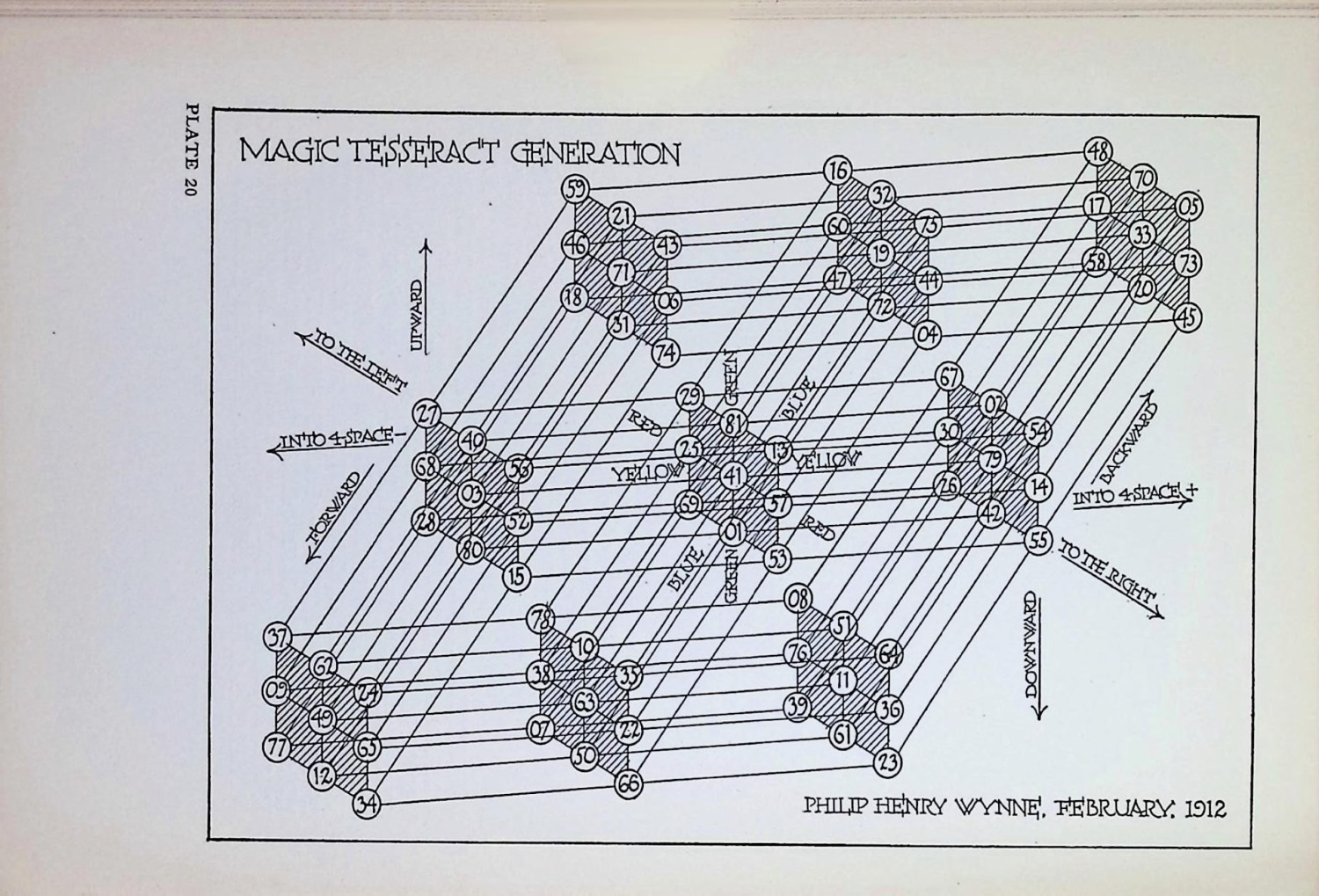
Wynne lays out the 81 numbers on Plate 20. The arrows distinguish the four directions in which to trace the lines of three numbers.
Philip Henry Wynne, in Claude Bragdon, A Primer of Higher Space (1913), Plate 20. Stickley Museum scan via Internet Archive. Rotated for reading. · Image source ↗ · Public Domain
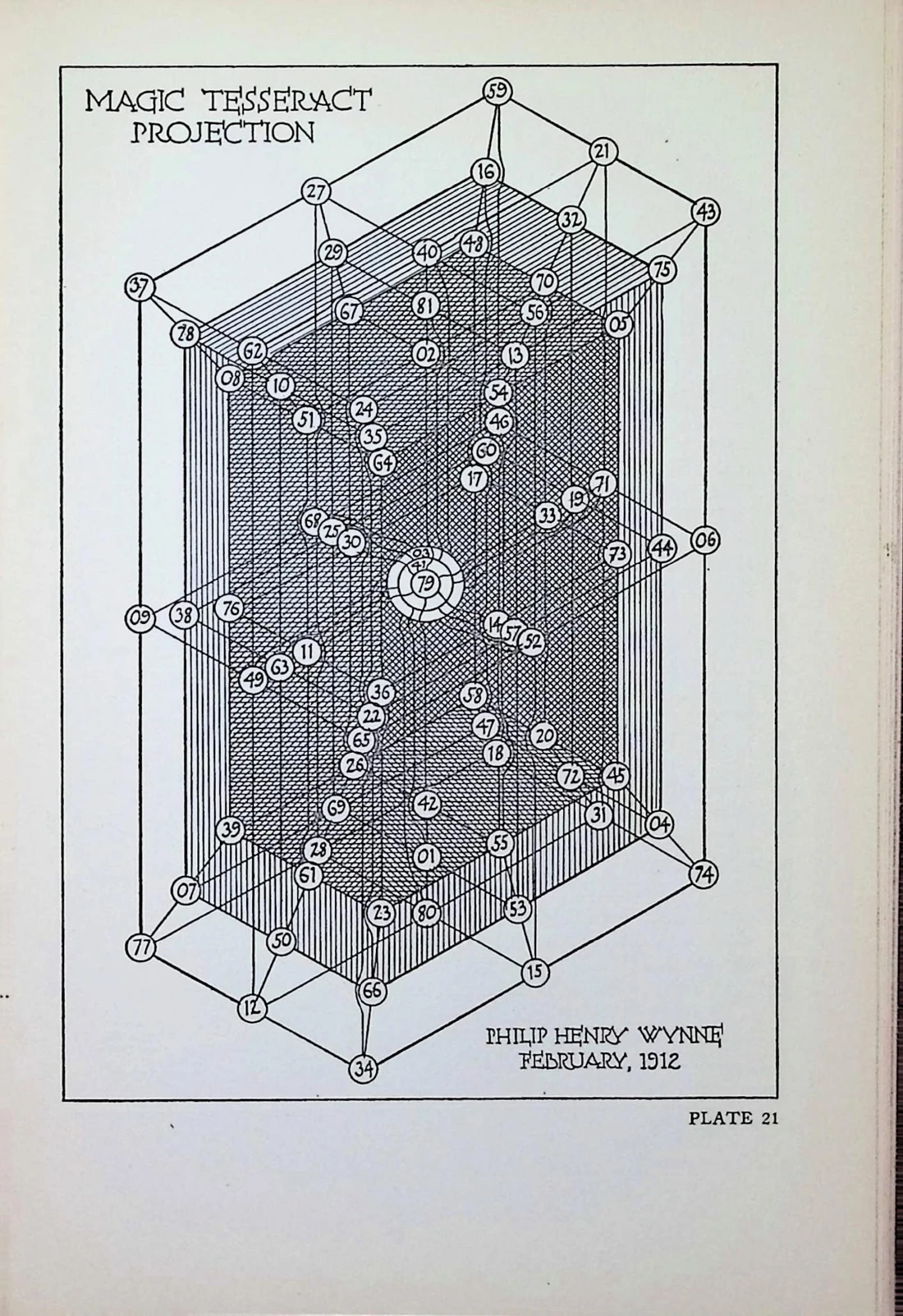
On Plate 21, Wynne projects the numbered construction so matching points can be traced in a nested drawing.
Philip Henry Wynne, Magic Tesseract Projection (February 1912), in Claude Bragdon, A Primer of Higher Space, The Manas Press, 1913. Stickley Museum scan via Internet Archive. · Image source ↗ · Public Domain
See references (6)
- A Primer of Higher Space, Plate 21, Reader page 50
- A Primer of Higher Space, Plate 27, Reader page 56
- A Primer of Higher Space, Plate 28, Reader page 57
- A Primer of Higher Space, Plate 29, Reader page 58
- A Primer of Higher Space, Plate 20, Reader page 49
- A Primer of Higher Space, Plate 25, Reader page 54
From a cube to a tesseract
A magic cube has three directions along which to test the line sum. The tesseract adds a fourth, joining corresponding positions across the cubical layers. [2][8][4][5]
In the library
A Primer of Higher Space
Reading note
The separately titled account draws on exact passages in the consulted Library edition.
Sources
See references (8)
- Plate 21, Philip Henry Wynne’s projection of a magic tesseract ↗Philip Henry Wynne, Magic Tesseract Projection (February 1912), in Claude Bragdon, A Primer of Higher Space, The Manas Press, 1913. Stickley Museum scan via Internet Archive.
- A Primer of Higher Space, Plate 21, Reader page 50Claude Bragdon, A Primer of Higher Space (The Fourth Dimension), The Manas Press, Rochester, New York, 1913. Lumitheca Library edition IMJ-0599-E001.Read this page in A Primer of Higher Space ↗
- A Primer of Higher Space, Plate 27, Reader page 56Claude Bragdon, A Primer of Higher Space (The Fourth Dimension), The Manas Press, Rochester, New York, 1913. Lumitheca Library edition IMJ-0599-E001.Read this page in A Primer of Higher Space ↗
- A Primer of Higher Space, Plate 28, Reader page 57Claude Bragdon, A Primer of Higher Space (The Fourth Dimension), The Manas Press, Rochester, New York, 1913. Lumitheca Library edition IMJ-0599-E001.Read this page in A Primer of Higher Space ↗
- A Primer of Higher Space, Plate 29, Reader page 58Claude Bragdon, A Primer of Higher Space (The Fourth Dimension), The Manas Press, Rochester, New York, 1913. Lumitheca Library edition IMJ-0599-E001.Read this page in A Primer of Higher Space ↗
- A Primer of Higher Space, Plate 20, Reader page 49Claude Bragdon, A Primer of Higher Space (The Fourth Dimension), The Manas Press, Rochester, New York, 1913. Lumitheca Library edition IMJ-0599-E001.Read this page in A Primer of Higher Space ↗
- A Primer of Higher Space, Plate 26, Reader page 55Claude Bragdon, A Primer of Higher Space (The Fourth Dimension), The Manas Press, Rochester, New York, 1913. Lumitheca Library edition IMJ-0599-E001.Read this page in A Primer of Higher Space ↗
- A Primer of Higher Space, Plate 25, Reader page 54Claude Bragdon, A Primer of Higher Space (The Fourth Dimension), The Manas Press, Rochester, New York, 1913. Lumitheca Library edition IMJ-0599-E001.Read this page in A Primer of Higher Space ↗