Magic Cube
What makes a magic cube work? Check Bragdon’s examples that sum to 42 and 130 and see why diagonal rules vary.
In this article
The same sum in three directions
A magic cube places numbers in a cubic grid so each row parallel to an edge has the same sum. A construction can also specify diagonals that share the sum. It matters which diagonals the author asks the reader to check. [2][3][4]
The numbers 1 through 64 average 32½. In a four-by-four-by-four cube, a line of four numbers must therefore total 130 if all parallel lines have a common sum. One row in Bragdon’s diagram shows 1, 62, 63 and 4. [2]
A Primer of Higher Space by Claude Bragdon
On Plate 23 of A Primer of Higher Space, Claude Bragdon displays a four-by-four-by-four cube as four square slices. Its rows and four long diagonals through the cube all total 130. A diagonal across an individual slice can give a different sum. [5][2][3]
Plate 25 shows a three-by-three-by-three cube with 14 at the centre. The rows and the four long diagonals through the cube total 42. The six diagonals through the centre of the three central square sections have the same sum. [4][6]
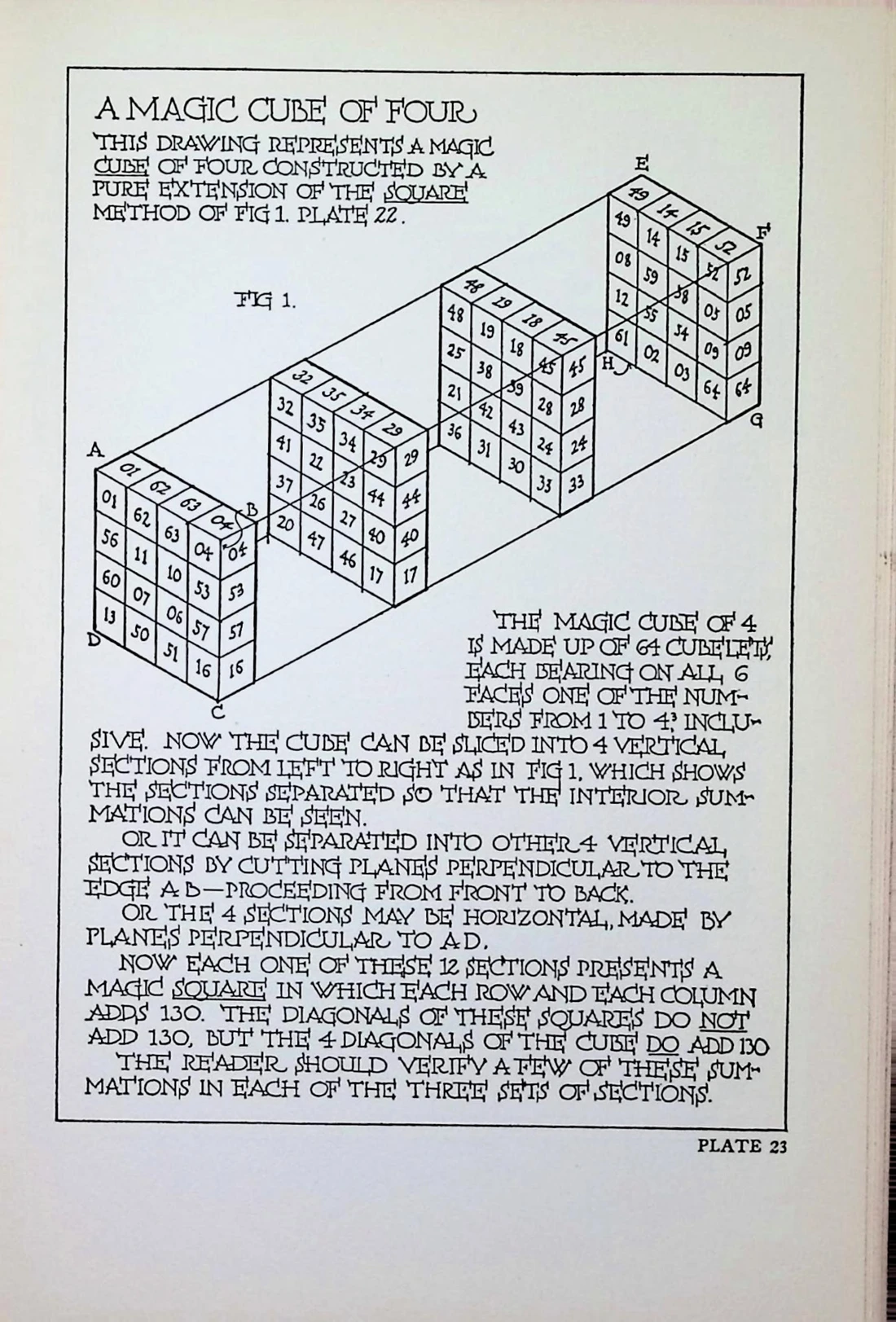
Plate 23 shows four slices of the order-four cube. The first row reads 1, 62, 63 and 4, for a sum of 130.
Claude Bragdon, A Primer of Higher Space, The Manas Press, 1913. Stickley Museum scan via Internet Archive. · Image source ↗ · Public Domain
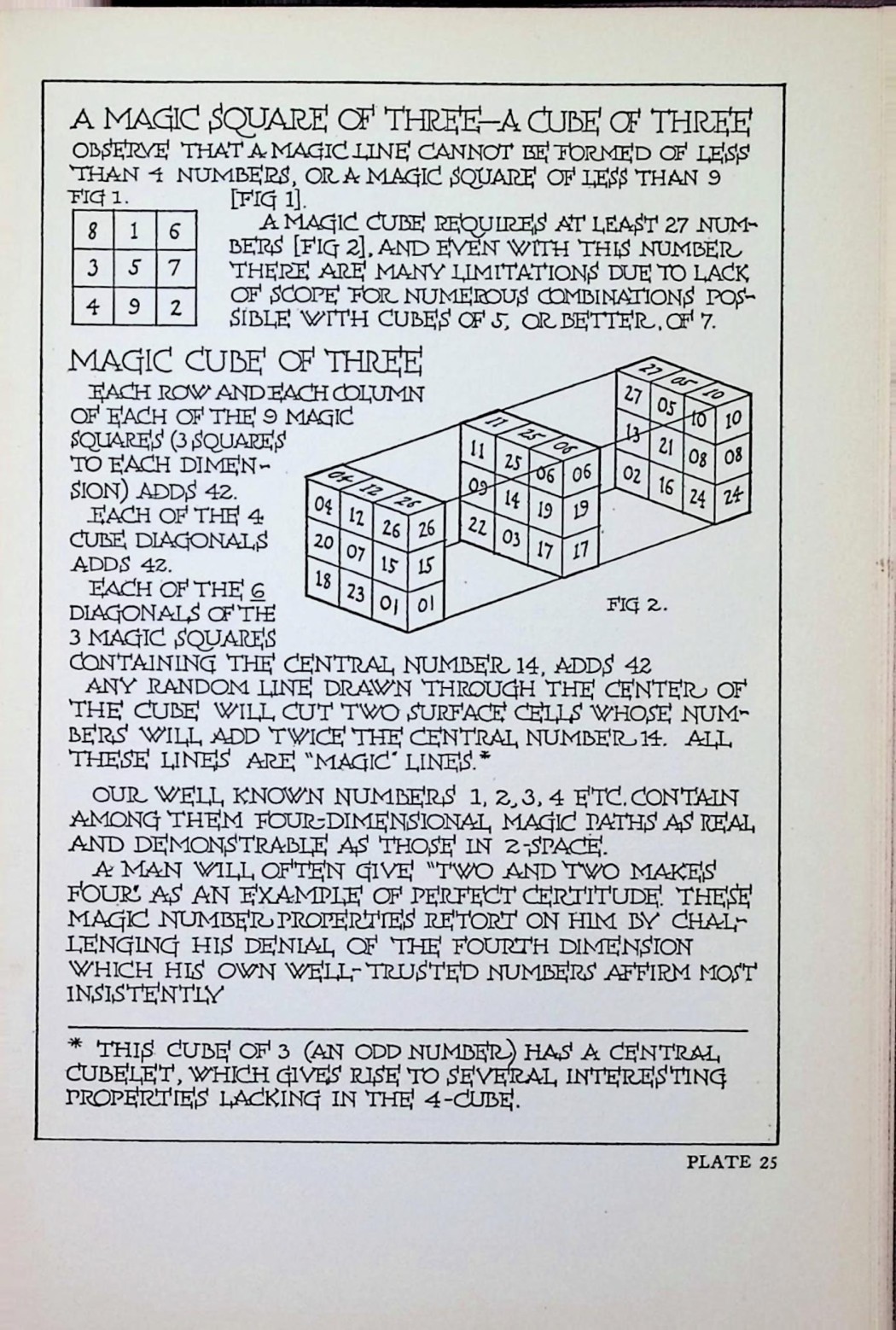
Plate 25 shows the order-three cube. The central slice contains 14, and its upper row contains 11, 25 and 6, which sum to 42.
Claude Bragdon, in Claude Bragdon, A Primer of Higher Space (1913), Plate 25. Stickley Museum scan via Internet Archive. · Image source ↗ · Public Domain
What another direction adds
A magic square has two directions of equal-sum rows. A cube adds rows between square slices. A magic tesseract adds another set of rows, between cubic layers. [5][2][4][7]
In the library
A Primer of Higher Space
Reading note
The separately titled account draws on exact passages in the consulted Library edition.
Sources
See references (7)
- Plate 23, four slices through a magic cube ↗Claude Bragdon, A Primer of Higher Space, The Manas Press, 1913. Stickley Museum scan via Internet Archive.
- A Primer of Higher Space, Plate 23, Reader page 52Claude Bragdon, A Primer of Higher Space (The Fourth Dimension), The Manas Press, Rochester, New York, 1913. Lumitheca Library edition IMJ-0599-E001.Read this page in A Primer of Higher Space ↗
- A Primer of Higher Space, Plate 24, Reader page 53Claude Bragdon, A Primer of Higher Space (The Fourth Dimension), The Manas Press, Rochester, New York, 1913. Lumitheca Library edition IMJ-0599-E001.Read this page in A Primer of Higher Space ↗
- A Primer of Higher Space, Plate 25, Reader page 54Claude Bragdon, A Primer of Higher Space (The Fourth Dimension), The Manas Press, Rochester, New York, 1913. Lumitheca Library edition IMJ-0599-E001.Read this page in A Primer of Higher Space ↗
- A Primer of Higher Space, Plate 22, Reader page 51Claude Bragdon, A Primer of Higher Space (The Fourth Dimension), The Manas Press, Rochester, New York, 1913. Lumitheca Library edition IMJ-0599-E001.Read this page in A Primer of Higher Space ↗
- A Primer of Higher Space, Plate 26, Reader page 55Claude Bragdon, A Primer of Higher Space (The Fourth Dimension), The Manas Press, Rochester, New York, 1913. Lumitheca Library edition IMJ-0599-E001.Read this page in A Primer of Higher Space ↗
- A Primer of Higher Space, Plate 28, Reader page 57Claude Bragdon, A Primer of Higher Space (The Fourth Dimension), The Manas Press, Rochester, New York, 1913. Lumitheca Library edition IMJ-0599-E001.Read this page in A Primer of Higher Space ↗