Tesseract: The Four-Dimensional Cube
A tesseract is the four-dimensional cube. See how Bragdon constructs it and counts its 8 cubical cells, 24 square faces, 32 edges, and 16 vertices.
In this article
The cube extended into a fourth dimension
A tesseract is the four-dimensional counterpart of a cube. Its boundary has 16 vertices, 32 edges, 24 square faces and 8 cubical cells. A drawing can show how the parts connect by representing them in fewer dimensions. [3][4][5][6]
A Primer of Higher Space by Claude Bragdon
In A Primer of Higher Space, Claude Bragdon starts with two copies of a cube and joins matching vertices along a fourth direction. The two cubes serve as end cells. Each of the moving cube’s six square faces sweeps out one more cubical cell, making eight in all. [3][4][5][6]
Plate 5 first counts the parts of a cube using nested squares, then counts the parts of a tesseract using nested cubes. The apparent difference in size comes from the drawing. In the tesseract, all eight boundary cubes are congruent. [7][6][8]
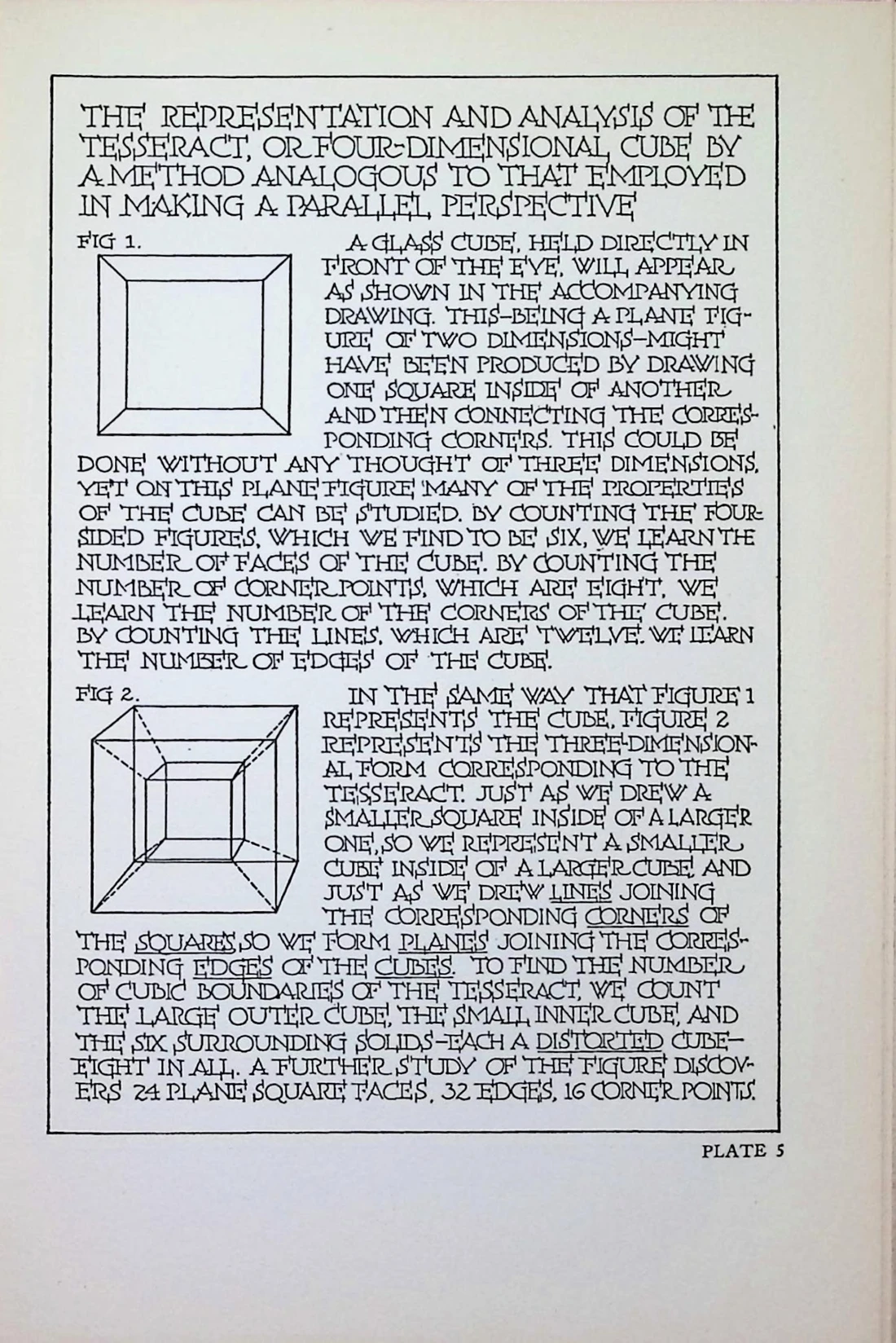
In Plate 5, a pair of nested squares represents a cube. Bragdon repeats the method with nested cubes to count the parts of a tesseract.
Claude Bragdon, A Primer of Higher Space, The Manas Press, 1913. Stickley Museum scan via Internet Archive. · Image source ↗ · Public Domain
See references (6)
- A Primer of Higher Space, printed p. 2, Reader page 9
- A Primer of Higher Space, printed p. 3, Reader page 10
- A Primer of Higher Space, Plate 1, Reader page 30
- A Primer of Higher Space, Plate 5, Reader page 34
- A Primer of Higher Space, Plate 4, Reader page 33
- A Primer of Higher Space, Plate 29, Reader page 58
The Fourth Dimension by Charles Howard Hinton
In the 1904 frontispiece to The Fourth Dimension, Charles Howard Hinton presents several coloured views of what he calls the tessaract. The colours help the reader track corresponding parts across views. [2]
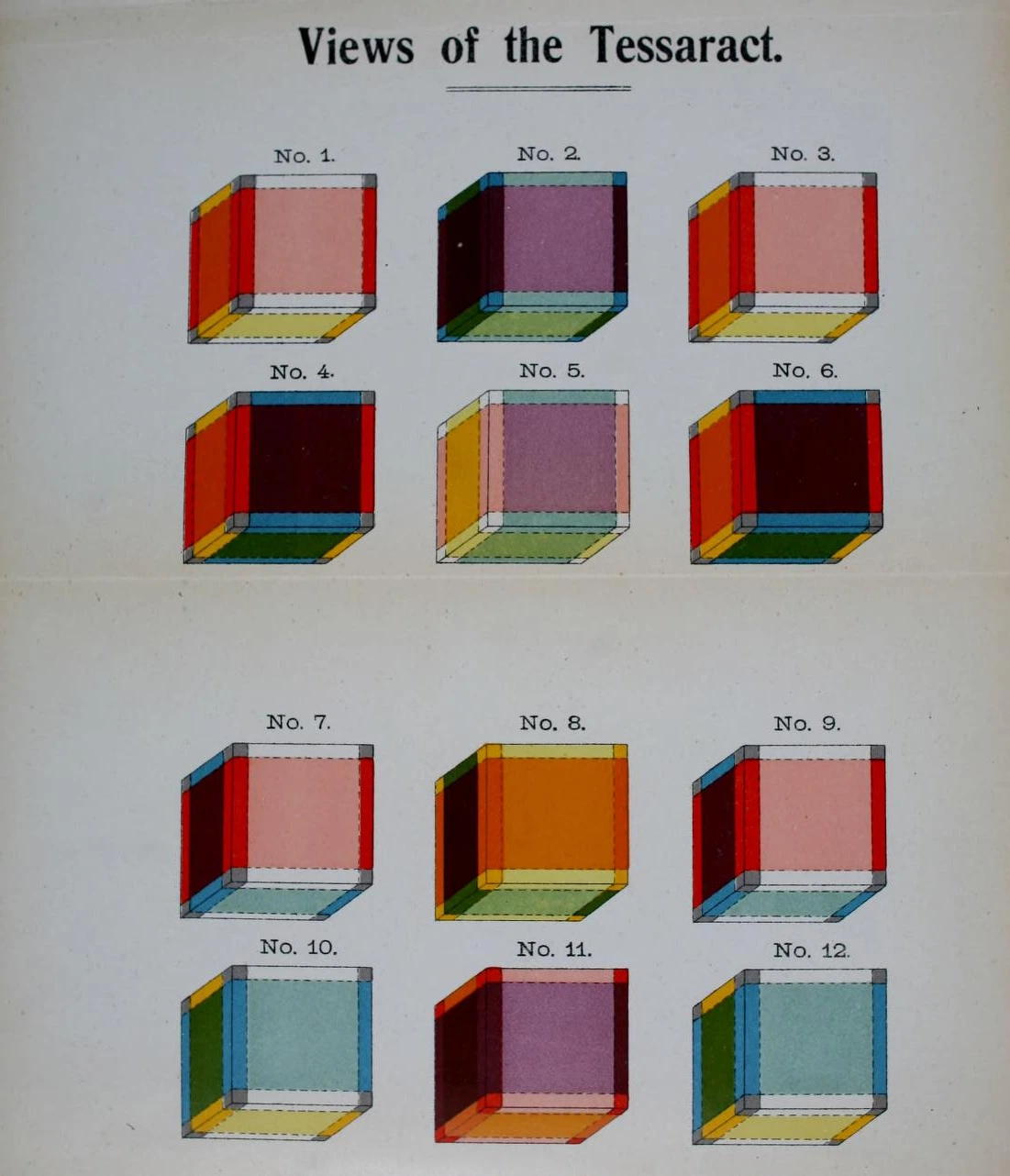
Hinton uses coloured regions across twelve numbered views in the frontispiece to The Fourth Dimension.
Charles Howard Hinton, The Fourth Dimension (1904), frontispiece. Internet Archive scan via Wikimedia Commons. · Image source ↗ · Public Domain
Reading a four-dimensional shape on paper
Hinton gives the reader several views to compare. Bragdon puts the links into a single nested-cube drawing so the parts can be counted. [5][7][6][2]
In the library
A Primer of Higher Space
Reading note
The separately titled account draws on exact passages in the consulted Library edition.
Sources
See references (8)
- Plate 5, counting the parts of a tesseract ↗Claude Bragdon, A Primer of Higher Space, The Manas Press, 1913. Stickley Museum scan via Internet Archive.
- Views of the Tessaract, frontispiece ↗Charles Howard Hinton, The Fourth Dimension (1904), frontispiece.
- A Primer of Higher Space, printed p. 2, Reader page 9Claude Bragdon, A Primer of Higher Space (The Fourth Dimension), The Manas Press, Rochester, New York, 1913. Lumitheca Library edition IMJ-0599-E001.Read this page in A Primer of Higher Space ↗
- A Primer of Higher Space, printed p. 3, Reader page 10Claude Bragdon, A Primer of Higher Space (The Fourth Dimension), The Manas Press, Rochester, New York, 1913. Lumitheca Library edition IMJ-0599-E001.Read this page in A Primer of Higher Space ↗
- A Primer of Higher Space, Plate 1, Reader page 30Claude Bragdon, A Primer of Higher Space (The Fourth Dimension), The Manas Press, Rochester, New York, 1913. Lumitheca Library edition IMJ-0599-E001.Read this page in A Primer of Higher Space ↗
- A Primer of Higher Space, Plate 5, Reader page 34Claude Bragdon, A Primer of Higher Space (The Fourth Dimension), The Manas Press, Rochester, New York, 1913. Lumitheca Library edition IMJ-0599-E001.Read this page in A Primer of Higher Space ↗
- A Primer of Higher Space, Plate 4, Reader page 33Claude Bragdon, A Primer of Higher Space (The Fourth Dimension), The Manas Press, Rochester, New York, 1913. Lumitheca Library edition IMJ-0599-E001.Read this page in A Primer of Higher Space ↗
- A Primer of Higher Space, Plate 29, Reader page 58Claude Bragdon, A Primer of Higher Space (The Fourth Dimension), The Manas Press, Rochester, New York, 1913. Lumitheca Library edition IMJ-0599-E001.Read this page in A Primer of Higher Space ↗