Jnana Yoga
Jnana Yoga is a Hindu path of spiritual knowledge. Compare the Bhagavad Gita with Vivekananda’s accounts of reasoning, self-inquiry and liberation.
In this article
Understanding the concept
Jnana Yoga is a Hindu path that pursues liberation through spiritual knowledge. Its central question is what a person comes to recognise about reality and the self. Swami Vivekananda gives reasoning a role in loosening identification with what is limited. [1][3][4]
Jnana means knowledge. The Bhagavad Gita links it to maturity in yoga, and Vivekananda’s Vedanta uses it to ask whether the body, the mind and the things a person calls theirs exhaust what the self is. [5][3][4][6]
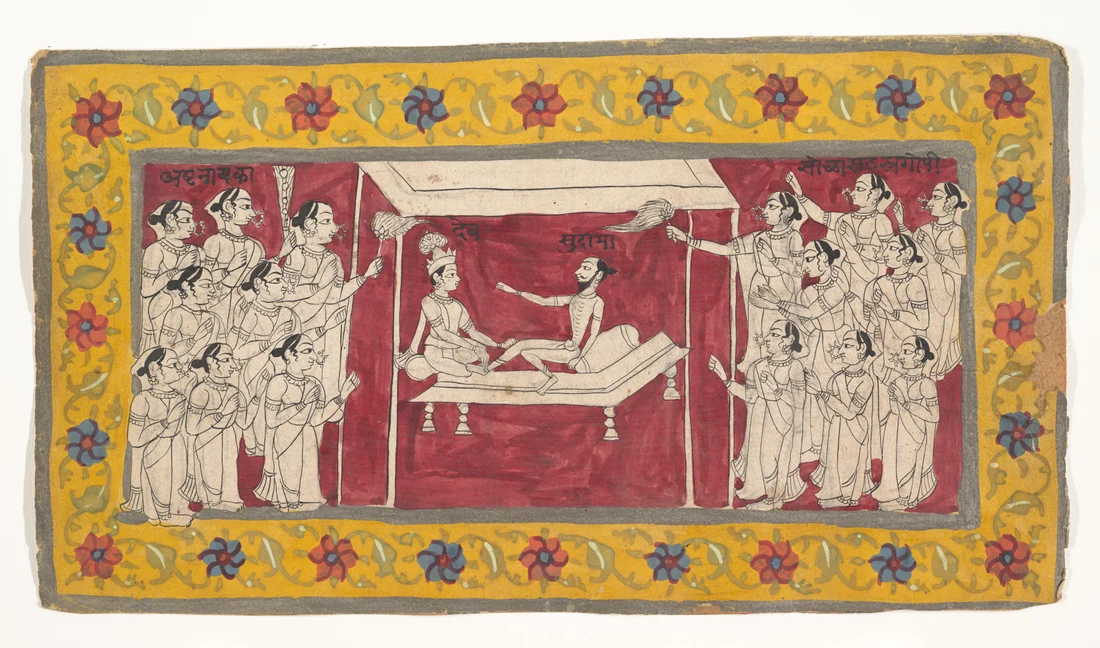
Krishna with an Ascetic, Maharashtra, c. 1850. Krishna and the ascetic converse before a group of onlookers.
The Metropolitan Museum of Art, Purchase, Mr. and Mrs. Peter Findlay Gift, 1979; object 1979.12.2. Open Access. · Image source ↗ · CC0
The Bhagavad Gita: the purifying power of knowledge
In Bhagavad Gita 4.38, Krishna gives knowledge a purifying role. It is something a person who has matured in yoga comes to find inwardly. The verse connects knowledge to practice and to a change that takes time. [1]
Vivekananda’s Jnana-Yoga
In “The Real Nature of Man”, Vivekananda examines what a person calls themselves and theirs. He argues that taking the finite body and mind for the whole self reinforces separateness. In his Vedanta, relinquishing that identification allows the infinite Self to become manifest. [11]
Karma-Yoga by Swami Vivekananda
Swami Vivekananda distinguishes two ways of loosening attachment. The negative way refuses identification with limited existence through the repeated discrimination expressed by neti neti. The positive way learns through engagement with the world until the mind lets its grasping go. [3][4]
He associates the first with Jnana Yoga and the second with Karma Yoga. His contrast is sharp: knowledge proceeds through reasoning, while action learns through work and experience. He describes direct renunciation as difficult and possible for exceptional minds and wills; most people, in his account, proceed gradually. [3][4][7]
That contrast does not leave knowledge and work permanently opposed. Earlier he describes the philosopher, worker and devotee as meeting in self-abnegation. Later he calls his four paths overlapping divisions named after a person’s prevailing tendency. His comparison therefore changes scale between a particular method and the goal he considers common. [8][5][6]
He also gives hearing, reflection and practice a role in realization. An external teacher can prompt understanding, but the learner must come to recognize the meaning inwardly. That passage helps explain why the book does not treat knowledge as a substitute for personal transformation. [9][10]
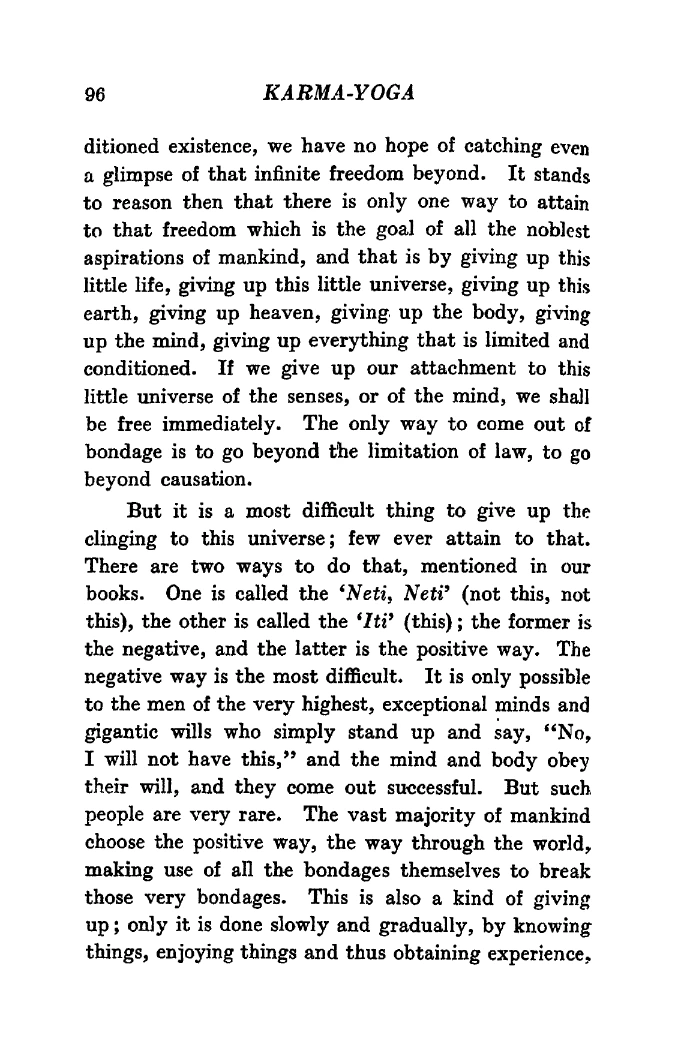
Source facsimile: Karma-Yoga (1939), Reader page 98. Vivekananda distinguishes the negative way of reasoning from gradual freedom through work and experience.
Swami Vivekananda, Karma-Yoga, English second printing in the 1939 combined volume. Historical public-domain text, exact checksum-verified Library scan. · Image source ↗ · Public Domain
What knowledge is meant to change
The Gita describes knowledge ripening through yoga. In Karma-Yoga, Vivekananda contrasts learning through experience with using reasoning to give up a mistaken identification. His Jnana-Yoga lecture explains what the reasoning is directed towards, the claim that a person is wholly defined by the finite body and mind. [1][3][4][6][11]
Read further in the library
Karma Yoga
Reading note
The separately titled account draws on exact passages in the consulted Library edition.
Sources
See references (11)
- Bhagavad Gita 4.38, translated by Swami Mukundananda ↗Bhagavad Gita 4.38: Sanskrit, word meanings and Swami Mukundananda’s English translation. The separately labelled commentary is not treated as the wording of the verse.Return to text ↑
- Krishna with an Ascetic, ca. 1850, Maharashtra, Marathi, The Metropolitan Museum of Art, 1979.12.2 ↗Official museum record and Open Access API identify the painting, historical setting and public-domain image status.
- Karma-Yoga, printed p. 96, Reader page 98Swami Vivekananda, Karma-Yoga, in Karma-Yoga & Bhakti-Yoga, English second printing, Ramakrishna-Vivekananda Center of New York, Inc., 1939. Exact Library edition IMJ-0097-E002. Only the Karma-Yoga part is used in this crawl; the old Work slug mentioning Hindi does not identify this edition’s language.Read this page in Karma Yoga ↗Return to text ↑
- Karma-Yoga, Reader page 99Swami Vivekananda, Karma-Yoga, in Karma-Yoga & Bhakti-Yoga, English second printing, Ramakrishna-Vivekananda Center of New York, Inc., 1939. Exact Library edition IMJ-0097-E002. Only the Karma-Yoga part is used in this crawl; the old Work slug mentioning Hindi does not identify this edition’s language.Read this page in Karma Yoga ↗Return to text ↑
- Karma-Yoga, Reader page 83Swami Vivekananda, Karma-Yoga, in Karma-Yoga & Bhakti-Yoga, English second printing, Ramakrishna-Vivekananda Center of New York, Inc., 1939. Exact Library edition IMJ-0097-E002. Only the Karma-Yoga part is used in this crawl; the old Work slug mentioning Hindi does not identify this edition’s language.Read this page in Karma Yoga ↗Return to text ↑
- Karma-Yoga, Reader page 111Swami Vivekananda, Karma-Yoga, in Karma-Yoga & Bhakti-Yoga, English second printing, Ramakrishna-Vivekananda Center of New York, Inc., 1939. Exact Library edition IMJ-0097-E002. Only the Karma-Yoga part is used in this crawl; the old Work slug mentioning Hindi does not identify this edition’s language.Read this page in Karma Yoga ↗Return to text ↑
- Karma-Yoga, Reader page 100Swami Vivekananda, Karma-Yoga, in Karma-Yoga & Bhakti-Yoga, English second printing, Ramakrishna-Vivekananda Center of New York, Inc., 1939. Exact Library edition IMJ-0097-E002. Only the Karma-Yoga part is used in this crawl; the old Work slug mentioning Hindi does not identify this edition’s language.Read this page in Karma Yoga ↗Return to text ↑
- Karma-Yoga, Reader page 82Swami Vivekananda, Karma-Yoga, in Karma-Yoga & Bhakti-Yoga, English second printing, Ramakrishna-Vivekananda Center of New York, Inc., 1939. Exact Library edition IMJ-0097-E002. Only the Karma-Yoga part is used in this crawl; the old Work slug mentioning Hindi does not identify this edition’s language.Read this page in Karma Yoga ↗Return to text ↑
- Karma-Yoga, Reader page 90Swami Vivekananda, Karma-Yoga, in Karma-Yoga & Bhakti-Yoga, English second printing, Ramakrishna-Vivekananda Center of New York, Inc., 1939. Exact Library edition IMJ-0097-E002. Only the Karma-Yoga part is used in this crawl; the old Work slug mentioning Hindi does not identify this edition’s language.Read this page in Karma Yoga ↗Return to text ↑
- Karma-Yoga, Reader page 91Swami Vivekananda, Karma-Yoga, in Karma-Yoga & Bhakti-Yoga, English second printing, Ramakrishna-Vivekananda Center of New York, Inc., 1939. Exact Library edition IMJ-0097-E002. Only the Karma-Yoga part is used in this crawl; the old Work slug mentioning Hindi does not identify this edition’s language.Read this page in Karma Yoga ↗Return to text ↑
- Swami Vivekananda, Jnana-Yoga, “The Real Nature of Man” ↗The Complete Works of Swami Vivekananda, Volume II, Jnana-Yoga, “The Real Nature of Man”.Return to text ↑