Neti neti
Neti neti means “not this, not this.” Read the Upanishadic passage on Brahman and Vivekananda’s account of the path of negation.
In this article
Understanding the concept
Neti neti means “not this, not this.” The Brihadaranyaka Upanishad uses the phrase when describing what can be said of Brahman, the ultimate reality addressed in the passage. In later spiritual teaching it can also describe a way of loosening identification with anything one can observe or describe. [1][2]
Brahman in the Brihadaranyaka Upanishad
Brihadaranyaka Upanishad II.3 opens with paired descriptions of Brahman, including the formed and the formless. After a series of images, verse 6 turns to negation. F. Max Müller renders the formula as “No, no,” and the verse closes with another designation, “the True of the True.” The movement between the two is part of what makes the brief formula worth reading in context. [1]
Karma-Yoga by Swami Vivekananda
For Swami Vivekananda, the point of the negative way is freedom beyond space, time and causation. Even a heaven imagined by the mind would still belong to conditioned existence. In the chapter “Freedom,” that puts the object of the search beyond any improved version of familiar experience. [3][2]
Vivekananda gives two approaches to letting go. Neti neti approaches non-attachment directly through reasoning, the route he associates with Jnana Yoga. Iti proceeds through work and experience until the mind relinquishes its hold. He considers the direct way exceptionally demanding and recommends the gradual path for most people. [2][4][5]
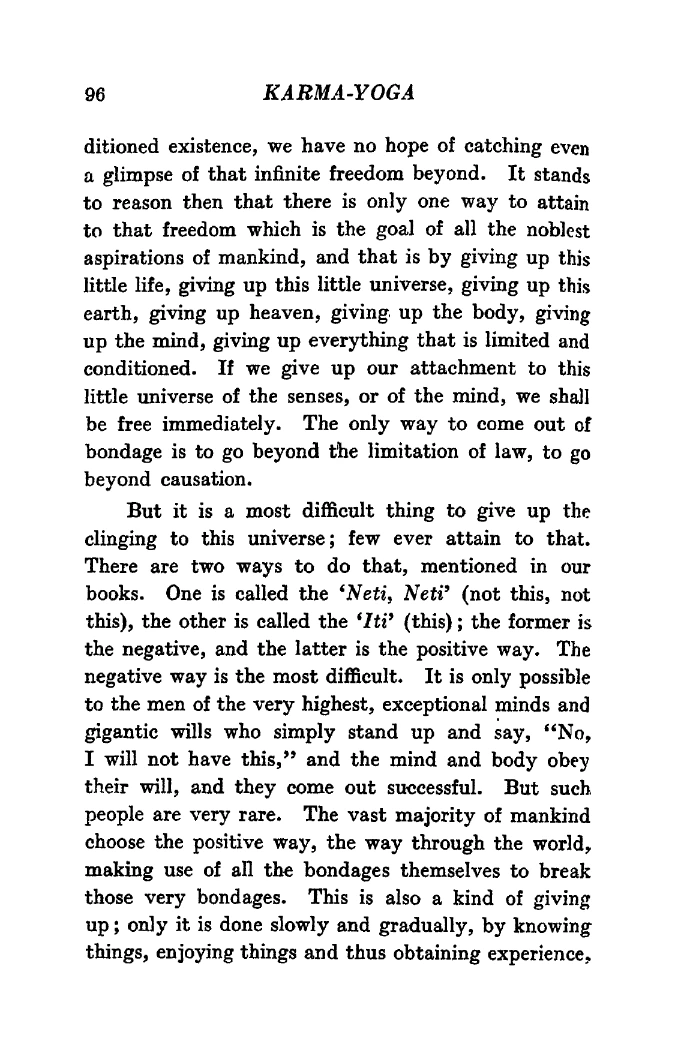
Vivekananda introduces neti neti and iti as two ways toward non-attachment. Karma-Yoga (1939), printed p. 96, Library reader p. 98.
Swami Vivekananda, Karma-Yoga, English second printing in the 1939 combined volume. Historical public-domain text, exact checksum-verified Library scan. · Image source ↗ · Public Domain
A way of speaking and a way of practising
The Upanishadic passage asks how Brahman can be indicated once familiar descriptions have been exhausted. Vivekananda asks how someone might relinquish attachment to conditioned things. The same words carry the reader from a problem of description to a choice about spiritual practice. [1][2][4]
Read further in the library
Karma Yoga
Reading note
The separately titled account draws on exact passages in the consulted Library edition.
Sources
See references (5)
- Brihadaranyaka Upanishad II.3.6, F. Max Müller translation, printed pp. 107–108 ↗Brihadaranyaka Upanishad II.3.1–6, in F. Max Müller’s The Upanishads, Part II, Sacred Books of the East XV (1884). The consulted transcription marks printed p. 108 at verse 6. It is not an owned Library leaf.Return to text ↑
- Karma-Yoga, printed p. 96, Reader page 98Swami Vivekananda, Karma-Yoga, in Karma-Yoga & Bhakti-Yoga, English second printing, Ramakrishna-Vivekananda Center of New York, Inc., 1939. Exact Library edition IMJ-0097-E002. Only the Karma-Yoga part is used in this crawl; the old Work slug mentioning Hindi does not identify this edition’s language.Read this page in Karma Yoga ↗Return to text ↑
- Karma-Yoga, Reader page 97Swami Vivekananda, Karma-Yoga, in Karma-Yoga & Bhakti-Yoga, English second printing, Ramakrishna-Vivekananda Center of New York, Inc., 1939. Exact Library edition IMJ-0097-E002. Only the Karma-Yoga part is used in this crawl; the old Work slug mentioning Hindi does not identify this edition’s language.Read this page in Karma Yoga ↗Return to text ↑
- Karma-Yoga, Reader page 99Swami Vivekananda, Karma-Yoga, in Karma-Yoga & Bhakti-Yoga, English second printing, Ramakrishna-Vivekananda Center of New York, Inc., 1939. Exact Library edition IMJ-0097-E002. Only the Karma-Yoga part is used in this crawl; the old Work slug mentioning Hindi does not identify this edition’s language.Read this page in Karma Yoga ↗Return to text ↑
- Karma-Yoga, Reader page 100Swami Vivekananda, Karma-Yoga, in Karma-Yoga & Bhakti-Yoga, English second printing, Ramakrishna-Vivekananda Center of New York, Inc., 1939. Exact Library edition IMJ-0097-E002. Only the Karma-Yoga part is used in this crawl; the old Work slug mentioning Hindi does not identify this edition’s language.Read this page in Karma Yoga ↗Return to text ↑