Jīvātman and Paramātman
Jīvātman and Paramātman name individual and supreme self. Read how Arthur Avalon relates embodied awareness to consciousness without form.
In this article
The individual and supreme self
Jīvātman means the individual self, and Paramātman the supreme self. In the nondual account discussed here, the distinction is between consciousness as it is experienced through a particular body and mind and consciousness in itself. Realizing their identity is central to the account of liberation. [2][3][4]
The Serpent Power in Arthur Avalon’s translation
In The Serpent Power, Arthur Avalon describes Paramātman as transcendent consciousness and Jīvātman as consciousness embodied. Mind and body are products of prakṛti, the principle of nature, through which awareness takes on a particular range and form. [2][5][3]
Avalon uses a lantern to explain how the light a person sees can seem limited by what encloses it. He also distinguishes the continuing subtle body from the supreme self and connects the end of that continuing embodiment with liberation. [3][6][7][8]
When Avalon speaks of union in a nondual sense, he means realizing an identity already present but concealed by ignorance. He also records a dualist use of the word for the union of the individual spirit with God. [4][9]
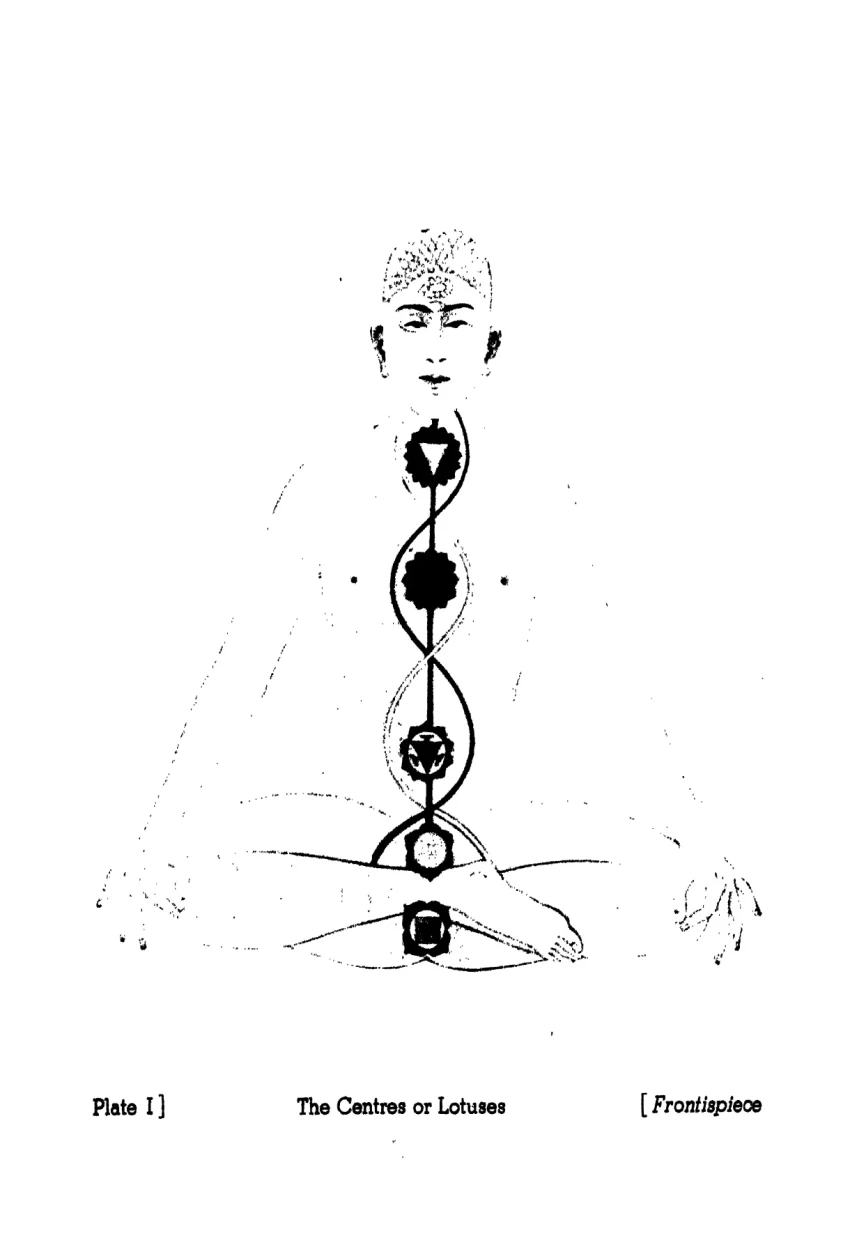
Plate I shows the channels and lotuses over a seated figure. Verse 52 describes the individual self accompanying Kuṇḍalinī on the ascent through this arrangement.
Illustrator unrecorded. The Serpent Power, Plate I. Library facsimile, compared with the 1924 second edition. · Image source ↗ · Public Domain
See references (8)
- The Serpent Power, Reader page 65
- The Serpent Power, printed p. 61, Reader page 67
- The Serpent Power, Reader page 195
- The Serpent Power, printed p. 60, Reader page 66
- The Serpent Power, printed p. 66, Reader page 72
- The Serpent Power, Reader page 81
- The Serpent Power, Reader page 82
- The Serpent Power, printed p. 182, Reader page 196
Distinctions and comparisons
In verse 52 of Pūrṇānanda’s poem, the practitioner leads Kuṇḍalinī with the individual self toward Para Śiva. Kālīcaraṇa identifies the self involved in the passage as Jīvātman. The ascent gives the relation between individual and supreme self a place in the imagery of liberation. [2][3][10][11]
In the library
The Serpent Power
Reading note
Separately attributed primary Library account, cited on exact verified Reader leaves.
Sources
See references (11)
- The Serpent Power, Plate I, Reader page 3Illustrator unrecorded. The Serpent Power, Plate I. Library facsimile, compared with the 1924 second edition.Read this page in The Serpent Power ↗
- The Serpent Power, Reader page 65Arthur Avalon (Sir John Woodroffe), The Serpent Power, fifth enlarged edition, Ganesh & Co., Madras, 1953. Includes Pūrṇānanda’s Ṣaṭ-cakra-nirūpaṇa, Pādukā-pañcaka and Kālīcaraṇa’s commentary. Exact Library edition IMJ-0608-E001.Read this page in The Serpent Power ↗
- The Serpent Power, printed p. 61, Reader page 67Arthur Avalon (Sir John Woodroffe), The Serpent Power, fifth enlarged edition, Ganesh & Co., Madras, 1953. Includes Pūrṇānanda’s Ṣaṭ-cakra-nirūpaṇa, Pādukā-pañcaka and Kālīcaraṇa’s commentary. Exact Library edition IMJ-0608-E001.Read this page in The Serpent Power ↗
- The Serpent Power, Reader page 195Arthur Avalon (Sir John Woodroffe), The Serpent Power, fifth enlarged edition, Ganesh & Co., Madras, 1953. Includes Pūrṇānanda’s Ṣaṭ-cakra-nirūpaṇa, Pādukā-pañcaka and Kālīcaraṇa’s commentary. Exact Library edition IMJ-0608-E001.Read this page in The Serpent Power ↗
- The Serpent Power, printed p. 60, Reader page 66Arthur Avalon (Sir John Woodroffe), The Serpent Power, fifth enlarged edition, Ganesh & Co., Madras, 1953. Includes Pūrṇānanda’s Ṣaṭ-cakra-nirūpaṇa, Pādukā-pañcaka and Kālīcaraṇa’s commentary. Exact Library edition IMJ-0608-E001.Read this page in The Serpent Power ↗
- The Serpent Power, printed p. 66, Reader page 72Arthur Avalon (Sir John Woodroffe), The Serpent Power, fifth enlarged edition, Ganesh & Co., Madras, 1953. Includes Pūrṇānanda’s Ṣaṭ-cakra-nirūpaṇa, Pādukā-pañcaka and Kālīcaraṇa’s commentary. Exact Library edition IMJ-0608-E001.Read this page in The Serpent Power ↗
- The Serpent Power, Reader page 81Arthur Avalon (Sir John Woodroffe), The Serpent Power, fifth enlarged edition, Ganesh & Co., Madras, 1953. Includes Pūrṇānanda’s Ṣaṭ-cakra-nirūpaṇa, Pādukā-pañcaka and Kālīcaraṇa’s commentary. Exact Library edition IMJ-0608-E001.Read this page in The Serpent Power ↗
- The Serpent Power, Reader page 82Arthur Avalon (Sir John Woodroffe), The Serpent Power, fifth enlarged edition, Ganesh & Co., Madras, 1953. Includes Pūrṇānanda’s Ṣaṭ-cakra-nirūpaṇa, Pādukā-pañcaka and Kālīcaraṇa’s commentary. Exact Library edition IMJ-0608-E001.Read this page in The Serpent Power ↗
- The Serpent Power, printed p. 182, Reader page 196Arthur Avalon (Sir John Woodroffe), The Serpent Power, fifth enlarged edition, Ganesh & Co., Madras, 1953. Includes Pūrṇānanda’s Ṣaṭ-cakra-nirūpaṇa, Pādukā-pañcaka and Kālīcaraṇa’s commentary. Exact Library edition IMJ-0608-E001.Read this page in The Serpent Power ↗
- The Serpent Power, printed p. 473, Reader page 499Arthur Avalon (Sir John Woodroffe), The Serpent Power, fifth enlarged edition, Ganesh & Co., Madras, 1953. Includes Pūrṇānanda’s Ṣaṭ-cakra-nirūpaṇa, Pādukā-pañcaka and Kālīcaraṇa’s commentary. Exact Library edition IMJ-0608-E001.Read this page in The Serpent Power ↗
- The Serpent Power, Reader page 500Arthur Avalon (Sir John Woodroffe), The Serpent Power, fifth enlarged edition, Ganesh & Co., Madras, 1953. Includes Pūrṇānanda’s Ṣaṭ-cakra-nirūpaṇa, Pādukā-pañcaka and Kālīcaraṇa’s commentary. Exact Library edition IMJ-0608-E001.Read this page in The Serpent Power ↗