Jannah
Discover Jannah in Islamic teaching: gardens, divine pleasure, gates, companionship and the sources behind descriptions of paradise.
In this article
What is Jannah?
Jannah is paradise in Islam, the enduring blessed life promised by God. Qur’an 9:72 addresses believing women and men together, joining gardens, flowing rivers and good dwellings with God’s pleasure. That final emphasis places the promise within a relationship with God, alongside its images of abundance. Jannah belongs to Islamic teaching about accountability and the life to come; the broader English word Heaven does not convey all of that setting. [1]
Gates, al-Firdaws and divine presence
Gates and the lives that lead towards them
In Sahih al-Bukhari 1896, a report attributed to Sahl describes al-Rayyan as a gate through which those who fast enter on the Day of Resurrection. Its name and association with fasting connect religious practice in this life with recognition in the next. A discipline marked by hunger and thirst is remembered at the entrance to blessed life. [2]
Al-Firdaws and degrees of paradise
Sahih al-Bukhari 2790 speaks of degrees of paradise and directs believers to ask God for al-Firdaws, described as its best and highest part. The transmitted wording also associates it with the divine throne and paradise’s rivers. The statement appears within a discussion of striving in God’s cause. Its language of degrees gives blessedness an ordered form within the report’s religious setting. [3]
The joy of divine presence
In Sahih Muslim 181a, the people of paradise are asked whether they desire anything more after their admission and rescue from the Fire. The report then describes the removal of a veil and the sight of their Lord as dearer than what they have already received. It is an important source for Sunni accounts of the vision of God. [4]
Its structure gives the reader a sense of ascending delight: the gifts of paradise lead towards an encounter understood as greater still. This is a particular hadith and its theological use. Muslim schools have debated the interpretation of language about seeing God; one collection’s formulation should not be presented as the wording of every school’s doctrine. [4]
Homecoming and interpretation
Paradise as homecoming
Contemporary devotional teaching often develops the social warmth of these descriptions. In Omar Suleiman’s Your Jannah Welcoming, arrival becomes a homecoming: angels offer peace, familiar dwellings await and reunion gives blessed life a communal shape. The presentation invites its audience to imagine welcome after endurance and loss. [5]
This is a modern Sunni devotional exposition, drawing together scriptural and transmitted images. Its published introduction and accompanying talk are useful evidence for how the promise is taught today. Details added in a sermon, an animation or an illustration should still be traced to their particular report before being repeated as direct Qur’anic wording. The programme itself describes its visual depictions as conceptual. [5]
Paradise evoked through a woven garden
An eighteenth-century carpet fragment attributed to Northwestern Iran or Kurdistan renders a garden as a patterned surface of channels, trees, flowers and birds. The Met relates the design to Persian garden planning and its association with the rivers of paradise. The carpet offers one regional artistic interpretation, alongside the scriptural and theological descriptions discussed here. [9]
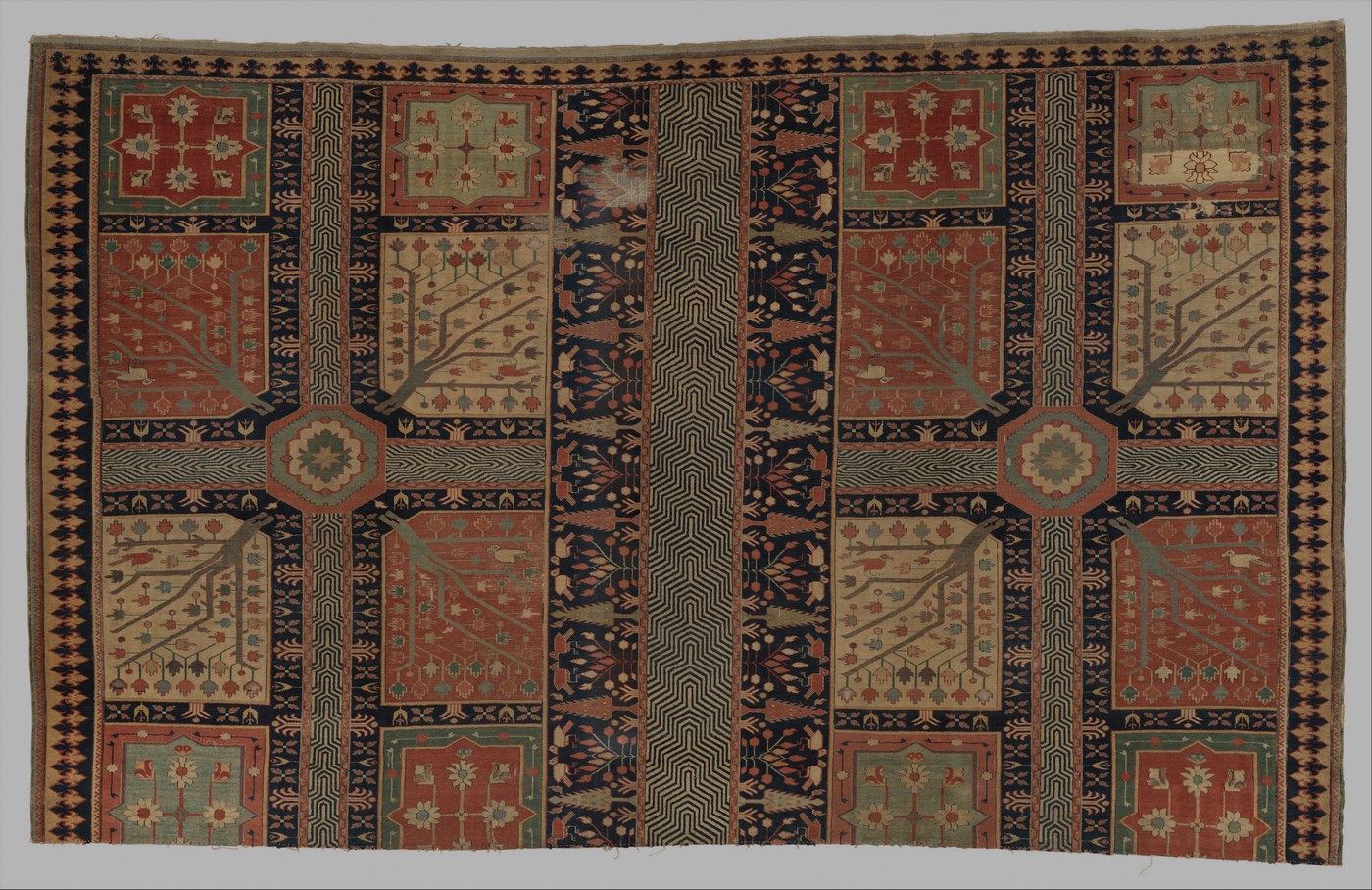
Fragment of a Garden Carpet, eighteenth century. Attributed to Northwestern Iran or Kurdistan. Cotton foundation and wool pile.
The Metropolitan Museum of Art. Theodore M. Davis Collection, Bequest of Theodore M. Davis, 1915. Accession 30.95.150. Public Domain (CC0). · Museum record ↗ · CC0
A Twelver Shi‘i source and a disputed garden
Al-Majlisi’s Haqq al-Yaqin collects reports about paradise and hell through a Twelver Shi‘i framework of authority. Its discussion treats their existence, the Prophet’s ascent and the testimony of the Imams as connected questions. The chapter preserves arguments and transmitted statements, rather than supplying a neutral catalogue of every Muslim position. [7]
One revealing question concerns Adam’s garden. The chapter discusses the view that it was the enduring paradise, while also transmitting Ibn Babawayh’s distinction between Adam’s earthly garden and the eternal destination. The shared word garden therefore does not remove disagreement about which garden a passage describes. Attribution matters here: a quoted authority inside a compilation is not automatically the compiler’s sole position, much less a consensus of Islam. [7]
Conduct and the limits of description
Hope expressed through conduct
The promise of Jannah also appears in practical instruction. Jami‘ at-Tirmidhi 2485 relates Abdullah ibn Salam’s account of Muhammad’s arrival in Medina. The teaching associates entrance into paradise with spreading greetings of peace, feeding others and praying while people sleep. Its scale is ordinary human conduct: speech, generosity and devotion. [8]
This gives the reader a different route into the subject from a list of celestial objects. Paradise is connected with how one treats other people and directs one’s attention. The report’s collection, narrator and reference remain part of its identity. It should be read as a transmitted teaching within the Islamic tradition, without inventing a numerical formula by which a reader could guarantee a particular afterlife reward. [8]
What remains beyond description
Suleiman’s episode on what remains unknown about Jannah returns to the limits of imagination. His argument is that the descriptions given to believers awaken longing without exhausting what God has prepared. The sermon’s emphasis shifts from collecting ever more detail to trust in a promise whose full experience remains unavailable in earthly life. [6]
Gardens, welcome, companionship and divine pleasure give the promise recognizable forms. The devotional claim is that its full reality exceeds those forms. Language awakens hope while leaving room for what has not been disclosed. This is why a list of pleasures can remain incomplete even when every item in it is drawn from a religious source. [6]
Sources
- Qur’an 9:72 ↗Qur’anic promise of paradise; Mustafa Khattab translation hosted by Quran.comReturn to text ↑
- Sahih al-Bukhari 1896 ↗Sunni hadith collection; report attributed to SahlReturn to text ↑
- Sahih al-Bukhari 2790 ↗Sunni hadith collection; report attributed to Abu HurairaReturn to text ↑
- Sahih Muslim 181a ↗Sunni hadith collection; report attributed to SuhaibReturn to text ↑
- Your Jannah Welcoming ↗Omar Suleiman, Yaqeen Institute; contemporary Sunni devotional presentationReturn to text ↑
- What We Still Don’t Know About Jannah ↗Omar Suleiman, Yaqeen Institute; contemporary devotional interpretationReturn to text ↑
- Haqq al-Yaqin: Paradise and Hell ↗Muhammad Baqir al-Majlisi; translated Twelver Shi‘i compilation hosted by Al-Islam.orgReturn to text ↑
- Jami‘ at-Tirmidhi 2485 ↗Sunni hadith collection; report attributed to Abdullah ibn SalamReturn to text ↑
- Fragment of a Garden Carpet ↗The Metropolitan Museum of Art; accession 30.95.150Return to text ↑
About this article & its sources
A focused account of Islamic paradise through Qur’anic passages, selected Sunni hadith and identified Sunni and Twelver Shi‘i interpretations. Individual reports and later devotional descriptions are not treated as one universally agreed map.
Passage attributions
What is Jannah?
Passage 1: Qur’anic promise of paradise; Mustafa Khattab translation hosted by Quran.com.
Gates and the lives that lead towards them
Passage 1: Sunni hadith collection; report attributed to Sahl.
Al-Firdaws and degrees of paradise
Passage 1: Sunni hadith collection; report attributed to Abu Huraira.
The joy of divine presence
Passage 1: Sunni hadith collection; report attributed to Suhaib.
Passage 2: Sunni hadith collection; report attributed to Suhaib.
Paradise as homecoming
Passage 1: Omar Suleiman, Yaqeen Institute; contemporary Sunni devotional presentation.
Passage 2: Omar Suleiman, Yaqeen Institute; contemporary Sunni devotional presentation.
Paradise evoked through a woven garden
Passage 1: The Metropolitan Museum of Art; curatorial interpretation and inspected object.
A Twelver Shi‘i source and a disputed garden
Passage 1: Muhammad Baqir al-Majlisi; translated Twelver Shi‘i compilation hosted by Al-Islam.org.
Passage 2: Muhammad Baqir al-Majlisi; translated Twelver Shi‘i compilation hosted by Al-Islam.org.