Ibn ʿArabī on the Barzakh and the Imaginal Afterlife
Read Ibn ʿArabī’s Meccan Openings on the barzakh. Follow the mirror, dreams and the weighing of deeds through chapter 63 and its Qur’anic references.
In this article
Follow Ibn ʿArabī’s examples
Choose an example to see which question it answers and where it appears in the chapter.
- Qur’an 55:19–20 and 23:99–100
Two uses of barzakh
A boundary in two Qur’anic settings
Put the chapter’s example of two seas beside the passage about a person at death. - Morris · PDF p. 7
The small mirror
A recognisable form in a different place and scale
Follow Ibn ʿArabī’s questions about where the reflection is. - Morris · PDF pp. 8 and 11
Deeds in the scales
A quality becomes perceptible in a form
Compare the deeds in the scales with the example of knowledge taking the form of milk. - Morris · PDF pp. 12–14
A dream and its interpreter
An image with several possible judgements
Separate noticing what appeared from deciding what it meant. - Qur’an 39:42 and 40:46
Between death and resurrection
Sleep as a parallel and the Day of Rising as a boundary
Read the two moments in the passage about Pharaoh’s people.
What is the barzakh in Ibn ʿArabī?
How can something appear to the senses without having an ordinary body in front of you? In chapter 63 of the Meccan Openings, Ibn ʿArabī gives the familiar example of a mirror. A person sees a recognisable likeness whose apparent size and position differ from those of the person standing before the mirror. He uses that difficulty to ask what kind of reality a perceptible form has. [6][7][13]
The chapter’s title places the barzakh between worldly life and resurrection. Its opening poem speaks of intermediate levels with their own limits, then the prose explores the role of imagination in making things perceptible. The examples move between a reflection, a scriptural image and an account of dreaming. Each asks a different question about what it means for something to appear. [6][7][11]
Two Qur’anic settings for the word
In chapter 63, Ibn ʿArabī quotes Qur’an 55:19–20, where two bodies of water meet and a barzakh stands between them. Qur’an 25:53 uses the word in a related image and names the water as fresh and salty. At 23:99–100 the setting changes. A person approaching death asks to go back and do good. That passage places a boundary before resurrection. [2][1][3][6]
Ibn ʿArabī sets the two seas beside another example, the dividing line between sunlit ground and shadow. Both lead the reader to ask how a limit can belong to a relationship without being identical with either side. Read his examples on Cairo p. 304 before moving to the mirror. The mirror carries this inquiry into the status of a visible image. [2][6][7][13]
What a mirror shows
A small mirror makes the problem easy to see. The person recognises their own face while seeing that the reflection is smaller than the body before the mirror. Ibn ʿArabī asks where the reflected form is and what kind of existence it has. The two observations hold together. Something recognisable appears and its dimensions belong to the appearance. [7][13]
The chapter uses this ordinary difficulty to make the reader more careful when speaking about divine self-disclosure. A person can recognise a familiar appearance while having incomplete knowledge of what makes it appear. The example is easiest to follow if you pause on the questions about size and location before moving to the theological argument. [7][13]
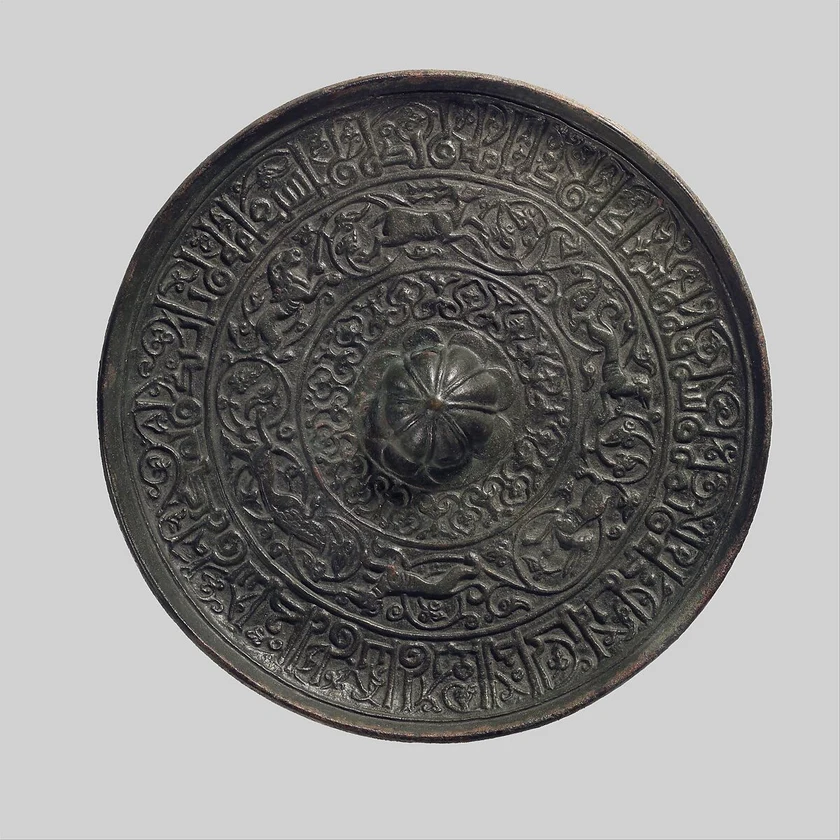
The decorated back of a twelfth-century Iranian mirror. A central knob is surrounded by running animals, ornament and an Arabic inscription. The object shows what a mirror of the period could look like.
Mirror, Iran, 12th century, cast and chased bronze. The Metropolitan Museum of Art, Rogers Fund, 1942, 42.136. Public domain. · Image source ↗ · Public Domain
When a deed acquires a visible form
A deed can be described by its qualities while it is taking place. In Morris’s English rendering, Ibn ʿArabī uses the weighing of deeds in the next world to ask how those qualities might be seen in a form. The point of the example is the relation between what the deed means and how it is presented to the one who perceives it. [8][14]
The chapter later gives the example of knowledge appearing as milk, alongside other forms such as honey or pearls. It describes imagination as remarkably wide in what it can represent. It still receives meanings through some form. Reading those two points together explains why the choice of image matters and why its interpretation needs care. [9][15]
Seeing a dream and understanding it
Ibn ʿArabī treats the occurrence of a dream image and the interpretation of it as separate events. He invokes the report in which the Prophet tells Abū Bakr that parts of an interpretation were right and parts were mistaken. The example makes room for a recognisable appearance and a fallible account of what it signifies. [11][12]
Earlier he applies the distinction to perception more broadly. The chapter assigns judging to the intellect and uses this distinction when it speaks about what the eye of imagination receives. To read the dream passage well, ask which statement describes what was seen and which statement assigns a meaning to it. [10][11]
Sleep, death and resurrection
Qur’an 39:42 puts sleep and death together while distinguishing what is retained and what returns until an appointed time. Morris’s selected translation from chapter 52 also brings sleep, death and barzakh together. These passages give a scriptural and textual setting for the parallel in chapter 63. [4][16][11]
At the end of chapter 63, Ibn ʿArabī connects Qur’an 40:46 with a distinction between one kind of perception before resurrection and another at the Day of Rising. His reading turns on the difference between the two moments in the verse. Consider this example alongside the earlier discussion of the mirror before giving the two kinds of perception a single description. [5][12]
How to read the Arabic and English pages together
Begin with the title and verse on Cairo p. 304, then read the passages on perception on p. 305 and the account of form on p. 306. Morris’s English version numbers its pages independently. Use the Arabic print numbers and the English PDF numbers side by side when passing a quotation or reference to another reader. [13][14][15][6][17]
The English PDF identifies itself as a version made before the corrected publication in Spanish. Its section labels make a useful way into a chapter with changes of subject that can be hard to see in the printed Arabic. Follow the links to read each of the examples in its own place. [6][7][11][17]
Sources
See references (18)
- Qur’an 25:53 ↗The Qur’an, Arabic and Mustafa Khattab’s The Clear Quran, Quran.com.Return to text ↑
- Qur’an 55:19-20 ↗The Qur’an, Arabic and Mustafa Khattab’s The Clear Quran, Quran.com.Return to text ↑
- Qur’an 23:99-100 ↗The Qur’an, Arabic and Mustafa Khattab’s The Clear Quran, Quran.com.Return to text ↑
- Qur’an 39:42 ↗The Qur’an, Arabic and Mustafa Khattab’s The Clear Quran, Quran.com.Return to text ↑
- Qur’an 40:46 ↗The Qur’an, Arabic and Mustafa Khattab’s The Clear Quran, Quran.com.Return to text ↑
- Chapter 63 opening poem and the boundary ↗Ibn ʿArabī, al-Futūḥāt al-Makkiyya, ch. 63. James W. Morris, Spiritual Imagination and the ‘Liminal’ World: Ibn ʿArabi on the Barzakh, hosted English version. Revised edition published in Spanish, POSTDATA 15, no. 2 (1995), pp. 42–49 and 104–109. PDF p. 6.Return to text ↑
- Mirror and the status of the reflected form ↗Ibn ʿArabī, al-Futūḥāt al-Makkiyya, ch. 63. James W. Morris, Spiritual Imagination and the ‘Liminal’ World: Ibn ʿArabi on the Barzakh, hosted English version. Revised edition published in Spanish, POSTDATA 15, no. 2 (1995), pp. 42–49 and 104–109. PDF p. 7.Return to text ↑
- Unveiling, dream, death and forms of deeds ↗Ibn ʿArabī, al-Futūḥāt al-Makkiyya, ch. 63. James W. Morris, Spiritual Imagination and the ‘Liminal’ World: Ibn ʿArabi on the Barzakh, hosted English version. Revised edition published in Spanish, POSTDATA 15, no. 2 (1995), pp. 42–49 and 104–109. PDF p. 8.Return to text ↑
- What imagination can receive through form ↗Ibn ʿArabī, al-Futūḥāt al-Makkiyya, ch. 63. James W. Morris, Spiritual Imagination and the ‘Liminal’ World: Ibn ʿArabi on the Barzakh, hosted English version. Revised edition published in Spanish, POSTDATA 15, no. 2 (1995), pp. 42–49 and 104–109. PDF p. 11.Return to text ↑
- The difference between perceiving and judging ↗Ibn ʿArabī, al-Futūḥāt al-Makkiyya, ch. 63. James W. Morris, Spiritual Imagination and the ‘Liminal’ World: Ibn ʿArabi on the Barzakh, hosted English version. Revised edition published in Spanish, POSTDATA 15, no. 2 (1995), pp. 42–49 and 104–109. PDF p. 12.Return to text ↑
- Dream perception and interpretation ↗Ibn ʿArabī, al-Futūḥāt al-Makkiyya, ch. 63. James W. Morris, Spiritual Imagination and the ‘Liminal’ World: Ibn ʿArabi on the Barzakh, hosted English version. Revised edition published in Spanish, POSTDATA 15, no. 2 (1995), pp. 42–49 and 104–109. PDF p. 13.Return to text ↑
- Imaginal perception and resurrection ↗Ibn ʿArabī, al-Futūḥāt al-Makkiyya, ch. 63. James W. Morris, Spiritual Imagination and the ‘Liminal’ World: Ibn ʿArabi on the Barzakh, hosted English version. Revised edition published in Spanish, POSTDATA 15, no. 2 (1995), pp. 42–49 and 104–109. PDF p. 14.Return to text ↑
- Arabic facsimile · vol. 1, p. 304 ↗Ibn ʿArabī, al-Futūḥāt al-Makkiyya, vol. 1, Cairo Maymaniyya printing, 1329 AH (1911 CE).Return to text ↑
- Arabic facsimile · vol. 1, p. 305 ↗Ibn ʿArabī, al-Futūḥāt al-Makkiyya, vol. 1, Cairo Maymaniyya printing, 1329 AH (1911 CE).Return to text ↑
- Arabic facsimile · vol. 1, p. 306 ↗Ibn ʿArabī, al-Futūḥāt al-Makkiyya, vol. 1, Cairo Maymaniyya printing, 1329 AH (1911 CE).Return to text ↑
- Chapter 52 selection on sleep and barzakh ↗Ibn ʿArabī, al-Futūḥāt al-Makkiyya, ch. 52. Selected translation by James W. Morris, Muhyiddin Ibn Arabi Society.Return to text ↑
- Which editions the chapter can be read in ↗Claude Addas, al-Futūḥāt al-Makkiyya Printed Editions. Muhyiddin Ibn Arabi Society.Return to text ↑
- The decorated reverse of a 12th-century bronze mirror ↗Mirror, Iran, 12th century, cast and chased bronze. The Metropolitan Museum of Art, Rogers Fund, 1942, 42.136. Public domain.