How to Read Egyptian Hieroglyphs
Learn to read Egyptian hieroglyphs with a real royal cartouche, a reading-direction exercise and six signs you can recognise on sight.
In this article
Read the throne name of Thutmose III
Look inside the outlined oval on this scarab. Use the three markers to compare the layout of the signs with their order in the name.
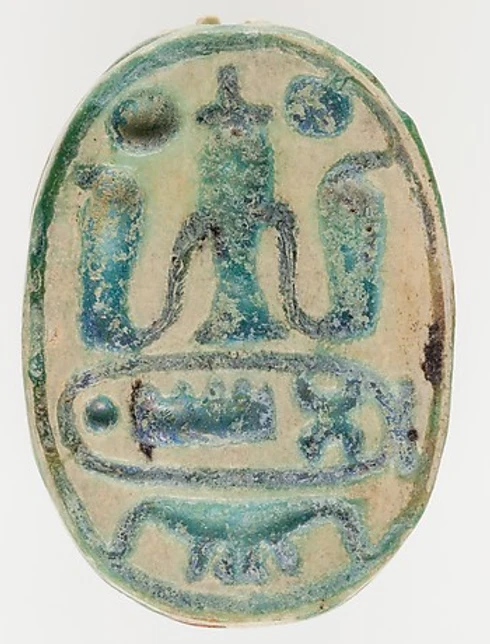
Gaming board · mn
The broad rectangular sign between the disk and beetle supplies the two consonants mn. It is read first in the throne name.
Scarab beetle · ḫpr
The beetle toward the right of the oval supplies ḫpr. Read it after the board.
Sun disk · Rꜥ
The small round disk inside the left end of the oval writes the name Re. It appears first on the surface and is read last.
Try reading direction
Which end of the uppermost line on Mentuwoser’s stela would you read first? Look for signs with a recognisable front, then check where the date sits. Crop from Met 12.184, Open Access.
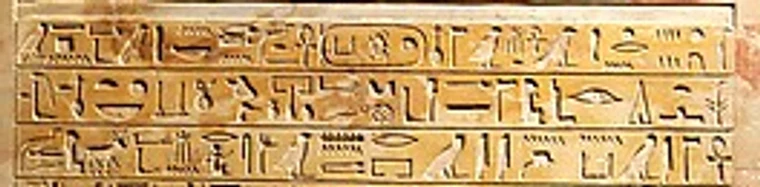
Reveal the starting side
Start at the right and move left. The date formula sits at the right end of the uppermost line, where the Met’s translation begins.
Six signs to recognise
- Owl
- m
- Water ripple
- n
- Mouth
- r
- Quail chick
- w
- Hand
- d
- Bread loaf
- t
These are common one-consonant values. Check each sign’s role in the word where it appears.
Start with a name you can see
On the underside of a small green scarab, find the oval around a round disk, a board and a beetle. Together they write Menkheperre, the throne name of Thutmose III. The Met dates the object to about 1479–1300 BCE. The name identifies the royal reference. The museum’s wider dating range leaves open when this particular piece was made. [1][9]
Begin with three questions. Where does this line start? Which marks belong together? What job does each sign do here? Seeing a beetle tells you its shape. Reading the word depends on recognising the value the scribe assigned to it in this context. [3][4][1]
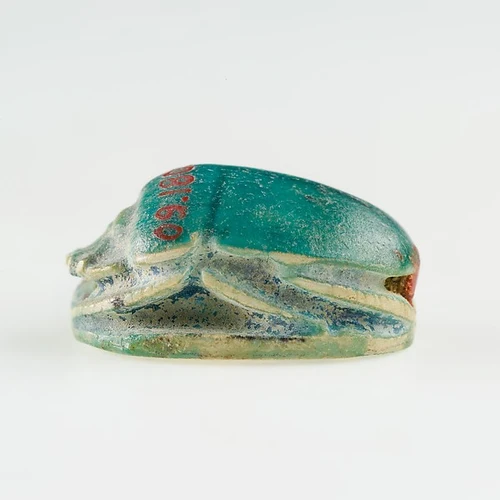
The amulet is carved in the shape of a scarab. The royal name is on its flat underside.
Scarab of Thutmose III, ca. 1479–1300 BCE. The Metropolitan Museum of Art, Rogers Fund, 1909, 09.180.942. Open Access. · Image source ↗ · Public Domain
Read the three signs in Menkheperre
The elongated loop is a cartouche. Its outline groups the name and its closing bar is outside the three signs that spell it. Within this oval the sun disk is at the left, the gaming board is in the middle and the scarab is toward the right. Keep your eye on the marks inside the outline. The museum identifies the vase and the cobras above it as part of a separate design. [1][9]
Read the name as mn–ḫpr–Rꜥ. The board supplies mn, the beetle supplies ḫpr and the disk writes Rꜥ, the name of the sun god. The disk is written first in this example and read last. Egyptologists call this convention honorific transposition. Giving a god’s name priority on the surface can leave the language order of the name intact. [1][9][8]
Menkheperre is a conventional rendering for readers. Transliteration records the sign values using a modern scholarly convention. Ancient pronunciation is a separate question, including how the vowels sounded. A cartouche can tell you which marks the carver grouped without preserving a recording of how the name was spoken. [5][9]
Find the start of a line
In an ordinary horizontal line, look for a person, bird or animal with an identifiable face. Start at the side the figure faces and read toward its back. If the heads point to the right, begin at the right. If they point to the left, begin at the left. A ripple or a circle is a poor clue because it can look much the same in either direction. [3][11]
A vertical column is read from the top down. Across columns, first identify the orientation of the signs. Look for frames and registers before applying the rule to the whole monument. A label beside a figure and a separate dedication can face different ways, especially when the writing is part of an arrangement of figures. [3][2]
Mentuwoser’s painted stela is useful practice because it shows both layouts on one surface. The first horizontal line begins with the date in the reign of Senwosret I, at the far right. Below the horizontal rows is a field of vertical columns. The large seated figure belongs to the offering scene, so use the signs and the museum’s translation to locate the start of the text. [2][3]
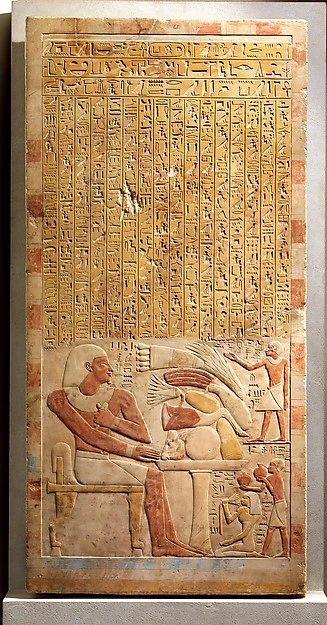
Mentuwoser’s monument combines horizontal lines, vertical columns and a scene of offerings. The date sits at the right end of the top line.
Stela of the Steward Mentuwoser, ca. 1944 B.C.. The Metropolitan Museum of Art, Gift of Edward S. Harkness, 1912, 12.184. Open Access. · Image source ↗ · Public Domain
Recognise what each sign does
A phonogram supplies one or more consonants. An owl can supply m, while a single gaming-board sign supplies the two consonants mn in the cartouche. A word sign can stand for a whole word. The plan of a house can write pr, meaning house, and a stroke may help signal this use. [4][6][7][9]
A determinative, also called a classifier, gives a clue to the kind of word you are reading. It often comes after the sound signs and contributes no sound of its own there. This matters when two words share a consonant sequence. A clue to the word’s category narrows your options even before you look it up. The shape of a sign can serve different purposes in different spellings. [4][7]
- Supply sounds
- Read the board in the cartouche for the consonants mn.
- Write a word
- The house plan can write the word pr, meaning house.
- Classify a word
- A sign after the consonants can indicate the category and stay silent in that spelling.
Use the sign lookup alongside a translation
Start with the six common signs in the chart above. Find one recognisable shape, write down its likely value, and see how it sits with its neighbours. On an object with tightly arranged signs, work within each compact group before moving to the next one. A sign below another sign can belong to the same group rather than a separate line. [3][6][7]
A one-consonant chart can get you started. To progress, practise with inscriptions that have a published translation, look up groups rather than isolated pictures, and allow for multiconsonant signs and silent classifiers. Translating a complete passage also takes knowledge of Egyptian vocabulary and grammar. Mentuwoser’s stela gives you a museum translation to compare with what you see. [4][2][5]
What the Rosetta Stone helped scholars do
The Rosetta Stone carries a decree dated 196 BCE in three scripts. Hieroglyphic and Demotic write Egyptian, and the third version is in Greek. The Greek version offered a way to align names and passages across the scripts. The decipherment also drew on other inscriptions and on Coptic, which preserved evidence of a later stage of the Egyptian language. [10][5]
Read printed page 185 of Lewis Spence for his explanation of sign types and direction, then page 186 for his introduction to the Rosetta Stone. On the second page, notice that he gives an older date and a broad account of how decipherment worked. The British Museum record dates the decree to 196 BCE and identifies the three versions. Keep the modern object record beside the historical account. [11][12][10]
Read further in the library
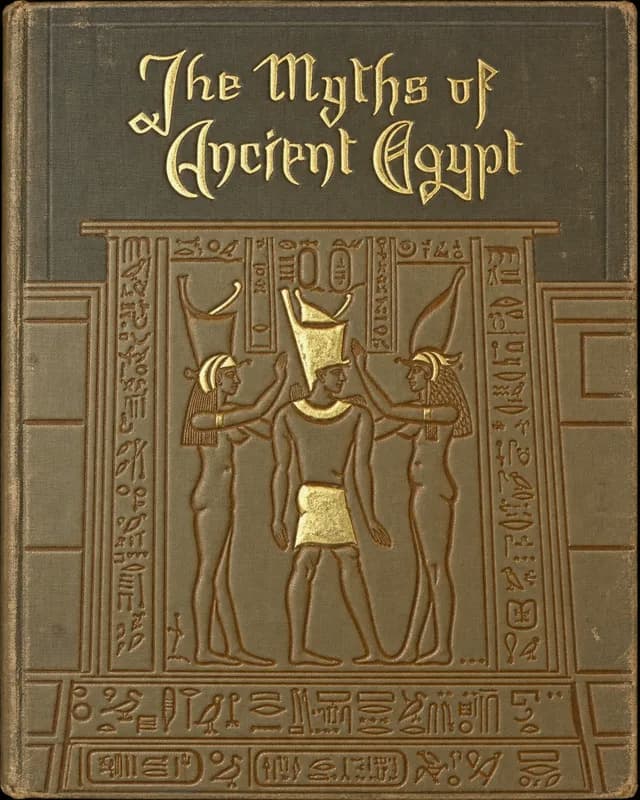
Myths and Legends of Ancient Egypt
Reading note
Read Spence on hieroglyphic signs and the Rosetta Stone, then check his account against current museum sources.
Sources
See references (12)
- The Met · Scarab of Thutmose III ↗Scarab of Thutmose III, ca. 1479–1300 BCE. The Metropolitan Museum of Art, Rogers Fund, 1909, 09.180.942. Open Access.Return to text ↑
- The Met · Stela of the Steward Mentuwoser ↗Stela of the Steward Mentuwoser, ca. 1944 B.C.. The Metropolitan Museum of Art, Gift of Edward S. Harkness, 1912, 12.184. Open Access. See also the museum’s translation and audio transcript.Return to text ↑
- UCL Digital Egypt · Orientation of writing ↗University College London. Orientation and the relation of writing to figures.Return to text ↑
- UCL Digital Egypt · The hieroglyphic writing system ↗University College London. Sound signs, word signs and determinatives.Return to text ↑
- UCL Digital Egypt · Language and sound ↗University College London. Script history and uncertainty about earlier Egyptian pronunciation.Return to text ↑
- Bibliotheca Alexandrina · Uniliteral signs ↗Writing and Scripts Center. Sign shapes and one-consonant values.Return to text ↑
- Bibliotheca Alexandrina · Hieroglyphic writing ↗Writing and Scripts Center. The house plan, phonograms and other functions.Return to text ↑
- Bibliotheca Alexandrina · Honorific transposition ↗Writing and Scripts Center. Revered names may be written ahead of signs read first.Return to text ↑
- Kathlyn M. Cooney · Scarab ↗UCLA Encyclopedia of Egyptology, figure 7. A separate example of the throne name Mn-ḫpr-Rꜥ and identification of its signs.Return to text ↑
- British Museum · The Rosetta Stone ↗Object EA24. The decree of 196 BCE and its three scripts.Return to text ↑
- Spence, printed page 185 · Sign functions and reading directionLewis Spence, Myths and Legends of Ancient Egypt, Harrap reprint, source leaf 263.Read this page in Myths and Legends of Ancient Egypt ↗Return to text ↑
- Spence, printed page 186 · The Rosetta Stone and deciphermentLewis Spence, Myths and Legends of Ancient Egypt, Harrap reprint, source leaf 264.Read this page in Myths and Legends of Ancient Egypt ↗Return to text ↑