Akhenaten, Aten and Amun in the Amarna Period
Follow Akhenaten’s shift toward the Aten through a reign timeline, an erased name of Amun and temple art from before and after the restoration.
In this article
Follow the changes in temple art
Compare what each monument puts in front of the worshipper, then follow the reign through dated inscriptions and excavated objects.
Two temple objects, two forms of divine presence
Look above the bird for the hands of the Aten. On the sculpture from the restoration, look above the face for the traces of Amun’s paired plumes.
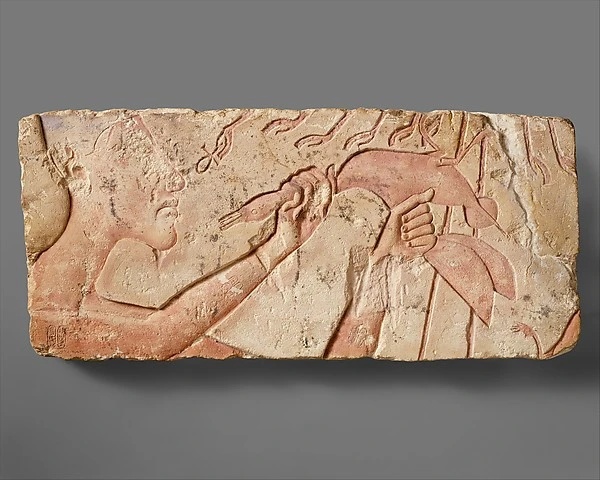
The visible rays end in small hands and reach toward the king and his offering.
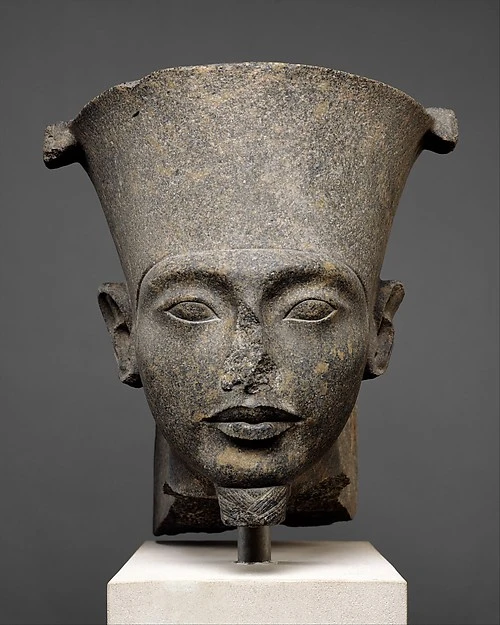
The flat cap, broken plumes and braided beard identify the god in human form.
What survives
- An offering to Aten
- A temple block showing the king bringing a duck before the deity.
- Amun restored at Karnak
- The surviving head of a much larger image commissioned for Amun’s temple.
What the object establishes
- An offering to Aten
- How an offering scene pictured the interaction of king and Aten.
- Amun restored at Karnak
- A new commission for Amun after Akhenaten’s reign, with traces of Amarna style.
How did Akhenaten change royal worship?
Amenhotep IV, the king later called Akhenaten, shifted royal worship toward the Aten, the solar disk. Early in his reign he still honoured Amun-Re, the great god of Thebes. He built for the Aten at Karnak and then founded Akhetaten, a city dedicated to that god. The royal promotion of the Aten and the attacks on Amun’s name left different kinds of evidence on stone. [1][2][10]
Aten and Amun-Re both belonged to a world of Egyptian solar imagery. Aten became the focus of a distinctive royal cult in which the sun’s rays reach the king and his family. Amun-Re had an established centre at Thebes. The term Amarna comes from the modern site name Tell el-Amarna. Akhetaten is the ancient name of the city at that site. [1][2][7]
The change in six stages
The sequence is clearest when dated by years of the reign. Absolute BCE dates vary among chronologies. The boundary inscriptions supply several regnal years, and different forms of names and of temple architecture give objects an order of their own. [2][3][1]
- Early reign
Aten worship develops at Karnak
The king continues early dedications to Amun-Re while developing a programme for the solar god. [1]
- Around year 4
Aten’s name takes cartouche form
The deity’s formal name appears in cartouches. New relief conventions and building methods emerge at Karnak. [1]
- Years 5–6
- Year 8 and later
- Under Tutankhamun
- Under Horemheb and later
What do the rays and cartouches show?
On the offering relief, Akhenaten holds a bird and raises it toward rays that end in small hands. On the relief with a queen, several fingers emerge from the rays and two hands hold ankhs. Look at the looped shapes close to the faces. The signs make the gift of life visible, and the royal figures give the encounter a human focus. [7][8][1]
A different fragment from the Great Aten Temple carries part of the Aten’s cartouche. It frames the god’s written name in a format also used for kings. Read the fragment together with the rays. One preserves part of the deity’s formal name, while the other shows what the god does in a royal scene. The revisions to the name are part of the history of the cult and help date some objects. [9][1][8]
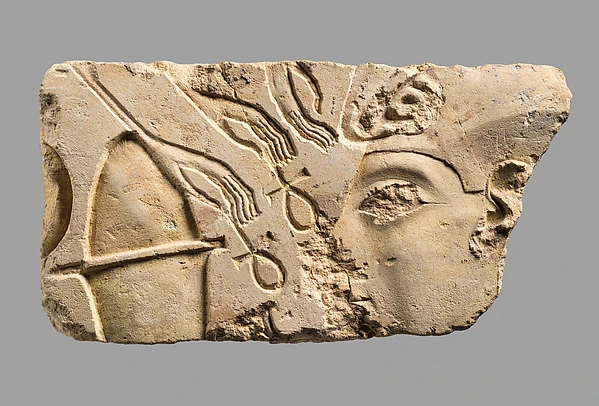
Two hands hold the ankh sign near the royal faces. The Met identifies the surviving face as an Amarna queen, probably Nefertiti.
Relief showing the Aten interacting with the queen, ca. 1347–1330 BCE. The Metropolitan Museum of Art, Purchase, Lila Acheson Wallace and The Joseph Rosen Foundation Inc. Gifts, 1993, 1993.326. Open Access. · Image source ↗ · Public Domain
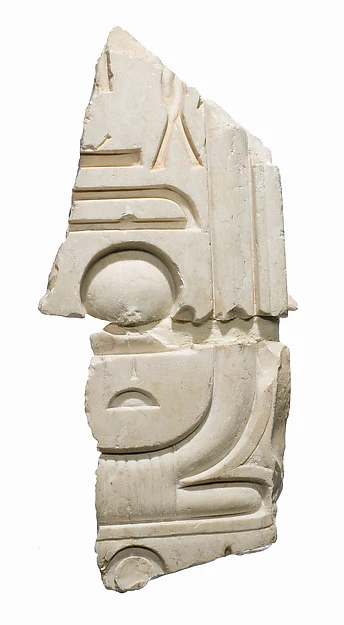
A fragment from the Great Temple of the Aten preserves part of the deity’s cartouche at Akhetaten.
Stela with Aten cartouche with traces of royal hand at one side, ca. 1347–1330 BCE. The Metropolitan Museum of Art, Gift of Edward S. Harkness, 1921, 21.9.466. Open Access. · Image source ↗ · Public Domain
Why did Akhenaten build Akhetaten?
Rock-cut boundary inscriptions announce the city’s foundation and define its territory. The royal account gives the choice of site a religious meaning by setting it apart for the Aten. Excavation gives a second line of evidence. The Great Aten Temple had distinct phases, and its arrangements included open spaces and places for offerings. [2][3][1]
The Met connects the new architecture with small stone blocks called talatat and with spaces for rites conducted under the open sky. After parts of the programme were dismantled, builders used some blocks as fill. Their reuse removed the original walls while preserving carved pieces that can help reconstruct them. [3][1][7]
Where was Amun’s name erased?
Look down the front of the quartzite sphinx. The narrow chest inscription still identifies Thutmose III by his throne name, Menkheperre. The Met reconstructs the epithet as “beloved of [Amun]” and identifies a deliberate erasure of Amun in the reign of Akhenaten. The roughened part of the inscription preserves an intervention on an older monument. [10]
Compare the surviving royal name with the cartouche of the Aten from the new temple. The two objects show distinct uses of writing under the reforms. A name was made conspicuous in a new setting, while another name was removed from older stone. The sphinx establishes what happened to this inscription. It gives limited evidence about the reach of the policy in other settings. [10][9][1]
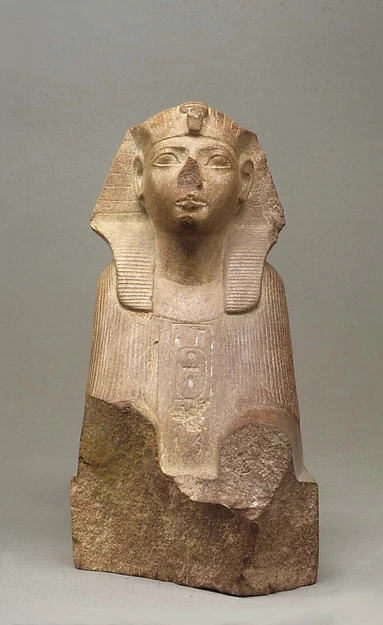
Thutmose III’s name survives on the chest. The Met records that the name of Amun in the same inscription was erased in the Amarna Period.
Sphinx of Thutmose III, ca. 1479–1425 BCE. The Metropolitan Museum of Art, Rogers Fund, 1908, 08.202.6. Open Access. · Image source ↗ · Public Domain
Was Atenism monotheism?
Aten became the centre of an unusually exclusive royal programme. Some scholars use monotheism for aspects of Atenism. The label works best when the evidence being discussed is clear. The dedication of a new city, the prominence of the king, and the treatment of Amun’s name are evidence of official religious policy. They cannot measure everyone’s beliefs. [1][2][10]
Finds from Amarna provide a different view. Excavated pendants include forms associated with Bes, Taweret and Hathor. Such objects keep personal practices visible in the archaeological record. A royal proclamation speaks for the court, while a pendant survives as something a person could wear or use. Both sorts of evidence matter to the history of the city. [4][1]
How did Amun return to royal prominence?
Tutankhaten became Tutankhamun. Under his reign the court moved from Akhetaten to Memphis and the royal relationship with Amun at Thebes was renewed. The Restoration Stela claims that temples had fallen into ruin and presents the king as the one who put things right. Horemheb later placed his own name on the monument while traces of Tutankhamun’s names survived. [1][6]
The head of Amun made for Karnak shows restoration in a material form. The cap with traces of double plumes and the divine beard identify the god. The Met sees similarities between the sculptural treatment of the face and late Amarna work. The return of Amun’s monuments could thus preserve something of the craft of the period whose official programme was being undone. [11][1]
Read the relief, royal changes and hymn in Spence
Start with the plate opposite printed page 156 for a historical reproduction of the rayed disk. Page 158 sets out Spence’s account of the move to Akhetaten, while page 160 describes the recovery of Amun’s royal standing. Set those pages beside the excavated objects above when Spence infers that a single policy applied everywhere. [12][13][14][1][10]
Printed page 161 opens Spence’s version of the hymn. The Amarna Project locates the surviving text in Ay’s unfinished South Tomb 25 and records its partial destruction. Use the hymn to read the language of life and light, then turn back to the reliefs to see how the rays and signs of life express those ideas on stone. [15][5][8]
See references (8)
- Marsha Hill · Art, Architecture, and the City in the Reign of Amenhotep IV / Akhenaten
- Amarna Project · South Tombs
- The Met · Relief showing the Aten interacting with the queen
- The Met · Sphinx of Thutmose III
- Spence · Plate opposite page 156, Aten and Akhenaten
- Spence, printed page 158 · The royal name and the move to Akhetaten
- Spence, printed page 160 · The restoration of Amun
- Spence, printed page 161 · Opening of the Hymn to Aten
Read further in the library
Myths and Legends of Ancient Egypt
Reading note
Compare Spence’s Aten relief plate, account of the royal reforms and opening of the hymn with museum and excavation evidence.
Sources
See references (15)
- Marsha Hill · Art, Architecture, and the City in the Reign of Amenhotep IV / Akhenaten ↗The Met’s Department of Egyptian Art. Early Karnak, Akhetaten, royal imagery and the succession.Return to text ↑
- Amarna Project · Boundary Stelae ↗Site survey and chronology of proclamations dated to regnal years 5, 6 and 8.Return to text ↑
- Amarna Project · Great Aten Temple ↗Excavation evidence for two building phases and the layout of the temple.Return to text ↑
- Amarna Project · Collar and necklace designs at Amarna ↗Excavated pendants and forms associated with Bes, Taweret and Hathor.Return to text ↑
- Amarna Project · South Tombs ↗South Tomb 25. Explains the location and surviving state of the Hymn to the Aten.Return to text ↑
- Digital Karnak · Restoration Stela of Tutankhamen ↗Description of the restoration claims on Cairo CG 34183 and Horemheb’s reuse of the monument.Return to text ↑
- The Met · Akhenaten Sacrificing a Duck ↗Akhenaten Sacrificing a Duck, ca. 1347–1330 BCE. The Metropolitan Museum of Art, Gift of Norbert Schimmel, 1985, 1985.328.2. Open Access.Return to text ↑
- The Met · Relief showing the Aten interacting with the queen ↗Relief showing the Aten interacting with the queen, ca. 1347–1330 BCE. The Metropolitan Museum of Art, Purchase, Lila Acheson Wallace and The Joseph Rosen Foundation Inc. Gifts, 1993, 1993.326. Open Access.Return to text ↑
- The Met · Stela with Aten cartouche with traces of royal hand at one side ↗Stela with Aten cartouche with traces of royal hand at one side, ca. 1347–1330 BCE. The Metropolitan Museum of Art, Gift of Edward S. Harkness, 1921, 21.9.466. Open Access.Return to text ↑
- The Met · Sphinx of Thutmose III ↗Sphinx of Thutmose III, ca. 1479–1425 BCE. The Metropolitan Museum of Art, Rogers Fund, 1908, 08.202.6. Open Access.Return to text ↑
- The Met · Head of the god Amun ↗Head of the god Amun, ca. 1328–1318 BCE. The Metropolitan Museum of Art, Rogers Fund, 1907, 07.228.34. Open Access.Return to text ↑
- Spence · Plate opposite page 156, Aten and AkhenatenLewis Spence, Myths and Legends of Ancient Egypt, source leaf 225.Read this page in Myths and Legends of Ancient Egypt ↗Return to text ↑
- Spence, printed page 158 · The royal name and the move to AkhetatenLewis Spence, Myths and Legends of Ancient Egypt, source leaf 228.Read this page in Myths and Legends of Ancient Egypt ↗Return to text ↑
- Spence, printed page 160 · The restoration of AmunLewis Spence, Myths and Legends of Ancient Egypt, source leaf 230.Read this page in Myths and Legends of Ancient Egypt ↗Return to text ↑
- Spence, printed page 161 · Opening of the Hymn to AtenLewis Spence, Myths and Legends of Ancient Egypt, source leaf 231.Read this page in Myths and Legends of Ancient Egypt ↗Return to text ↑