Hiranyapura
Hiranyapura is a moving city in the Mahābhārata. Read how Arjuna attacks it and why Mātali visits a city of the same name in Patala.
In this article
What is Hiranyapura?
Hiranyapura is a city of the Daityas and Danavas in the Mahābhārata. In the account of Arjuna’s attack, it moves through the sky and can sink beneath the earth or sea to escape. A separate visit puts Hiranyapura in Patala and describes it as a place of gardens, treasures and possible marriage alliances. [4][5][6]
Hiranyapura in the Mahabharata, Vana Parva CLXXII
In Vana Parva CLXXII, translated by Kisari Mohan Ganguli, Arjuna sees the city shining like fire, with jewelled trees, birds and fortified gates. Mātali explains that the Paulamas and Kalakanjas are protected against several kinds of divine and supernatural opponents. A mortal can still defeat them. As Arjuna attacks, the city plunges between sky, earth and water. The section ends the fighting with women mourning their relatives. [1]
Hiranyapura in the Mahabharata, Udyoga Parva C
In Udyoga Parva C, Nārada shows Mātali Hiranyapura’s residences and gardens in Patala, during the search for a suitable marriage. Mātali declines to pursue an alliance there. In this episode, existing ties of kinship have done little to end hostility between the gods and the Danavas. [2]
Indian Myth and Legend by Donald A. Mackenzie
In Indian Myth and Legend, Donald A. Mackenzie describes Hiranyapura as a protected dwelling built by its inhabitants. He compares its mobility with that of Indra’s aerial residence and distinguishes it from Patala in the account of Arjuna’s journey. [4]
Arjuna approaches after a battle beneath the ocean, with Mātali driving his chariot. In Mackenzie’s telling, women come out to entice the hero and then flee. Arjuna enters the city, sees its magnificent chariots and destroys its dwellings. [7][5]
Indra rewards his son with a golden chain, a diadem and a war conch. The book then turns to the other Pandavas’ travels. [6]
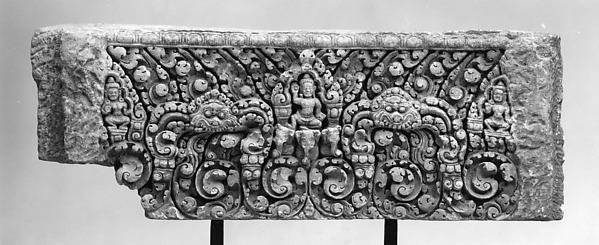
Indra between attendants on a Thai lintel, eleventh to twelfth century. Mackenzie compares the mobility of Indra’s residence with that of Hiranyapura.
The Metropolitan Museum of Art, Gift of Mr. and Mrs. Earl Morse, 1972, 1972.214. Open Access CC0; resized and converted to JPEG. · Image source ↗ · CC0
A fortified city and a prospective alliance
The forest book gives the city an aerial origin and tests its protection against a mortal. The book of preparations describes it as a splendid residence to visit while weighing an alliance. The inhabitants’ wealth is visible in both accounts, and both use it to show how much is at stake in the rivalry. [4][5][1][2]
Read further in the library
Indian Myth and Legend
Reading note
The separately titled account draws on exact passages in the consulted Library edition.
Sources
See references (7)
- Mahabharata, Vana Parva CLXXII, translated by Kisari Mohan Ganguli ↗Complete main translated section directly read through the public text viewer. City, boons, mobility, weapons, destruction, lamentation and return to Indra were consulted.Return to text ↑
- Mahabharata, Udyoga Parva C, translated by Kisari Mohan Ganguli ↗Complete main translated section directly read, Narada’s description and Matali’s refusal of an alliance. Its Patala setting remains distinct from the Vana Parva’s battle account.Return to text ↑
- Lintel with Indra and Two Attendants, 11th–12th century ↗The Metropolitan Museum of Art, Gift of Mr. and Mrs. Earl Morse, 1972, 1972.214. Open Access CC0; resized and converted to JPEG.
- Indian Myth and Legend, Reader page 131Donald A. Mackenzie, Indian Myth and Legend, Gresham Publishing Company Limited, London, undated consulted impression. Library edition IMJ-0649-E001. Persistent PageIDs and current Reader positions verified against the supplied PDF and cached Reader manifest. Embedded translations are Mackenzie’s presentation unless a separately consulted primary text is named.Read this page in Indian Myth and Legend ↗Return to text ↑
- Indian Myth and Legend, Reader page 343Donald A. Mackenzie, Indian Myth and Legend, Gresham Publishing Company Limited, London, undated consulted impression. Library edition IMJ-0649-E001. Persistent PageIDs and current Reader positions verified against the supplied PDF and cached Reader manifest. Embedded translations are Mackenzie’s presentation unless a separately consulted primary text is named.Read this page in Indian Myth and Legend ↗Return to text ↑
- Indian Myth and Legend, Reader page 344Donald A. Mackenzie, Indian Myth and Legend, Gresham Publishing Company Limited, London, undated consulted impression. Library edition IMJ-0649-E001. Persistent PageIDs and current Reader positions verified against the supplied PDF and cached Reader manifest. Embedded translations are Mackenzie’s presentation unless a separately consulted primary text is named.Read this page in Indian Myth and Legend ↗Return to text ↑
- Indian Myth and Legend, Reader page 342Donald A. Mackenzie, Indian Myth and Legend, Gresham Publishing Company Limited, London, undated consulted impression. Library edition IMJ-0649-E001. Persistent PageIDs and current Reader positions verified against the supplied PDF and cached Reader manifest. Embedded translations are Mackenzie’s presentation unless a separately consulted primary text is named.Read this page in Indian Myth and Legend ↗Return to text ↑