Hermeticism
Explore Hermes Trismegistus, the Corpus Hermeticum, divine mind and spiritual rebirth, with the history of Hermetic texts and their later interpretations.
In this article
Hermes and the ancient writings
What is Hermeticism?
Hermeticism names traditions of religious and philosophical thought associated with Hermes Trismegistus. At their ancient core are teachings about God, the cosmos and humanity’s divine origin, expressed through revelation and conversations between teachers and pupils. The Corpus Hermeticum is a central collection of these writings. Its seventeen treatises were produced in Roman Egypt, broadly between 100 and 300 CE. [1]
These texts ask how a mortal person can come to know the divine. Their answers join understanding with ethical change, reverence and a transformation of consciousness. The modern umbrella term also covers a much longer history of readers who interpreted, translated and adapted writings attributed to Hermes. Ancient Hermetic teaching and later Hermetic movements belong to related histories, with important differences between them. [1]
Who is Hermes Trismegistus?
Hermes Trismegistus, whose epithet means thrice great, is a legendary figure of sacred wisdom associated with the Greek Hermes and Egyptian Thoth. Texts present him as an authoritative revealer and teacher. A modern reader should distinguish this literary and religious authority from a securely documented individual author with a recoverable biography. [2]
An extraordinary range of writings circulated under his name. Stanton Linden distinguishes philosophical works, including the Corpus Hermeticum and Latin Asclepius, from technical material concerning astrology, alchemy, talismans and magic. The Emerald Tablet belongs to the latter history. Its association with Hermes helped give a brief and enigmatic alchemical text an authority far beyond its length. The shared attribution connects these writings without making them chapters of one original book. [2]
This small Egyptian figure depicts the ibis-headed Thoth, with a long wig and surviving portions of the body below. The Met dates it broadly to 664–30 BCE and identifies its material as bronze or another copper alloy. It gives the Egyptian side of Hermes Trismegistus’s background a visible form. The object is an image of Thoth, without establishing a connection to the later Hermetic writings or a particular Hermetic community. [15]
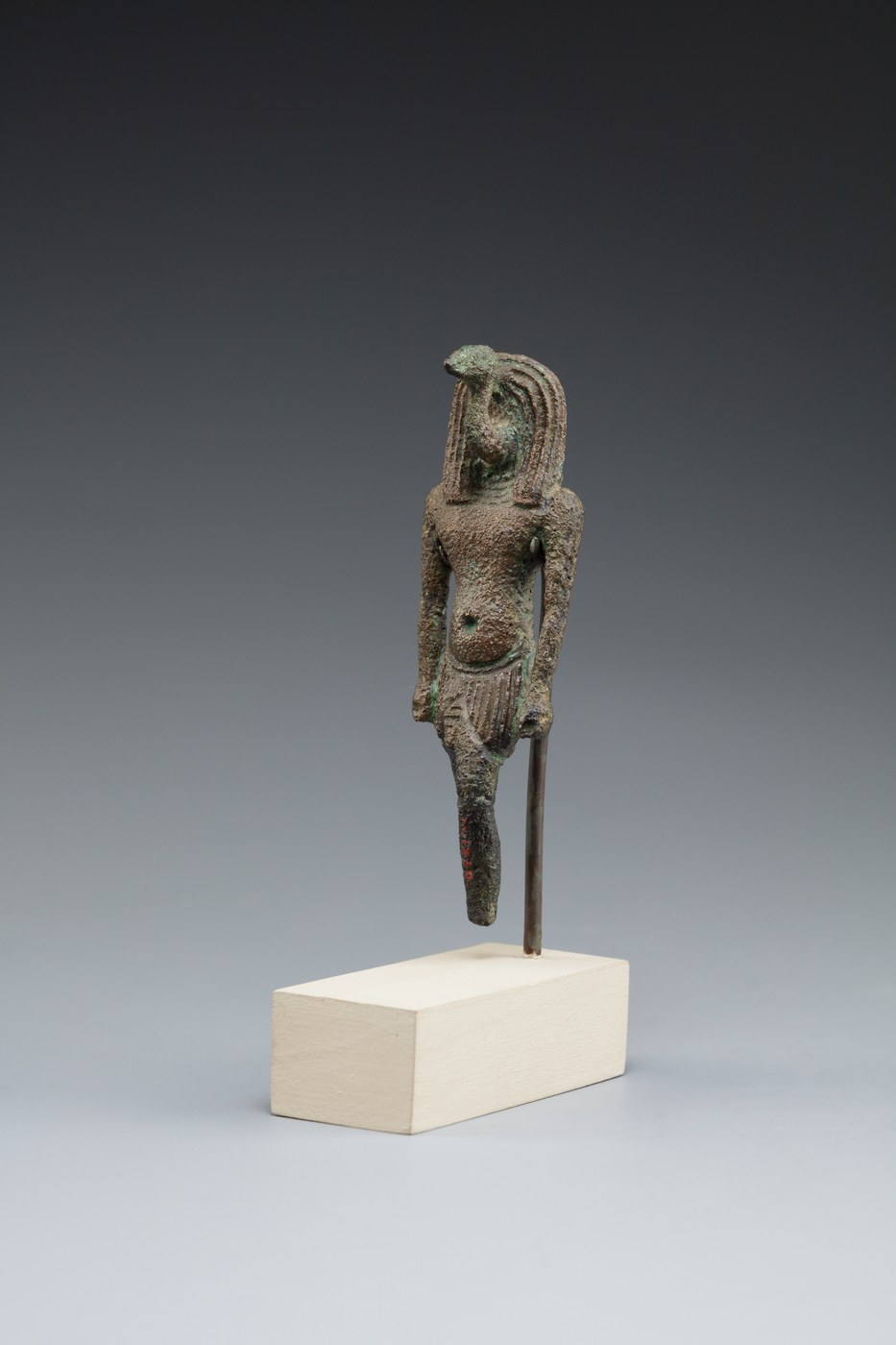
Ibis-headed god, Thoth, 664–30 BCE. Bronze or cupreous alloy. Egypt.
The Metropolitan Museum of Art. Gift of Helen Miller Gould, 1910. Accession 10.130.1360. Public Domain (CC0). · Museum record ↗ · CC0
Poimandres: a vision of the beginning
The first treatise begins with a person absorbed in thought about reality. A vast being appears and offers instruction. The vision unfolds through light, darkness, nature and a divine word. Questions and explanations follow: the experience becomes a lesson about how the world came to be and what place humanity occupies within it. [3]
In Mead’s translation, Poimandres identifies himself with divine Mind. The account gives the first human a divine origin and places human life in relation to the planetary powers and nature. Its dramatic form matters. Understanding arrives through encounter, astonishment and interpretation, rather than through a list of propositions. The reader follows someone learning to recognize the significance of a vision. This is an ancient religious account of creation and human destiny. [3]
Mind, cosmos and spiritual transformation
Nous, logos and the cup of understanding
Nous is often translated as mind or intellect, while logos can mean reason, word or discourse. Their meanings depend on the argument in which they occur. Treatise IV, addressed to Tat, distinguishes the reason distributed among human beings from a fuller participation in divine Mind. Its central image is a great vessel filled with Mind and a herald calling people to take part. [4]
The invitation is connected with knowledge of why one has come into existence. Those who respond gain a different orientation towards life; those absorbed in appetite remain unaware of that purpose. The cup therefore represents a change in understanding and allegiance. Its language of immersion belongs to the text’s religious imagery. It should not be turned into a claim that an actual surviving vessel or one standard initiation ceremony explains every Hermetic work. [4]
Knowing the invisible through the visible
Treatise V approaches the divine through the ordered world. Hermes asks Tat to consider the sun, the movements of the stars and the formation of the human body. These visible works become occasions for recognizing an unseen maker. Attention moves from the familiar object to the power that the teaching understands as giving it existence. [5]
The same discourse stretches the language of naming. God exceeds every particular name, yet can be spoken of through everything that comes into being. This combination helps explain a recurring Hermetic tension: the divine is beyond bodily sight while also manifest through the world. The cosmos can invite wonder, even in a collection whose other passages criticize bodily attachment. A single slogan about hating matter would miss that range. [5]
The living cosmos and the reach of mind
In treatise XI, Mind teaches Hermes to see the cosmos as a unity filled with life. Its argument moves among God, soul, matter, living bodies and the relation between change and death. Unity does not erase the variety of beings. Their life and movement are understood through a common divine source. [6]
A striking passage asks the hearer to imagine the soul travelling across lands and seas, beyond the heavens and across the stages of life. The imaginative expansion serves a theological purpose: the pupil is to enlarge a cramped conception of what knowing God could mean. The exercise belongs to the discourse’s ancient cosmology and spiritual instruction. Its language of thought crossing space expresses a religious understanding of mind, rather than a measurement of physical travel. [6]
Rebirth, ethics and praise
Treatise XIII stages Tat’s request to understand rebirth. Hermes describes a transformation that cannot be recognized simply by looking at a person’s outward body. The dialogue names inner afflictions, including ignorance, greed, envy and anger, and describes their displacement through divine powers such as knowledge, joy, self-control, generosity and truth. [7]
The lesson culminates in praise. Tat’s altered understanding is expressed through a hymn addressed to the divine and the powers within him. Rebirth here is an event of spiritual recognition and transformation. It is distinct from a straightforward account of a soul taking another earthly body. The sequence also keeps ethics close to knowledge: the pupil’s progress concerns how one lives and perceives, alongside what one can explain. [7]
Prayer, silence and a community of learners
The Discourse on the Eighth and Ninth gives another picture of Hermetic religious life. A pupil asks to advance through stages of understanding, and the teacher calls for prayer with spiritual brothers. The exchange combines instruction, mutual affection and a vision that exceeds ordinary speech. Praise continues in silence as the pupil comes to recognize the divine Mind. [13]
The closing instructions imagine the teaching inscribed for a temple at Diospolis, guarded by an oath and approached through earlier stages of learning. This literary setting places the text in an Egyptian sacred landscape. Understanding depends on preparation, conduct and divine assistance, with books forming one part of the journey. The text’s imagined inscriptions are part of its narrative, rather than an independently excavated monument. [13]
Manuscripts, readers and changing interpretations
Hermetic texts at Nag Hammadi
The manuscript collection found near Nag Hammadi includes Hermetic works alongside other religious and philosophical writings. The scholarly codex inventory lists the Discourse on the Eighth and Ninth, the Prayer of Thanksgiving and an excerpt of Asclepius in Codex VI. It also records a passage adapted from Plato’s Republic in that same codex. [10]
This is a useful reminder that a manuscript collection is not automatically the scripture of a single uniform religion. Texts can be copied, read and preserved beside works with different histories. The overlap connects the study of Hermeticism with Gnosticism, while leaving the individual texts available for comparison. The inventory also makes a practical distinction between a work and its surviving version: a title alone does not identify every manuscript witness. [13]
Hermes in Arabic scholarship
The history of Hermes extends well beyond a Greek-to-Latin path. Kevin van Bladel’s study traces an Arabic reception developing for centuries before the better-known Renaissance revival. Writings and accounts of Hermes circulated through the languages and regions of the Roman and Sasanian worlds before entering the expanding culture of Arabic scholarship. [14]
From the eighth century, translations of ancient learning brought accounts of Hermes alongside other works from Greek, Middle Persian and further literary traditions. His identity as a sage could carry authority across changing intellectual settings. This history deserves a place alongside European reception: Hermes’ reputation and the books attributed to him travelled through several cultures. The surviving tradition is a history of translation and adaptation, rather than a message moving unchanged from one original author to every later reader. [14]
Renaissance readers and the promise of ancient wisdom
Marsilio Ficino’s Latin translation brought the philosophical Hermetica to a new European readership in the fifteenth century. Its early printed history began with the Pimander edition of 1471. Readers approached Hermes within larger narratives of ancient wisdom and its relationship to Christianity and Platonism. [8]
Hanegraaff questions the familiar picture of one continuous Renaissance Hermetic tradition. His study identifies significant problems in translation and early editions, and distinguishes interest in Hermes’ authority from an accurate understanding of the ancient texts. That distinction changes the historical question. We can ask what a particular reader found in a particular edition, rather than assume that every Renaissance admirer inherited the same ancient teaching. Reception can be creative and influential while also changing what it receives. [8]
A surviving 1481 Venetian printing makes that history of translation tangible. This leaf names the printer, Venice and the date beneath a Latin address to the reader; the book transmits Marsilio Ficino’s translation. The physical page lets us examine a specific Renaissance edition, following the first printing of 1471 discussed above. Its typography and introductory material belong to the later reception of the ancient writings. [16]
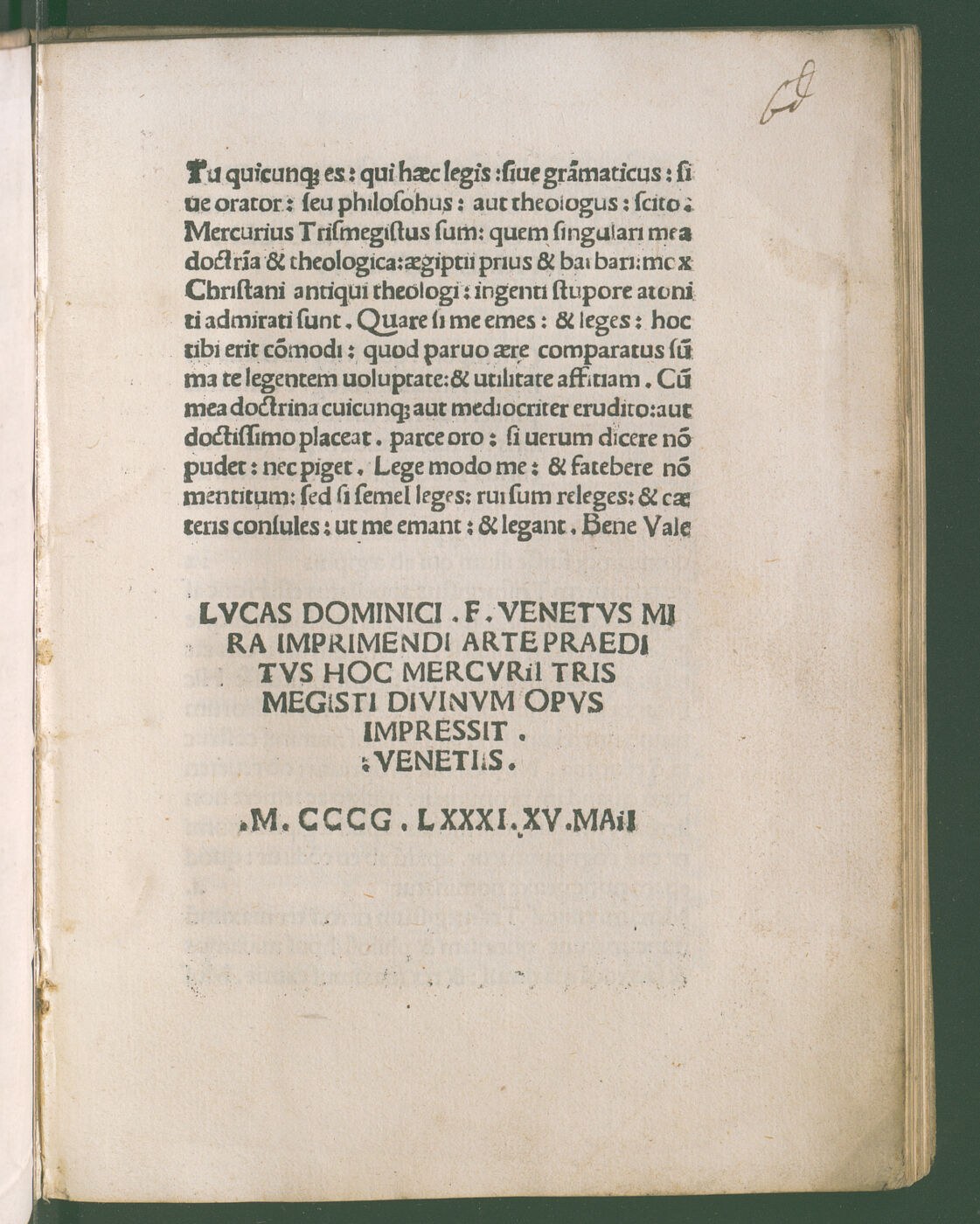
Pimander de potestate et sapientia Dei, Latin translation by Marsilio Ficino. Venice: L. Dominici, 1481. Introductory leaf with the printer’s imprint.
Wellcome Collection. Public Domain. · Museum record ↗ · Public Domain
Modern Hermeticism and further reading
Is the Kybalion an ancient Hermetic scripture?
The Kybalion is an early twentieth-century work published under the name Three Initiates. It presents seven principles, including mentalism, correspondence, vibration, polarity, rhythm, cause and effect, and gender. This familiar scheme belongs to that book’s presentation. It is not the table of contents of the ancient Corpus Hermeticum. [11]
Reading the two beside one another reveals a change of emphasis. The ancient dialogues explored above move through particular revelations, arguments and scenes of instruction. The Kybalion organizes its teaching as principles to be understood and applied. Readers interested in it can study the work as part of modern occult literature while keeping its date and authorship claims visible. Its scientific vocabulary should likewise be read as the book’s teaching, rather than accepted as a substitute for scientific evidence. [11]
Following the tradition through its books
Hermetic reception extends across manuscripts, printed books, philosophy and the arts of nature. The Allard Pierson’s account of its esoteric collections places Hermetic themes in relation to alchemy, astrology, Christian mysticism, Rosicrucianism and other movements. The State Collection of the Bibliotheca Philosophica Hermetica preserves thousands of rare works from this broader history. [9]
A productive reading path begins with an ancient dialogue, then follows a clearly identified later interpretation. The later book may transform the vocabulary or connect it with a new religious programme. The Hermetic titles in Lumitheca’s Library are useful for following those acts of reception. Their authors and periods matter: a modern occult essay or a collection of Paracelsian writings offers a different encounter from a translation of the ancient philosophical corpus. [9]
Read further in the library
The Hermetic and Alchemical Writings of Paracelsus
Reading note
A later collection of Paracelsian writings edited by A. E. Waite. It belongs to the history of Hermetic and alchemical reception, rather than the ancient Corpus Hermeticum.
Some Philosophy of the Hermetics
Reading note
David Patterson Hatch’s modern interpretation offers a later voice in Hermetic philosophy. Compare its vocabulary with the ancient dialogues discussed in this article.
Sources
- Corpus Hermeticum I ↗Matthew Andrews, Center for the Study of World Religions, Harvard Divinity School, 2026Return to text ↑
- Hermes Trismegistus: The Emerald Table ↗Stanton J. Linden, editor, The Alchemy Reader, Cambridge University Press, 2003Return to text ↑
- Corpus Hermeticum I: Poemandres ↗Ancient Hermetic text, translated by G. R. S. Mead; Internet Sacred Text ArchiveReturn to text ↑
- Corpus Hermeticum IV: The Cup or Monad ↗Ancient Hermetic text, translated by G. R. S. Mead; Internet Sacred Text ArchiveReturn to text ↑
- Corpus Hermeticum V: Though Unmanifest God Is Most Manifest ↗Ancient Hermetic text, translated by G. R. S. Mead; Internet Sacred Text ArchiveReturn to text ↑
- Corpus Hermeticum XI: Mind Unto Hermes ↗Ancient Hermetic text, translated by G. R. S. Mead; Internet Sacred Text ArchiveReturn to text ↑
- Corpus Hermeticum XIII: The Secret Sermon on the Mountain ↗Ancient Hermetic text, translated by G. R. S. Mead; Internet Sacred Text ArchiveReturn to text ↑
- How Hermetic was Renaissance Hermetism? ↗Wouter J. Hanegraaff, Aries 15, 2015, pp. 179–209Return to text ↑
- Esotericism: About the collections ↗Allard Pierson, University of AmsterdamReturn to text ↑
- Coptic Gnostic Library Online: Work and codex inventory ↗Brill Scholarly Editions; editions under the general editorship of James M. RobinsonReturn to text ↑
- The Kybalion ↗Three Initiates, The Kybalion, 1912 edition; Project GutenbergReturn to text ↑
- Hermeticism, the Cabala, and the Search for Ancient Wisdom ↗Mark A. Waddell, Magic, Science, and Religion in Early Modern Europe, Cambridge University Press, 2021Return to text ↑
- Discourse on the Eighth and Ninth ↗Ancient Hermetic text, translated by James Brashler, Peter A. Dirkse and Douglas M. Parrott; Early Christian WritingsReturn to text ↑
- The Arabic Hermes: From Pagan Sage to Prophet of Science ↗Kevin van Bladel, Oxford University Press, 2009; publisher’s abstractReturn to text ↑
- Ibis-headed god, Thoth ↗The Metropolitan Museum of Art; accession 10.130.1360Return to text ↑
- Pimander de potestate et sapientia Dei ↗Wellcome CollectionReturn to text ↑
About this article & its sources
An introduction centred on the philosophical Hermetica and their reception. Ancient texts, technical Hermetic literature and modern occult interpretations are distinguished.
Passage attributions
What is Hermeticism?
Passage 1: Matthew Andrews, Center for the Study of World Religions, Harvard Divinity School, 2026.
Passage 2: Matthew Andrews, Center for the Study of World Religions, Harvard Divinity School, 2026.
Who is Hermes Trismegistus?
Passage 1: Stanton J. Linden, editor, The Alchemy Reader, Cambridge University Press, 2003.
Passage 2: Stanton J. Linden, editor, The Alchemy Reader, Cambridge University Press, 2003.
Passage 3: Inspected object, collection record and actual historical image.
Poimandres: a vision of the beginning
Passage 1: Ancient Hermetic text, translated by G. R. S. Mead; Internet Sacred Text Archive.
Passage 2: Ancient Hermetic text, translated by G. R. S. Mead; Internet Sacred Text Archive.
Nous, logos and the cup of understanding
Passage 1: Ancient Hermetic text, translated by G. R. S. Mead; Internet Sacred Text Archive.
Passage 2: Ancient Hermetic text, translated by G. R. S. Mead; Internet Sacred Text Archive.
Knowing the invisible through the visible
Passage 1: Ancient Hermetic text, translated by G. R. S. Mead; Internet Sacred Text Archive.
Passage 2: Ancient Hermetic text, translated by G. R. S. Mead; Internet Sacred Text Archive.
The living cosmos and the reach of mind
Passage 1: Ancient Hermetic text, translated by G. R. S. Mead; Internet Sacred Text Archive.
Passage 2: Ancient Hermetic text, translated by G. R. S. Mead; Internet Sacred Text Archive.
Rebirth, ethics and praise
Passage 1: Ancient Hermetic text, translated by G. R. S. Mead; Internet Sacred Text Archive.
Passage 2: Ancient Hermetic text, translated by G. R. S. Mead; Internet Sacred Text Archive.
Prayer, silence and a community of learners
Passage 1: Ancient Hermetic text, translated by James Brashler, Peter A. Dirkse and Douglas M. Parrott; Early Christian Writings.
Passage 2: Ancient Hermetic text, translated by James Brashler, Peter A. Dirkse and Douglas M. Parrott; Early Christian Writings.
Hermetic texts at Nag Hammadi
Passage 1: Brill Scholarly Editions; editions under the general editorship of James M. Robinson.
Passage 2: Ancient Hermetic text, translated by James Brashler, Peter A. Dirkse and Douglas M. Parrott; Early Christian Writings.
Hermes in Arabic scholarship
Passage 1: Kevin van Bladel, Oxford University Press, 2009; publisher’s abstract.
Passage 2: Kevin van Bladel, Oxford University Press, 2009; publisher’s abstract.
Renaissance readers and the promise of ancient wisdom
Passage 1: Wouter J. Hanegraaff, Aries 15, 2015, pp. 179–209.
Passage 2: Wouter J. Hanegraaff, Aries 15, 2015, pp. 179–209.
Passage 3: Inspected object, collection record and actual historical image.
What changed when the texts were dated?
Passage 1: Michael R. Lynn, Magic, Science, and Religion in Early Modern Europe, Cambridge University Press.
Passage 2: Michael R. Lynn, Magic, Science, and Religion in Early Modern Europe, Cambridge University Press.