Heavenly Government
Heavenly government in Swedenborg puts authority in service of a shared good. Compare his angels with the forms of government imagined in Lumen.
In this article
Understanding the concept
Heavenly government is the organisation of life and work in a heavenly society. Emanuel Swedenborg describes several forms of government, each meant to serve the people who live within it. [1][2][3][4]
His account allows governors, laws and differences in wisdom. It asks what those with authority owe to others and how the good of an individual depends on the good of the society. [1][2][4][5]
See references (5)
- Heaven and Its Wonders and Hell, printed p. 157, Reader page 164
- Heaven and Its Wonders and Hell, printed p. 158, Reader page 165
- Heaven and Its Wonders and Hell, printed p. 159, Reader page 166
- Heaven and Its Wonders and Hell, printed p. 160, Reader page 167
- Heaven and Its Wonders and Hell, printed p. 161, Reader page 168
Heaven and Its Wonders and Hell by Emanuel Swedenborg
In Heaven and Its Wonders and Hell, Emanuel Swedenborg distinguishes government in the celestial and spiritual kingdoms. The first is called righteousness and is described through direct leading by the Lord. The second is called judgement and works through governors who administer laws. [1][2]
The variety of government corresponds to the variety of functions. He compares heavenly societies with bodily organs whose different services contribute to a whole. Public good and individual good are related: the member receives within the shared good rather than being conceived as isolated from it. [3][4]
Swedenborg’s governors earn honour because they excel in love and wisdom and seek the good of others. They may live in splendid houses. Their standing is meant to express the service they give. [4][5]
Households form a smaller example, described through masters and servants mutually serving from love. Hell also has government, but its order depends on self-love, fear and restraint. The contrast is between different ends and means of rule, not between any government and its complete absence. [5][6]
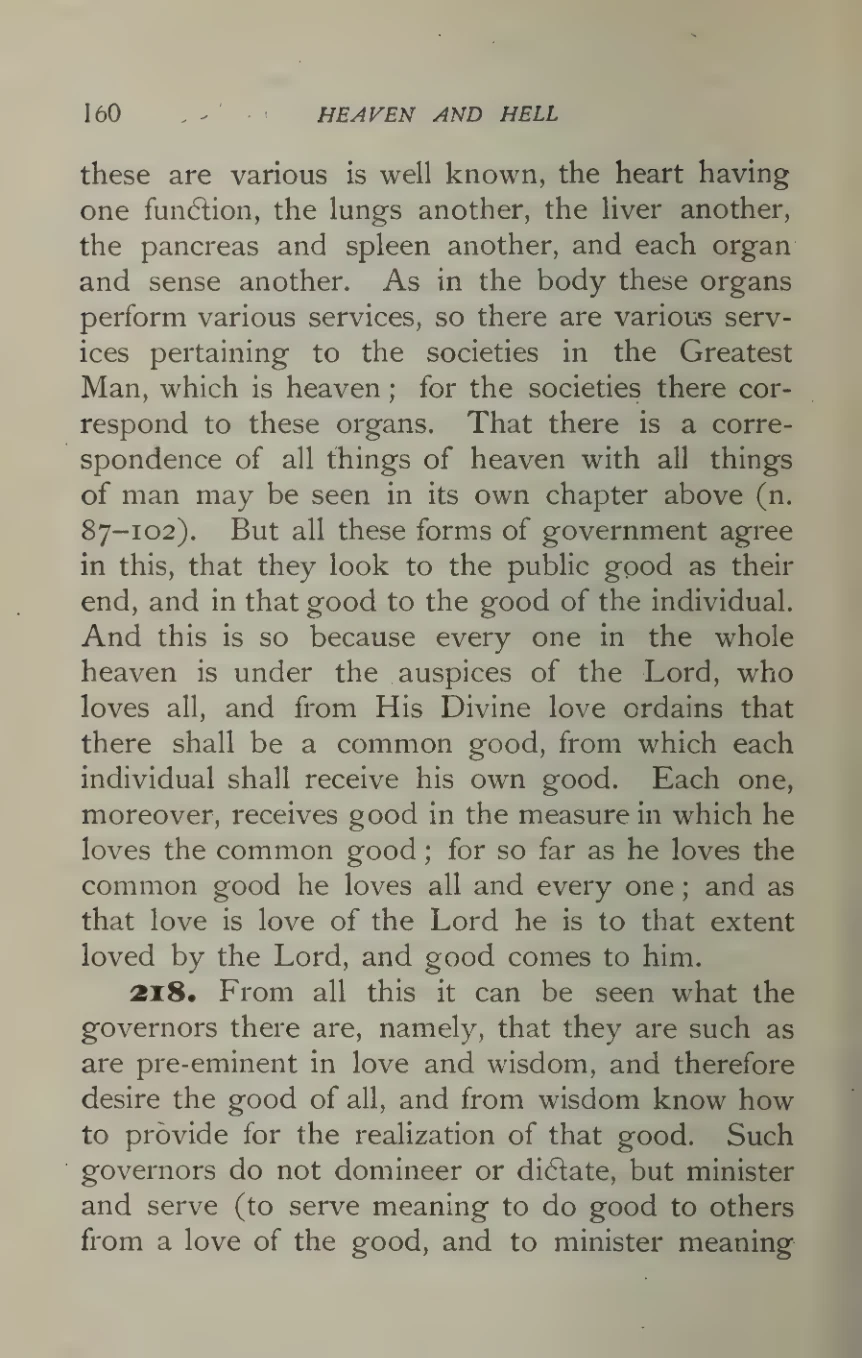
Heaven and Its Wonders and Hell (1916), printed p. 160, Library Reader page 167. Swedenborg describes service as the work of a governor.
Emanuel Swedenborg, Heaven and Its Wonders and Hell, J. C. Ager translation, New York, 1916. Public-domain historical page from the checksum-verified Library PDF. · Image source ↗ · Public Domain
See references (6)
- Heaven and Its Wonders and Hell, printed p. 157, Reader page 164
- Heaven and Its Wonders and Hell, printed p. 158, Reader page 165
- Heaven and Its Wonders and Hell, printed p. 159, Reader page 166
- Heaven and Its Wonders and Hell, printed p. 160, Reader page 167
- Heaven and Its Wonders and Hell, printed p. 161, Reader page 168
- Heaven and Its Wonders and Hell, printed p. 162, Reader page 169
Lumen by Camille Flammarion
Camille Flammarion’s Lumen offers a planetary comparison with accounts of heavenly order. In one world of the Milky Way, the narrator says, moral worth determines who is placed at the head of the state. The rulers’ responsibility is then to discover other capable people and give them work worthy of their abilities. Good government actively seeks merit rather than waiting for it to promote itself. [8][9]
Lumen contrasts a society that searches for capable people with Earth, where hidden talent can go unrewarded while money and ambition open doors. He measures the search for ability against the energy Earth devotes to finding gold and diamonds. [8][9]
On another world, in Andromeda, a king keeps the richest resources and sends his subjects to fight neighbouring peoples. The survivors give thanks with the dignitaries of their sects and pray for their ruler. Quaerens’s assurance that Earth behaves differently gives the scene its satirical edge. [10][11][12][13]
The virtuous state and the extractive monarchy are separate settings. Nor does the book say that every peaceful society needs a government: its rooted Cygnus people are described as having no such institution. Flammarion’s worlds test different relations between organisation, character and social life, rather than reproducing one heavenly hierarchy throughout space. [14][15][8][9]
What authority is for
Swedenborg asks how governors can serve a shared good. Flammarion’s exemplary rulers seek out people who can be trusted with responsibility. His Andromedan king uses his office to keep the best resources and command his people’s obedience. [5][6][1][2][3][4][10][11][12][13][8][9]
An angelic hierarchy can classify heavenly beings by order or function. Government concerns who makes decisions, how people serve and whose good the arrangement advances. [1][2][3][4]
The title page of Robert Fludd’s Utriusque cosmi historia places a human figure within concentric cosmic rings. Swedenborg uses a related bodily image when he compares societies to organs that share bodily functions. The earlier engraving gives a visual example of order seen through the body. [7][3][4]
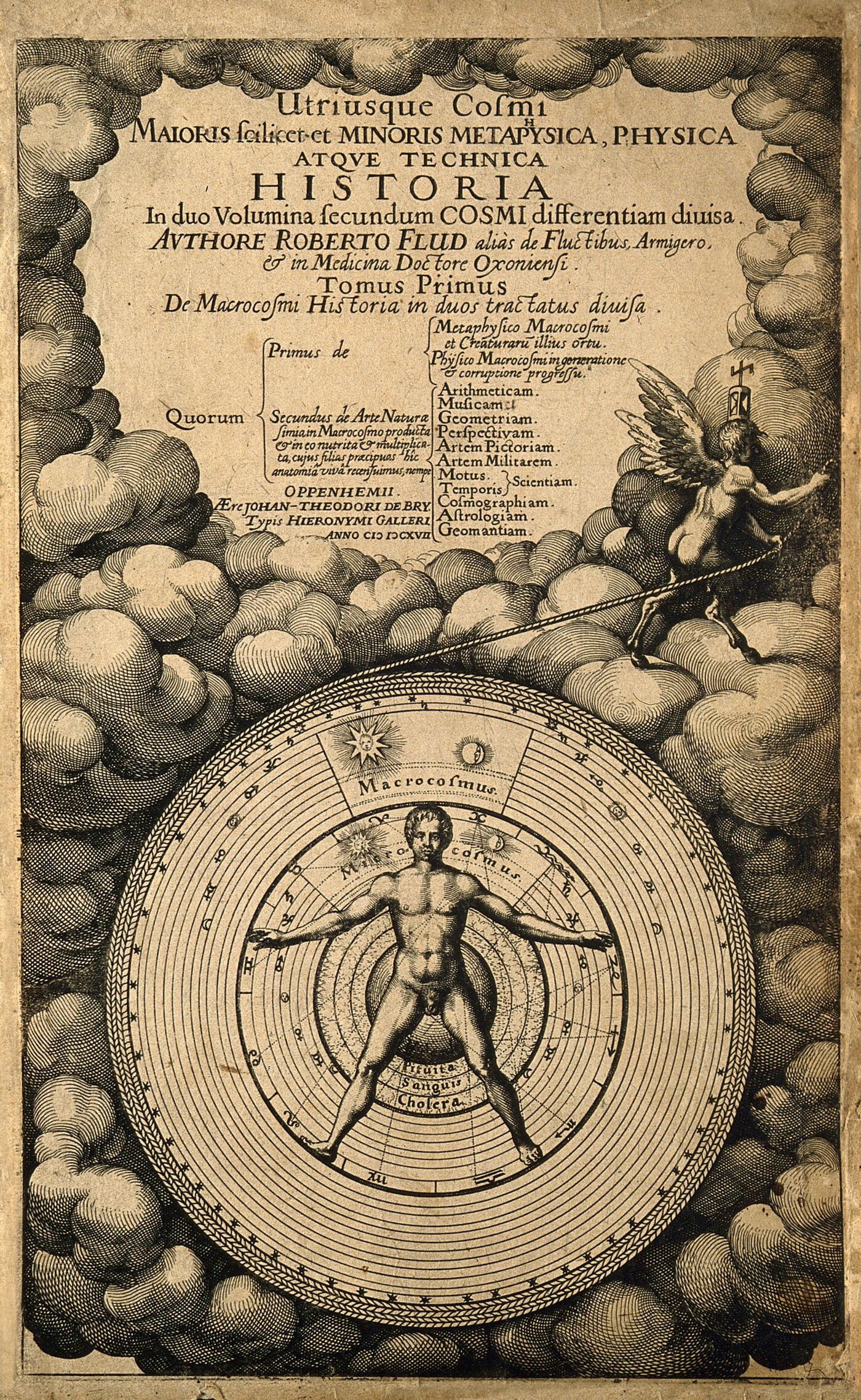
T. de Bry’s engraving for Robert Fludd, 1617. A human figure appears within cosmic rings.
Wellcome Collection, 2989i. Public Domain Mark. · Image source ↗ · Public Domain
See references (13)
- Heaven and Its Wonders and Hell, printed p. 157, Reader page 164
- Heaven and Its Wonders and Hell, printed p. 158, Reader page 165
- Heaven and Its Wonders and Hell, printed p. 159, Reader page 166
- Heaven and Its Wonders and Hell, printed p. 160, Reader page 167
- Heaven and Its Wonders and Hell, printed p. 161, Reader page 168
- Heaven and Its Wonders and Hell, printed p. 162, Reader page 169
- The microcosm (man) and the macrocosm (the world), 1617: Wellcome Collection 2989i
- Lumen, Reader page 222
- Lumen, Reader page 223
- Lumen, Reader page 186
- Lumen, Reader page 187
- Lumen, Reader page 188
- Lumen, Reader page 189
Read further in the library

Heaven and Its Wonders and Hell
Reading note
The separately titled account draws on exact passages in the consulted Library edition.

Lumen
Reading note
The separately titled account draws on exact passages in the consulted Library edition.
Sources
See references (15)
- Heaven and Its Wonders and Hell, printed p. 157, Reader page 164Emanuel Swedenborg, Heaven and Its Wonders and Hell, From Things Heard and Seen, translated by J. C. Ager. American Swedenborg Printing and Publishing Society, New York, 1916. Latin original first published in 1758. Numbered sections and exact pages refer to this consulted edition. Claims of spiritual experience remain attributed.Read this page in Heaven and Its Wonders and Hell ↗Return to text ↑
- Heaven and Its Wonders and Hell, printed p. 158, Reader page 165Emanuel Swedenborg, Heaven and Its Wonders and Hell, From Things Heard and Seen, translated by J. C. Ager. American Swedenborg Printing and Publishing Society, New York, 1916. Latin original first published in 1758. Numbered sections and exact pages refer to this consulted edition. Claims of spiritual experience remain attributed.Read this page in Heaven and Its Wonders and Hell ↗Return to text ↑
- Heaven and Its Wonders and Hell, printed p. 159, Reader page 166Emanuel Swedenborg, Heaven and Its Wonders and Hell, From Things Heard and Seen, translated by J. C. Ager. American Swedenborg Printing and Publishing Society, New York, 1916. Latin original first published in 1758. Numbered sections and exact pages refer to this consulted edition. Claims of spiritual experience remain attributed.Read this page in Heaven and Its Wonders and Hell ↗Return to text ↑
- Heaven and Its Wonders and Hell, printed p. 160, Reader page 167Emanuel Swedenborg, Heaven and Its Wonders and Hell, From Things Heard and Seen, translated by J. C. Ager. American Swedenborg Printing and Publishing Society, New York, 1916. Latin original first published in 1758. Numbered sections and exact pages refer to this consulted edition. Claims of spiritual experience remain attributed.Read this page in Heaven and Its Wonders and Hell ↗Return to text ↑
- Heaven and Its Wonders and Hell, printed p. 161, Reader page 168Emanuel Swedenborg, Heaven and Its Wonders and Hell, From Things Heard and Seen, translated by J. C. Ager. American Swedenborg Printing and Publishing Society, New York, 1916. Latin original first published in 1758. Numbered sections and exact pages refer to this consulted edition. Claims of spiritual experience remain attributed.Read this page in Heaven and Its Wonders and Hell ↗Return to text ↑
- Heaven and Its Wonders and Hell, printed p. 162, Reader page 169Emanuel Swedenborg, Heaven and Its Wonders and Hell, From Things Heard and Seen, translated by J. C. Ager. American Swedenborg Printing and Publishing Society, New York, 1916. Latin original first published in 1758. Numbered sections and exact pages refer to this consulted edition. Claims of spiritual experience remain attributed.Read this page in Heaven and Its Wonders and Hell ↗Return to text ↑
- The microcosm (man) and the macrocosm (the world), 1617: Wellcome Collection 2989i ↗Wellcome Collection, 2989i. Engraving credited to T. de Bry, 1617; associated with Robert Fludd. Public Domain Mark.Return to text ↑
- Lumen, Reader page 222Camille Flammarion, Lumen, authorised English translation by A. A. M. and R. M., Dodd, Mead and Company, New York, 1897. Exact selected Library edition IMJ-0398-E001. Lumen and Quaerens are speakers in the dialogue; claims made by the narrator are attributed to this text. Original PageIDs and current Reader positions are verified separately from printed pagination.Read this page in Lumen ↗Return to text ↑
- Lumen, Reader page 223Camille Flammarion, Lumen, authorised English translation by A. A. M. and R. M., Dodd, Mead and Company, New York, 1897. Exact selected Library edition IMJ-0398-E001. Lumen and Quaerens are speakers in the dialogue; claims made by the narrator are attributed to this text. Original PageIDs and current Reader positions are verified separately from printed pagination.Read this page in Lumen ↗Return to text ↑
- Lumen, Reader page 186Camille Flammarion, Lumen, authorised English translation by A. A. M. and R. M., Dodd, Mead and Company, New York, 1897. Exact selected Library edition IMJ-0398-E001. Lumen and Quaerens are speakers in the dialogue; claims made by the narrator are attributed to this text. Original PageIDs and current Reader positions are verified separately from printed pagination.Read this page in Lumen ↗Return to text ↑
- Lumen, Reader page 187Camille Flammarion, Lumen, authorised English translation by A. A. M. and R. M., Dodd, Mead and Company, New York, 1897. Exact selected Library edition IMJ-0398-E001. Lumen and Quaerens are speakers in the dialogue; claims made by the narrator are attributed to this text. Original PageIDs and current Reader positions are verified separately from printed pagination.Read this page in Lumen ↗Return to text ↑
- Lumen, Reader page 188Camille Flammarion, Lumen, authorised English translation by A. A. M. and R. M., Dodd, Mead and Company, New York, 1897. Exact selected Library edition IMJ-0398-E001. Lumen and Quaerens are speakers in the dialogue; claims made by the narrator are attributed to this text. Original PageIDs and current Reader positions are verified separately from printed pagination.Read this page in Lumen ↗Return to text ↑
- Lumen, Reader page 189Camille Flammarion, Lumen, authorised English translation by A. A. M. and R. M., Dodd, Mead and Company, New York, 1897. Exact selected Library edition IMJ-0398-E001. Lumen and Quaerens are speakers in the dialogue; claims made by the narrator are attributed to this text. Original PageIDs and current Reader positions are verified separately from printed pagination.Read this page in Lumen ↗Return to text ↑
- Lumen, Reader page 195Camille Flammarion, Lumen, authorised English translation by A. A. M. and R. M., Dodd, Mead and Company, New York, 1897. Exact selected Library edition IMJ-0398-E001. Lumen and Quaerens are speakers in the dialogue; claims made by the narrator are attributed to this text. Original PageIDs and current Reader positions are verified separately from printed pagination.Read this page in Lumen ↗Return to text ↑
- Lumen, Reader page 196Camille Flammarion, Lumen, authorised English translation by A. A. M. and R. M., Dodd, Mead and Company, New York, 1897. Exact selected Library edition IMJ-0398-E001. Lumen and Quaerens are speakers in the dialogue; claims made by the narrator are attributed to this text. Original PageIDs and current Reader positions are verified separately from printed pagination.Read this page in Lumen ↗Return to text ↑