The Four Horsemen of the Apocalypse
The Four Horsemen are commonly called Conquest, War, Famine and Death. Read what Revelation 6 says and identify each rider in Dürer’s woodcut.
In this article
Find all four riders in Dürer’s woodcut
The four seals open in order in Revelation. Dürer puts the riders into a single charge. Start with the archer at the right and use the four markers to follow the order of the seals.
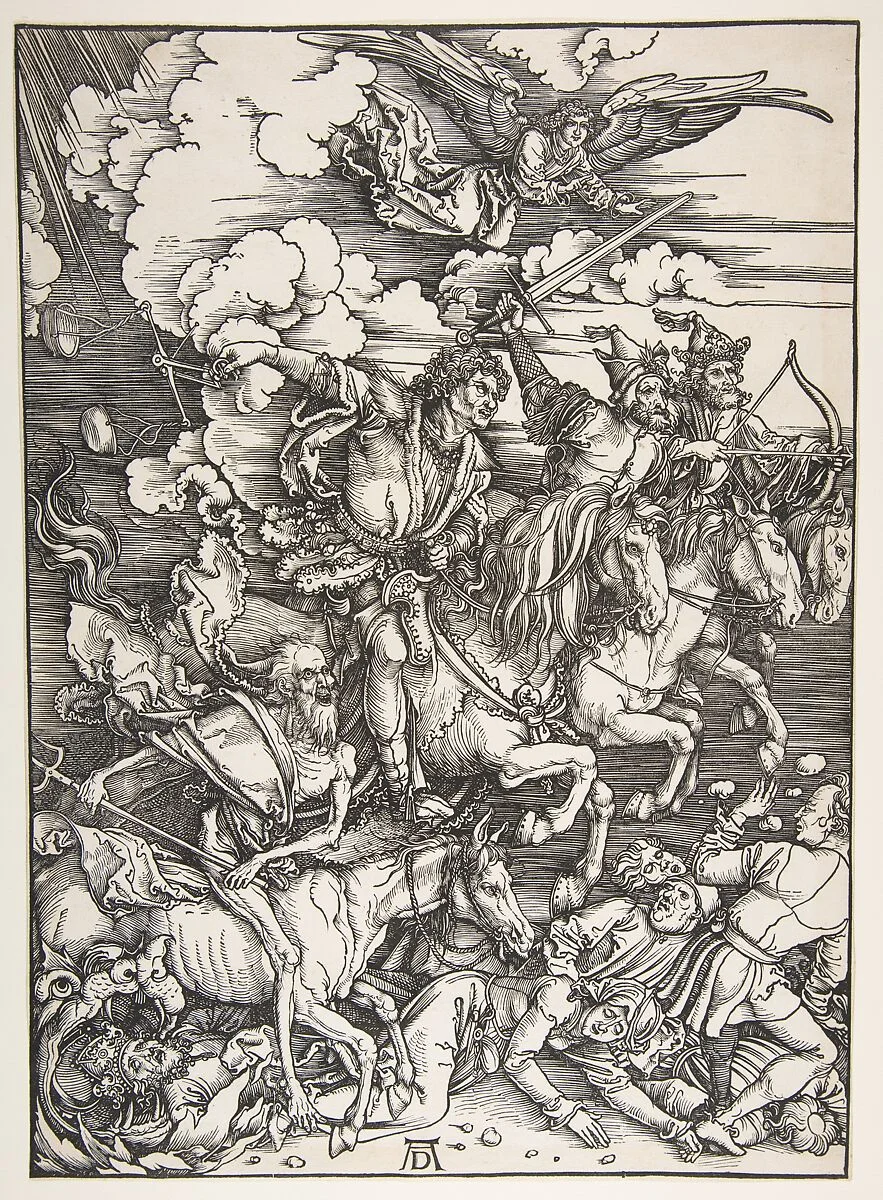
Conquest · bow and crown
Look at the right edge. The rider aims his bow ahead of the others. The Met calls this figure Plague or Pestilence. Conquest describes what the white rider does in Revelation 6:2.
War · great sword
Follow the raised blade above the riders to the figure holding it. In Revelation 6:3–4 the second rider is given a great sword and power to take peace from the earth.
Famine · scales
Look left of centre for the balance hanging from an outstretched hand. The scales accompany the announcement of grain prices in Revelation 6:5–6.
Death · gaunt horse
Look below Famine for the rider on the emaciated horse. The open jaws at lower left give visible form to Hades, which follows Death in Revelation 6:7–8.
The four horsemen in order
Conquest, War, Famine and Death are the usual names for the rider on the white, red, black and pale horses in Revelation 6:1–8. Death is the only rider explicitly named. The other names describe a rider’s actions, equipment or effects. The sequence begins when the Lamb opens the first four of the scroll’s seven seals. [1]
- White horse: Conquest. The rider carries a bow, receives a crown and goes out to conquer. The chapter gives him his purpose and insignia. The USCCB notes suggest that the bow may evoke Parthian horse archers. [1]
- Red horse: War. A great sword is given to the rider, who takes peace from the earth. The text describes people killing one another. The white rider’s movement towards conquest gives way to violence breaking out across the land. [1]
- Black horse: Famine. The rider holds scales. A voice announces the price of wheat and barley and tells the rider to spare the oil and wine. The scales and the price announcement put the scarcity of staple food at the centre of the vision. [1]
- Pale or pale green horse: Death. Death rides the last horse and Hades follows. The two figure in the closing description of power over a quarter of the earth. The ashen or greenish colour reinforces the rider’s association with death. [1]
Is the first horseman Conquest or Pestilence?
Conquest comes directly from what the white rider does in Revelation 6:2. Pestilence belongs to a different reading familiar from later depictions. The Met describes the archer in Dürer’s woodcut as Plague or Pestilence. In Revelation 6:8, pestilence appears among the ways death comes, in the description following the fourth rider. These are two different ways of attaching a familiar name to the imagery. [1][5]
The first rider also sometimes prompts comparison with the white horse of Revelation 19. Read the two passages side by side. Chapter 6 gives its rider a bow and a crown. Chapter 19 calls its rider Faithful and True, gives him many diadems, and depicts a sword coming from his mouth. A white horse links the scenes visually. The names, weapons and narrative setting let you identify which scene an illustration depicts. [1][2]
Why Famine carries scales and Death rides a pale horse
The famine scene asks the reader to think about what a wage will buy. The price of a measure of wheat is a denarius, identified in the translation notes with a day’s wage. Three measures of barley cost the same. Rather than describe an empty landscape, the vision shows the pressure of buying staple food at steep prices. The instruction about oil and wine interrupts that picture and leaves something in reserve. [1]
Pale and pale green are translations of the colour of the fourth horse. In the final scene Hades accompanies Death. The name here refers to the realm of the dead. The verse also recalls the four judgments of Ezekiel 14:21: sword, famine, wild beasts and pestilence. Zechariah 6 supplies a further comparison through its four groups of differently coloured horses. Its chariots belong to a separate prophetic vision with their own directions and purpose. [1][4][3]
How to read Dürer’s Four Horsemen woodcut
Start at the right edge of the print. A bow identifies the first rider, and a sword rises above the horse beside him. Follow the arm extending leftward to find the scales of Famine. Below the other riders, Death leans forward on a gaunt horse. At the lower left, the jaws of the creature swallowing a fallen figure give Hades a visible presence in the scene. [5][1]
Revelation releases the horsemen one at a time. Dürer makes them charge together, and the sweep of the horses carries the eye across the image before it can stop at any one rider. Read the verses in seal order, then look at the woodcut in the opposite direction from the Met’s left-to-right description. Following bow, sword, scales and Death brings you back to the order in which they appear in the text. [5][1]
Sources
See references (5)
- Revelation 6:1–8, the first four seals ↗New American Bible, Revised Edition with USCCB notes on the ridersReturn to text ↑
- Revelation 19:11–16, Faithful and True ↗New American Bible, Revised Edition with USCCB notesReturn to text ↑
- Zechariah 6:1–8, four chariots ↗New American Bible, Revised EditionReturn to text ↑
- Ezekiel 14:21, four judgments ↗New American Bible, Revised EditionReturn to text ↑
- Albrecht Dürer, The Four Horsemen, from The Apocalypse, 1498 ↗The Metropolitan Museum of Art, woodcut, Public DomainReturn to text ↑