What Does 666 Mean in Revelation? The Number of the Beast and 616
What does 666 mean in Revelation 13? Compare the 666 and 616 readings, see the Nero Caesar calculation, and read the ancient sources behind the debate.
In this article
Compare 666 and 616
The Hebrew-letter calculation tests a proposed name. The Greek numeral gives the value preserved in Papyrus 115.
The Nero calculation, letter by letter
Read the names right to left. The values below follow the letters in reading order.
| Form | Hebrew letters and values | Total |
|---|---|---|
| Neron Caesarנרון קסר |
| 666 |
| Nero Caesarנרו קסר |
| 616 |
The final nun adds 50. Source for the Hebrew-letter calculation
Papyrus 115 records a Greek numeral
χιϛ 600 + 10 + 6 = 616
Chi, iota and stigma. The typeset letters have been normalised for reading. Manuscript record · Published transcription
What 666 means in Revelation 13
In Revelation 13:18, 666 is the number of the beast, a riddle the text asks a discerning reader to calculate. A leading historical interpretation connects it to Nero Caesar through the numeric values of Hebrew letters. An ancient variant reads 616. In the Nero interpretation, dropping the final n of the Greek form Neron accounts for the difference of fifty. The two totals fit the theory, while the verse itself leaves the name unstated. [1][2][6][5]
Three questions guide the reading. What are the beasts doing in the story? What numbers do ancient witnesses give? And what assumptions are needed to turn a proposed name into either total? The text, the manuscript and the calculation each answer a different question. [1][4][6]
See references (5)
- Revelation 13 · The two beasts, the mark and the number
- Revelation 13:18 · Notes on Nero and 616
- Papyrus 115 · P.Oxy. LXVI 4499, including Revelation 13:18
- P. J. Williams · P115 and the Number of the Beast
- Craig R. Koester · The Number of the Beast in Revelation 13 in Light of Papyri, Graffiti, and Inscriptions
The two beasts and the mark
Revelation 13 presents the beast from the sea first. It has multiple heads and horns, receives authority from the dragon, and is followed by people astonished at the recovery of a wounded head. The second beast comes from the earth, has lamb-like horns, and uses its influence to secure worship of the first. It is the second beast that enforces the mark. Verse 17 connects the mark to the first beast’s name or the number of its name and to the ability to buy or sell. [1]
In Dürer’s image, start with the small horned figure on the left. Then follow the crowd towards the much larger figure on the right. Looking between them helps identify the two creatures the chapter gives distinct roles. Read Revelation 17 as a later interpretation within the same book: there the heads are interpreted in relation to hills and kings, part of the reason the Roman setting matters to historical readings of chapter 13. [13][1][12]
The four horsemen appear earlier, in Revelation 6. The beasts in chapters 12 and 13 belong to a later series of visions. Read each image with its own chapter and sequence before comparing their shared subject of power and violence. [10][11][1]
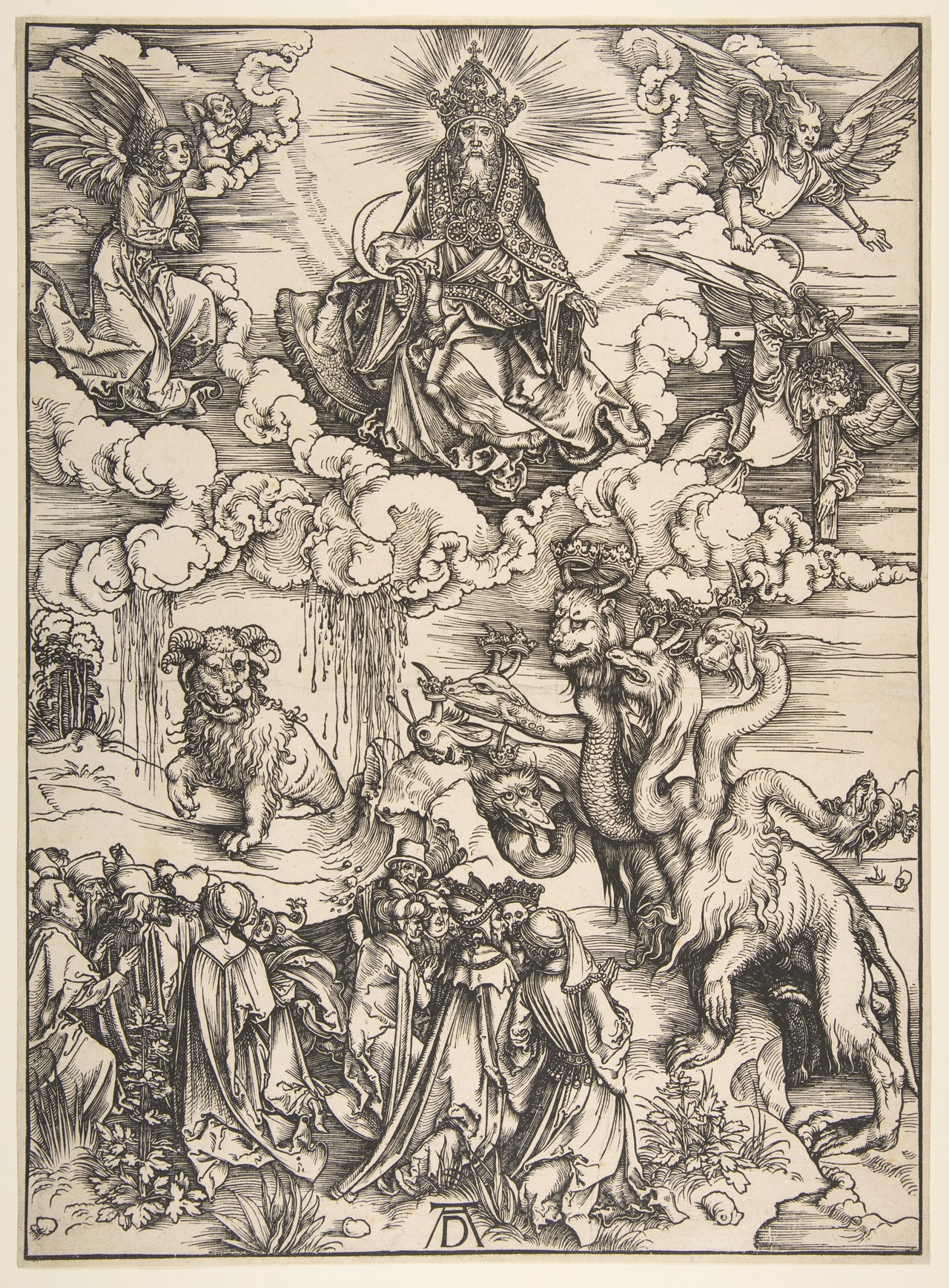
Dürer sets the smaller, horned beast on land at left and the many-headed sea beast at right. The Met dates this impression to 1511.
Albrecht Dürer, The Beast with the Seven Heads and the Beast with Lamb’s Horns, 1511 impression. Metropolitan Museum of Art, Gift of Junius Spencer Morgan, 1919. · Image source ↗ · CC0
How Nero Caesar gives 666 and 616
The name is written in Hebrew letters and each letter is assigned its usual numeric value. In the calculation for 666, Neron contributes 306 and Qesar contributes 360. The last letter in Neron is a final nun and contributes 50. The shorter form Nero contributes 256 and the same spelling of Qesar still contributes 360, yielding 616. These are Hebrew-letter sums of transliterated forms, even though the relevant passages of Revelation were transmitted in Greek. [6][7][5]
The spelling of the title matters as much as the spelling of the name. The calculation uses QSR, without a yod. Koester discusses a close ancient attestation in the dated Aramaic document Murabbaʿat 18, which gives a spelling of Nero’s name and title that fits the calculation. The gold coin shows the Latin name in an official Roman object. The Aramaic document supplies the evidence for the Semitic spelling used in the sum. [7][14]
Critics ask whether readers of a Greek apocalypse would have known to switch scripts, or how confidently the spelling can be inferred without already knowing the answer. A recent proposal calculates an alternative from a Greek name associated with Claudius. The point of setting out the Nero arithmetic is to expose its assumptions. Several names can yield the same total, and the case for a reading also depends on independent evidence and the vision’s historical setting. [8][9][6][2]
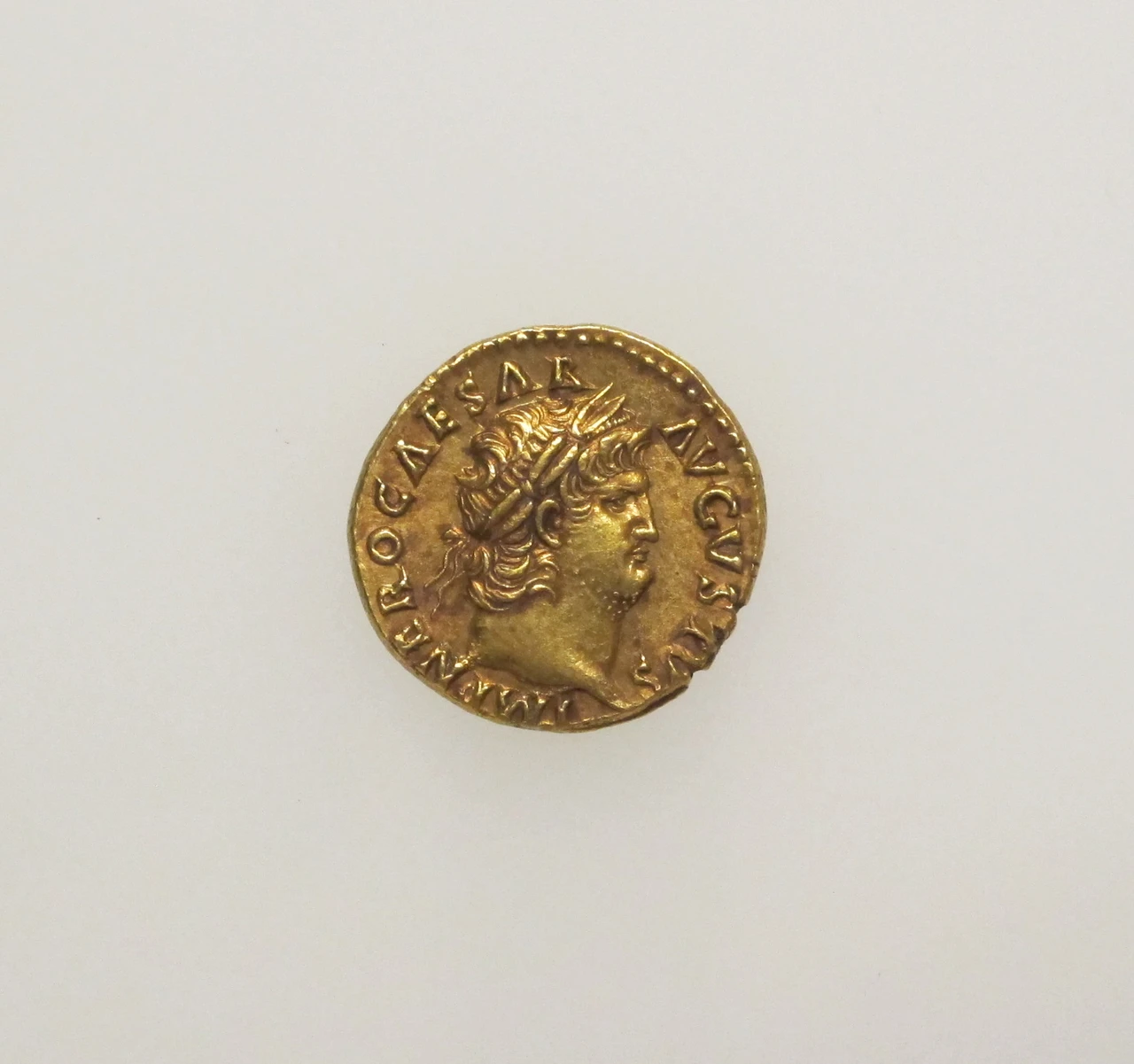
The obverse of a gold aureus names Nero in Latin. The letters NERO CAESAR are part of the longer imperial inscription.
Gold aureus of Nero, Roman, 66–67 CE. Metropolitan Museum of Art, Gift of Joseph H. Durkee, 1899. · Image source ↗ · CC0
See references (7)
- Revelation 13:18 · Notes on Nero and 616
- P. J. Williams · P115 and the Number of the Beast
- Craig R. Koester · The Number of the Beast in Revelation 13 in Light of Papyri, Graffiti, and Inscriptions
- Koester · Full text and Murabbaʿat 18
- Forward and Reverse Gematria are Very Different Beasts
- A Concealed Claudian · An alternative reading of 666
- Roman gold aureus of Nero · 66–67 CE
Where 616 appears
The Greek fragments grouped as Papyrus 115 include part of Revelation 13:18. Here the number is written with three Greek numeral signs, transcribed as χιϛ. Chi supplies 600, iota 10 and stigma 6. The line over the signs in the manuscript marks them as a number. The chart above uses ordinary typeset signs to explain what the papyrus contains. Codex Ephraemi Rescriptus also supports 616, written out in words. [4][5][7]
The papyrus shows that 616 circulated in antiquity. To evaluate what the first form of the verse read, scholars compare other manuscripts and early writers. Irenaeus knew that some copies had the lower number, yet defended 666 in Against Heresies V.30. He considered Greek candidates, including Lateinos and Teitan, and discouraged settling on a name. His discussion establishes that the disagreement was already known in the late second century. His claims about copying reflect his own assessment. [3][4][5]
How to weigh the evidence
Begin with verses 11–18, where the story gives the number its purpose. Then open the Papyrus 115 catalogue and the account of how the numeral is read. The manuscript gives a Greek number. The Nero table gives a possible name behind it by another route. Williams notes that the appearance of 616 can have more than one explanation, and modern scholarship continues to debate the strength of the inference. [1][4][5][6]
Reading Revelation as Christian scripture and tracing its first-century political setting are both long-standing ways to approach the text. In historical discussion, any proposed name needs to fit the details around the riddle as well as the sum. Comparing the beasts’ demand for allegiance, the economic pressure attached to the mark, and the language of kings in Revelation 17 gives readers more to work with than the number in isolation. [1][12][6]
See references (5)
- Revelation 13 · The two beasts, the mark and the number
- Papyrus 115 · P.Oxy. LXVI 4499, including Revelation 13:18
- P. J. Williams · P115 and the Number of the Beast
- Craig R. Koester · The Number of the Beast in Revelation 13 in Light of Papyri, Graffiti, and Inscriptions
- Revelation 17 · The heads interpreted as hills and kings
Sources
See references (14)
- Revelation 13 · The two beasts, the mark and the number ↗New American Bible, Revised Edition, United States Conference of Catholic Bishops.Return to text ↑
- Revelation 13:18 · Notes on Nero and 616 ↗New American Bible, Revised Edition, note on Revelation 13:18.Return to text ↑
- Irenaeus · Against Heresies V.30 ↗Irenaeus of Lyons, late second century, in the Ante-Nicene Fathers translation hosted by New Advent.Return to text ↑
- Papyrus 115 · P.Oxy. LXVI 4499, including Revelation 13:18 ↗Oxford Papyrology, Digital Bodleian Data Portal, Egypt Exploration Society collection.Return to text ↑
- P. J. Williams · P115 and the Number of the Beast ↗Tyndale Bulletin 58.1, 2007, pp. 151–153.Return to text ↑
- Craig R. Koester · The Number of the Beast in Revelation 13 in Light of Papyri, Graffiti, and Inscriptions ↗Journal of Early Christian History 6.3, 2016.Return to text ↑
- Koester · Full text and Murabbaʿat 18 ↗Author’s article deposited in Digital Commons at Luther Seminary, discussion of the Aramaic legal text Murabbaʿat 18.Return to text ↑
- Forward and Reverse Gematria are Very Different Beasts ↗Open Theology, research article on testing ancient number riddles and the Nero hypothesis.Return to text ↑
- A Concealed Claudian · An alternative reading of 666 ↗The Journal of Theological Studies 76.1, 2025, p. 109 ff..Return to text ↑
- Revelation 6 · The seals and four riders ↗New American Bible, Revised Edition, United States Conference of Catholic Bishops.Return to text ↑
- Revelation 12 · The dragon ↗New American Bible, Revised Edition, United States Conference of Catholic Bishops.Return to text ↑
- Revelation 17 · The heads interpreted as hills and kings ↗New American Bible, Revised Edition, United States Conference of Catholic Bishops.Return to text ↑
- Dürer · The Beast with the Seven Heads and the Beast with Lamb’s Horns, 1511 impression ↗The Metropolitan Museum of Art, Gift of Junius Spencer Morgan, 1919. Open Access.Return to text ↑
- Roman gold aureus of Nero · 66–67 CE ↗The Metropolitan Museum of Art, Gift of Joseph H. Durkee, 1899. Open Access.Return to text ↑