Food and sleep after death
Do spirits eat or sleep? Compare accounts of appetite, hospitality and recovery in Ward, Dresser and Rafferty, Shelhamer, The Angels’ Diary and Lumen.
In this article
Needs, habits and rest
Understanding food and sleep after death
In afterlife literature, a spiritual body can be said to enjoy a meal or enter a sleep-like state without having the same bodily needs as a living person. Accounts differ on whether food and sleep are habits, experiences people can choose or things they need during a period of recovery. [1][2][3][4]
The setting matters. A guest offered fruit is in a different situation from someone who still feels hungry or is too exhausted to stay awake. These books give each experience its own place and purpose. [2][3][5][6][4][26][27][18][20]
See references (10)
- Gone West, printed p. 28, Reader page 41
- Gone West, printed p. 60, Reader page 73
- Gone West, printed p. 72, Reader page 85
- Gone West, printed p. 155, Reader page 168
- Gone West, printed p. 80, Reader page 93
- Gone West, printed p. 106, Reader page 119
- Life and Labor in the Spirit World, printed p. 358, Reader page 359
- Life and Labor in the Spirit World, printed p. 393, Reader page 394
- Life Here and Hereafter, Reader page 67
- Life Here and Hereafter, Reader page 68
Gone West by J. S. M. Ward
In J. S. M. Ward’s Gone West, H. J. L. says that bodily drudgery has disappeared: his rooms need no cleaning, food need not be prepared and the inhabitants do not sleep. His funeral account likewise separates spiritual experience from earthly day and night, assigning the need for rest to the physical body. [1][2]
Continued appetite appears elsewhere. Animals on the astral plane keep searching for food until they supposedly learn that they do not require it. H. J. L. describes some continuing to hunt without success. The search expresses a habit carried forward, rather than proof that the new body needs calories. [3]
The Officer’s infernal banquet offers another version. Dishes appear before hungry guests, yet eating yields nothing. Later, plundered wine and food give no satisfaction. The narrator contrasts these conditions with physical dreams, which he still connects to the living body. [6][7]
Sleep-like transitions also receive different explanations. Carrie’s wish to go to bed during an astral visit is interpreted as her physical body drawing her back. In another episode, apparently sleeping spirits are said to have imposed a prolonged coma on themselves through denial of continued life. That is the guide’s moral and spiritual interpretation, rather than an account of ordinary restorative sleep. [5][4]
The different cases keep the meaning of sleep tied to a setting. H. J. L. has no ordinary need for it. Carrie is still linked to an earthly body. The sleeping people in the last example are said to have withdrawn from their surroundings into a prolonged state of unawareness. [1][2][3][5][6][4]
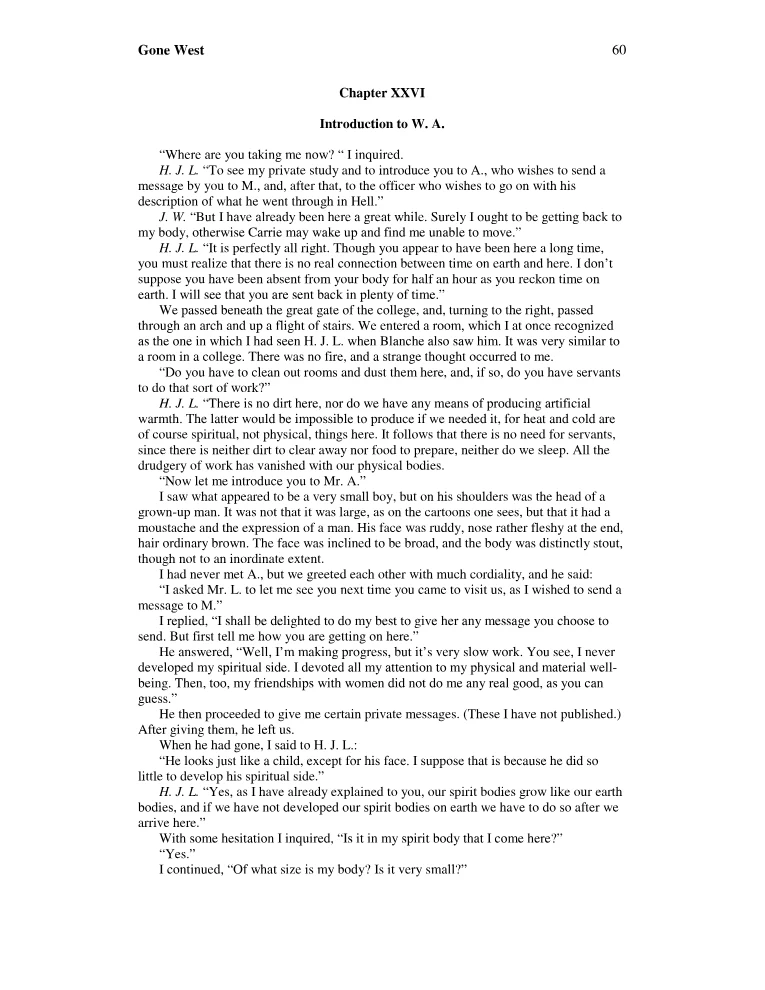
Source page: Gone West, Reader page 73. Ward’s 1920 text is shown in Geoff Cutler’s 2009 digital transcription, rather than an original printed facsimile.
J. S. M. Ward, Gone West, historical text in the public domain. Geoff Cutler’s 2009 transcription expressly permits reuse for any purpose on source leaf2. This image shows the digital transcription, not an original printed facsimile. · Image source ↗ · Public Domain
See references (7)
A Subaltern in Spirit Land by J. S. M. Ward
J. S. M. Ward’s sequel makes the location more explicit. His mother, now living with Rex and H. J. L., welcomes being free from meals and housekeeping. Another woman has told her of a district whose inhabitants still eat and sleep. H. J. L. assigns that district to a division nearer earthly conditions. [12]
The guide says that some inhabitants recognise that food and sleep are unnecessary yet retain the habits. Others are so accustomed to their surroundings that they deny having died. He also treats dissatisfaction with astral food as a possible route back towards harmful attachment to the living. These are his account’s explanations, not a universal description of appetite. [12][13]
Earlier in the same book, Ward’s mother requires sleep-like care after her transition and remains unresponsive in hospital. Her later lack of need for ordinary sleep therefore belongs to a later condition. Reading the passages in sequence preserves the difference between recovery and routine bodily rest. [14][15][12]
Ward also describes people choosing to observe an earthly festival. An occasion involving food or familiar customs can be kept voluntarily, even in a world where those customs are unnecessary to daily life. [14][12][13][16]
The sequel separates situations the earlier book placed side by side. An ordinary routine can end, even though a newcomer needs hospital care or residents of a district keep old habits. Ward’s mother passes through more than one of these conditions. [1][2][3][4][14][15][12][13]
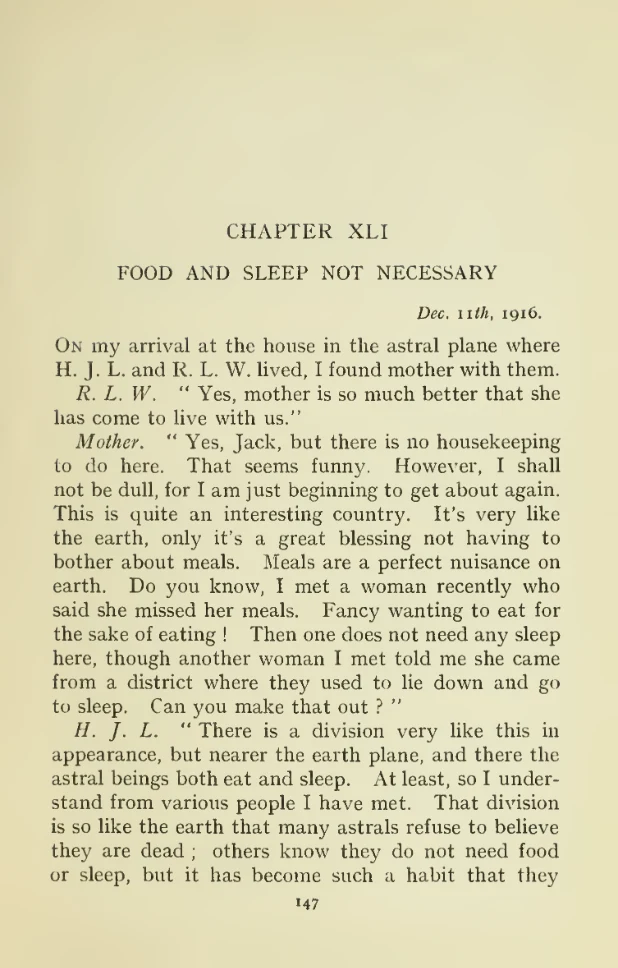
Source facsimile: A Subaltern in Spirit Land (1920), printed p. 147, Reader page 162.
J. S. M. Ward, A Subaltern in Spirit Land. William Rider & Son, 1920. Public-domain historical text and page image, extracted from the checksum-verified retained Library scan. · Image source ↗ · Public Domain
See references (9)
- Gone West, printed p. 28, Reader page 41
- Gone West, printed p. 60, Reader page 73
- Gone West, printed p. 72, Reader page 85
- Gone West, printed p. 155, Reader page 168
- A Subaltern in Spirit Land, printed p. 147, Reader page 162
- A Subaltern in Spirit Land, printed p. 148, Reader page 163
- A Subaltern in Spirit Land, printed p. 124, Reader page 139
- A Subaltern in Spirit Land, printed p. 127, Reader page 142
- A Subaltern in Spirit Land, printed p. 254, Reader page 269
Life Here and Hereafter: Charlotte E. Dresser and Fred Rafferty
Charlotte E. Dresser and Fred Rafferty’s Life Here and Hereafter distinguishes rest from the unconsciousness called sleep. The communicators allow quiet and passive times but say that the developed spirit does not need an earthly pattern of sleeping. This differs from the initial unconsciousness described after death, which belongs to awakening and adjustment. [22][23][24][25]
The two brothers who grew up after dying in infancy make the contrast concrete. They have tried to sleep and cannot understand how it is done. They taste fruit but forget to eat it and report no hunger. Their questions make nourishment and sleep unfamiliar earthly experiences rather than compulsory spirit routines. [26][27][28][29]
The appendix complicates the language of inexhaustible energy. Its teacher compares the use of particles in forming thought records to a limited fatigue, followed by restoration during a short rest. This proposed mechanism qualifies earlier broad statements without turning the book into a unified physiology of spiritual bodies. [30][31]
See references (10)
- Life Here and Hereafter, Reader page 99
- Life Here and Hereafter, Reader page 121
- Life Here and Hereafter, Reader page 123
- Life Here and Hereafter, Reader page 124
- Life Here and Hereafter, Reader page 67
- Life Here and Hereafter, Reader page 68
- Life Here and Hereafter, Reader page 69
- Life Here and Hereafter, Reader page 70
- Life Here and Hereafter, Reader page 245
- Life Here and Hereafter, Reader page 246
Recovery, refreshment and embodiment
The Angels’ Diary and Celestion Study of Man
The diary attributed to Effie M. Shirey includes spiritual food, but gives it a different function from rebuilding bodily tissue. The food is said to increase higher vibrations and make the individual more spiritual. Its presence therefore does not imply an ordinary physical need for nourishment. [8][9][10][11]
Life and Labor in the Spirit World: Shelhamer’s spirit-band
Life and Labor in the Spirit World, credited to the medium M. T. Shelhamer’s spirit-band, retains rest and refreshment in several scenes. In the account attributed to John Critchley Prince, the exhausted newcomer falls asleep amid peaceful natural surroundings. He later learns that several days passed during the rest. Another scene offers fruit and water, giving familiar experiences a place in the reported spirit world. [18][19]
The visit to Robert Burns makes the refreshments explicit: different fruits, a cake made from honey and nuts, and sparkling water. The scene is a shared household meal within this narrative. It does not supply one rule for what every spirit must eat or how every source understands spiritual nourishment. [20]
Other passages describe refreshment through the enjoyment of beauty. Reading those images beside the actual food scene preserves a useful difference between figurative feeding and the narrative’s presentation of a meal. The book can use both without requiring them to mean the same thing. [21][20]
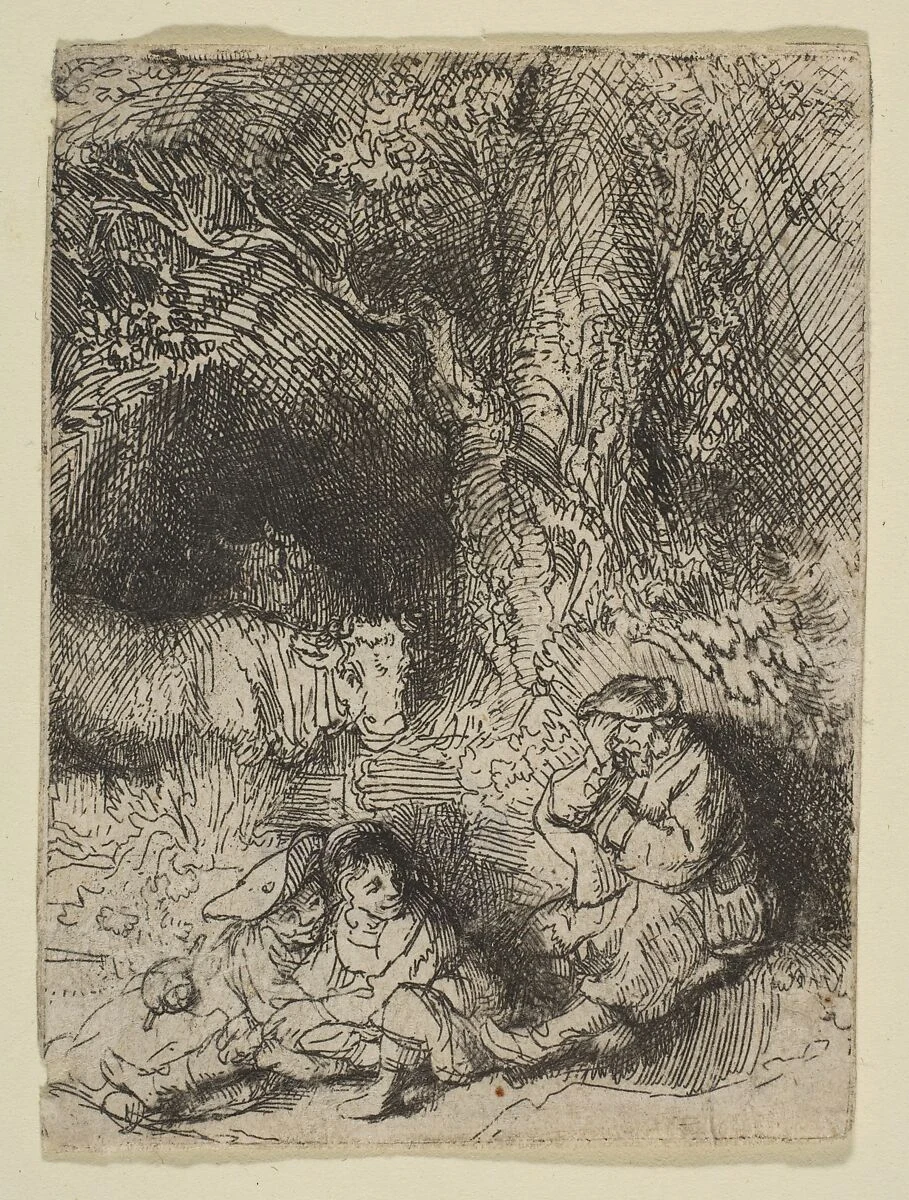
Rembrandt, The Sleeping Herdsman, ca. 1644. An earthly image of rest provides a familiar visual starting point for the books’ different accounts of sleep and recovery after death.
Rembrandt van Rijn. Etching and drypoint. The Metropolitan Museum of Art, Rogers Fund and Bequest of Ida Kammerer, in memory of Frederick Kammerer, M.D., by exchange; 1972.628. Public Domain, Open Access. · Image source ↗ · Public Domain
Lumen by Camille Flammarion
Camille Flammarion’s Lumen adds planetary comparisons to the question of food and sleep. These concern differently constituted inhabitants as well as the narrator’s life beyond the earthly body. The book does not apply one rule to every world: the need for rest or nourishment changes with the conditions it assigns to each organism. [32][33][34][35][36][37]
An Orionic world has day suns and night suns, with no interval of complete darkness. Elsewhere, Lumen says, continuous light makes sleep unnecessary for plants, animals and people. This is the dialogue’s proposed connection between a world’s illumination and its life. It should remain attributed to the book, rather than becoming a general biological explanation of sleep. [34][35][38][36]
Another world illuminates its nights differently. The rocks are said to retain daylight and give it out again, while flowers and animals shine. Stored light, living luminosity and several suns are distinct narrative devices. The glowing world need not be turned into the same physical arrangement as the Orionic one. [36][39]
The Andromedan beings supply a contrasting absence of rest. Their surrounding fluid must be kept passing into their bodies through continual effort, and stopping would threaten their lives. The source describes this as an oppressive struggle for existence. Being unable to sleep is therefore not automatically a sign of a higher or happier condition. [32][33][40]
Finally, Lumen describes organisms nourished by their environment without terrestrial eating, explicitly giving them a different bodily construction without stomachs or intestines. The claim concerns his hypothetical adapted inhabitants. It is distinct both from a spirit retaining an earthly food habit and from a person receiving symbolic nourishment after death. [37]
A need, a pleasure or a period of recovery?
Ward’s characters can keep an appetite after they lose the need to prepare meals. The Angels’ Diary gives food a positive role, saying it increases spiritual vibration. Those accounts distinguish wanting something, receiving something and physically needing it. [2][3][5][6][4][8][9][10][11][7][18][19][20]
In Shelhamer’s collection, Prince sleeps for days while recovering. Dresser and Rafferty’s brothers can taste fruit but feel no hunger, and they cannot make themselves fall asleep. Flammarion shifts the question to the inhabitants of other planets, some of whom are said to remain awake because of light or the labour their bodies require. [18][19][20][28][29][24][25][30][1][2][22][23][32][33][34][35][36][37]
See references (27)
- Gone West, printed p. 28, Reader page 41
- Gone West, printed p. 60, Reader page 73
- Gone West, printed p. 72, Reader page 85
- Gone West, printed p. 155, Reader page 168
- Gone West, printed p. 80, Reader page 93
- Gone West, printed p. 106, Reader page 119
- Gone West, printed p. 111, Reader page 124
- The Angels’ Diary and Celestion Study of Man, Reader page 34
- The Angels’ Diary and Celestion Study of Man, Reader page 35
- The Angels’ Diary and Celestion Study of Man, Reader page 40
- The Angels’ Diary and Celestion Study of Man, Reader page 41
- Life and Labor in the Spirit World, printed p. 358, Reader page 359
- Life and Labor in the Spirit World, printed p. 363, Reader page 364
- Life and Labor in the Spirit World, printed p. 393, Reader page 394
- Life Here and Hereafter, Reader page 99
- Life Here and Hereafter, Reader page 121
- Life Here and Hereafter, Reader page 123
- Life Here and Hereafter, Reader page 124
- Life Here and Hereafter, Reader page 69
- Life Here and Hereafter, Reader page 70
- Life Here and Hereafter, Reader page 245
- Lumen, Reader page 176
- Lumen, Reader page 179
- Lumen, Reader page 203
- Lumen, Reader page 204
- Lumen, Reader page 213
- Lumen, Reader page 221
Read further in the library
Gone West
Reading note
The separately titled account draws on exact passages in the consulted Library edition.

The Angels’ Diary and Celestion Study of Man
Reading note
Separately attributed comparison with exact previously researched Library passages.
A Subaltern in Spirit Land: A Sequel to Gone West
Reading note
The separately titled account draws on exact passages in the consulted Library edition.
Life and Labour in the Spirit World
Reading note
The separately titled account draws on exact passages in the consulted Library edition.

Life Here and Hereafter
Reading note
The separately titled account draws on exact passages in the consulted Library edition.

Lumen
Reading note
The separately titled account draws on exact passages in the consulted Library edition.
Sources
See references (40)
- Gone West, printed p. 28, Reader page 41J. S. M. Ward, Gone West: Three Narratives of After-Death Experiences, third impression, William Rider & Son, London, 1920, as reproduced in Geoff Cutler’s December 2009 digital transcription. Ward’s introduction is distinct from the supplied 1974 foreword.Read this page in Gone West ↗Return to text ↑
- Gone West, printed p. 60, Reader page 73J. S. M. Ward, Gone West: Three Narratives of After-Death Experiences, third impression, William Rider & Son, London, 1920, as reproduced in Geoff Cutler’s December 2009 digital transcription. Ward’s introduction is distinct from the supplied 1974 foreword.Read this page in Gone West ↗Return to text ↑
- Gone West, printed p. 72, Reader page 85J. S. M. Ward, Gone West: Three Narratives of After-Death Experiences, third impression, William Rider & Son, London, 1920, as reproduced in Geoff Cutler’s December 2009 digital transcription. Ward’s introduction is distinct from the supplied 1974 foreword.Read this page in Gone West ↗Return to text ↑
- Gone West, printed p. 155, Reader page 168J. S. M. Ward, Gone West: Three Narratives of After-Death Experiences, third impression, William Rider & Son, London, 1920, as reproduced in Geoff Cutler’s December 2009 digital transcription. Ward’s introduction is distinct from the supplied 1974 foreword.Read this page in Gone West ↗Return to text ↑
- Gone West, printed p. 80, Reader page 93J. S. M. Ward, Gone West: Three Narratives of After-Death Experiences, third impression, William Rider & Son, London, 1920, as reproduced in Geoff Cutler’s December 2009 digital transcription. Ward’s introduction is distinct from the supplied 1974 foreword.Read this page in Gone West ↗Return to text ↑
- Gone West, printed p. 106, Reader page 119J. S. M. Ward, Gone West: Three Narratives of After-Death Experiences, third impression, William Rider & Son, London, 1920, as reproduced in Geoff Cutler’s December 2009 digital transcription. Ward’s introduction is distinct from the supplied 1974 foreword.Read this page in Gone West ↗Return to text ↑
- Gone West, printed p. 111, Reader page 124J. S. M. Ward, Gone West: Three Narratives of After-Death Experiences, third impression, William Rider & Son, London, 1920, as reproduced in Geoff Cutler’s December 2009 digital transcription. Ward’s introduction is distinct from the supplied 1974 foreword.Read this page in Gone West ↗Return to text ↑
- The Angels’ Diary and Celestion Study of Man, Reader page 34Effie M. Shirey and Charles Samson, The Angels’ Diary and Celestion Study of Man (1903).Read this page in The Angels’ Diary and Celestion Study of Man ↗Return to text ↑
- The Angels’ Diary and Celestion Study of Man, Reader page 35Effie M. Shirey and Charles Samson, The Angels’ Diary and Celestion Study of Man (1903).Read this page in The Angels’ Diary and Celestion Study of Man ↗Return to text ↑
- The Angels’ Diary and Celestion Study of Man, Reader page 40Effie M. Shirey and Charles Samson, The Angels’ Diary and Celestion Study of Man (1903).Read this page in The Angels’ Diary and Celestion Study of Man ↗Return to text ↑
- The Angels’ Diary and Celestion Study of Man, Reader page 41Effie M. Shirey and Charles Samson, The Angels’ Diary and Celestion Study of Man (1903).Read this page in The Angels’ Diary and Celestion Study of Man ↗Return to text ↑
- A Subaltern in Spirit Land, printed p. 147, Reader page 162J. S. M. Ward, A Subaltern in Spirit Land: A Sequel to Gone West. William Rider & Son, London, 1920. Narrated experiences and explanations are attributed to Ward and his reported spirit contributors, especially his brother Rex (R. L. W.) and H. J. L.Read this page in A Subaltern in Spirit Land: A Sequel to Gone West ↗Return to text ↑
- A Subaltern in Spirit Land, printed p. 148, Reader page 163J. S. M. Ward, A Subaltern in Spirit Land: A Sequel to Gone West. William Rider & Son, London, 1920. Narrated experiences and explanations are attributed to Ward and his reported spirit contributors, especially his brother Rex (R. L. W.) and H. J. L.Read this page in A Subaltern in Spirit Land: A Sequel to Gone West ↗Return to text ↑
- A Subaltern in Spirit Land, printed p. 124, Reader page 139J. S. M. Ward, A Subaltern in Spirit Land: A Sequel to Gone West. William Rider & Son, London, 1920. Narrated experiences and explanations are attributed to Ward and his reported spirit contributors, especially his brother Rex (R. L. W.) and H. J. L.Read this page in A Subaltern in Spirit Land: A Sequel to Gone West ↗Return to text ↑
- A Subaltern in Spirit Land, printed p. 127, Reader page 142J. S. M. Ward, A Subaltern in Spirit Land: A Sequel to Gone West. William Rider & Son, London, 1920. Narrated experiences and explanations are attributed to Ward and his reported spirit contributors, especially his brother Rex (R. L. W.) and H. J. L.Read this page in A Subaltern in Spirit Land: A Sequel to Gone West ↗Return to text ↑
- A Subaltern in Spirit Land, printed p. 254, Reader page 269J. S. M. Ward, A Subaltern in Spirit Land: A Sequel to Gone West. William Rider & Son, London, 1920. Narrated experiences and explanations are attributed to Ward and his reported spirit contributors, especially his brother Rex (R. L. W.) and H. J. L.Read this page in A Subaltern in Spirit Land: A Sequel to Gone West ↗Return to text ↑
- The Metropolitan Museum of Art, The Sleeping Herdsman by Rembrandt, ca. 1644, object 391761 ↗Official collection record: title, attribution, medium, date and Public Domain reuse status checked. The artwork supplies a historical representation of sleep, not a measurement of a sleeper’s awareness.
- Life and Labor in the Spirit World, printed p. 358, Reader page 359Members of the Spirit-Band of Miss M. T. Shelhamer, Life and Labor in the Spirit World, Second Thousand, Boston: Colby & Rich, 1885. Exact Library edition IMJ-0202-E001. Parts I, II and III are respectively attributed to Spirit Violet, Spirit May and John Critchley Prince. Original metadata and retained Library PageRefs verified; consequential passages checked against actual Library facsimiles. Original Library PDF bytes remain unavailable.Read this page in Life and Labour in the Spirit World ↗Return to text ↑
- Life and Labor in the Spirit World, printed p. 363, Reader page 364Members of the Spirit-Band of Miss M. T. Shelhamer, Life and Labor in the Spirit World, Second Thousand, Boston: Colby & Rich, 1885. Exact Library edition IMJ-0202-E001. Parts I, II and III are respectively attributed to Spirit Violet, Spirit May and John Critchley Prince. Original metadata and retained Library PageRefs verified; consequential passages checked against actual Library facsimiles. Original Library PDF bytes remain unavailable.Read this page in Life and Labour in the Spirit World ↗Return to text ↑
- Life and Labor in the Spirit World, printed p. 393, Reader page 394Members of the Spirit-Band of Miss M. T. Shelhamer, Life and Labor in the Spirit World, Second Thousand, Boston: Colby & Rich, 1885. Exact Library edition IMJ-0202-E001. Parts I, II and III are respectively attributed to Spirit Violet, Spirit May and John Critchley Prince. Original metadata and retained Library PageRefs verified; consequential passages checked against actual Library facsimiles. Original Library PDF bytes remain unavailable.Read this page in Life and Labour in the Spirit World ↗Return to text ↑
- Life and Labor in the Spirit World, printed p. 388, Reader page 389Members of the Spirit-Band of Miss M. T. Shelhamer, Life and Labor in the Spirit World, Second Thousand, Boston: Colby & Rich, 1885. Exact Library edition IMJ-0202-E001. Parts I, II and III are respectively attributed to Spirit Violet, Spirit May and John Critchley Prince. Original metadata and retained Library PageRefs verified; consequential passages checked against actual Library facsimiles. Original Library PDF bytes remain unavailable.Read this page in Life and Labour in the Spirit World ↗Return to text ↑
- Life Here and Hereafter, Reader page 99Charlotte E. Dresser and Fred Rafferty, Life Here and Hereafter, edited by Fred Rafferty. Modern transcription reproducing the Author’s Edition, San Jose, California, 1927. Exact selected Library edition IMJ-0447-E001; original PageIDs and current Reader positions verified. Communications and their claimed spiritual origins remain attributed to this source.Read this page in Life Here and Hereafter ↗Return to text ↑
- Life Here and Hereafter, Reader page 121Charlotte E. Dresser and Fred Rafferty, Life Here and Hereafter, edited by Fred Rafferty. Modern transcription reproducing the Author’s Edition, San Jose, California, 1927. Exact selected Library edition IMJ-0447-E001; original PageIDs and current Reader positions verified. Communications and their claimed spiritual origins remain attributed to this source.Read this page in Life Here and Hereafter ↗Return to text ↑
- Life Here and Hereafter, Reader page 123Charlotte E. Dresser and Fred Rafferty, Life Here and Hereafter, edited by Fred Rafferty. Modern transcription reproducing the Author’s Edition, San Jose, California, 1927. Exact selected Library edition IMJ-0447-E001; original PageIDs and current Reader positions verified. Communications and their claimed spiritual origins remain attributed to this source.Read this page in Life Here and Hereafter ↗Return to text ↑
- Life Here and Hereafter, Reader page 124Charlotte E. Dresser and Fred Rafferty, Life Here and Hereafter, edited by Fred Rafferty. Modern transcription reproducing the Author’s Edition, San Jose, California, 1927. Exact selected Library edition IMJ-0447-E001; original PageIDs and current Reader positions verified. Communications and their claimed spiritual origins remain attributed to this source.Read this page in Life Here and Hereafter ↗Return to text ↑
- Life Here and Hereafter, Reader page 67Charlotte E. Dresser and Fred Rafferty, Life Here and Hereafter, edited by Fred Rafferty. Modern transcription reproducing the Author’s Edition, San Jose, California, 1927. Exact selected Library edition IMJ-0447-E001; original PageIDs and current Reader positions verified. Communications and their claimed spiritual origins remain attributed to this source.Read this page in Life Here and Hereafter ↗Return to text ↑
- Life Here and Hereafter, Reader page 68Charlotte E. Dresser and Fred Rafferty, Life Here and Hereafter, edited by Fred Rafferty. Modern transcription reproducing the Author’s Edition, San Jose, California, 1927. Exact selected Library edition IMJ-0447-E001; original PageIDs and current Reader positions verified. Communications and their claimed spiritual origins remain attributed to this source.Read this page in Life Here and Hereafter ↗Return to text ↑
- Life Here and Hereafter, Reader page 69Charlotte E. Dresser and Fred Rafferty, Life Here and Hereafter, edited by Fred Rafferty. Modern transcription reproducing the Author’s Edition, San Jose, California, 1927. Exact selected Library edition IMJ-0447-E001; original PageIDs and current Reader positions verified. Communications and their claimed spiritual origins remain attributed to this source.Read this page in Life Here and Hereafter ↗Return to text ↑
- Life Here and Hereafter, Reader page 70Charlotte E. Dresser and Fred Rafferty, Life Here and Hereafter, edited by Fred Rafferty. Modern transcription reproducing the Author’s Edition, San Jose, California, 1927. Exact selected Library edition IMJ-0447-E001; original PageIDs and current Reader positions verified. Communications and their claimed spiritual origins remain attributed to this source.Read this page in Life Here and Hereafter ↗Return to text ↑
- Life Here and Hereafter, Reader page 245Charlotte E. Dresser and Fred Rafferty, Life Here and Hereafter, edited by Fred Rafferty. Modern transcription reproducing the Author’s Edition, San Jose, California, 1927. Exact selected Library edition IMJ-0447-E001; original PageIDs and current Reader positions verified. Communications and their claimed spiritual origins remain attributed to this source.Read this page in Life Here and Hereafter ↗Return to text ↑
- Life Here and Hereafter, Reader page 246Charlotte E. Dresser and Fred Rafferty, Life Here and Hereafter, edited by Fred Rafferty. Modern transcription reproducing the Author’s Edition, San Jose, California, 1927. Exact selected Library edition IMJ-0447-E001; original PageIDs and current Reader positions verified. Communications and their claimed spiritual origins remain attributed to this source.Read this page in Life Here and Hereafter ↗Return to text ↑
- Lumen, Reader page 176Camille Flammarion, Lumen, authorised English translation by A. A. M. and R. M., Dodd, Mead and Company, New York, 1897. Exact selected Library edition IMJ-0398-E001. Lumen and Quaerens are speakers in the dialogue; claims made by the narrator are attributed to this text. Original PageIDs and current Reader positions are verified separately from printed pagination.Read this page in Lumen ↗Return to text ↑
- Lumen, Reader page 179Camille Flammarion, Lumen, authorised English translation by A. A. M. and R. M., Dodd, Mead and Company, New York, 1897. Exact selected Library edition IMJ-0398-E001. Lumen and Quaerens are speakers in the dialogue; claims made by the narrator are attributed to this text. Original PageIDs and current Reader positions are verified separately from printed pagination.Read this page in Lumen ↗Return to text ↑
- Lumen, Reader page 203Camille Flammarion, Lumen, authorised English translation by A. A. M. and R. M., Dodd, Mead and Company, New York, 1897. Exact selected Library edition IMJ-0398-E001. Lumen and Quaerens are speakers in the dialogue; claims made by the narrator are attributed to this text. Original PageIDs and current Reader positions are verified separately from printed pagination.Read this page in Lumen ↗Return to text ↑
- Lumen, Reader page 204Camille Flammarion, Lumen, authorised English translation by A. A. M. and R. M., Dodd, Mead and Company, New York, 1897. Exact selected Library edition IMJ-0398-E001. Lumen and Quaerens are speakers in the dialogue; claims made by the narrator are attributed to this text. Original PageIDs and current Reader positions are verified separately from printed pagination.Read this page in Lumen ↗Return to text ↑
- Lumen, Reader page 213Camille Flammarion, Lumen, authorised English translation by A. A. M. and R. M., Dodd, Mead and Company, New York, 1897. Exact selected Library edition IMJ-0398-E001. Lumen and Quaerens are speakers in the dialogue; claims made by the narrator are attributed to this text. Original PageIDs and current Reader positions are verified separately from printed pagination.Read this page in Lumen ↗Return to text ↑
- Lumen, Reader page 221Camille Flammarion, Lumen, authorised English translation by A. A. M. and R. M., Dodd, Mead and Company, New York, 1897. Exact selected Library edition IMJ-0398-E001. Lumen and Quaerens are speakers in the dialogue; claims made by the narrator are attributed to this text. Original PageIDs and current Reader positions are verified separately from printed pagination.Read this page in Lumen ↗Return to text ↑
- Lumen, Reader page 212Camille Flammarion, Lumen, authorised English translation by A. A. M. and R. M., Dodd, Mead and Company, New York, 1897. Exact selected Library edition IMJ-0398-E001. Lumen and Quaerens are speakers in the dialogue; claims made by the narrator are attributed to this text. Original PageIDs and current Reader positions are verified separately from printed pagination.Read this page in Lumen ↗Return to text ↑
- Lumen, Reader page 214Camille Flammarion, Lumen, authorised English translation by A. A. M. and R. M., Dodd, Mead and Company, New York, 1897. Exact selected Library edition IMJ-0398-E001. Lumen and Quaerens are speakers in the dialogue; claims made by the narrator are attributed to this text. Original PageIDs and current Reader positions are verified separately from printed pagination.Read this page in Lumen ↗Return to text ↑
- Lumen, Reader page 186Camille Flammarion, Lumen, authorised English translation by A. A. M. and R. M., Dodd, Mead and Company, New York, 1897. Exact selected Library edition IMJ-0398-E001. Lumen and Quaerens are speakers in the dialogue; claims made by the narrator are attributed to this text. Original PageIDs and current Reader positions are verified separately from printed pagination.Read this page in Lumen ↗Return to text ↑