The Binding of Fenrir and Why Týr Loses His Hand
Why did Týr put his hand in Fenrir’s mouth? Follow the three fetters, the six ingredients of Gleipnir and the wolf’s escape at Ragnarök.
In this article
Look closely at the binding in SÁM 66
Three details show how Jakob Sigurðsson fits the wolf, the pledge and the fetter into one scene.
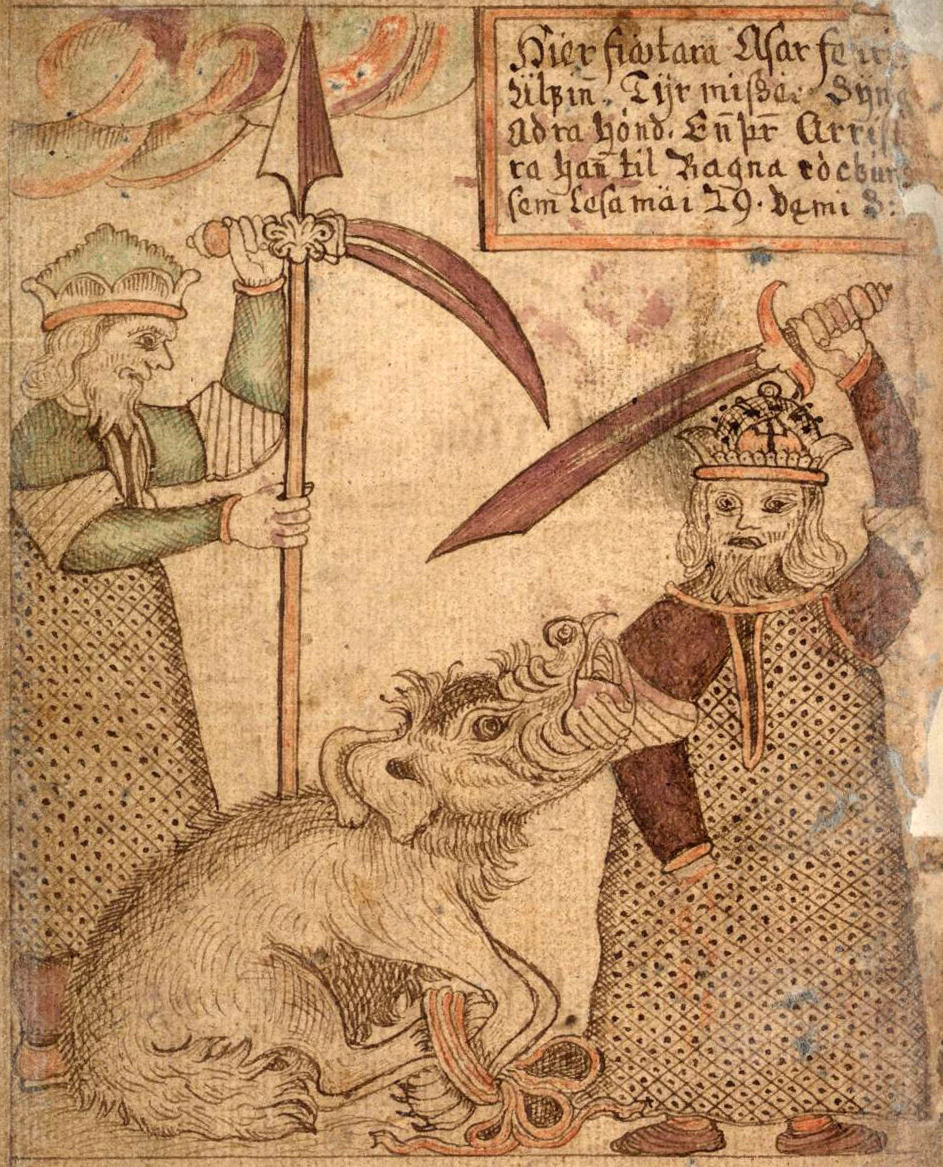

The hand at the jaws
The illustrated hand sits at the front of the wolf’s head. The catalogue identifies this as the loss of Týr’s hand.
The loops at the forelegs
Orange loops cross in front of the wolf and carry the binding down towards the ground.
The manuscript caption
The framed handwriting belongs to the original folio. It shares the page with the image and gives the scene its own space in the manuscript.
Why did the gods bind Fenrir?
In Gylfaginning, Fenrir grows so fast that the gods fear the prophecies predicting their destruction. Týr is the only one willing to feed him. The gods ask the wolf to test his strength against two fetters. When he breaks both, they obtain Gleipnir, a soft-looking bond he will accept only if one of them gives a pledge. Týr puts his right hand in the wolf’s mouth and loses it when the gods keep Fenrir bound. [1][2][4]
Týr’s earlier willingness to approach the wolf matters when the gods look at one another for a volunteer. The story’s danger grows out of something familiar: the person willing to come near Fenrir is also the one whose hand finally guarantees the gods’ promise. Huard’s illustration gives that earlier meeting a scene of its own. [1][4][15]
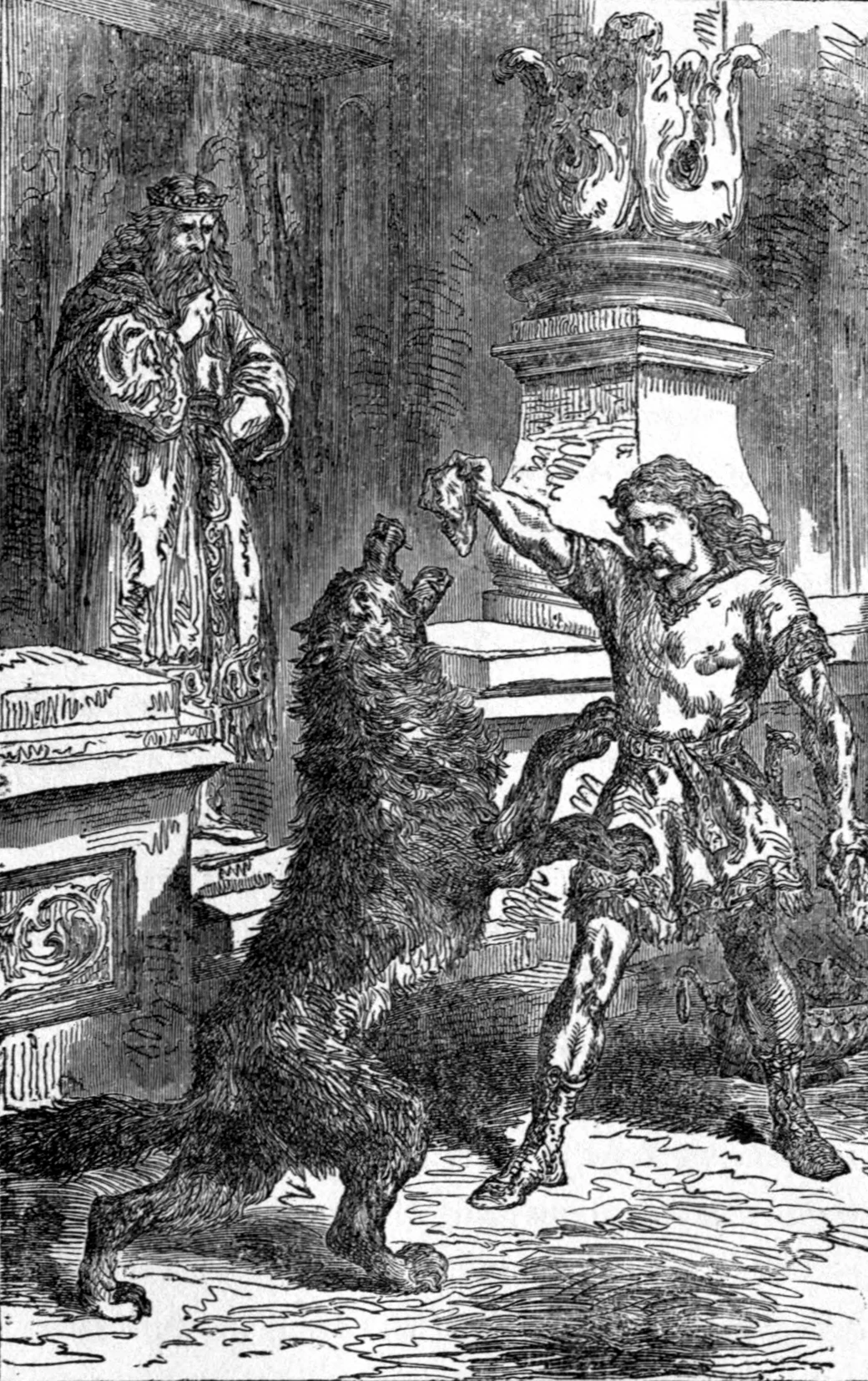
Huard gives the feeding scene its own illustration. In the Prose Edda, Týr was already the one god willing to approach Fenrir before the binding.
Louis Huard, The Heroes of Asgard by A. and E. Keary, 1891 edition. Public-domain reproduction via Wikimedia Commons. · Image source ↗ · Public Domain
The three fetters in order
Fenrir agrees to the first trial because the fetter looks manageable. For the second, the gods appeal to fame. Fenrir can see that Drómi is stronger, but he knows that he has grown stronger too and judges the risk worth taking. Gleipnir reverses that reasoning. Breaking a ribbon would prove little, while consenting to an enchanted binding could cost him his freedom. [1][3][4]
The narrator says the names of the first two bonds survived in proverbial expressions about escaping a difficult situation. That detail makes the early trials more than a prelude. A speaker could refer to getting loose from Læðingr or bursting out of Drómi and assume that the names already conveyed how hard the escape was. [1]
- Læðingr
- A strong fetter. Fenrir accepts the first test and breaks it when he strains against it.
- Drómi
- Stronger by half. Fenrir takes the risk for the sake of fame and scatters the pieces when he breaks free.
- Gleipnir
- A soft dwarf-made band. Fenrir suspects a trick and agrees only after Týr puts a hand in his mouth as a pledge.
What is Gleipnir made of?
The dwarfs use six things: the sound of a cat’s footfall, a woman’s beard, the roots of a rock, a bear’s sinews, a fish’s breath and a bird’s spittle. The narrator challenges Gangleri to test such examples in the world around him. In the story, the reasoning turns the strangeness of the ingredients into evidence for the account. The list is a storyteller’s riddle about things that are hard to find or imagine. [2]
Gleipnir’s softness matters as much as its materials. The gods can show the band to Fenrir as a small thing even though none of them can break it. When he strains, the band tightens. Read this sequence beside the flying pieces of Drómi to see how the final contest changes the rules the wolf thought he understood. [1][3][5]
Which hand does Týr lose, and why?
Both Gylfaginning and Loki’s taunt in Lokasenna specify the right hand. Fenrir asks for a hand as a guarantee that the test is in good faith. Once the gods refuse to free him, he takes the hand that sealed the pledge. Gylfaginning 25 praises Týr’s courage. In chapter 34, everyone laughs except Týr, a detail that keeps the cost of the gods’ success in view. [4][7][8]
Týr’s answer in Lokasenna looks past the loss of his hand. He reminds Loki that Loki has also lost the wolf to captivity and that Fenrir must wait in bonds until Ragnarök. The exchange gives the cost of the event to all three figures: Týr is maimed, Loki is separated from Fenrir and the wolf is left alive but bound. [8][9]
How two manuscripts picture the binding
On folio 78v of SÁM 66, look first at the hand at Fenrir’s mouth, then down to the loops at the forelegs. The picture lets a reader see the bite and the binding at once. The drawn weapons and the clothing belong to an eighteenth-century Icelandic depiction of the story. The folio is evidence of how the story was pictured centuries after the medieval Edda was written. [12][14][4]
MyNDIR pairs this folio with a related illustration in NKS 1867 4to. Its catalogue discusses the figure carrying a spiked club as a possible Thor. That identification depends on a comparison with another tale about Thor and his weapon. The manuscript record leaves it open, so the annotation above describes what can be seen without relying on a certain name. [12][13]
What happens to Fenrir at Ragnarök?
After the bite, the gods secure the bond to a stone and wedge a sword across Fenrir’s jaws. In the story the river Ván flows from his mouth. Asked why they spare the wolf, Hár says the gods will not stain their sanctuary with his blood, even though he is fated to kill Odin. The delay links the binding directly to the prophecy the gods hoped to escape. [5][6]
When bonds break at Ragnarök, Fenrir escapes and swallows Odin. Víðarr avenges him. The prose describes Víðarr bracing a foot on the lower jaw and tearing the wolf apart. The verse quoted in the same chapter describes a sword driven into the wolf’s heart. Týr has his own final opponent, the dog Garmr, in the prose account. Frølich’s picture follows the encounter at the jaws. [10][11][16]
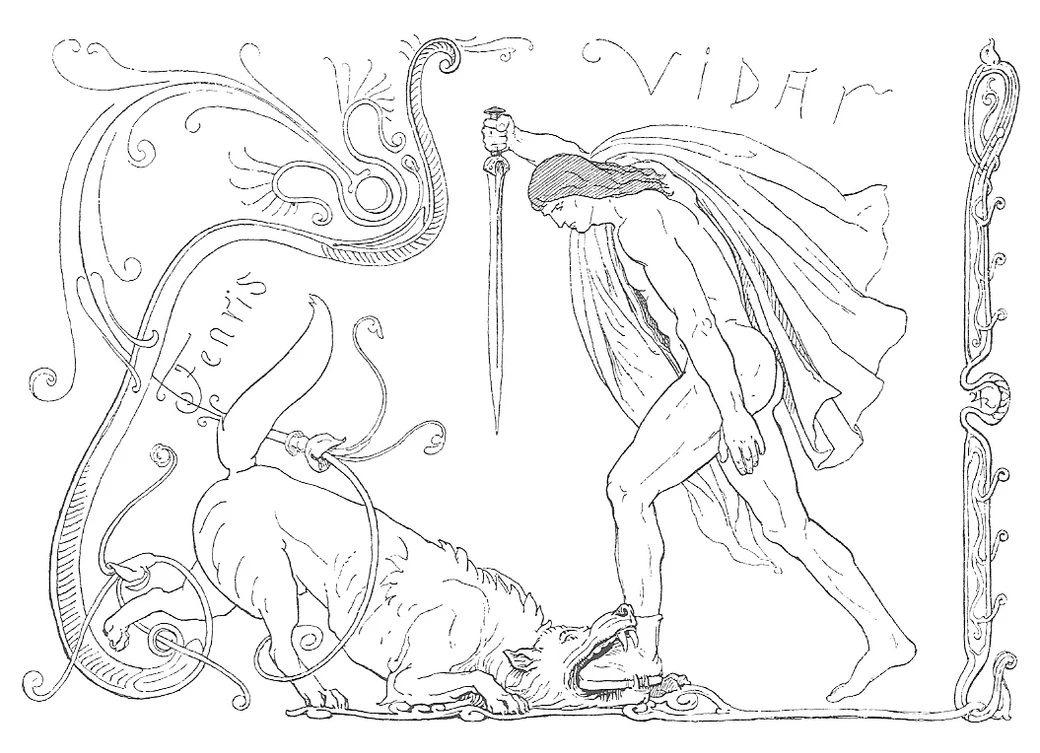
Frølich shows Víðarr bracing himself at the wolf’s jaws. This scene comes after Fenrir breaks free at Ragnarök.
Lorenz Frølich, Den ældre Eddas Gudesange, 1895, page 48. Public-domain reproduction via Wikimedia Commons. · Image source ↗ · Public Domain
Read the binding in Colum’s illustrated retelling
Printed pages 183 and 184 take you from Læðingr to the dwarfs’ list of ingredients, and page 185 follows the soft band to the island. On page 186, Colum gives Týr and Fenrir a line of dialogue absent from the prose source: Týr offers his left hand first, and the wolf demands the sword hand. The same page describes the wolf’s bite and the river that flows until Ragnarök. [17][18][19][20][4]
See references (5)
- Gylfaginning 34.10–11 · Týr’s pledge and the binding
- Colum, printed page 183 · Týr feeds Fenrir and Læðingr breaks
- Colum, printed page 184 · Drómi breaks and the dwarfs name the materials
- Colum, printed page 185 · Gleipnir reaches Asgard and Fenrir is suspicious
- Colum, printed page 186 · Fenrir demands Týr’s sword hand
Read further in the library
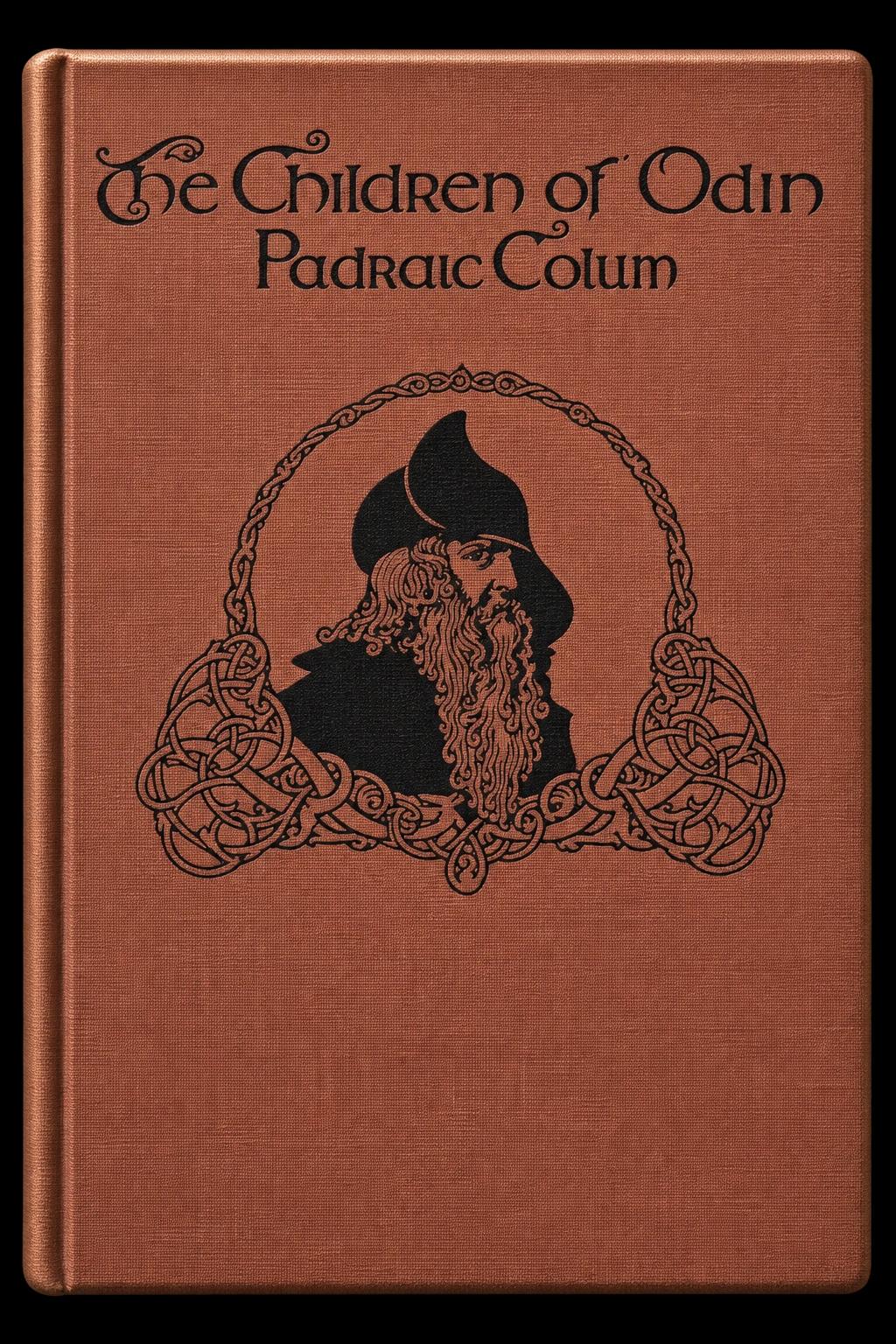
The Children of Odin
Reading note
Open Colum’s sequence from the first broken chain to the loss of Týr’s sword hand.
Sources
See references (20)
- Gylfaginning 34.3 · Læðingr and Drómi break ↗Old Norse and Arthur Gilchrist Brodeur’s 1916 translation.Return to text ↑
- Gylfaginning 34.4–5 · the making of Gleipnir ↗Old Norse and Brodeur’s 1916 translation.Return to text ↑
- Gylfaginning 34.7–9 · the test at Lyngvi ↗The gods test the ribbon and bring it to Fenrir. The following paragraphs record his refusal and their promise.Return to text ↑
- Gylfaginning 34.10–11 · Týr’s pledge and the binding ↗Fenrir asks for the pledge and the following passage names Týr’s right hand.Return to text ↑
- Gylfaginning 34.11 · the sword and the river Ván ↗Brodeur’s translation of the aftermath, when the gods secure the wolf.Return to text ↑
- Gylfaginning 34.12–13 · why do the gods spare Fenrir? ↗Gangleri asks why the gods do not kill the wolf. Hár answers in the following paragraph.Return to text ↑
- Gylfaginning 25.2 · the account of Týr ↗The account of Týr uses the pledge to illustrate his courage.Return to text ↑
- Lokasenna 38 · Loki names the right hand ↗Old Norse and Henry Adams Bellows’s 1923 translation.Return to text ↑
- Lokasenna 39 · Týr answers Loki ↗Týr pairs his loss with Loki’s and says the wolf waits in bonds.Return to text ↑
- Gylfaginning 51.4–5 · Fenrir at Ragnarök ↗The episode narrates the breaking of the bonds, Odin’s death, Víðarr’s revenge and Týr’s separate fight with Garmr.Return to text ↑
- Gylfaginning 51.12 · Víðarr in the quoted verse ↗The quoted Völuspá stanza describes Víðarr driving a sword into the wolf’s heart.Return to text ↑
- MyNDIR · SÁM 66, folio 78v ↗University of Victoria description of Jakob Sigurðsson’s coloured manuscript illustration.Return to text ↑
- MyNDIR · NKS 1867 4to, folio 98v ↗University of Victoria description, including the proposed identification of a figure as Thor.Return to text ↑
- Fenrir and Týr in SÁM 66 ↗Jakob Sigurðsson, SÁM 66, folio 78v, 1765. Árni Magnússon Institute for Icelandic Studies. Public-domain reproduction via Wikimedia Commons.Return to text ↑
- Týr feeding Fenrir ↗Louis Huard, The Heroes of Asgard by A. and E. Keary, 1891 edition. Public-domain reproduction via Wikimedia Commons.Return to text ↑
- Víðarr confronts Fenrir ↗Lorenz Frølich, Den ældre Eddas Gudesange, 1895, page 48. Public-domain reproduction via Wikimedia Commons.Return to text ↑
- Colum, printed page 183 · Týr feeds Fenrir and Læðingr breaksPadraic Colum, The Children of Odin, ‘The Children of Loki,’ printed page 183.Read this page in The Children of Odin ↗Return to text ↑
- Colum, printed page 184 · Drómi breaks and the dwarfs name the materialsPadraic Colum, The Children of Odin, ‘The Children of Loki,’ printed page 184.Read this page in The Children of Odin ↗Return to text ↑
- Colum, printed page 185 · Gleipnir reaches Asgard and Fenrir is suspiciousPadraic Colum, The Children of Odin, ‘The Children of Loki,’ printed page 185.Read this page in The Children of Odin ↗Return to text ↑
- Colum, printed page 186 · Fenrir demands Týr’s sword handPadraic Colum, The Children of Odin, ‘The Children of Loki,’ printed page 186.Read this page in The Children of Odin ↗Return to text ↑