Elementary souls
In Lumen, elementary souls are centres of activity within a larger organism. Compare them with George S. Arundale’s permanent atoms.
In this article
Understanding elementary souls
Elementary souls are small centres of activity that Camille Flammarion’s Lumen places within a larger organism. Their work is coordinated by the soul of the whole individual. The book gives these smaller centres a role in bodily organisation without giving them awareness of themselves. [2][3][4][5][6][7]
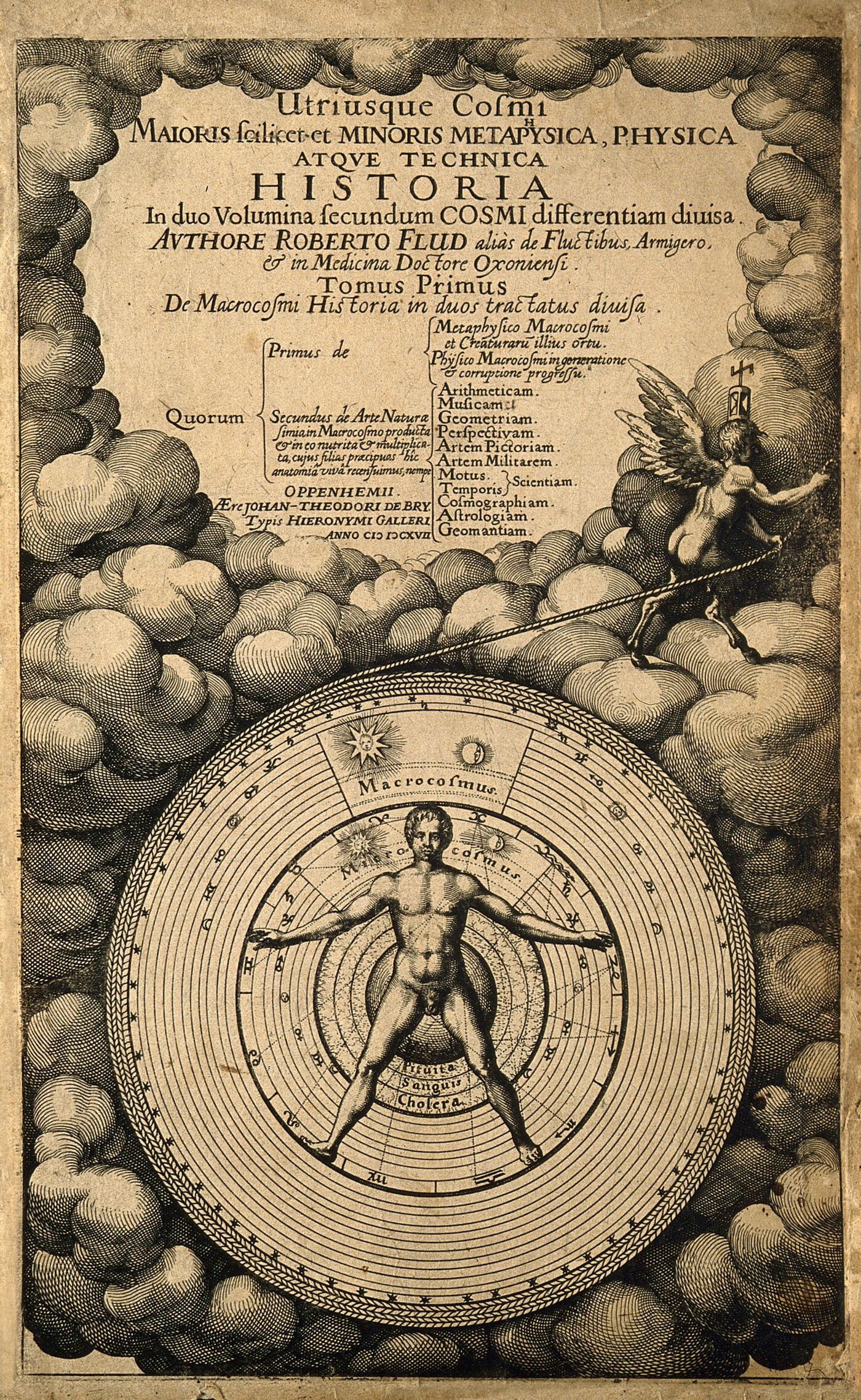
Robert Fludd’s cosmic title page (1617). The engraving represents the human body as a microcosm within the wider universe.
Wellcome Collection, 2989i. T. de Bry, 1617, associated with Robert Fludd. Public Domain Mark. · Image source ↗ · Public Domain
Lumen by Camille Flammarion
In Lumen, Camille Flammarion’s narrator describes matter as centres of force. He compares the human soul with the subordinate centres associated with carbon, oxygen and nerve ganglia. The whole body is a microcosm: its smaller beings carry out activities without knowing themselves as individuals. [3][4][10][11][6][7]
The book compares bodily parts to provinces that govern some of their own affairs under a central authority. It points to regeneration in segmented organisms as an analogy. On the imagined world near Orion, the idea is dramatised by a being that falls apart and pulls itself together again around a directing centre. [8][9][5][6][7]
Kundalini: An Occult Experience by George S. Arundale
In a footnote to Kundalini: An Occult Experience, George S. Arundale describes permanent atoms as nuclei that persist through a change of bodies. A new body is supposed to form through a web emanating from its nucleus. Its vibrations retain the results of experience. [12][13]
Coordinating a body and carrying experience
Flammarion’s centres explain how many parts work together in one organism. Arundale’s permanent atom explains what he believes carries experience forward when a body has disintegrated and another takes form. [3][4][6][7][12][13][5]
Read further in the library

Lumen
Reading note
The separately titled account draws on exact passages in the consulted Library edition.

Kundalini: An Occult Experience
Reading note
Separately attributed comparison with exact previously researched Library passages.
Sources
See references (13)
- Robert Fludd’s microcosm and macrocosm title page, engraving associated with T. de Bry, 1617 ↗Wellcome Collection, 2989i. T. de Bry, 1617, associated with Robert Fludd. Public Domain Mark.
- Lumen, Reader page 200Camille Flammarion, Lumen, authorised English translation by A. A. M. and R. M., Dodd, Mead and Company, New York, 1897. Exact selected Library edition IMJ-0398-E001. Lumen and Quaerens are speakers in the dialogue; claims made by the narrator are attributed to this text. Original PageIDs and current Reader positions are verified separately from printed pagination.Read this page in Lumen ↗Return to text ↑
- Lumen, printed p. 195, Reader page 201Camille Flammarion, Lumen, authorised English translation by A. A. M. and R. M., Dodd, Mead and Company, New York, 1897. Exact selected Library edition IMJ-0398-E001. Lumen and Quaerens are speakers in the dialogue; claims made by the narrator are attributed to this text. Original PageIDs and current Reader positions are verified separately from printed pagination.Read this page in Lumen ↗Return to text ↑
- Lumen, Reader page 202Camille Flammarion, Lumen, authorised English translation by A. A. M. and R. M., Dodd, Mead and Company, New York, 1897. Exact selected Library edition IMJ-0398-E001. Lumen and Quaerens are speakers in the dialogue; claims made by the narrator are attributed to this text. Original PageIDs and current Reader positions are verified separately from printed pagination.Read this page in Lumen ↗Return to text ↑
- Lumen, Reader page 207Camille Flammarion, Lumen, authorised English translation by A. A. M. and R. M., Dodd, Mead and Company, New York, 1897. Exact selected Library edition IMJ-0398-E001. Lumen and Quaerens are speakers in the dialogue; claims made by the narrator are attributed to this text. Original PageIDs and current Reader positions are verified separately from printed pagination.Read this page in Lumen ↗Return to text ↑
- Lumen, Reader page 208Camille Flammarion, Lumen, authorised English translation by A. A. M. and R. M., Dodd, Mead and Company, New York, 1897. Exact selected Library edition IMJ-0398-E001. Lumen and Quaerens are speakers in the dialogue; claims made by the narrator are attributed to this text. Original PageIDs and current Reader positions are verified separately from printed pagination.Read this page in Lumen ↗Return to text ↑
- Lumen, Reader page 209Camille Flammarion, Lumen, authorised English translation by A. A. M. and R. M., Dodd, Mead and Company, New York, 1897. Exact selected Library edition IMJ-0398-E001. Lumen and Quaerens are speakers in the dialogue; claims made by the narrator are attributed to this text. Original PageIDs and current Reader positions are verified separately from printed pagination.Read this page in Lumen ↗Return to text ↑
- Lumen, Reader page 205Camille Flammarion, Lumen, authorised English translation by A. A. M. and R. M., Dodd, Mead and Company, New York, 1897. Exact selected Library edition IMJ-0398-E001. Lumen and Quaerens are speakers in the dialogue; claims made by the narrator are attributed to this text. Original PageIDs and current Reader positions are verified separately from printed pagination.Read this page in Lumen ↗Return to text ↑
- Lumen, Reader page 206Camille Flammarion, Lumen, authorised English translation by A. A. M. and R. M., Dodd, Mead and Company, New York, 1897. Exact selected Library edition IMJ-0398-E001. Lumen and Quaerens are speakers in the dialogue; claims made by the narrator are attributed to this text. Original PageIDs and current Reader positions are verified separately from printed pagination.Read this page in Lumen ↗Return to text ↑
- Lumen, printed p. 103, Reader page 109Camille Flammarion, Lumen, authorised English translation by A. A. M. and R. M., Dodd, Mead and Company, New York, 1897. Exact selected Library edition IMJ-0398-E001. Lumen and Quaerens are speakers in the dialogue; claims made by the narrator are attributed to this text. Original PageIDs and current Reader positions are verified separately from printed pagination.Read this page in Lumen ↗Return to text ↑
- Lumen, printed p. 104, Reader page 110Camille Flammarion, Lumen, authorised English translation by A. A. M. and R. M., Dodd, Mead and Company, New York, 1897. Exact selected Library edition IMJ-0398-E001. Lumen and Quaerens are speakers in the dialogue; claims made by the narrator are attributed to this text. Original PageIDs and current Reader positions are verified separately from printed pagination.Read this page in Lumen ↗Return to text ↑
- Kundalini: An Occult Experience, printed p. 88, Reader page 90George S. Arundale, Kundalini: An Occult Experience, The Theosophical Publishing House, Adyar, Madras, India, 1938. Consulted Library edition IMJ-0227-E001.Read this page in Kundalini: An Occult Experience ↗Return to text ↑
- Kundalini: An Occult Experience, printed p. 89, Reader page 91George S. Arundale, Kundalini: An Occult Experience, The Theosophical Publishing House, Adyar, Madras, India, 1938. Consulted Library edition IMJ-0227-E001.Read this page in Kundalini: An Occult Experience ↗Return to text ↑