Permanent atoms in Theosophy
Permanent atoms are enduring nuclei in Theosophical accounts of rebirth. Read how Arundale says they carry experience and help form new bodies.
In this article
Understanding the concept
A permanent atom is an enduring nucleus said to carry traces of a person’s experience from one embodiment to another. The idea belongs to Theosophy, where a person can have several bodies and a new body can be built around what persists from an earlier one. [3][4]
Kundalini: An Occult Experience by George S. Arundale
George S. Arundale explains the term in a footnote. He says each body has a nucleus that survives its disintegration and remains in the higher aura. A web is supposed to extend from that nucleus and give a subsequent body its framework. He attributes the record of experience to a capacity for many vibrations. [3]
In the main text, Arundale suggests that an individual’s Kundalini may be something like a permanent atom. He imagines the Fire gathering experience before returning to its universal source for rest. The analogy gives him a way to picture what might carry that experience into a later phase. [3][4]
A Study in Consciousness by Annie Besant
Annie Besant groups a physical atom, an astral atom and a mental unit on a thread she calls the Sūtrātmā. In her diagram, the dotted line connects them to the higher spiritual triad. The following page describes a fine mesh extending from that thread as the framework in which a body takes shape. Besant gives a diagram to a relation Arundale evokes through the image of a web. [5][6]
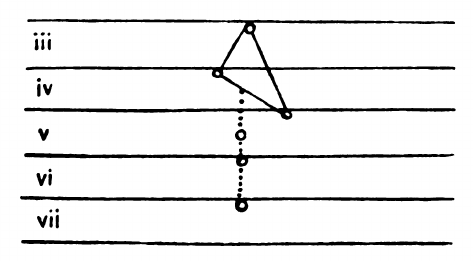
Besant’s diagram shows the physical atom, astral atom and mental unit joined to the spiritual triad above. A Study in Consciousness (1904), printed p. 90.
Annie Besant, Theosophical Publishing Society, 1904. Harvard University copy digitized by Google and hosted by Internet Archive. Public-domain diagram cropped from PDF leaf 105. · Image source ↗ · Public Domain
Bhagavad Gita 2.22, translated and interpreted by Swami Mukundananda
In Bhagavad Gita 2.22, Krishna compares taking another body to changing clothes. Swami Mukundananda’s translation and commentary emphasize that the soul continues while the bodies it wears change. [1]
Majjhima Nikāya 38, translated by Bhikkhu Sujato
In Majjhima Nikāya 38, the monk Sāti says the same consciousness goes from life to life. In Bhikkhu Sujato’s translation, the Buddha rejects that account and explains that consciousness arises dependent on conditions. He uses the analogy of fire, which is named for what it burns. [2]
What carries experience across lives?
The Gita pictures a continuing soul exchanging bodies. Arundale proposes enduring nuclei that help new bodies take shape and carry a record of experience. The garment image explains continuity, while the Theosophical account proposes a mechanism. [1][3][4]
The Buddhist discourse examines the claim that one consciousness persists unchanged. Its explanation attends to the conditions under which consciousness arises and gives the reader a different way to think about continuity. [2][3]
Read further in the library
Kundalini: An Occult Experience
Reading note
The separately titled account draws on exact passages in the consulted Library edition.
Sources
See references (6)
- Bhagavad Gita 2.22, the image of changing garments ↗Bhagavad Gita, chapter2 verse 22, translation and commentary by Swami Mukundananda.Return to text ↑
- Majjhima Nikaya 38, §§ 2–8: consciousness and conditions ↗Bhikkhu Sujato’s translation on SuttaCentral. Exact segments 2–8 checked in SuttaCentral’s official published Bilara source.Return to text ↑
- Kundalini: An Occult Experience, printed p. 88, Reader page 90George S. Arundale, Kundalini: An Occult Experience, The Theosophical Publishing House, Adyar, Madras, India, 1938. Consulted Library edition IMJ-0227-E001.Read this page in Kundalini: An Occult Experience ↗Return to text ↑
- Kundalini: An Occult Experience, printed p. 89, Reader page 91George S. Arundale, Kundalini: An Occult Experience, The Theosophical Publishing House, Adyar, Madras, India, 1938. Consulted Library edition IMJ-0227-E001.Read this page in Kundalini: An Occult Experience ↗Return to text ↑
- A Study in Consciousness (1904), printed p. 90, PDF leaf 105 ↗Annie Besant, A Study in Consciousness, Theosophical Publishing Society and John Lane, 1904. Harvard University copy digitized by Google.Return to text ↑
- A Study in Consciousness (1904), printed p. 91, PDF leaf 106 ↗Annie Besant, A Study in Consciousness, Theosophical Publishing Society and John Lane, 1904. Harvard University copy digitized by Google.Return to text ↑