Doppelgängers
A doppelgänger is a double of a living person. See Rossetti’s woodland encounter and Frank Hamel’s stories of a duplicate nurse and an absent shepherd.
In this article
What is a doppelgänger?
A doppelgänger is a figure that looks like a living person. Someone might meet their own likeness, as the lovers do in Rossetti’s drawing, or see a familiar person who is believed to be elsewhere. [1][2][11][10]
A story can explain the double as a projected self, a deceptive spirit or an appearance whose cause remains unresolved. The likeness creates the puzzle. The explanation depends on what else the story establishes about the person and the figure. [1][3][2][4]
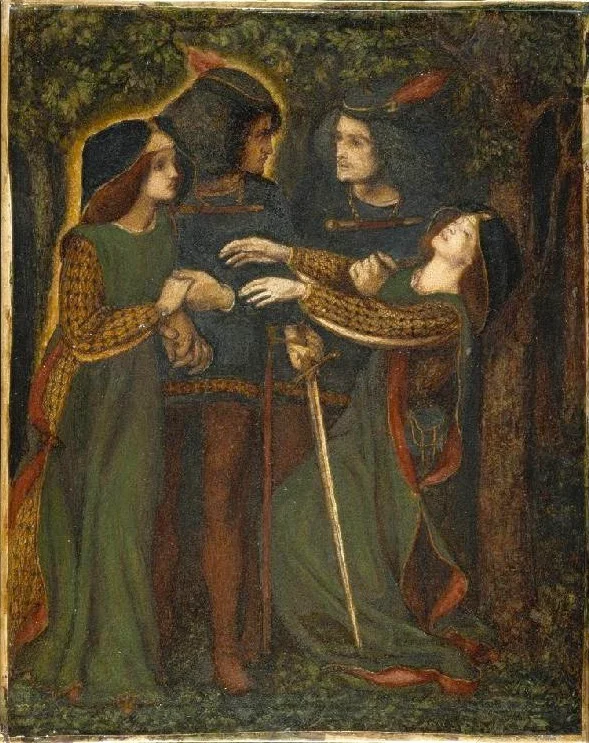
Dante Gabriel Rossetti, How They Met Themselves, about 1860–64. A couple in a wood encounters a second version of themselves.
Dante Gabriel Rossetti, 1828–1882. Faithful reproduction of a public-domain painting, via Wikimedia Commons. · Image source ↗ · Public Domain
See references (6)
- Human Animals, printed p. 96, Reader page 105
- Human Animals, printed p. 262, Reader page 271
- Human Animals, printed p. 261, Reader page 270
- Human Animals, printed p. 265, Reader page 274
- Dante Gabriel Rossetti, How They Met Themselves, about 1860–64
- Dante Gabriel Rossetti, How They Met Themselves, work history
Human Animals by Frank Hamel
In Frank Hamel’s Human Animals, a fox story presents two figures who look like the same nurse. The second may be a fox or another kind of spirit. The story turns on the uncertainty: the likeness is clear, but the being behind it is not. [1]
Hamel draws on Adolphe d’Assier for a story about a shepherd whose appearance is seen away from his body. The dogs respond as if they recognise the person they know. This is part of the evidence the story offers its reader for identifying the double. [3][2]
Other passages complicate the category by introducing animal-shaped human phantoms. Hamel notes that the same outward animal form can receive incompatible explanations. A double need not be a surviving dead person, and an animal appearance need not be the ghost of an animal. [4][5]
The witness and the absent person
Astral projection puts the person’s journey at the centre of the account. A doppelgänger story can be told entirely from the witness’s side, where the puzzle is seeing a recognisable figure in an unexpected place. [6][7][2]
Animal doubles can remain recognisable by behaviour or a shared wound even when they lack a human likeness. An external-soul story adds a connection between the two lives. The image of a double covers all these comparisons, but the clue that makes the identification changes. [8][9][1][4][5]
See references (8)
- Human Animals, printed p. 96, Reader page 105
- Human Animals, printed p. 262, Reader page 271
- Human Animals, printed p. 265, Reader page 274
- Human Animals, printed p. 266, Reader page 275
- Human Animals, printed p. 68, Reader page 77
- Human Animals, printed p. 69, Reader page 78
- Human Animals, printed p. 20, Reader page 29
- Human Animals, printed p. 21, Reader page 30
Read further in the library
Human Animals
Reading note
Frank Hamel collects the particular stories and interpretations discussed here; the account identifies exact printed and Library Reader pages.
Sources
See references (11)
- Human Animals, printed p. 96, Reader page 105Frank Hamel, Human Animals. Frederick A. Stokes Co., New York, undated title page; preface dated London, 1915. Exact printed pages refer to the retained Library scan.Read this page in Human Animals ↗Return to text ↑
- Human Animals, printed p. 262, Reader page 271Frank Hamel, Human Animals. Frederick A. Stokes Co., New York, undated title page; preface dated London, 1915. Exact printed pages refer to the retained Library scan.Read this page in Human Animals ↗Return to text ↑
- Human Animals, printed p. 261, Reader page 270Frank Hamel, Human Animals. Frederick A. Stokes Co., New York, undated title page; preface dated London, 1915. Exact printed pages refer to the retained Library scan.Read this page in Human Animals ↗Return to text ↑
- Human Animals, printed p. 265, Reader page 274Frank Hamel, Human Animals. Frederick A. Stokes Co., New York, undated title page; preface dated London, 1915. Exact printed pages refer to the retained Library scan.Read this page in Human Animals ↗Return to text ↑
- Human Animals, printed p. 266, Reader page 275Frank Hamel, Human Animals. Frederick A. Stokes Co., New York, undated title page; preface dated London, 1915. Exact printed pages refer to the retained Library scan.Read this page in Human Animals ↗Return to text ↑
- Human Animals, printed p. 68, Reader page 77Frank Hamel, Human Animals. Frederick A. Stokes Co., New York, undated title page; preface dated London, 1915. Exact printed pages refer to the retained Library scan.Read this page in Human Animals ↗Return to text ↑
- Human Animals, printed p. 69, Reader page 78Frank Hamel, Human Animals. Frederick A. Stokes Co., New York, undated title page; preface dated London, 1915. Exact printed pages refer to the retained Library scan.Read this page in Human Animals ↗Return to text ↑
- Human Animals, printed p. 20, Reader page 29Frank Hamel, Human Animals. Frederick A. Stokes Co., New York, undated title page; preface dated London, 1915. Exact printed pages refer to the retained Library scan.Read this page in Human Animals ↗Return to text ↑
- Human Animals, printed p. 21, Reader page 30Frank Hamel, Human Animals. Frederick A. Stokes Co., New York, undated title page; preface dated London, 1915. Exact printed pages refer to the retained Library scan.Read this page in Human Animals ↗Return to text ↑
- Dante Gabriel Rossetti, How They Met Themselves, about 1860–64 ↗Dante Gabriel Rossetti, 1828–1882. Faithful reproduction of a public-domain painting, via Wikimedia Commons.Return to text ↑
- Dante Gabriel Rossetti, How They Met Themselves, work history ↗Rossetti Archive, University of Virginia.Return to text ↑