Divine Grace
Divine grace is God’s freely given help and gift of life. Explore the Catholic account and compare gift, response and mercy in Dante and Swedenborg.
In this article
What is divine grace?
Divine grace is God’s freely given help and gift of life in Christian theology. The Catholic Catechism describes it as participation in divine life and help that heals and sanctifies. The word gift identifies where the help comes from, while leaving room to ask how a person receives it. [1]
Gift and response
The Catholic Catechism distinguishes a lasting disposition to live with God from particular acts of help along the way. Even becoming ready to receive grace involves grace, and the person’s response is free. The Catechism says feeling certain of something is an insufficient way to tell whether one is justified. [1]
The Divine Comedy by Dante Alighieri
In Dante Alighieri’s Paradise XX, the pilgrim sees Trajan and Ripheus among the blessed in the eagle’s eye. He cannot reconcile their presence with what he knows of their lives. The eagle’s answer gives each a history of help and belief that was hidden from earthly observers. [2][3]
Trajan is said to have returned to bodily life, believed in Christ and then died again in love. Ripheus is granted an understanding of the future redemption, while the three theological virtues supply what the narrative describes as his baptismal sponsorship. The poem does not simply set aside its Christian framework. It imagines grace operating beyond the biographies and religious labels available to Dante’s first judgment. [3][4]
The eagle ends with a limit: even the blessed do not know the full number of the chosen. Their happiness includes agreement with the divine good without possessing every explanation. Grace here calls for humility about another person’s final destiny. These are poetic accounts of ancient figures, rather than independently established episodes in their historical lives. [4]
Paradise XXXII applies gift differently to children who died before they could choose for themselves. Their differing places are attributed to grace rather than personal accomplishments. The following canto carries the pilgrim himself beyond his own powers. Prayer, strengthened sight and a final illuminating flash make possible what effort and analogy could not complete. Grace becomes part of both the subject of the vision and the telling of how it was reached. [5][6][7][8]
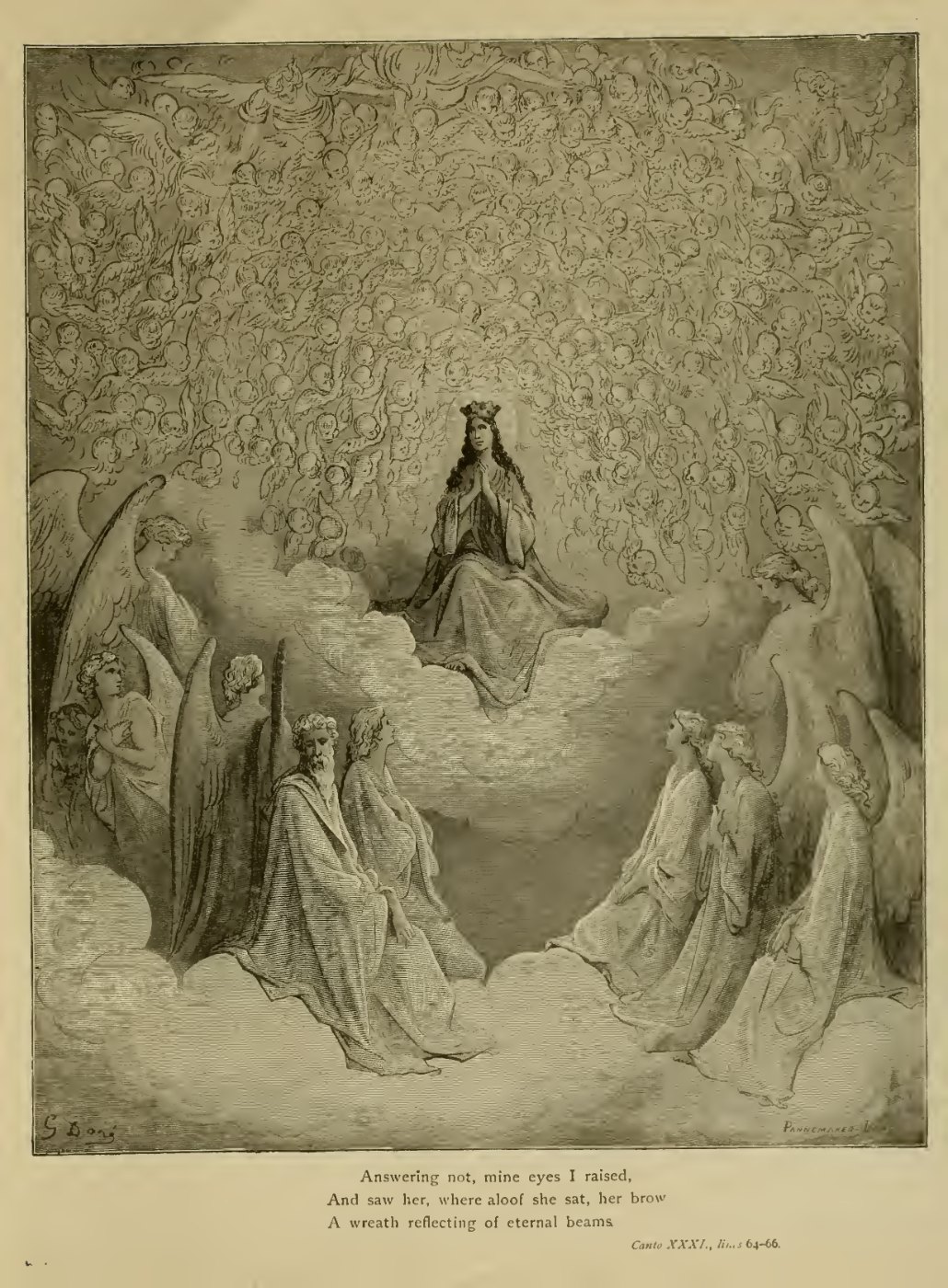
Beatrice in her heavenly place, Doré’s design for Paradise XXXI. Dante has just thanked her for the help that brought him from bondage towards freedom. The scene gives received assistance a personal face.
Design by Gustave Doré. Purgatory and Paradise, Henry Francis Cary translation, Thompson & Thomas, Chicago, 1901. Public Domain. · Image source ↗ · Public Domain
See references (7)
- Purgatory and Paradise, Paradise XX, Reader page 302
- Purgatory and Paradise, Paradise XX, Reader page 303
- Purgatory and Paradise, Paradise XX, Reader page 304
- Purgatory and Paradise, Paradise XXXII, Reader page 360
- Purgatory and Paradise, Paradise XXXII, Reader page 361
- Purgatory and Paradise, Paradise XXXIII, Reader page 366
- Purgatory and Paradise, Paradise XXXIII, Reader page 368
Heaven and Its Wonders and Hell
In Heaven and Its Wonders and Hell, Emanuel Swedenborg discusses salvation through the language of Divine mercy. He says that mercy is directed towards the whole human race and is never withdrawn from anyone. Yet it operates through means: truths that disclose how to live, a turning away from evil and a growing reception of heavenly life. [15][16][17]
Admission alone cannot provide that life. Swedenborg reports spirits allowed to approach heaven who found its light and warmth unbearable because their loves opposed what the surroundings expressed. The problem was not a lack of permission to enter. It was the relation between their inward life and the life they were trying to receive. [17][18]
This is also why exemplary names confer no automatic privilege. Abraham, Isaac, Jacob, David and the apostles are said to be received according to their lives, while their scriptural names bear further meanings in Swedenborg’s account of correspondences. People born outside Christianity may receive heavenly instruction where their lives have expressed charity, although his account gives that instruction a Christian end. [10][11][12][13][14][19][20]
Swedenborg’s phrase mercy through means should not be mistaken for a denial of Divine initiative. He attributes the guidance itself to the Lord. At the same time, he rejects a last-minute favour that would replace an evil ruling love with a heavenly one after death. That limitation belongs to his particular explanation of salvation and keeps it distinct from other accounts of grace. [16][17][19][20][21]
See references (12)
- Heaven and Its Wonders and Hell, printed p. 258, Reader page 265
- Heaven and Its Wonders and Hell, printed p. 261, Reader page 268
- Heaven and Its Wonders and Hell, printed p. 262, Reader page 269
- Heaven and Its Wonders and Hell, printed p. 267, Reader page 274
- Heaven and Its Wonders and Hell, printed p. 268, Reader page 275
- Heaven and Its Wonders and Hell, printed p. 479, Reader page 486
- Heaven and Its Wonders and Hell, printed p. 480, Reader page 487
- Heaven and Its Wonders and Hell, printed p. 481, Reader page 488
- Heaven and Its Wonders and Hell, printed p. 482, Reader page 489
- Heaven and Its Wonders and Hell, printed p. 484, Reader page 491
- Heaven and Its Wonders and Hell, printed p. 485, Reader page 492
- Heaven and Its Wonders and Hell, printed p. 486, Reader page 493
Divine initiative and the means of reception
Dante makes the limits of the pilgrim’s knowledge part of his account of grace. Swedenborg gives divine mercy a continual role through guidance and changed conduct, with a settled ruling love carrying forward after death. Both give the divine initiative a place alongside what the person comes to do or become. [2][3][5][6][7][8][15][16][17][19][20][21]
See references (12)
- Purgatory and Paradise, Paradise XX, Reader page 302
- Purgatory and Paradise, Paradise XX, Reader page 303
- Purgatory and Paradise, Paradise XXXII, Reader page 360
- Purgatory and Paradise, Paradise XXXII, Reader page 361
- Purgatory and Paradise, Paradise XXXIII, Reader page 366
- Purgatory and Paradise, Paradise XXXIII, Reader page 368
- Heaven and Its Wonders and Hell, printed p. 479, Reader page 486
- Heaven and Its Wonders and Hell, printed p. 480, Reader page 487
- Heaven and Its Wonders and Hell, printed p. 481, Reader page 488
- Heaven and Its Wonders and Hell, printed p. 484, Reader page 491
- Heaven and Its Wonders and Hell, printed p. 485, Reader page 492
- Heaven and Its Wonders and Hell, printed p. 486, Reader page 493
Read further in the library
Purgatory and Paradise: The Vision of Dante
Reading note
A separately attributed account in the consulted Cary translation, with exact current Library Reader leaves.

Heaven and Its Wonders and Hell
Reading note
Mercy operates through guidance and reception of heavenly life, rather than admission by favour alone.
Sources
See references (21)
- Catechism of the Catholic Church, 1996–2005: grace ↗Catholic Church, official account of grace, divine initiative and human response.Return to text ↑
- Purgatory and Paradise, Paradise XX, Reader page 302Dante Alighieri, The Divine Comedy, translated by Henry Francis Cary. Inferno: undated New Edition, Thompson & Thomas, Chicago. Purgatory and Paradise: New Edition, Thompson & Thomas, Chicago, 1901. Designs by Gustave Doré.Read this page in Purgatory and Paradise: The Vision of Dante ↗Return to text ↑
- Purgatory and Paradise, Paradise XX, Reader page 303Dante Alighieri, The Divine Comedy, translated by Henry Francis Cary. Inferno: undated New Edition, Thompson & Thomas, Chicago. Purgatory and Paradise: New Edition, Thompson & Thomas, Chicago, 1901. Designs by Gustave Doré.Read this page in Purgatory and Paradise: The Vision of Dante ↗Return to text ↑
- Purgatory and Paradise, Paradise XX, Reader page 304Dante Alighieri, The Divine Comedy, translated by Henry Francis Cary. Inferno: undated New Edition, Thompson & Thomas, Chicago. Purgatory and Paradise: New Edition, Thompson & Thomas, Chicago, 1901. Designs by Gustave Doré.Read this page in Purgatory and Paradise: The Vision of Dante ↗Return to text ↑
- Purgatory and Paradise, Paradise XXXII, Reader page 360Dante Alighieri, The Divine Comedy, translated by Henry Francis Cary. Inferno: undated New Edition, Thompson & Thomas, Chicago. Purgatory and Paradise: New Edition, Thompson & Thomas, Chicago, 1901. Designs by Gustave Doré.Read this page in Purgatory and Paradise: The Vision of Dante ↗Return to text ↑
- Purgatory and Paradise, Paradise XXXII, Reader page 361Dante Alighieri, The Divine Comedy, translated by Henry Francis Cary. Inferno: undated New Edition, Thompson & Thomas, Chicago. Purgatory and Paradise: New Edition, Thompson & Thomas, Chicago, 1901. Designs by Gustave Doré.Read this page in Purgatory and Paradise: The Vision of Dante ↗Return to text ↑
- Purgatory and Paradise, Paradise XXXIII, Reader page 366Dante Alighieri, The Divine Comedy, translated by Henry Francis Cary. Inferno: undated New Edition, Thompson & Thomas, Chicago. Purgatory and Paradise: New Edition, Thompson & Thomas, Chicago, 1901. Designs by Gustave Doré.Read this page in Purgatory and Paradise: The Vision of Dante ↗Return to text ↑
- Purgatory and Paradise, Paradise XXXIII, Reader page 368Dante Alighieri, The Divine Comedy, translated by Henry Francis Cary. Inferno: undated New Edition, Thompson & Thomas, Chicago. Purgatory and Paradise: New Edition, Thompson & Thomas, Chicago, 1901. Designs by Gustave Doré.Read this page in Purgatory and Paradise: The Vision of Dante ↗Return to text ↑
- Purgatory and Paradise, Paradise XXXI, Reader page 363Dante Alighieri, The Divine Comedy, translated by Henry Francis Cary. Inferno: undated New Edition, Thompson & Thomas, Chicago. Purgatory and Paradise: New Edition, Thompson & Thomas, Chicago, 1901. Designs by Gustave Doré.Read this page in Purgatory and Paradise: The Vision of Dante ↗
- Heaven and Its Wonders and Hell, printed p. 258, Reader page 265Emanuel Swedenborg, Heaven and Its Wonders and Hell, translated by J. C. Ager. The American Swedenborg Printing and Publishing Society, New York, 1916. Original Latin work first published in 1758.Read this page in Heaven and Its Wonders and Hell ↗Return to text ↑
- Heaven and Its Wonders and Hell, printed p. 261, Reader page 268Emanuel Swedenborg, Heaven and Its Wonders and Hell, translated by J. C. Ager. The American Swedenborg Printing and Publishing Society, New York, 1916. Original Latin work first published in 1758.Read this page in Heaven and Its Wonders and Hell ↗Return to text ↑
- Heaven and Its Wonders and Hell, printed p. 262, Reader page 269Emanuel Swedenborg, Heaven and Its Wonders and Hell, translated by J. C. Ager. The American Swedenborg Printing and Publishing Society, New York, 1916. Original Latin work first published in 1758.Read this page in Heaven and Its Wonders and Hell ↗Return to text ↑
- Heaven and Its Wonders and Hell, printed p. 267, Reader page 274Emanuel Swedenborg, Heaven and Its Wonders and Hell, translated by J. C. Ager. The American Swedenborg Printing and Publishing Society, New York, 1916. Original Latin work first published in 1758.Read this page in Heaven and Its Wonders and Hell ↗Return to text ↑
- Heaven and Its Wonders and Hell, printed p. 268, Reader page 275Emanuel Swedenborg, Heaven and Its Wonders and Hell, translated by J. C. Ager. The American Swedenborg Printing and Publishing Society, New York, 1916. Original Latin work first published in 1758.Read this page in Heaven and Its Wonders and Hell ↗Return to text ↑
- Heaven and Its Wonders and Hell, printed p. 479, Reader page 486Emanuel Swedenborg, Heaven and Its Wonders and Hell, translated by J. C. Ager. The American Swedenborg Printing and Publishing Society, New York, 1916. Original Latin work first published in 1758.Read this page in Heaven and Its Wonders and Hell ↗Return to text ↑
- Heaven and Its Wonders and Hell, printed p. 480, Reader page 487Emanuel Swedenborg, Heaven and Its Wonders and Hell, translated by J. C. Ager. The American Swedenborg Printing and Publishing Society, New York, 1916. Original Latin work first published in 1758.Read this page in Heaven and Its Wonders and Hell ↗Return to text ↑
- Heaven and Its Wonders and Hell, printed p. 481, Reader page 488Emanuel Swedenborg, Heaven and Its Wonders and Hell, translated by J. C. Ager. The American Swedenborg Printing and Publishing Society, New York, 1916. Original Latin work first published in 1758.Read this page in Heaven and Its Wonders and Hell ↗Return to text ↑
- Heaven and Its Wonders and Hell, printed p. 482, Reader page 489Emanuel Swedenborg, Heaven and Its Wonders and Hell, translated by J. C. Ager. The American Swedenborg Printing and Publishing Society, New York, 1916. Original Latin work first published in 1758.Read this page in Heaven and Its Wonders and Hell ↗Return to text ↑
- Heaven and Its Wonders and Hell, printed p. 484, Reader page 491Emanuel Swedenborg, Heaven and Its Wonders and Hell, translated by J. C. Ager. The American Swedenborg Printing and Publishing Society, New York, 1916. Original Latin work first published in 1758.Read this page in Heaven and Its Wonders and Hell ↗Return to text ↑
- Heaven and Its Wonders and Hell, printed p. 485, Reader page 492Emanuel Swedenborg, Heaven and Its Wonders and Hell, translated by J. C. Ager. The American Swedenborg Printing and Publishing Society, New York, 1916. Original Latin work first published in 1758.Read this page in Heaven and Its Wonders and Hell ↗Return to text ↑
- Heaven and Its Wonders and Hell, printed p. 486, Reader page 493Emanuel Swedenborg, Heaven and Its Wonders and Hell, translated by J. C. Ager. The American Swedenborg Printing and Publishing Society, New York, 1916. Original Latin work first published in 1758.Read this page in Heaven and Its Wonders and Hell ↗Return to text ↑