Deathbed Visions
Deathbed visions are experiences reported near the end of life. Compare historical bedside accounts and hospice research on dreams and visions.
In this article
What are deathbed visions?
Deathbed visions are experiences reported near the end of life, such as seeming to see a person, a place or the start of a journey. Hospice researchers use the broader term end-of-life dreams and visions for experiences reported during sleep as well as waking. [1][2][5]
The subject concerns what the dying person reports experiencing. It differs from a deathbed apparition in which someone elsewhere believes they have seen a person who is dying. It also differs from a life review, where the central experience is the return or reassessment of one’s memories. These experiences can share themes without being interchangeable. [5][7]
See references (4)
- Kerr et al., End-of-life dreams and visions: a longitudinal study of hospice patients’ experiences (2014), abstract
- Nosek et al., End-of-Life Dreams and Visions: A Qualitative Perspective From Hospice Patients (2015), abstract
- The Encyclopaedia of Death and Life in Spirit-World, Volume I, printed p. 157, Reader page 156
- The Encyclopaedia of Death and Life in Spirit-World, Volume I, printed p. 229, Reader page 228
What hospice interviews can tell us
Christopher W. Kerr and colleagues interviewed hospice inpatients over time. In the final sample of 59 patients, common experiences involved living or deceased relatives and friends. Almost half of the experiences occurred during sleep. Patients rated experiences involving deceased people as especially comforting. [1]
Cheryl L. Nosek, Kerr and colleagues analysed interviews with 63 hospice patients. Those accounts include people felt to be waiting, the sense of preparing for a journey, and experiences of distress or unfinished business. The interviews record what patients described and how it felt to them. [2]
The Encyclopaedia of Death and Life in Spirit-World, Volume I
J. R. Francis’s The Encyclopaedia of Death and Life in Spirit-World, Volume I, brings together a bedside narrative and an argument against the spiritual interpretation of such narratives. In ‘I See the Angels Now’, the Reverend A. A. Miner recounts his attendance on Julia Avery Norris, an eleven-year-old whose family has been told that she will not recover. The anthology identifies The Universalist as the source of Miner’s account. [4][5]
Julia first anticipates seeing Henry, her deceased brother, and other relatives. Later, Miner reports, she describes a boat approaching the shore. Asked whether she sees Henry, she initially says she does not; only afterwards does she say he is in the boat. She takes leave of the people present and subsequently speaks of angels. The sequence gives the story its character: an anticipated reunion becomes a reported scene, followed by farewells to the household. [5]
Miner presents this as a consoling final encounter and emphasises Julia’s coherence. His narrative nevertheless describes considerable physical suffering during the same interval. The presence of a comforting vision therefore does not make this a story of an entirely painless death. What survives in the anthology is the minister’s account of Julia’s words, not a statement from Henry or a separately verified description of another world. [5]
A different voice appears in Thomas D. Spencer’s discussion of dying visions, reproduced from Popular Science Monthly. Spencer proposes a physiological explanation and treats the figures seen as products of memory and imagination. Bracketed editorial interjections dispute him repeatedly, sometimes suggesting that an experience could be genuinely spiritual. The anthology thus preserves a disagreement within its own pages. Spencer’s nineteenth-century mechanism is a historical proposal, while the editorial objections express the spiritual position resisting it; neither becomes established simply by appearing beside the other. [6][7][8]
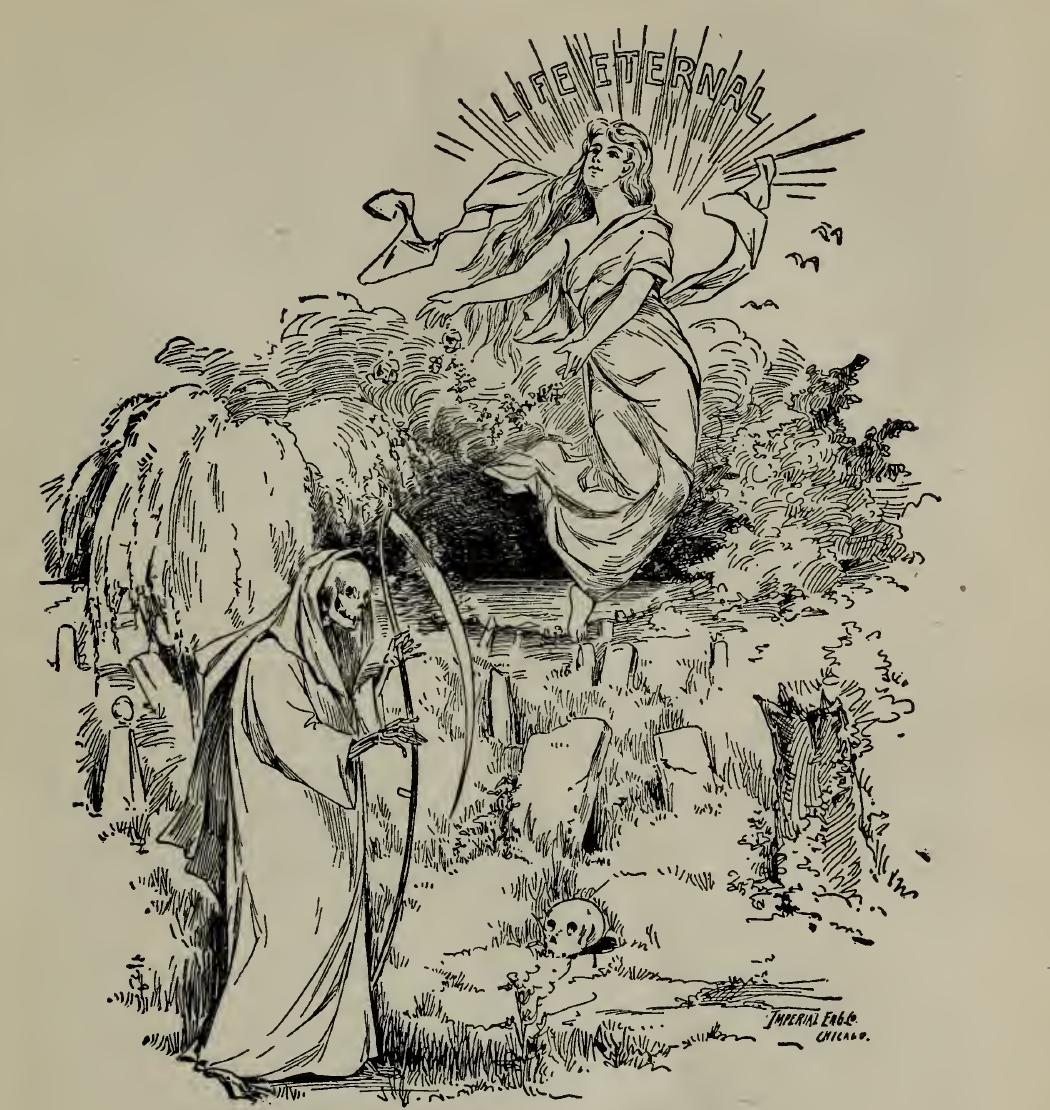
Death and Life Eternal Contrasted, an illustration in the 1903 Encyclopaedia, printed p. 25. The skeleton and rising figure express the anthology’s contrast between bodily death and continuing life. This symbolic image does not depict Julia Norris’s reported vision.
Unidentified artist. The Encyclopaedia of Death and Life in Spirit-World, Volume I, fourth edition, 1903. Public Domain. · Image source ↗ · Public Domain
See references (5)
- The Encyclopaedia of Death and Life in Spirit-World, Volume I, printed p. 156, Reader page 155
- The Encyclopaedia of Death and Life in Spirit-World, Volume I, printed p. 157, Reader page 156
- The Encyclopaedia of Death and Life in Spirit-World, Volume I, printed p. 228, Reader page 227
- The Encyclopaedia of Death and Life in Spirit-World, Volume I, printed p. 229, Reader page 228
- The Encyclopaedia of Death and Life in Spirit-World, Volume I, printed p. 230, Reader page 229
Experience, witness and interpretation
Miner tells what he witnessed at a bedside. Spencer sets out an argument about why such scenes occur. The interviews record the patients’ own descriptions in a particular hospice setting. Who speaks and who records the experience determine what each source can tell us. [5][6][1][2]
Reunion after death is a belief about what happens beyond this life. Someone who sees a relative near death may give the experience that meaning. A description of the experience and an explanation of what caused it require different evidence. [5][2]
See references (4)
- Kerr et al., End-of-life dreams and visions: a longitudinal study of hospice patients’ experiences (2014), abstract
- Nosek et al., End-of-Life Dreams and Visions: A Qualitative Perspective From Hospice Patients (2015), abstract
- The Encyclopaedia of Death and Life in Spirit-World, Volume I, printed p. 157, Reader page 156
- The Encyclopaedia of Death and Life in Spirit-World, Volume I, printed p. 228, Reader page 227
Read further in the library
The Encyclopaedia of Death and Life in the Spirit-World, Volume I
Reading note
Distinct contributions in the complete consulted 1903 Volume I, with exact printed pages and current Reader links.
Sources
See references (8)
- Kerr et al., End-of-life dreams and visions: a longitudinal study of hospice patients’ experiences (2014), abstract ↗Christopher W. Kerr and colleagues, Journal of Palliative Medicine 17(3), 296–303, DOI 10.1089/jpm.2013.0371. Published abstract consulted; full article not reviewed.Return to text ↑
- Nosek et al., End-of-Life Dreams and Visions: A Qualitative Perspective From Hospice Patients (2015), abstract ↗Cheryl L. Nosek and colleagues, American Journal of Hospice and Palliative Care 32(3), 269–274, DOI 10.1177/1049909113517291. Published abstract consulted; full article not reviewed.Return to text ↑
- The Encyclopaedia of Death and Life in Spirit-World, Volume I, printed p. 25, Reader page 24J. R. Francis (compiler), The Encyclopaedia of Death and Life in Spirit-World, Volume I, fourth edition, Progressive Thinker Publishing House, Chicago, 1903. Individual contributors identified in the article.Read this page in The Encyclopaedia of Death and Life in the Spirit-World, Volume I ↗
- The Encyclopaedia of Death and Life in Spirit-World, Volume I, printed p. 156, Reader page 155J. R. Francis (compiler), The Encyclopaedia of Death and Life in Spirit-World, Volume I, fourth edition, Progressive Thinker Publishing House, Chicago, 1903. Individual contributors identified in the article.Read this page in The Encyclopaedia of Death and Life in the Spirit-World, Volume I ↗Return to text ↑
- The Encyclopaedia of Death and Life in Spirit-World, Volume I, printed p. 157, Reader page 156J. R. Francis (compiler), The Encyclopaedia of Death and Life in Spirit-World, Volume I, fourth edition, Progressive Thinker Publishing House, Chicago, 1903. Individual contributors identified in the article.Read this page in The Encyclopaedia of Death and Life in the Spirit-World, Volume I ↗Return to text ↑
- The Encyclopaedia of Death and Life in Spirit-World, Volume I, printed p. 228, Reader page 227J. R. Francis (compiler), The Encyclopaedia of Death and Life in Spirit-World, Volume I, fourth edition, Progressive Thinker Publishing House, Chicago, 1903. Individual contributors identified in the article.Read this page in The Encyclopaedia of Death and Life in the Spirit-World, Volume I ↗Return to text ↑
- The Encyclopaedia of Death and Life in Spirit-World, Volume I, printed p. 229, Reader page 228J. R. Francis (compiler), The Encyclopaedia of Death and Life in Spirit-World, Volume I, fourth edition, Progressive Thinker Publishing House, Chicago, 1903. Individual contributors identified in the article.Read this page in The Encyclopaedia of Death and Life in the Spirit-World, Volume I ↗Return to text ↑
- The Encyclopaedia of Death and Life in Spirit-World, Volume I, printed p. 230, Reader page 229J. R. Francis (compiler), The Encyclopaedia of Death and Life in Spirit-World, Volume I, fourth edition, Progressive Thinker Publishing House, Chicago, 1903. Individual contributors identified in the article.Read this page in The Encyclopaedia of Death and Life in the Spirit-World, Volume I ↗Return to text ↑