Cosmic consciousness
Cosmic consciousness is a sense of awareness extending into a wider whole. Compare Arundale’s account of unity, Russell’s universal Mind and Swedenborg’s spiritual sun.
In this article
Understanding the concept
Cosmic consciousness is a sense of awareness extending beyond the individual self into a wider whole. George S. Arundale uses the experience to ask how a self can belong to universal life and keep a distinct part in it. [9][10][11][12]
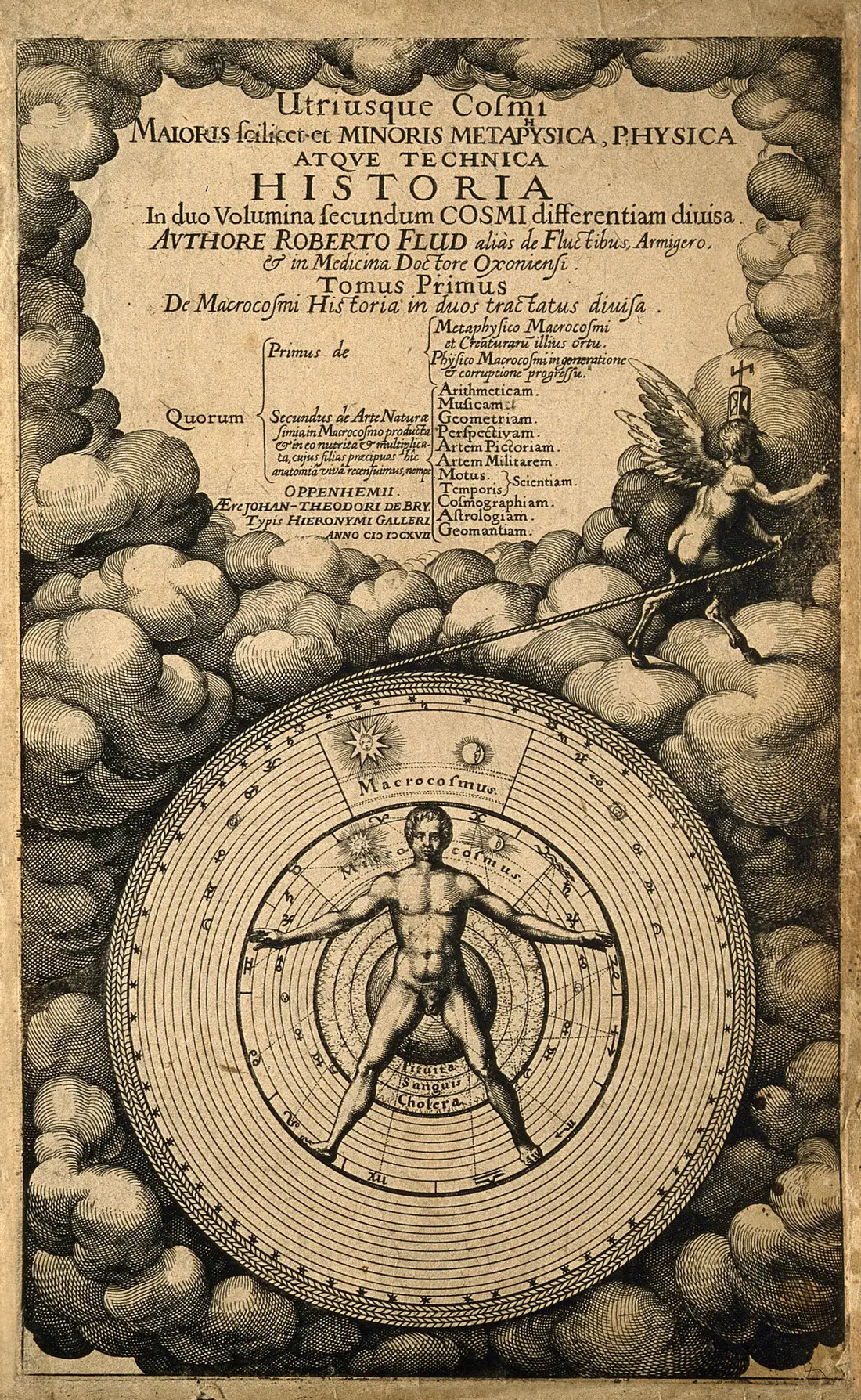
The human figure enclosed within the world, from the title page engraved by Theodor de Bry for Robert Fludd, 1617. The picture gives a historical form to the relation of microcosm and macrocosm.
Wellcome Collection, 2989i. From Robert Fludd’s macrocosm and microcosm history; the collection attributes the engraving to T. de Bry. Public Domain Mark. Resized and converted to WebP without crop or recolouring. · Image source ↗ · Public Domain
Kundalini: An Occult Experience by George S. Arundale
George S. Arundale describes an early feeling of being carried beyond familiar limits into unity. He leaves open whether the whole he seemed to encounter could itself belong to something wider. He likens individual consciousness to one piece in a mosaic whose pattern is still taking shape. [10][11]
Arundale identifies the Sun with the heart of a universal Kundalini and imagines life on Earth drawing from that source. He goes on to speculate about connections among the parts of a solar system and between different systems. The account moves from a reported experience to a model of the cosmos. [12][13][14]
In the final chapter he imagines moving back toward the beginning of an evolutionary cycle. A Knower awakens beings that are themselves able to know, and the kingdoms of nature give their early powers scope to develop. [15][16][17][18][19]
See references (10)
- Kundalini: An Occult Experience, printed p. 11, Reader page 27
- Kundalini: An Occult Experience, Reader page 28
- Kundalini: An Occult Experience, printed p. 13, Reader page 29
- Kundalini: An Occult Experience, printed p. 35, Reader page 51
- Kundalini: An Occult Experience, Reader page 30
- Kundalini: An Occult Experience, Reader page 105
- Kundalini: An Occult Experience, Reader page 106
- Kundalini: An Occult Experience, printed p. 105, Reader page 107
- Kundalini: An Occult Experience, printed p. 106, Reader page 108
- Kundalini: An Occult Experience, printed p. 107, Reader page 109
Knowledge and divine presence
The Universal One by Walter Russell
Walter Russell uses thinking in light for inward thought that he believes reaches universal Mind. A thinker recognizes relations that ordinary sight only partially discloses and may give them form through inspired work. [21][22][23][24][25][26]
Lao Russell’s preface gives her account of her husband’s reported illumination in May 1921. She links it to the knowledge later expressed in The Divine Iliad. Her testimony brings the general theory into the account of a particular experience. [27][28][29]
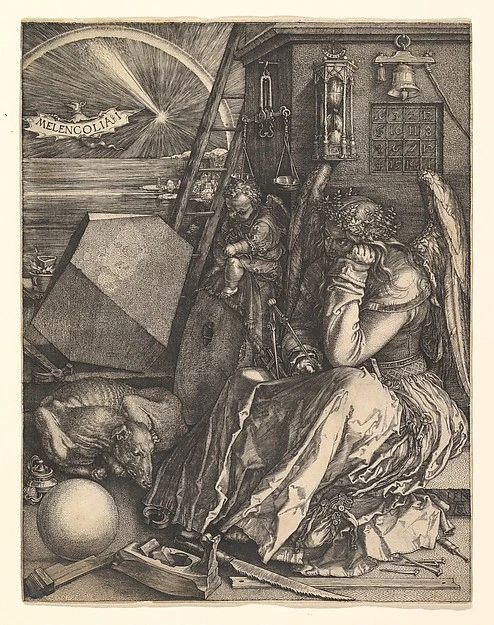
Albrecht Dürer’s engraving presents a winged figure surrounded by tools. Its image of creative possibility gives historical context for Russell’s emphasis on inspired work.
Albrecht Dürer, Melencolia I. The Metropolitan Museum of Art. Harris Brisbane Dick Fund, 1943. · Image source ↗ · CC0
See references (9)
Heaven and Its Wonders and Hell by Emanuel Swedenborg
Emanuel Swedenborg distinguishes the spiritual sun from the natural sun. The Lord appears through Divine love in the spiritual world, and the appearance varies with the capacity of angels to receive it. [1][2][3][4][5][6][7]
See references (7)
- Heaven and Its Wonders and Hell, printed p. 85, Reader page 92
- Heaven and Its Wonders and Hell, printed p. 86, Reader page 93
- Heaven and Its Wonders and Hell, printed p. 88, Reader page 95
- Heaven and Its Wonders and Hell, printed p. 89, Reader page 96
- Heaven and Its Wonders and Hell, printed p. 90, Reader page 97
- Heaven and Its Wonders and Hell, printed p. 91, Reader page 98
- Heaven and Its Wonders and Hell, printed p. 92, Reader page 99
Unity, knowledge and the spiritual sun
Arundale turns an experience of unity into a speculation about solar life. Swedenborg uses the spiritual sun to explain how divine love is received. For Arundale, the solar image helps describe a larger whole to which the observer belongs. Swedenborg distinguishes that image from the astronomical sun. [12][14][1][2][3][4][5][6][7][10][11]
Russell’s emphasis falls on what the inward turn makes knowable. Arundale first describes the feeling of being part of a whole. Russell asks how the thinker might recognize relations that can then be expressed through work. [21][22][25][26][10][11]
See references (15)
- Heaven and Its Wonders and Hell, printed p. 85, Reader page 92
- Heaven and Its Wonders and Hell, printed p. 86, Reader page 93
- Heaven and Its Wonders and Hell, printed p. 88, Reader page 95
- Heaven and Its Wonders and Hell, printed p. 89, Reader page 96
- Heaven and Its Wonders and Hell, printed p. 90, Reader page 97
- Heaven and Its Wonders and Hell, printed p. 91, Reader page 98
- Heaven and Its Wonders and Hell, printed p. 92, Reader page 99
- Kundalini: An Occult Experience, printed p. 11, Reader page 27
- Kundalini: An Occult Experience, Reader page 28
- Kundalini: An Occult Experience, printed p. 13, Reader page 29
- Kundalini: An Occult Experience, Reader page 30
- The Universal One, Reader page 8
- The Universal One, Reader page 9
- The Universal One, Reader page 85
- The Universal One, Reader page 86
Read further in the library

Heaven and Its Wonders and Hell
Reading note
Separately attributed primary Library account, cited on exact verified Reader leaves.

Kundalini: An Occult Experience
Reading note
The separately titled account draws on exact passages in the consulted Library edition.
The Universal One
Reading note
The separately titled account draws on exact passages in the consulted Library edition.
Sources
See references (29)
- Heaven and Its Wonders and Hell, printed p. 85, Reader page 92Emanuel Swedenborg, Heaven and Its Wonders and Hell, translated by J. C. Ager. The American Swedenborg Printing and Publishing Society, New York, 1916. Original Latin work first published in 1758.Read this page in Heaven and Its Wonders and Hell ↗Return to text ↑
- Heaven and Its Wonders and Hell, printed p. 86, Reader page 93Emanuel Swedenborg, Heaven and Its Wonders and Hell, translated by J. C. Ager. The American Swedenborg Printing and Publishing Society, New York, 1916. Original Latin work first published in 1758.Read this page in Heaven and Its Wonders and Hell ↗Return to text ↑
- Heaven and Its Wonders and Hell, printed p. 88, Reader page 95Emanuel Swedenborg, Heaven and Its Wonders and Hell, translated by J. C. Ager. The American Swedenborg Printing and Publishing Society, New York, 1916. Original Latin work first published in 1758.Read this page in Heaven and Its Wonders and Hell ↗Return to text ↑
- Heaven and Its Wonders and Hell, printed p. 89, Reader page 96Emanuel Swedenborg, Heaven and Its Wonders and Hell, translated by J. C. Ager. The American Swedenborg Printing and Publishing Society, New York, 1916. Original Latin work first published in 1758.Read this page in Heaven and Its Wonders and Hell ↗Return to text ↑
- Heaven and Its Wonders and Hell, printed p. 90, Reader page 97Emanuel Swedenborg, Heaven and Its Wonders and Hell, translated by J. C. Ager. The American Swedenborg Printing and Publishing Society, New York, 1916. Original Latin work first published in 1758.Read this page in Heaven and Its Wonders and Hell ↗Return to text ↑
- Heaven and Its Wonders and Hell, printed p. 91, Reader page 98Emanuel Swedenborg, Heaven and Its Wonders and Hell, translated by J. C. Ager. The American Swedenborg Printing and Publishing Society, New York, 1916. Original Latin work first published in 1758.Read this page in Heaven and Its Wonders and Hell ↗Return to text ↑
- Heaven and Its Wonders and Hell, printed p. 92, Reader page 99Emanuel Swedenborg, Heaven and Its Wonders and Hell, translated by J. C. Ager. The American Swedenborg Printing and Publishing Society, New York, 1916. Original Latin work first published in 1758.Read this page in Heaven and Its Wonders and Hell ↗Return to text ↑
- Robert Fludd, macrocosm and microcosm title-page engraving, 1617; Wellcome Collection 2989i ↗Wellcome Collection, 2989i. From Robert Fludd’s macrocosm and microcosm history; the collection attributes the engraving to T. de Bry. Current primary collection record designates Public Domain Mark.
- Kundalini: An Occult Experience, printed p. 5, Reader page 21George S. Arundale, Kundalini: An Occult Experience, The Theosophical Publishing House, Adyar, Madras, India, 1938. Consulted Library edition IMJ-0227-E001.Read this page in Kundalini: An Occult Experience ↗Return to text ↑
- Kundalini: An Occult Experience, printed p. 11, Reader page 27George S. Arundale, Kundalini: An Occult Experience, The Theosophical Publishing House, Adyar, Madras, India, 1938. Consulted Library edition IMJ-0227-E001.Read this page in Kundalini: An Occult Experience ↗Return to text ↑
- Kundalini: An Occult Experience, Reader page 28George S. Arundale, Kundalini: An Occult Experience, The Theosophical Publishing House, Adyar, Madras, India, 1938. Consulted Library edition IMJ-0227-E001.Read this page in Kundalini: An Occult Experience ↗Return to text ↑
- Kundalini: An Occult Experience, printed p. 13, Reader page 29George S. Arundale, Kundalini: An Occult Experience, The Theosophical Publishing House, Adyar, Madras, India, 1938. Consulted Library edition IMJ-0227-E001.Read this page in Kundalini: An Occult Experience ↗Return to text ↑
- Kundalini: An Occult Experience, printed p. 35, Reader page 51George S. Arundale, Kundalini: An Occult Experience, The Theosophical Publishing House, Adyar, Madras, India, 1938. Consulted Library edition IMJ-0227-E001.Read this page in Kundalini: An Occult Experience ↗Return to text ↑
- Kundalini: An Occult Experience, Reader page 30George S. Arundale, Kundalini: An Occult Experience, The Theosophical Publishing House, Adyar, Madras, India, 1938. Consulted Library edition IMJ-0227-E001.Read this page in Kundalini: An Occult Experience ↗Return to text ↑
- Kundalini: An Occult Experience, Reader page 105George S. Arundale, Kundalini: An Occult Experience, The Theosophical Publishing House, Adyar, Madras, India, 1938. Consulted Library edition IMJ-0227-E001.Read this page in Kundalini: An Occult Experience ↗Return to text ↑
- Kundalini: An Occult Experience, Reader page 106George S. Arundale, Kundalini: An Occult Experience, The Theosophical Publishing House, Adyar, Madras, India, 1938. Consulted Library edition IMJ-0227-E001.Read this page in Kundalini: An Occult Experience ↗Return to text ↑
- Kundalini: An Occult Experience, printed p. 105, Reader page 107George S. Arundale, Kundalini: An Occult Experience, The Theosophical Publishing House, Adyar, Madras, India, 1938. Consulted Library edition IMJ-0227-E001.Read this page in Kundalini: An Occult Experience ↗Return to text ↑
- Kundalini: An Occult Experience, printed p. 106, Reader page 108George S. Arundale, Kundalini: An Occult Experience, The Theosophical Publishing House, Adyar, Madras, India, 1938. Consulted Library edition IMJ-0227-E001.Read this page in Kundalini: An Occult Experience ↗Return to text ↑
- Kundalini: An Occult Experience, printed p. 107, Reader page 109George S. Arundale, Kundalini: An Occult Experience, The Theosophical Publishing House, Adyar, Madras, India, 1938. Consulted Library edition IMJ-0227-E001.Read this page in Kundalini: An Occult Experience ↗Return to text ↑
- Albrecht Dürer, Melencolia I ↗Albrecht Dürer, Melencolia I. The Metropolitan Museum of Art. Harris Brisbane Dick Fund, 1943.
- The Universal One, Reader page 8Walter Russell, The Universal One, edited by Louise Russell, University of Science and Philosophy, Limited Edition De Luxe. Lumitheca Library edition IMJ-0605-E001.Read this page in The Universal One ↗Return to text ↑
- The Universal One, Reader page 9Walter Russell, The Universal One, edited by Louise Russell, University of Science and Philosophy, Limited Edition De Luxe. Lumitheca Library edition IMJ-0605-E001.Read this page in The Universal One ↗Return to text ↑
- The Universal One, Reader page 40Walter Russell, The Universal One, edited by Louise Russell, University of Science and Philosophy, Limited Edition De Luxe. Lumitheca Library edition IMJ-0605-E001.Read this page in The Universal One ↗Return to text ↑
- The Universal One, Reader page 70Walter Russell, The Universal One, edited by Louise Russell, University of Science and Philosophy, Limited Edition De Luxe. Lumitheca Library edition IMJ-0605-E001.Read this page in The Universal One ↗Return to text ↑
- The Universal One, Reader page 85Walter Russell, The Universal One, edited by Louise Russell, University of Science and Philosophy, Limited Edition De Luxe. Lumitheca Library edition IMJ-0605-E001.Read this page in The Universal One ↗Return to text ↑
- The Universal One, Reader page 86Walter Russell, The Universal One, edited by Louise Russell, University of Science and Philosophy, Limited Edition De Luxe. Lumitheca Library edition IMJ-0605-E001.Read this page in The Universal One ↗Return to text ↑
- The Universal One, Reader page 4Walter Russell, The Universal One, edited by Louise Russell, University of Science and Philosophy, Limited Edition De Luxe. Lumitheca Library edition IMJ-0605-E001.Read this page in The Universal One ↗Return to text ↑
- The Universal One, Reader page 5Walter Russell, The Universal One, edited by Louise Russell, University of Science and Philosophy, Limited Edition De Luxe. Lumitheca Library edition IMJ-0605-E001.Read this page in The Universal One ↗Return to text ↑
- The Universal One, Reader page 6Walter Russell, The Universal One, edited by Louise Russell, University of Science and Philosophy, Limited Edition De Luxe. Lumitheca Library edition IMJ-0605-E001.Read this page in The Universal One ↗Return to text ↑