Children in the Afterlife
How do Spiritualist writers imagine children growing after death? Compare guardians, schools and family reunions in The Angels’ Diary and other books.
In this article
How do these accounts describe children?
In some accounts of the afterlife, children who die young continue to grow. The child can be remembered at one age and imagined at another. Spiritualist books give that belief a setting in homes, schools and gatherings where someone looks after the child until the family meets again. [1][2]
The books describe different kinds of care. Some focus on guardians and reunion. Others ask how children find teachers or what they can learn when they have few memories of earthly life. [3][4][9][20][21]
Care, guardians and schooling
Life Here and Hereafter: Charlotte E. Dresser and Fred Rafferty
In Life Here and Hereafter, received chiefly by Charlotte E. Dresser and edited by Fred Rafferty, Dee describes watchers caring for children as they first begin to perceive their surroundings. Teachers later group them by temperament and interests. The examples include music, mathematics and missionary work. [61][62]
Two brothers said to have died as infants have since grown up in spirit life. Because they have no remembered earthly routine, hunger, sleep, weariness and slow mechanical travel puzzle them. They have tasted fruit without needing it and tried unsuccessfully to sleep. Innocence does not make them experts in earthly experience: their work with arrivals begins after the earliest, most confusing stage. [63][64][65][66][67]
Other children need a different welcome. The nine-year-old girl longs for her family and is offered other children’s games and Dee’s companionship. The football boy’s recognition is paced over more than one meeting. These accounts preserve particular fears, interests and relationships rather than describing all children as immediately alike. [68][69][70][71][72][73][74]
See references (14)
- Life Here and Hereafter, Reader page 115
- Life Here and Hereafter, Reader page 116
- Life Here and Hereafter, Reader page 66
- Life Here and Hereafter, Reader page 67
- Life Here and Hereafter, Reader page 68
- Life Here and Hereafter, Reader page 69
- Life Here and Hereafter, Reader page 70
- Life Here and Hereafter, Reader page 189
- Life Here and Hereafter, Reader page 190
- Life Here and Hereafter, Reader page 191
- Life Here and Hereafter, Reader page 192
- Life Here and Hereafter, Reader page 193
- Life Here and Hereafter, Reader page 213
- Life Here and Hereafter, Reader page 214
The Angels’ Diary
The preface to The Angels’ Diary, attributed to Effie M. Shirey and Charles Samson, addresses a mother whose child has died. Guardians care for the child, and the intervening years are years of growth. The comfort the book offers is the prospect of meeting someone who has kept living and changing. [5][1]
The traveller meets a brother who died before she was born. He is now a young man. She thinks how proud their mother would be to see him and looks forward to spending time together. Their kinship exists before they have any shared earthly memories. The meeting begins a relationship that earthly chronology prevented. [2]
On her travels she sees babies carried by guardians and visits homes containing thousands of children, including infants who never opened their eyes on earth. The homes combine care with education. Guardian angels work alongside women whose interests draw them to raising children. The narrator also distinguishes movement on the ground from the ability to ascend and descend through the air, which the children acquire after some time. [6][3][4]
The later description of Summerland places these homes among colleges, music halls and communal residences. A child's surroundings belong to a larger society in which learning and visiting continue. The book repeatedly invites a grieving mother to imagine seeing the child within that community. [7][8]
Another chapter describes children becoming speakers and lecturers. Some gatherings have children both in the choir and at the lectern. Learning to express a thought is preparation for being able to reach a wider audience later. Their growth includes intellectual and public life alongside the promise of being safe and loved. [9]
Family gatherings preserve a child’s place among relatives, while schools and public speaking give that child a future beyond the age at death. Those details make the diary’s promise of reunion emotionally concrete. [10][11][3][9]
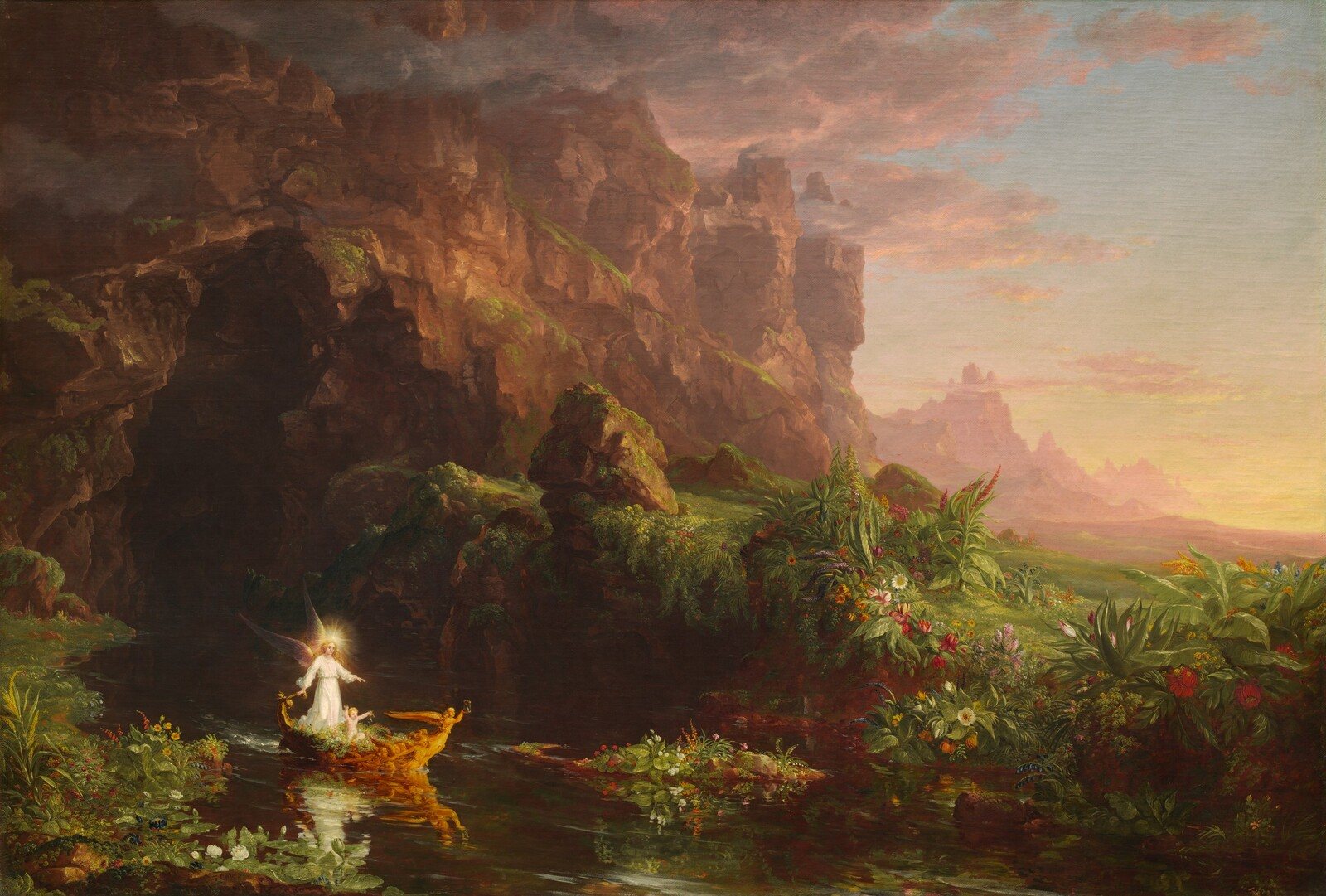
Thomas Cole, The Voyage of Life: Childhood, 1842. In this allegory of earthly life, the angel steers the child’s boat. The image gives protection a visible task, guiding someone who cannot yet guide themselves.
National Gallery of Art, Washington. Ailsa Mellon Bruce Fund, 1971.16.1. Public Domain. · Image source ↗ · Public Domain
See references (11)
- The Angels’ Diary, Reader page 6
- The Angels’ Diary, Reader page 29
- The Angels’ Diary, Reader page 60
- The Angels’ Diary, Reader page 61
- The Angels’ Diary, Reader page 5
- The Angels’ Diary, Reader page 58
- The Angels’ Diary, Reader page 76
- The Angels’ Diary, Reader page 77
- The Angels’ Diary, Reader page 175
- The Angels’ Diary, Reader page 36
- The Angels’ Diary, Reader page 37
Gone West by J. S. M. Ward
J. S. M. Ward’s Gone West describes schools for children who died too young to learn much on earth. H. J. L., one of Ward’s reported spirit contributors, says they are taught belief and can learn activities corresponding to earthly work as recreation. Reading and writing are said to be unnecessary in the form familiar to the living. [13][14]
The teachers include women who had no children on earth, schoolmasters and clergy. Some come from a higher division for a time and then return to their own occupations. The passage imagines care for children as an activity through which adults can also find fulfilment. [14]
Ward asks why another school is kept separate from the children’s. H. J. L. explains that the other learners are adults with little spiritual understanding and troubling pasts to face. Calling such people babes in knowledge is a metaphor for their condition. The book distinguishes that use from children who died in infancy. [14]
These details supply a useful companion to the homes and lecturers in The Angels’ Diary. Both books imagine education continuing beyond death. Ward additionally asks who the different learners are and why they are taught apart. [13][14][3][9]
A later visit reaches a school specifically for young children, with a courtyard, flowers, a fountain and rooms for different stages of growth. The guide says suitable relatives may care for them; other carers include people whose love of children had found little opportunity on earth. The account’s placement of this protected school within an upper division of hell follows its particular vocabulary for spiritual development. [15][16]
When Ward asks about the fate of children more directly, H. J. L. rejects a single fixed age boundary. He describes several possible routes, depending on development, knowledge and responsibility. He distinguishes the infant schools from the punitive conditions he calls hell proper, and says children do not remain children by the time a prolonged downward course could lead there. These distinctions explain the book’s terminology without turning it into a general teaching about bereavement. [17][18]
See references (8)
- The Angels’ Diary, Reader page 60
- The Angels’ Diary, Reader page 175
- Gone West, printed p. 20, Reader page 33
- Gone West, printed p. 21, Reader page 34
- Gone West, printed p. 48, Reader page 61
- Gone West, printed p. 49, Reader page 62
- Gone West, printed p. 70, Reader page 83
- Gone West, printed p. 71, Reader page 84
A Subaltern in Spirit Land by J. S. M. Ward
In J. S. M. Ward’s A Subaltern in Spirit Land, Rex, Ward’s deceased brother, asks about children because he hopes to help them. H. J. L., one of Ward’s reported spirit contributors, begins by distinguishing earthly age from the age expressed by a spiritual form. He says he himself appeared as a small boy on first reaching the spirit plane, while some children could appear more developed. [19][20]
The guide then returns to the two kinds of school described in Gone West. One serves people trying to emerge from wrongdoing; another receives infants and children who had no opportunity to learn about God. Their shared position in the book’s map does not give them the same history or condition. [20][21]
Rex objects that placing innocent children in a region called hell sounds unfair. H. J. L. answers that their schools are full of the light given by their teachers. The passage explicitly separates the protected life within those schools from the darkness associated with other parts of the realm. [21]
Rex’s wish to work there is welcomed, but he is told he must first learn before he can teach. Care for children becomes one possible future occupation. These are details of Ward’s particular Spiritualist cosmology, with its own relationship between faith, development and the names assigned to places. [20][21]
The later Fairyland journey gives children a different role. Beryl and Joyce guide Rex through a country he cannot find by himself. Their innocence allows them to cross a threshold which initially bars him, and they are eventually permitted to remain in the seventh astral division with people from whom they had been separated. The children possess their own knowledge and possibilities of travel within the narrative. [22][23][24][25][26][27][28]
By the end, Ward’s mother chooses to work with children. She hopes that storytelling can help them find the gentler route through Fairyland described by Rex. In the conclusion she reports that several groups have departed, while acknowledging that their failure to return is her reason for thinking they reached their destination. The book distinguishes her hope and inference from a directly witnessed arrival. [29][30]
See references (12)
- A Subaltern in Spirit Land, printed p. 54, Reader page 69
- A Subaltern in Spirit Land, printed p. 55, Reader page 70
- A Subaltern in Spirit Land, printed p. 56, Reader page 71
- A Subaltern in Spirit Land, printed p. 263, Reader page 278
- A Subaltern in Spirit Land, printed p. 264, Reader page 279
- A Subaltern in Spirit Land, printed p. 288, Reader page 303
- A Subaltern in Spirit Land, printed p. 289, Reader page 304
- A Subaltern in Spirit Land, printed p. 294, Reader page 309
- A Subaltern in Spirit Land, printed p. 301, Reader page 316
- A Subaltern in Spirit Land, printed p. 304, Reader page 319
- A Subaltern in Spirit Land, printed p. 305, Reader page 320
- A Subaltern in Spirit Land, printed p. 309, Reader page 324
Growth in the next life
Heaven and Its Wonders and Hell
In Heaven and Its Wonders and Hell, Emanuel Swedenborg says that the Lord receives every child who dies, regardless of birthplace, baptism or the parents’ character. The children are initially children in their new surroundings. Wisdom comes through care and instruction. [31][32]
Their first carers are angelic women who had loved children during earthly life. Swedenborg describes teaching through beautiful representations, play and surroundings suited to the child’s disposition. A gentle dramatic representation of the Lord’s resurrection and ascent becomes an occasion for learning. Gardens, flowers and companionship belong to the same account of growth through delight. [33][34][35][36][37]
Children eventually reach the appearance of early adulthood and remain in its freshness. Swedenborg connects this change with increasing intelligence and wisdom. He also distinguishes inherited tendencies from evils deliberately made one’s own: children are not punished for what they merely inherit. Instruction includes learning to recognise misleading influence and to resist being led into it. [38][39][40][41][42]
This education does not make earthly adulthood a permanent disadvantage. At the close of the chapter, Swedenborg says that people who grew up on earth can attain states as perfect as those of children raised in heaven. His emphasis falls on the love a life comes to express, while retaining the different histories through which that love develops. [43][44]
See references (14)
- Heaven and Its Wonders and Hell, printed p. 270, Reader page 277
- Heaven and Its Wonders and Hell, printed p. 271, Reader page 278
- Heaven and Its Wonders and Hell, printed p. 272, Reader page 279
- Heaven and Its Wonders and Hell, printed p. 273, Reader page 280
- Heaven and Its Wonders and Hell, printed p. 274, Reader page 281
- Heaven and Its Wonders and Hell, printed p. 275, Reader page 282
- Heaven and Its Wonders and Hell, printed p. 276, Reader page 283
- Heaven and Its Wonders and Hell, printed p. 277, Reader page 284
- Heaven and Its Wonders and Hell, printed p. 278, Reader page 285
- Heaven and Its Wonders and Hell, printed p. 279, Reader page 286
- Heaven and Its Wonders and Hell, printed p. 280, Reader page 287
- Heaven and Its Wonders and Hell, printed p. 281, Reader page 288
- Heaven and Its Wonders and Hell, printed p. 282, Reader page 289
- Heaven and Its Wonders and Hell, printed p. 283, Reader page 290
Life and Labor in the Spirit World: Shelhamer’s spirit-band
Life and Labor in the Spirit World, credited to the medium M. T. Shelhamer’s spirit-band, introduces Spirit May as someone who died in infancy and later became a teacher of children. Her own introduction gives continued growth a personal example. Childhood after death is presented as a stage with new abilities to acquire. [45][46]
May’s Lily Vale has small round homes called Rhonas, where carers teach limited groups of children. The account prefers individual attention, sometimes with only one or two pupils, and places older children alongside younger ones as helpers. Children are described as growing towards adulthood, while their particular interests receive room to develop. [47][48][49][50][51][52]
Golden Nest gives some children messenger work, while Rocky Nook accommodates children who have needed recovery from difficult earthly lives. Those still avoiding painful memories of earth are not assigned the same immediate task as the eager messengers. The narrative varies its care and expectations with the child’s history. [53][54][55][56][57][58][59][60]
See references (16)
- Life and Labor in the Spirit World, printed p. 233, Reader page 234
- Life and Labor in the Spirit World, printed p. 234, Reader page 235
- Life and Labor in the Spirit World, printed p. 272, Reader page 273
- Life and Labor in the Spirit World, printed p. 273, Reader page 274
- Life and Labor in the Spirit World, printed p. 274, Reader page 275
- Life and Labor in the Spirit World, printed p. 275, Reader page 276
- Life and Labor in the Spirit World, printed p. 276, Reader page 277
- Life and Labor in the Spirit World, printed p. 277, Reader page 278
- Life and Labor in the Spirit World, printed p. 307, Reader page 308
- Life and Labor in the Spirit World, printed p. 308, Reader page 309
- Life and Labor in the Spirit World, printed p. 309, Reader page 310
- Life and Labor in the Spirit World, printed p. 310, Reader page 311
- Life and Labor in the Spirit World, printed p. 311, Reader page 312
- Life and Labor in the Spirit World, printed p. 317, Reader page 318
- Life and Labor in the Spirit World, printed p. 318, Reader page 319
- Life and Labor in the Spirit World, printed p. 319, Reader page 320
Growth and care, with different conditions
In The Angels’ Diary, guardians keep care going between death and reunion. Swedenborg makes the child’s reception universal. Ward describes schools too, and in his sequel has a guide distinguish protected schools from the punitive conditions suggested by his use of the word hell. [6][3][4][31][32][20][21]
Ward’s Gone West asks when a child is capable of responsibility. Swedenborg begins with the Lord’s reception of every child. Those starting points explain why their accounts give different weight to age, belief and instruction. [31][32][17][18]
Spirit May, in Shelhamer’s collection, imagines children becoming helpers to earthly circles. Swedenborg describes education as preparation for angelic life. The children’s growth gives them different work in the two books. [31][32][33][34][35][36][37][38][39][40][41][42][45][46][50][51][52][54][55][58][59][60]
Spirit May’s Rhonas in Shelhamer’s collection allow close care in small groups and older children helping younger ones. Dresser and Rafferty also tailor instruction, but the brothers’ account adds a distinctive limit: growing up beyond earth leaves whole kinds of earthly experience unfamiliar. Continued development is not the same as immediate knowledge of everything. [45][46][47][48][49][50][51][52][64][65][61][62]
See references (36)
- The Angels’ Diary, Reader page 60
- The Angels’ Diary, Reader page 61
- The Angels’ Diary, Reader page 58
- Gone West, printed p. 70, Reader page 83
- Gone West, printed p. 71, Reader page 84
- A Subaltern in Spirit Land, printed p. 55, Reader page 70
- A Subaltern in Spirit Land, printed p. 56, Reader page 71
- Heaven and Its Wonders and Hell, printed p. 270, Reader page 277
- Heaven and Its Wonders and Hell, printed p. 271, Reader page 278
- Heaven and Its Wonders and Hell, printed p. 272, Reader page 279
- Heaven and Its Wonders and Hell, printed p. 273, Reader page 280
- Heaven and Its Wonders and Hell, printed p. 274, Reader page 281
- Heaven and Its Wonders and Hell, printed p. 275, Reader page 282
- Heaven and Its Wonders and Hell, printed p. 276, Reader page 283
- Heaven and Its Wonders and Hell, printed p. 277, Reader page 284
- Heaven and Its Wonders and Hell, printed p. 278, Reader page 285
- Heaven and Its Wonders and Hell, printed p. 279, Reader page 286
- Heaven and Its Wonders and Hell, printed p. 280, Reader page 287
- Heaven and Its Wonders and Hell, printed p. 281, Reader page 288
- Life and Labor in the Spirit World, printed p. 233, Reader page 234
- Life and Labor in the Spirit World, printed p. 234, Reader page 235
- Life and Labor in the Spirit World, printed p. 272, Reader page 273
- Life and Labor in the Spirit World, printed p. 273, Reader page 274
- Life and Labor in the Spirit World, printed p. 274, Reader page 275
- Life and Labor in the Spirit World, printed p. 275, Reader page 276
- Life and Labor in the Spirit World, printed p. 276, Reader page 277
- Life and Labor in the Spirit World, printed p. 277, Reader page 278
- Life and Labor in the Spirit World, printed p. 308, Reader page 309
- Life and Labor in the Spirit World, printed p. 309, Reader page 310
- Life and Labor in the Spirit World, printed p. 317, Reader page 318
- Life and Labor in the Spirit World, printed p. 318, Reader page 319
- Life and Labor in the Spirit World, printed p. 319, Reader page 320
- Life Here and Hereafter, Reader page 115
- Life Here and Hereafter, Reader page 116
- Life Here and Hereafter, Reader page 67
- Life Here and Hereafter, Reader page 68
Read further in the library
The Angels’ Diary and Celestion Study of Man
Reading note
Growing up between meetings. Read the original passage in the 1903 edition.

Gone West
Reading note
Ward’s communicated accounts supply the separately cited comparison in this entry.
A Subaltern in Spirit Land: A Sequel to Gone West
Reading note
Ward’s sequel adds the separately cited account of this subject.

Heaven and Its Wonders and Hell
Reading note
Children receive care and delightful instruction, growing into angelic life irrespective of baptism or their parents’ faith.
Life and Labour in the Spirit World
Reading note
The separately titled account draws on exact passages in the consulted Library edition.

Life Here and Hereafter
Reading note
The separately titled account draws on exact passages in the consulted Library edition.
Sources
See references (74)
- The Angels’ Diary, Reader page 6The Angels’ Diary (1903), attributed to Effie M. Shirey and Charles SamsonRead this page in The Angels’ Diary and Celestion Study of Man ↗Return to text ↑
- The Angels’ Diary, Reader page 29The Angels’ Diary (1903), attributed to Effie M. Shirey and Charles SamsonRead this page in The Angels’ Diary and Celestion Study of Man ↗Return to text ↑
- The Angels’ Diary, Reader page 60The Angels’ Diary (1903), attributed to Effie M. Shirey and Charles SamsonRead this page in The Angels’ Diary and Celestion Study of Man ↗Return to text ↑
- The Angels’ Diary, Reader page 61The Angels’ Diary (1903), attributed to Effie M. Shirey and Charles SamsonRead this page in The Angels’ Diary and Celestion Study of Man ↗Return to text ↑
- The Angels’ Diary, Reader page 5Effie M. Shirey and Charles Samson, The Angels’ Diary and Celestion Study of Man (1903), communicated through Elizabeth Maud Weatherhead according to the acknowledgment.Read this page in The Angels’ Diary and Celestion Study of Man ↗Return to text ↑
- The Angels’ Diary, Reader page 58Effie M. Shirey and Charles Samson, The Angels’ Diary and Celestion Study of Man (1903), communicated through Elizabeth Maud Weatherhead according to the acknowledgment.Read this page in The Angels’ Diary and Celestion Study of Man ↗Return to text ↑
- The Angels’ Diary, Reader page 76Effie M. Shirey and Charles Samson, The Angels’ Diary and Celestion Study of Man (1903), communicated through Elizabeth Maud Weatherhead according to the acknowledgment.Read this page in The Angels’ Diary and Celestion Study of Man ↗Return to text ↑
- The Angels’ Diary, Reader page 77Effie M. Shirey and Charles Samson, The Angels’ Diary and Celestion Study of Man (1903), communicated through Elizabeth Maud Weatherhead according to the acknowledgment.Read this page in The Angels’ Diary and Celestion Study of Man ↗Return to text ↑
- The Angels’ Diary, Reader page 175Effie M. Shirey and Charles Samson, The Angels’ Diary and Celestion Study of Man (1903), communicated through Elizabeth Maud Weatherhead according to the acknowledgment.Read this page in The Angels’ Diary and Celestion Study of Man ↗Return to text ↑
- The Angels’ Diary, Reader page 36Effie M. Shirey and Charles Samson, The Angels’ Diary and Celestion Study of Man (1903), communicated through Elizabeth Maud Weatherhead according to the acknowledgment.Read this page in The Angels’ Diary and Celestion Study of Man ↗Return to text ↑
- The Angels’ Diary, Reader page 37Effie M. Shirey and Charles Samson, The Angels’ Diary and Celestion Study of Man (1903), communicated through Elizabeth Maud Weatherhead according to the acknowledgment.Read this page in The Angels’ Diary and Celestion Study of Man ↗Return to text ↑
- Thomas Cole, The Voyage of Life: Childhood, 1842. ↗National Gallery of Art, Washington. Ailsa Mellon Bruce Fund, 1971.16.1. Public Domain.
- Gone West, printed p. 20, Reader page 33J. S. M. Ward, Gone West, 1920 third impression as reproduced in the 2009 Geoff Cutler digital transcription.Read this page in Gone West ↗Return to text ↑
- Gone West, printed p. 21, Reader page 34J. S. M. Ward, Gone West, 1920 third impression as reproduced in the 2009 Geoff Cutler digital transcription.Read this page in Gone West ↗Return to text ↑
- Gone West, printed p. 48, Reader page 61J. S. M. Ward, Gone West, 1920 third impression in the 2009 Geoff Cutler digital transcription.Read this page in Gone West ↗Return to text ↑
- Gone West, printed p. 49, Reader page 62J. S. M. Ward, Gone West, 1920 third impression in the 2009 Geoff Cutler digital transcription.Read this page in Gone West ↗Return to text ↑
- Gone West, printed p. 70, Reader page 83J. S. M. Ward, Gone West, 1920 third impression in the 2009 Geoff Cutler digital transcription.Read this page in Gone West ↗Return to text ↑
- Gone West, printed p. 71, Reader page 84J. S. M. Ward, Gone West, 1920 third impression in the 2009 Geoff Cutler digital transcription.Read this page in Gone West ↗Return to text ↑
- A Subaltern in Spirit Land, printed p. 54, Reader page 69J. S. M. Ward, A Subaltern in Spirit Land: A Sequel to Gone West, William Rider & Son, 1920.Read this page in A Subaltern in Spirit Land: A Sequel to Gone West ↗Return to text ↑
- A Subaltern in Spirit Land, printed p. 55, Reader page 70J. S. M. Ward, A Subaltern in Spirit Land: A Sequel to Gone West, William Rider & Son, 1920.Read this page in A Subaltern in Spirit Land: A Sequel to Gone West ↗Return to text ↑
- A Subaltern in Spirit Land, printed p. 56, Reader page 71J. S. M. Ward, A Subaltern in Spirit Land: A Sequel to Gone West, William Rider & Son, 1920.Read this page in A Subaltern in Spirit Land: A Sequel to Gone West ↗Return to text ↑
- A Subaltern in Spirit Land, printed p. 263, Reader page 278J. S. M. Ward, A Subaltern in Spirit Land: A Sequel to Gone West, William Rider & Son, 1920.Read this page in A Subaltern in Spirit Land: A Sequel to Gone West ↗Return to text ↑
- A Subaltern in Spirit Land, printed p. 264, Reader page 279J. S. M. Ward, A Subaltern in Spirit Land: A Sequel to Gone West, William Rider & Son, 1920.Read this page in A Subaltern in Spirit Land: A Sequel to Gone West ↗Return to text ↑
- A Subaltern in Spirit Land, printed p. 288, Reader page 303J. S. M. Ward, A Subaltern in Spirit Land: A Sequel to Gone West, William Rider & Son, 1920.Read this page in A Subaltern in Spirit Land: A Sequel to Gone West ↗Return to text ↑
- A Subaltern in Spirit Land, printed p. 289, Reader page 304J. S. M. Ward, A Subaltern in Spirit Land: A Sequel to Gone West, William Rider & Son, 1920.Read this page in A Subaltern in Spirit Land: A Sequel to Gone West ↗Return to text ↑
- A Subaltern in Spirit Land, printed p. 294, Reader page 309J. S. M. Ward, A Subaltern in Spirit Land: A Sequel to Gone West, William Rider & Son, 1920.Read this page in A Subaltern in Spirit Land: A Sequel to Gone West ↗Return to text ↑
- A Subaltern in Spirit Land, printed p. 301, Reader page 316J. S. M. Ward, A Subaltern in Spirit Land: A Sequel to Gone West, William Rider & Son, 1920.Read this page in A Subaltern in Spirit Land: A Sequel to Gone West ↗Return to text ↑
- A Subaltern in Spirit Land, printed p. 304, Reader page 319J. S. M. Ward, A Subaltern in Spirit Land: A Sequel to Gone West, William Rider & Son, 1920.Read this page in A Subaltern in Spirit Land: A Sequel to Gone West ↗Return to text ↑
- A Subaltern in Spirit Land, printed p. 305, Reader page 320J. S. M. Ward, A Subaltern in Spirit Land: A Sequel to Gone West, William Rider & Son, 1920.Read this page in A Subaltern in Spirit Land: A Sequel to Gone West ↗Return to text ↑
- A Subaltern in Spirit Land, printed p. 309, Reader page 324J. S. M. Ward, A Subaltern in Spirit Land: A Sequel to Gone West, William Rider & Son, 1920.Read this page in A Subaltern in Spirit Land: A Sequel to Gone West ↗Return to text ↑
- Heaven and Its Wonders and Hell, printed p. 270, Reader page 277Emanuel Swedenborg, Heaven and Its Wonders and Hell, translated by J. C. Ager. The American Swedenborg Printing and Publishing Society, New York, 1916. Original Latin work first published in 1758.Read this page in Heaven and Its Wonders and Hell ↗Return to text ↑
- Heaven and Its Wonders and Hell, printed p. 271, Reader page 278Emanuel Swedenborg, Heaven and Its Wonders and Hell, translated by J. C. Ager. The American Swedenborg Printing and Publishing Society, New York, 1916. Original Latin work first published in 1758.Read this page in Heaven and Its Wonders and Hell ↗Return to text ↑
- Heaven and Its Wonders and Hell, printed p. 272, Reader page 279Emanuel Swedenborg, Heaven and Its Wonders and Hell, translated by J. C. Ager. The American Swedenborg Printing and Publishing Society, New York, 1916. Original Latin work first published in 1758.Read this page in Heaven and Its Wonders and Hell ↗Return to text ↑
- Heaven and Its Wonders and Hell, printed p. 273, Reader page 280Emanuel Swedenborg, Heaven and Its Wonders and Hell, translated by J. C. Ager. The American Swedenborg Printing and Publishing Society, New York, 1916. Original Latin work first published in 1758.Read this page in Heaven and Its Wonders and Hell ↗Return to text ↑
- Heaven and Its Wonders and Hell, printed p. 274, Reader page 281Emanuel Swedenborg, Heaven and Its Wonders and Hell, translated by J. C. Ager. The American Swedenborg Printing and Publishing Society, New York, 1916. Original Latin work first published in 1758.Read this page in Heaven and Its Wonders and Hell ↗Return to text ↑
- Heaven and Its Wonders and Hell, printed p. 275, Reader page 282Emanuel Swedenborg, Heaven and Its Wonders and Hell, translated by J. C. Ager. The American Swedenborg Printing and Publishing Society, New York, 1916. Original Latin work first published in 1758.Read this page in Heaven and Its Wonders and Hell ↗Return to text ↑
- Heaven and Its Wonders and Hell, printed p. 276, Reader page 283Emanuel Swedenborg, Heaven and Its Wonders and Hell, translated by J. C. Ager. The American Swedenborg Printing and Publishing Society, New York, 1916. Original Latin work first published in 1758.Read this page in Heaven and Its Wonders and Hell ↗Return to text ↑
- Heaven and Its Wonders and Hell, printed p. 277, Reader page 284Emanuel Swedenborg, Heaven and Its Wonders and Hell, translated by J. C. Ager. The American Swedenborg Printing and Publishing Society, New York, 1916. Original Latin work first published in 1758.Read this page in Heaven and Its Wonders and Hell ↗Return to text ↑
- Heaven and Its Wonders and Hell, printed p. 278, Reader page 285Emanuel Swedenborg, Heaven and Its Wonders and Hell, translated by J. C. Ager. The American Swedenborg Printing and Publishing Society, New York, 1916. Original Latin work first published in 1758.Read this page in Heaven and Its Wonders and Hell ↗Return to text ↑
- Heaven and Its Wonders and Hell, printed p. 279, Reader page 286Emanuel Swedenborg, Heaven and Its Wonders and Hell, translated by J. C. Ager. The American Swedenborg Printing and Publishing Society, New York, 1916. Original Latin work first published in 1758.Read this page in Heaven and Its Wonders and Hell ↗Return to text ↑
- Heaven and Its Wonders and Hell, printed p. 280, Reader page 287Emanuel Swedenborg, Heaven and Its Wonders and Hell, translated by J. C. Ager. The American Swedenborg Printing and Publishing Society, New York, 1916. Original Latin work first published in 1758.Read this page in Heaven and Its Wonders and Hell ↗Return to text ↑
- Heaven and Its Wonders and Hell, printed p. 281, Reader page 288Emanuel Swedenborg, Heaven and Its Wonders and Hell, translated by J. C. Ager. The American Swedenborg Printing and Publishing Society, New York, 1916. Original Latin work first published in 1758.Read this page in Heaven and Its Wonders and Hell ↗Return to text ↑
- Heaven and Its Wonders and Hell, printed p. 282, Reader page 289Emanuel Swedenborg, Heaven and Its Wonders and Hell, translated by J. C. Ager. The American Swedenborg Printing and Publishing Society, New York, 1916. Original Latin work first published in 1758.Read this page in Heaven and Its Wonders and Hell ↗Return to text ↑
- Heaven and Its Wonders and Hell, printed p. 283, Reader page 290Emanuel Swedenborg, Heaven and Its Wonders and Hell, translated by J. C. Ager. The American Swedenborg Printing and Publishing Society, New York, 1916. Original Latin work first published in 1758.Read this page in Heaven and Its Wonders and Hell ↗Return to text ↑
- Life and Labor in the Spirit World, printed p. 233, Reader page 234Members of the Spirit-Band of Miss M. T. Shelhamer, Life and Labor in the Spirit World, Second Thousand, Boston: Colby & Rich, 1885. Exact Library edition IMJ-0202-E001. Parts I, II and III are respectively attributed to Spirit Violet, Spirit May and John Critchley Prince. Original metadata and retained Library PageRefs verified; consequential passages checked against actual Library facsimiles. Original Library PDF bytes remain unavailable.Read this page in Life and Labour in the Spirit World ↗Return to text ↑
- Life and Labor in the Spirit World, printed p. 234, Reader page 235Members of the Spirit-Band of Miss M. T. Shelhamer, Life and Labor in the Spirit World, Second Thousand, Boston: Colby & Rich, 1885. Exact Library edition IMJ-0202-E001. Parts I, II and III are respectively attributed to Spirit Violet, Spirit May and John Critchley Prince. Original metadata and retained Library PageRefs verified; consequential passages checked against actual Library facsimiles. Original Library PDF bytes remain unavailable.Read this page in Life and Labour in the Spirit World ↗Return to text ↑
- Life and Labor in the Spirit World, printed p. 272, Reader page 273Members of the Spirit-Band of Miss M. T. Shelhamer, Life and Labor in the Spirit World, Second Thousand, Boston: Colby & Rich, 1885. Exact Library edition IMJ-0202-E001. Parts I, II and III are respectively attributed to Spirit Violet, Spirit May and John Critchley Prince. Original metadata and retained Library PageRefs verified; consequential passages checked against actual Library facsimiles. Original Library PDF bytes remain unavailable.Read this page in Life and Labour in the Spirit World ↗Return to text ↑
- Life and Labor in the Spirit World, printed p. 273, Reader page 274Members of the Spirit-Band of Miss M. T. Shelhamer, Life and Labor in the Spirit World, Second Thousand, Boston: Colby & Rich, 1885. Exact Library edition IMJ-0202-E001. Parts I, II and III are respectively attributed to Spirit Violet, Spirit May and John Critchley Prince. Original metadata and retained Library PageRefs verified; consequential passages checked against actual Library facsimiles. Original Library PDF bytes remain unavailable.Read this page in Life and Labour in the Spirit World ↗Return to text ↑
- Life and Labor in the Spirit World, printed p. 274, Reader page 275Members of the Spirit-Band of Miss M. T. Shelhamer, Life and Labor in the Spirit World, Second Thousand, Boston: Colby & Rich, 1885. Exact Library edition IMJ-0202-E001. Parts I, II and III are respectively attributed to Spirit Violet, Spirit May and John Critchley Prince. Original metadata and retained Library PageRefs verified; consequential passages checked against actual Library facsimiles. Original Library PDF bytes remain unavailable.Read this page in Life and Labour in the Spirit World ↗Return to text ↑
- Life and Labor in the Spirit World, printed p. 275, Reader page 276Members of the Spirit-Band of Miss M. T. Shelhamer, Life and Labor in the Spirit World, Second Thousand, Boston: Colby & Rich, 1885. Exact Library edition IMJ-0202-E001. Parts I, II and III are respectively attributed to Spirit Violet, Spirit May and John Critchley Prince. Original metadata and retained Library PageRefs verified; consequential passages checked against actual Library facsimiles. Original Library PDF bytes remain unavailable.Read this page in Life and Labour in the Spirit World ↗Return to text ↑
- Life and Labor in the Spirit World, printed p. 276, Reader page 277Members of the Spirit-Band of Miss M. T. Shelhamer, Life and Labor in the Spirit World, Second Thousand, Boston: Colby & Rich, 1885. Exact Library edition IMJ-0202-E001. Parts I, II and III are respectively attributed to Spirit Violet, Spirit May and John Critchley Prince. Original metadata and retained Library PageRefs verified; consequential passages checked against actual Library facsimiles. Original Library PDF bytes remain unavailable.Read this page in Life and Labour in the Spirit World ↗Return to text ↑
- Life and Labor in the Spirit World, printed p. 277, Reader page 278Members of the Spirit-Band of Miss M. T. Shelhamer, Life and Labor in the Spirit World, Second Thousand, Boston: Colby & Rich, 1885. Exact Library edition IMJ-0202-E001. Parts I, II and III are respectively attributed to Spirit Violet, Spirit May and John Critchley Prince. Original metadata and retained Library PageRefs verified; consequential passages checked against actual Library facsimiles. Original Library PDF bytes remain unavailable.Read this page in Life and Labour in the Spirit World ↗Return to text ↑
- Life and Labor in the Spirit World, printed p. 307, Reader page 308Members of the Spirit-Band of Miss M. T. Shelhamer, Life and Labor in the Spirit World, Second Thousand, Boston: Colby & Rich, 1885. Exact Library edition IMJ-0202-E001. Parts I, II and III are respectively attributed to Spirit Violet, Spirit May and John Critchley Prince. Original metadata and retained Library PageRefs verified; consequential passages checked against actual Library facsimiles. Original Library PDF bytes remain unavailable.Read this page in Life and Labour in the Spirit World ↗Return to text ↑
- Life and Labor in the Spirit World, printed p. 308, Reader page 309Members of the Spirit-Band of Miss M. T. Shelhamer, Life and Labor in the Spirit World, Second Thousand, Boston: Colby & Rich, 1885. Exact Library edition IMJ-0202-E001. Parts I, II and III are respectively attributed to Spirit Violet, Spirit May and John Critchley Prince. Original metadata and retained Library PageRefs verified; consequential passages checked against actual Library facsimiles. Original Library PDF bytes remain unavailable.Read this page in Life and Labour in the Spirit World ↗Return to text ↑
- Life and Labor in the Spirit World, printed p. 309, Reader page 310Members of the Spirit-Band of Miss M. T. Shelhamer, Life and Labor in the Spirit World, Second Thousand, Boston: Colby & Rich, 1885. Exact Library edition IMJ-0202-E001. Parts I, II and III are respectively attributed to Spirit Violet, Spirit May and John Critchley Prince. Original metadata and retained Library PageRefs verified; consequential passages checked against actual Library facsimiles. Original Library PDF bytes remain unavailable.Read this page in Life and Labour in the Spirit World ↗Return to text ↑
- Life and Labor in the Spirit World, printed p. 310, Reader page 311Members of the Spirit-Band of Miss M. T. Shelhamer, Life and Labor in the Spirit World, Second Thousand, Boston: Colby & Rich, 1885. Exact Library edition IMJ-0202-E001. Parts I, II and III are respectively attributed to Spirit Violet, Spirit May and John Critchley Prince. Original metadata and retained Library PageRefs verified; consequential passages checked against actual Library facsimiles. Original Library PDF bytes remain unavailable.Read this page in Life and Labour in the Spirit World ↗Return to text ↑
- Life and Labor in the Spirit World, printed p. 311, Reader page 312Members of the Spirit-Band of Miss M. T. Shelhamer, Life and Labor in the Spirit World, Second Thousand, Boston: Colby & Rich, 1885. Exact Library edition IMJ-0202-E001. Parts I, II and III are respectively attributed to Spirit Violet, Spirit May and John Critchley Prince. Original metadata and retained Library PageRefs verified; consequential passages checked against actual Library facsimiles. Original Library PDF bytes remain unavailable.Read this page in Life and Labour in the Spirit World ↗Return to text ↑
- Life and Labor in the Spirit World, printed p. 317, Reader page 318Members of the Spirit-Band of Miss M. T. Shelhamer, Life and Labor in the Spirit World, Second Thousand, Boston: Colby & Rich, 1885. Exact Library edition IMJ-0202-E001. Parts I, II and III are respectively attributed to Spirit Violet, Spirit May and John Critchley Prince. Original metadata and retained Library PageRefs verified; consequential passages checked against actual Library facsimiles. Original Library PDF bytes remain unavailable.Read this page in Life and Labour in the Spirit World ↗Return to text ↑
- Life and Labor in the Spirit World, printed p. 318, Reader page 319Members of the Spirit-Band of Miss M. T. Shelhamer, Life and Labor in the Spirit World, Second Thousand, Boston: Colby & Rich, 1885. Exact Library edition IMJ-0202-E001. Parts I, II and III are respectively attributed to Spirit Violet, Spirit May and John Critchley Prince. Original metadata and retained Library PageRefs verified; consequential passages checked against actual Library facsimiles. Original Library PDF bytes remain unavailable.Read this page in Life and Labour in the Spirit World ↗Return to text ↑
- Life and Labor in the Spirit World, printed p. 319, Reader page 320Members of the Spirit-Band of Miss M. T. Shelhamer, Life and Labor in the Spirit World, Second Thousand, Boston: Colby & Rich, 1885. Exact Library edition IMJ-0202-E001. Parts I, II and III are respectively attributed to Spirit Violet, Spirit May and John Critchley Prince. Original metadata and retained Library PageRefs verified; consequential passages checked against actual Library facsimiles. Original Library PDF bytes remain unavailable.Read this page in Life and Labour in the Spirit World ↗Return to text ↑
- Life Here and Hereafter, Reader page 115Charlotte E. Dresser and Fred Rafferty, Life Here and Hereafter, edited by Fred Rafferty. Modern transcription reproducing the Author’s Edition, San Jose, California, 1927. Exact selected Library edition IMJ-0447-E001; original PageIDs and current Reader positions verified. Communications and their claimed spiritual origins remain attributed to this source.Read this page in Life Here and Hereafter ↗Return to text ↑
- Life Here and Hereafter, Reader page 116Charlotte E. Dresser and Fred Rafferty, Life Here and Hereafter, edited by Fred Rafferty. Modern transcription reproducing the Author’s Edition, San Jose, California, 1927. Exact selected Library edition IMJ-0447-E001; original PageIDs and current Reader positions verified. Communications and their claimed spiritual origins remain attributed to this source.Read this page in Life Here and Hereafter ↗Return to text ↑
- Life Here and Hereafter, Reader page 66Charlotte E. Dresser and Fred Rafferty, Life Here and Hereafter, edited by Fred Rafferty. Modern transcription reproducing the Author’s Edition, San Jose, California, 1927. Exact selected Library edition IMJ-0447-E001; original PageIDs and current Reader positions verified. Communications and their claimed spiritual origins remain attributed to this source.Read this page in Life Here and Hereafter ↗Return to text ↑
- Life Here and Hereafter, Reader page 67Charlotte E. Dresser and Fred Rafferty, Life Here and Hereafter, edited by Fred Rafferty. Modern transcription reproducing the Author’s Edition, San Jose, California, 1927. Exact selected Library edition IMJ-0447-E001; original PageIDs and current Reader positions verified. Communications and their claimed spiritual origins remain attributed to this source.Read this page in Life Here and Hereafter ↗Return to text ↑
- Life Here and Hereafter, Reader page 68Charlotte E. Dresser and Fred Rafferty, Life Here and Hereafter, edited by Fred Rafferty. Modern transcription reproducing the Author’s Edition, San Jose, California, 1927. Exact selected Library edition IMJ-0447-E001; original PageIDs and current Reader positions verified. Communications and their claimed spiritual origins remain attributed to this source.Read this page in Life Here and Hereafter ↗Return to text ↑
- Life Here and Hereafter, Reader page 69Charlotte E. Dresser and Fred Rafferty, Life Here and Hereafter, edited by Fred Rafferty. Modern transcription reproducing the Author’s Edition, San Jose, California, 1927. Exact selected Library edition IMJ-0447-E001; original PageIDs and current Reader positions verified. Communications and their claimed spiritual origins remain attributed to this source.Read this page in Life Here and Hereafter ↗Return to text ↑
- Life Here and Hereafter, Reader page 70Charlotte E. Dresser and Fred Rafferty, Life Here and Hereafter, edited by Fred Rafferty. Modern transcription reproducing the Author’s Edition, San Jose, California, 1927. Exact selected Library edition IMJ-0447-E001; original PageIDs and current Reader positions verified. Communications and their claimed spiritual origins remain attributed to this source.Read this page in Life Here and Hereafter ↗Return to text ↑
- Life Here and Hereafter, Reader page 189Charlotte E. Dresser and Fred Rafferty, Life Here and Hereafter, edited by Fred Rafferty. Modern transcription reproducing the Author’s Edition, San Jose, California, 1927. Exact selected Library edition IMJ-0447-E001; original PageIDs and current Reader positions verified. Communications and their claimed spiritual origins remain attributed to this source.Read this page in Life Here and Hereafter ↗Return to text ↑
- Life Here and Hereafter, Reader page 190Charlotte E. Dresser and Fred Rafferty, Life Here and Hereafter, edited by Fred Rafferty. Modern transcription reproducing the Author’s Edition, San Jose, California, 1927. Exact selected Library edition IMJ-0447-E001; original PageIDs and current Reader positions verified. Communications and their claimed spiritual origins remain attributed to this source.Read this page in Life Here and Hereafter ↗Return to text ↑
- Life Here and Hereafter, Reader page 191Charlotte E. Dresser and Fred Rafferty, Life Here and Hereafter, edited by Fred Rafferty. Modern transcription reproducing the Author’s Edition, San Jose, California, 1927. Exact selected Library edition IMJ-0447-E001; original PageIDs and current Reader positions verified. Communications and their claimed spiritual origins remain attributed to this source.Read this page in Life Here and Hereafter ↗Return to text ↑
- Life Here and Hereafter, Reader page 192Charlotte E. Dresser and Fred Rafferty, Life Here and Hereafter, edited by Fred Rafferty. Modern transcription reproducing the Author’s Edition, San Jose, California, 1927. Exact selected Library edition IMJ-0447-E001; original PageIDs and current Reader positions verified. Communications and their claimed spiritual origins remain attributed to this source.Read this page in Life Here and Hereafter ↗Return to text ↑
- Life Here and Hereafter, Reader page 193Charlotte E. Dresser and Fred Rafferty, Life Here and Hereafter, edited by Fred Rafferty. Modern transcription reproducing the Author’s Edition, San Jose, California, 1927. Exact selected Library edition IMJ-0447-E001; original PageIDs and current Reader positions verified. Communications and their claimed spiritual origins remain attributed to this source.Read this page in Life Here and Hereafter ↗Return to text ↑
- Life Here and Hereafter, Reader page 213Charlotte E. Dresser and Fred Rafferty, Life Here and Hereafter, edited by Fred Rafferty. Modern transcription reproducing the Author’s Edition, San Jose, California, 1927. Exact selected Library edition IMJ-0447-E001; original PageIDs and current Reader positions verified. Communications and their claimed spiritual origins remain attributed to this source.Read this page in Life Here and Hereafter ↗Return to text ↑
- Life Here and Hereafter, Reader page 214Charlotte E. Dresser and Fred Rafferty, Life Here and Hereafter, edited by Fred Rafferty. Modern transcription reproducing the Author’s Edition, San Jose, California, 1927. Exact selected Library edition IMJ-0447-E001; original PageIDs and current Reader positions verified. Communications and their claimed spiritual origins remain attributed to this source.Read this page in Life Here and Hereafter ↗Return to text ↑