The Caverns of Slumber
The Caverns of Slumber house unresponsive spirits in A Wanderer in the Spirit Lands. Read how the story describes prolonged care and the recovery of awareness.
In this article
Understanding the concept
The Caverns of Slumber are places of prolonged unresponsiveness and care in A Wanderer in the Spirit Lands. The book attributes the occupants’ condition to the effects of opium use in their former lives. [1][2][3]
The narrator compares the surviving soul with a seed that can still grow. The attendants care for people whose ability to respond has yet to return. [1][2]
A Wanderer in the Spirit Lands: Franchezzo, transcribed by A. Farnese
In the account attributed to Franchezzo and transcribed by A. Farnese, the travellers arrive after crossing the Frozen Land. The guide describes periods of unresponsiveness he says can last an extremely long time. [1]
The attendants have known a similar condition. The story says they lend strength while awareness returns gradually. Instruction begins when the person can respond, making recovery a precondition for the next part of the work. [2]
The chapter also condemns those who profit from the opium trade. Its concern extends beyond an individual’s habits to a commercial system that encourages harm. At the same time, its descriptions of intellectual impairment use dated and disparaging language which need not be adopted to explain the scene. [2][3]
Reincarnation is something Franchezzo has heard proposed as a possible way forward. He says he cannot offer his own conclusion. His certainty in describing the cavern gives way to uncertainty about what else might speed recovery. [3]
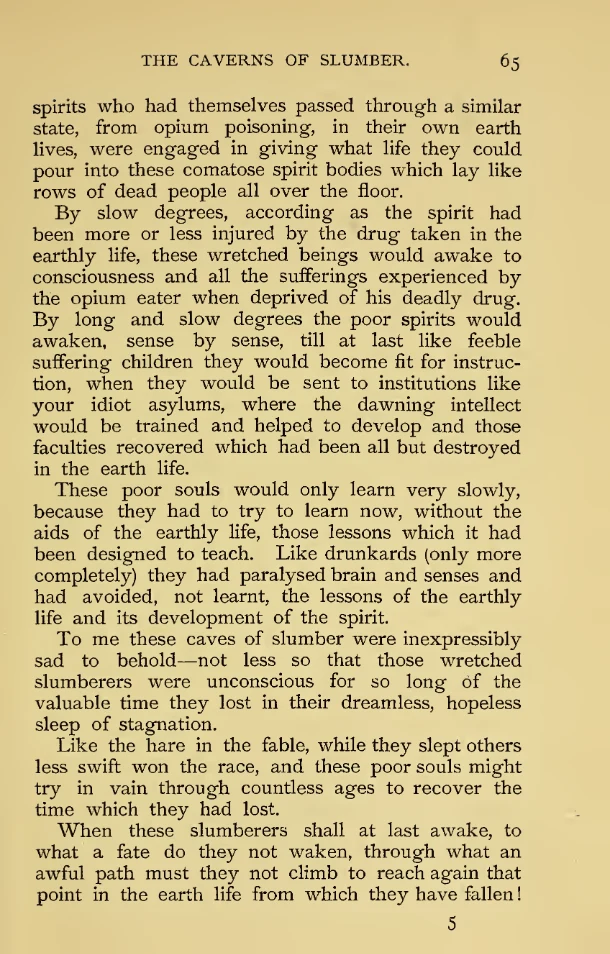
Source facsimile: A Wanderer in the Spirit Lands (1896), printed p. 65, Reader page 74.
A Wanderer in the Spirit Lands, W. J. Sinkins, London, preface dated 1896. Public-domain historical page from the checksum-verified Library PDF. · Image source ↗ · Public Domain
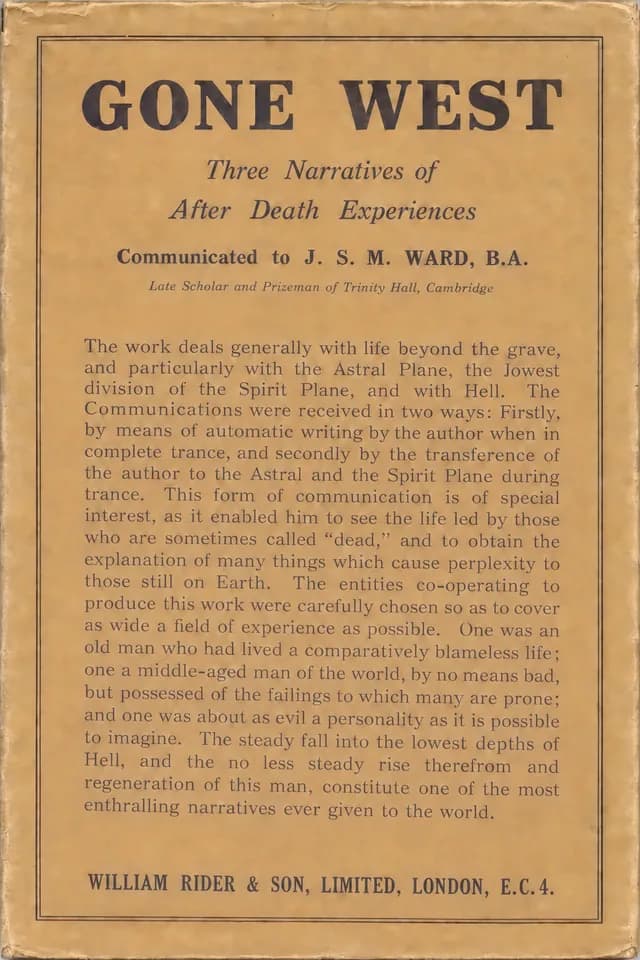
Gone West by J. S. M. Ward
J. S. M. Ward’s Gone West includes apparently sleeping spirits whose prolonged coma is explained by their refusal to accept that earthly life has ended. That explanation belongs to the guide’s account of denial, rather than ordinary bodily tiredness. [6]
Different meanings of a sleep-like state
The caverns describe a long loss of awareness followed by care. A later Home of Rest receives a traveller after demanding work. The two episodes give rest a different place in the person’s journey. [1][2][3][4][5]
In Gone West, Ward’s guide interprets some prolonged sleep-like states as refusal to accept that life continues. Franchezzo’s account gives the occupants impaired faculties and attendants who wait for them to return. The people may look similarly still, but the books explain their condition differently. [6][1][2][3]
See references (6)
- A Wanderer in the Spirit Lands, printed p. 64, Reader page 73
- A Wanderer in the Spirit Lands, printed p. 65, Reader page 74
- A Wanderer in the Spirit Lands, printed p. 66, Reader page 75
- A Wanderer in the Spirit Lands, printed p. 246, Reader page 255
- A Wanderer in the Spirit Lands, printed p. 247, Reader page 256
- Gone West, printed p. 155, Reader page 168
Read further in the library

A Wanderer in the Spirit Lands
Reading note
The separately titled account draws on exact passages in the consulted Library edition.
Gone West
Reading note
Separately attributed comparison with exact previously researched Library passages.
Sources
See references (6)
- A Wanderer in the Spirit Lands, printed p. 64, Reader page 73A Wanderer in the Spirit Lands, attributed to the spirit Franchezzo and transcribed by A. Farnese. W. J. Sinkins, London. Title page undated; preface dated 1896. The narrator’s experiences and the guides’ explanations are reported claims, not independently established observations.Read this page in A Wanderer in the Spirit Lands ↗Return to text ↑
- A Wanderer in the Spirit Lands, printed p. 65, Reader page 74A Wanderer in the Spirit Lands, attributed to the spirit Franchezzo and transcribed by A. Farnese. W. J. Sinkins, London. Title page undated; preface dated 1896. The narrator’s experiences and the guides’ explanations are reported claims, not independently established observations.Read this page in A Wanderer in the Spirit Lands ↗Return to text ↑
- A Wanderer in the Spirit Lands, printed p. 66, Reader page 75A Wanderer in the Spirit Lands, attributed to the spirit Franchezzo and transcribed by A. Farnese. W. J. Sinkins, London. Title page undated; preface dated 1896. The narrator’s experiences and the guides’ explanations are reported claims, not independently established observations.Read this page in A Wanderer in the Spirit Lands ↗Return to text ↑
- A Wanderer in the Spirit Lands, printed p. 246, Reader page 255A Wanderer in the Spirit Lands, attributed to the spirit Franchezzo and transcribed by A. Farnese. W. J. Sinkins, London. Title page undated; preface dated 1896. The narrator’s experiences and the guides’ explanations are reported claims, not independently established observations.Read this page in A Wanderer in the Spirit Lands ↗Return to text ↑
- A Wanderer in the Spirit Lands, printed p. 247, Reader page 256A Wanderer in the Spirit Lands, attributed to the spirit Franchezzo and transcribed by A. Farnese. W. J. Sinkins, London. Title page undated; preface dated 1896. The narrator’s experiences and the guides’ explanations are reported claims, not independently established observations.Read this page in A Wanderer in the Spirit Lands ↗Return to text ↑
- Gone West, printed p. 155, Reader page 168J. S. M. Ward, Gone West: Three Narratives of After-Death Experiences, third impression, William Rider & Son, London, 1920, as reproduced in Geoff Cutler’s December 2009 digital transcription. Ward’s introduction is distinct from the supplied 1974 foreword.Read this page in Gone West ↗Return to text ↑