The Frozen Land
The Frozen Land is Franchezzo’s icy region of cruelty and ambition. Compare its possibility of thaw with Dante’s frozen Cocytus.
In this article
Understanding the concept
The Frozen Land is an icy region in A Wanderer in the Spirit Lands. Franchezzo gives the cold a moral meaning: it expresses lives spent suppressing affection and using others for ambition. In his account a tear of remorse can begin to melt the ice. [1][2]
The narrator also finds a prisoner he cannot release. The cage protects him from people seeking revenge and prevents him from exercising the power he still wants. The visit tests what a rescuer can do when the captive has yet to change. [2][3][4][5]
See references (5)
- A Wanderer in the Spirit Lands, printed p. 59, Reader page 68
- A Wanderer in the Spirit Lands, printed p. 60, Reader page 69
- A Wanderer in the Spirit Lands, printed p. 61, Reader page 70
- A Wanderer in the Spirit Lands, printed p. 62, Reader page 71
- A Wanderer in the Spirit Lands, printed p. 63, Reader page 72
A Wanderer in the Spirit Lands: Franchezzo, transcribed by A. Farnese
The account attributed to Franchezzo and transcribed by A. Farnese describes an icy country with pinnacles on its buildings. The narrator reads their height through the ambition of the people there. They come from different nations and religions, linked by what he says they have done. [1][2]
Franchezzo says a tear of genuine remorse can melt the ice. The imprisoned Grand Inquisitor gives him a case where that change has yet to begin. The narrator calls some of the surrounding figures astral remains and identifies others as people who still seek revenge. [2][3]
A voice allows Franchezzo to perceive what the captive would do if released. He would return to earthly influence and re-establish domination. The cage therefore also limits his capacity to injure others. Franchezzo leaves distressed because he can find no one there whom he can presently help. [4][5][6]
The Inquisitor remains unnamed. The book’s polemic against persecution gives no warrant for identifying him with a particular historical person or treating the scene as documentary evidence about an institution’s dead members. [2][3][5]
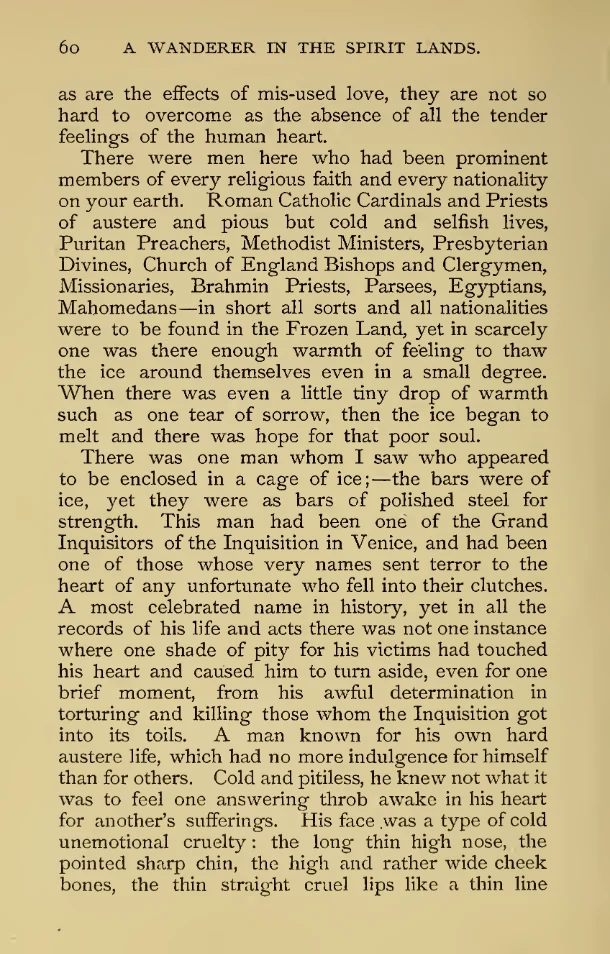
Source facsimile: A Wanderer in the Spirit Lands (1896), printed p. 60, Reader page 69.
A Wanderer in the Spirit Lands, W. J. Sinkins, London, preface dated 1896. Public-domain historical page from the checksum-verified Library PDF. · Image source ↗ · Public Domain
See references (6)
- A Wanderer in the Spirit Lands, printed p. 59, Reader page 68
- A Wanderer in the Spirit Lands, printed p. 60, Reader page 69
- A Wanderer in the Spirit Lands, printed p. 61, Reader page 70
- A Wanderer in the Spirit Lands, printed p. 62, Reader page 71
- A Wanderer in the Spirit Lands, printed p. 63, Reader page 72
- A Wanderer in the Spirit Lands, printed p. 64, Reader page 73
The Divine Comedy by Dante Alighieri
Dante Alighieri’s Inferno places betrayers in the frozen lake Cocytus. Heads emerge from the ice, tears can freeze against the eyes, and Satan’s beating wings chill the deepest region. Cold makes broken relations and immobilisation visible at the centre of the poem’s hell. [7][8][9]
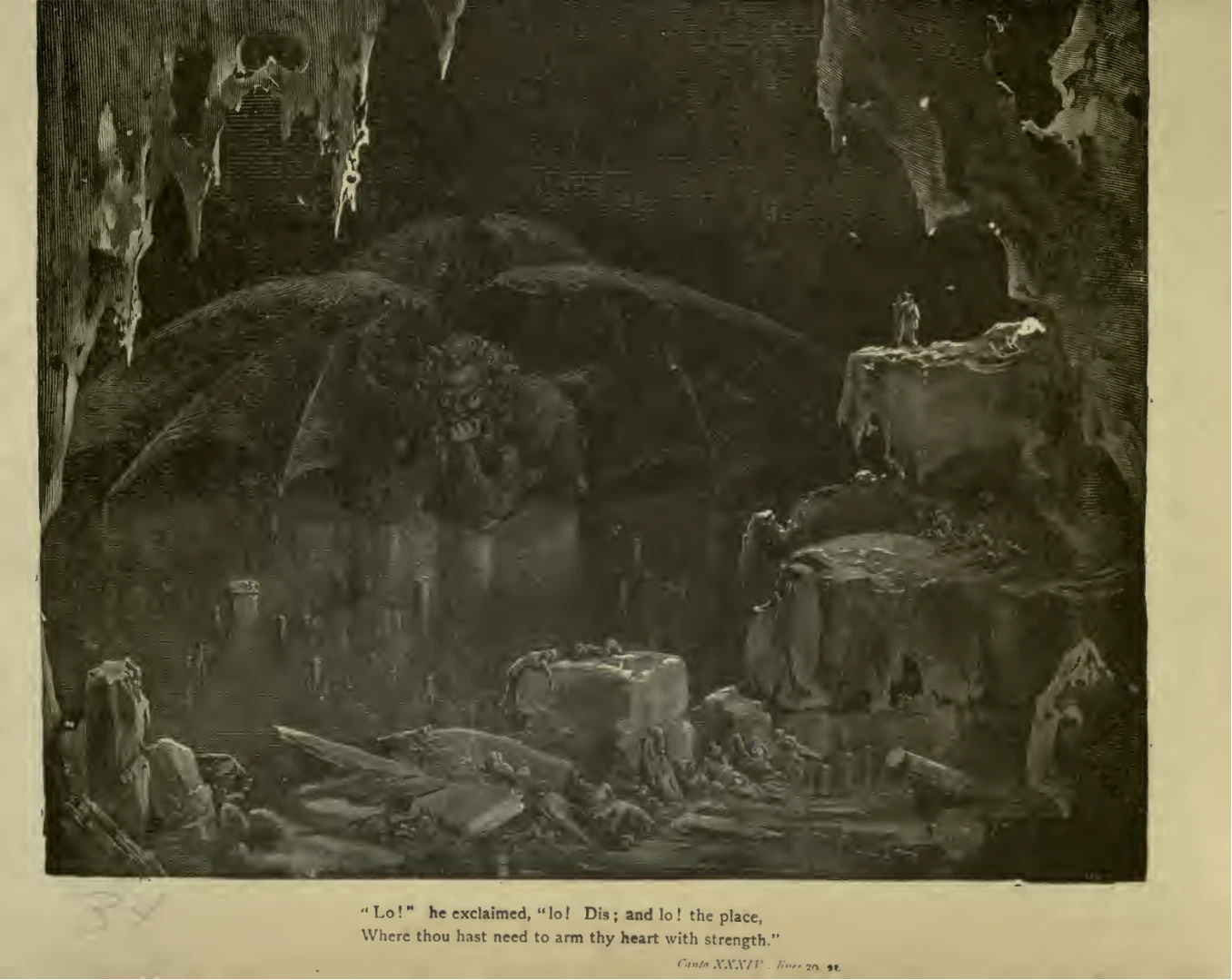
Gustave Doré, Inferno XXXIV. Lucifer stands in Dante’s frozen lake of Cocytus.
Design by Gustave Doré. Dante Alighieri, Inferno, Henry Francis Cary translation, Thompson & Thomas, Chicago, undated New Edition. Original design Public Domain. Complete landscape plate displayed upright. · Image source ↗ · Public Domain
When the ice can thaw
Franchezzo connects the cold with what people did to others and gives remorse a role in thawing it. In the attempted rescue, the captive still intends to do harm. Pity gives the visitor a reason to help, while readiness to change determines what help can do. [1][2][4][5][6]
In Dante’s Cocytus, ice fixes betrayers within the condition assigned to them. Franchezzo’s ice can begin to yield when someone feels remorse. The difference is what each landscape lets a person become after entering it. [7][8][9][1][2][3][4][5][6]
See references (9)
- A Wanderer in the Spirit Lands, printed p. 59, Reader page 68
- A Wanderer in the Spirit Lands, printed p. 60, Reader page 69
- A Wanderer in the Spirit Lands, printed p. 61, Reader page 70
- A Wanderer in the Spirit Lands, printed p. 62, Reader page 71
- A Wanderer in the Spirit Lands, printed p. 63, Reader page 72
- A Wanderer in the Spirit Lands, printed p. 64, Reader page 73
- Dante’s Inferno, Reader page 217
- Dante’s Inferno, Reader page 230
- Dante’s Inferno, Reader page 233
Read further in the library
A Wanderer in the Spirit Lands
Reading note
The separately titled account draws on exact passages in the consulted Library edition.
Dante's Inferno
Reading note
Separately attributed comparison with exact previously researched Library passages.
Sources
See references (10)
- A Wanderer in the Spirit Lands, printed p. 59, Reader page 68A Wanderer in the Spirit Lands, attributed to the spirit Franchezzo and transcribed by A. Farnese. W. J. Sinkins, London. Title page undated; preface dated 1896. The narrator’s experiences and the guides’ explanations are reported claims, not independently established observations.Read this page in A Wanderer in the Spirit Lands ↗Return to text ↑
- A Wanderer in the Spirit Lands, printed p. 60, Reader page 69A Wanderer in the Spirit Lands, attributed to the spirit Franchezzo and transcribed by A. Farnese. W. J. Sinkins, London. Title page undated; preface dated 1896. The narrator’s experiences and the guides’ explanations are reported claims, not independently established observations.Read this page in A Wanderer in the Spirit Lands ↗Return to text ↑
- A Wanderer in the Spirit Lands, printed p. 61, Reader page 70A Wanderer in the Spirit Lands, attributed to the spirit Franchezzo and transcribed by A. Farnese. W. J. Sinkins, London. Title page undated; preface dated 1896. The narrator’s experiences and the guides’ explanations are reported claims, not independently established observations.Read this page in A Wanderer in the Spirit Lands ↗Return to text ↑
- A Wanderer in the Spirit Lands, printed p. 62, Reader page 71A Wanderer in the Spirit Lands, attributed to the spirit Franchezzo and transcribed by A. Farnese. W. J. Sinkins, London. Title page undated; preface dated 1896. The narrator’s experiences and the guides’ explanations are reported claims, not independently established observations.Read this page in A Wanderer in the Spirit Lands ↗Return to text ↑
- A Wanderer in the Spirit Lands, printed p. 63, Reader page 72A Wanderer in the Spirit Lands, attributed to the spirit Franchezzo and transcribed by A. Farnese. W. J. Sinkins, London. Title page undated; preface dated 1896. The narrator’s experiences and the guides’ explanations are reported claims, not independently established observations.Read this page in A Wanderer in the Spirit Lands ↗Return to text ↑
- A Wanderer in the Spirit Lands, printed p. 64, Reader page 73A Wanderer in the Spirit Lands, attributed to the spirit Franchezzo and transcribed by A. Farnese. W. J. Sinkins, London. Title page undated; preface dated 1896. The narrator’s experiences and the guides’ explanations are reported claims, not independently established observations.Read this page in A Wanderer in the Spirit Lands ↗Return to text ↑
- Dante’s Inferno, Reader page 217Dante Alighieri, The Divine Comedy, translated by Henry Francis Cary, designs by Gustave Doré. Inferno: undated New Edition, Thompson & Thomas, Chicago. Purgatory and Paradise: New Edition, Thompson & Thomas, Chicago, 1901. Canto arguments are editorial matter and are distinguished from the poem.Read this page in Dante's Inferno ↗Return to text ↑
- Dante’s Inferno, Reader page 230Dante Alighieri, The Divine Comedy, translated by Henry Francis Cary, designs by Gustave Doré. Inferno: undated New Edition, Thompson & Thomas, Chicago. Purgatory and Paradise: New Edition, Thompson & Thomas, Chicago, 1901. Canto arguments are editorial matter and are distinguished from the poem.Read this page in Dante's Inferno ↗Return to text ↑
- Dante’s Inferno, Reader page 233Dante Alighieri, The Divine Comedy, translated by Henry Francis Cary, designs by Gustave Doré. Inferno: undated New Edition, Thompson & Thomas, Chicago. Purgatory and Paradise: New Edition, Thompson & Thomas, Chicago, 1901. Canto arguments are editorial matter and are distinguished from the poem.Read this page in Dante's Inferno ↗Return to text ↑
- Dante’s Inferno, plate for Canto XXXIV, Reader page 228Dante Alighieri, The Divine Comedy, translated by Henry Francis Cary, designs by Gustave Doré. Inferno: undated New Edition, Thompson & Thomas, Chicago. Purgatory and Paradise: New Edition, Thompson & Thomas, Chicago, 1901. Canto arguments are editorial matter and are distinguished from the poem.Read this page in Dante's Inferno ↗