Asuras
Asuras are often rivals of the gods in Hindu narratives. See how the term serves as divine praise in the Rigveda and how Buddhist texts frame their conflicts.
In this article
Who are the Asuras?
Asuras are powerful beings often cast as rivals of the Devas in Hindu narratives. In the Rigveda, the word asura can also praise a deity’s power. The term’s meaning depends on the passage. Some epic characters are called both Asuras and Rakshasas. [5][6][7][8][1][9][10][11]
See references (8)
- Rigveda 2.1.3–10, translated by Ralph T. H. Griffith
- Indian Myth and Legend, Reader page 126
- Indian Myth and Legend, Reader page 128
- Indian Myth and Legend, Reader page 129
- Indian Myth and Legend, Reader page 221
- Indian Myth and Legend, Reader page 132
- Indian Myth and Legend, Reader page 290
- Indian Myth and Legend, Reader page 291
A divine epithet in Rigveda 2.1.6
Rigveda 2.1 praises Agni through a series of divine identifications. In verse 6, Ralph T. H. Griffith’s translation addresses him as Rudra and uses Asura as part of the praise. [1]
A truce in Bhagavata Purana 8.6.19
In A. C. Bhaktivedanta Swami Prabhupada’s translation of Bhāgavata Purāṇa 8.6.19, the gods are advised to seek a truce while their opponents have the advantage. The advice prepares for the joint work that produces the nectar. [2]
Indian Myth and Legend by Donald A. Mackenzie
In Indian Myth and Legend, Donald A. Mackenzie contrasts Suras and Asuras, then notes that Asura was used of deities such as Varuna and Mitra. His chapter considers Iranian Ahura and several historical explanations for the change in usage while acknowledging that no explanation is conclusive. [5][12]
In a ritual account he quotes, the Asuras perform the same rites as the gods until a kind of silent praise gives the gods an advantage. Other stories make truthfulness or the sharing of offerings decide who prospers. [6]
Mackenzie describes the splendid underworld homes of Daityas and Danavas and the Asuras’ part in the ocean churning. His story of Vaka applies both Rakshasa and king of the Asuras to the same figure. [13][8][14][10][11]
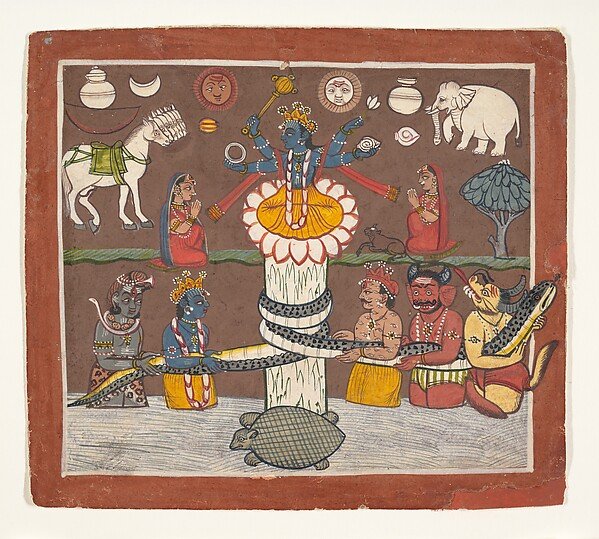
The gods and their rivals work together in a Mandi painting of the churning, around 1780–1790.
The Metropolitan Museum of Art, Gift of Mr. and Mrs. Alvin N. Haas, 1977, 1977.443.2. Open Access CC0; resized and converted to JPEG. · Image source ↗ · CC0
See references (8)
- Indian Myth and Legend, Reader page 126
- Indian Myth and Legend, Reader page 128
- Indian Myth and Legend, Reader page 221
- Indian Myth and Legend, Reader page 290
- Indian Myth and Legend, Reader page 291
- Indian Myth and Legend, Reader page 127
- Indian Myth and Legend, Reader page 131
- Indian Myth and Legend, Reader page 222
Divine power, rivalry and its causes
The Vedic hymn uses asura inside an address to a god. The Purāṇa makes former enemies work together. The Buddhist discourse asks what brings many kinds of beings into hostility in the first place. [5][12][1][8][2][6][3]
See references (7)
- Rigveda 2.1.3–10, translated by Ralph T. H. Griffith
- Bhagavata Purana 8.6.19, translated by A. C. Bhaktivedanta Swami Prabhupada
- Digha Nikaya 21, Sakka’s first question, translated by Thanissaro Bhikkhu
- Indian Myth and Legend, Reader page 126
- Indian Myth and Legend, Reader page 128
- Indian Myth and Legend, Reader page 221
- Indian Myth and Legend, Reader page 127
Read further in the library
Indian Myth and Legend
Reading note
The separately titled account draws on exact passages in the consulted Library edition.
Sources
See references (14)
- Rigveda 2.1.3–10, translated by Ralph T. H. Griffith ↗Verses 3–10 directly read, especially the divine asura epithet in verse 6. No etymology or precise chronology of semantic change is inferred from this one hymn.Return to text ↑
- Bhagavata Purana 8.6.19, translated by A. C. Bhaktivedanta Swami Prabhupada ↗Verse and short purport directly read in the Bhaktivedanta Book Trust’s Gaudiya Vaishnava presentation. Its temporary truce is distinguished from an assertion that every text treats the groups identically.Return to text ↑
- Digha Nikaya 21, Sakka’s first question, translated by Thanissaro Bhikkhu ↗Only the first question and answer of the displayed chapter-two excerpt are used: devas, humans, asuras and other beings share envy and stinginess. No reading of the entire discourse through this excerpt is claimed.Return to text ↑
- The Churning of the Ocean of Milk, ca. 1780–90 ↗The Metropolitan Museum of Art, Gift of Mr. and Mrs. Alvin N. Haas, 1977, 1977.443.2. Open Access CC0; resized and converted to JPEG.
- Indian Myth and Legend, Reader page 126Donald A. Mackenzie, Indian Myth and Legend, Gresham Publishing Company Limited, London, undated consulted impression. Library edition IMJ-0649-E001. Persistent PageIDs and current Reader positions verified against the supplied PDF and cached Reader manifest. Embedded translations are Mackenzie’s presentation unless a separately consulted primary text is named.Read this page in Indian Myth and Legend ↗Return to text ↑
- Indian Myth and Legend, Reader page 128Donald A. Mackenzie, Indian Myth and Legend, Gresham Publishing Company Limited, London, undated consulted impression. Library edition IMJ-0649-E001. Persistent PageIDs and current Reader positions verified against the supplied PDF and cached Reader manifest. Embedded translations are Mackenzie’s presentation unless a separately consulted primary text is named.Read this page in Indian Myth and Legend ↗Return to text ↑
- Indian Myth and Legend, Reader page 129Donald A. Mackenzie, Indian Myth and Legend, Gresham Publishing Company Limited, London, undated consulted impression. Library edition IMJ-0649-E001. Persistent PageIDs and current Reader positions verified against the supplied PDF and cached Reader manifest. Embedded translations are Mackenzie’s presentation unless a separately consulted primary text is named.Read this page in Indian Myth and Legend ↗Return to text ↑
- Indian Myth and Legend, Reader page 221Donald A. Mackenzie, Indian Myth and Legend, Gresham Publishing Company Limited, London, undated consulted impression. Library edition IMJ-0649-E001. Persistent PageIDs and current Reader positions verified against the supplied PDF and cached Reader manifest. Embedded translations are Mackenzie’s presentation unless a separately consulted primary text is named.Read this page in Indian Myth and Legend ↗Return to text ↑
- Indian Myth and Legend, Reader page 132Donald A. Mackenzie, Indian Myth and Legend, Gresham Publishing Company Limited, London, undated consulted impression. Library edition IMJ-0649-E001. Persistent PageIDs and current Reader positions verified against the supplied PDF and cached Reader manifest. Embedded translations are Mackenzie’s presentation unless a separately consulted primary text is named.Read this page in Indian Myth and Legend ↗Return to text ↑
- Indian Myth and Legend, Reader page 290Donald A. Mackenzie, Indian Myth and Legend, Gresham Publishing Company Limited, London, undated consulted impression. Library edition IMJ-0649-E001. Persistent PageIDs and current Reader positions verified against the supplied PDF and cached Reader manifest. Embedded translations are Mackenzie’s presentation unless a separately consulted primary text is named.Read this page in Indian Myth and Legend ↗Return to text ↑
- Indian Myth and Legend, Reader page 291Donald A. Mackenzie, Indian Myth and Legend, Gresham Publishing Company Limited, London, undated consulted impression. Library edition IMJ-0649-E001. Persistent PageIDs and current Reader positions verified against the supplied PDF and cached Reader manifest. Embedded translations are Mackenzie’s presentation unless a separately consulted primary text is named.Read this page in Indian Myth and Legend ↗Return to text ↑
- Indian Myth and Legend, Reader page 127Donald A. Mackenzie, Indian Myth and Legend, Gresham Publishing Company Limited, London, undated consulted impression. Library edition IMJ-0649-E001. Persistent PageIDs and current Reader positions verified against the supplied PDF and cached Reader manifest. Embedded translations are Mackenzie’s presentation unless a separately consulted primary text is named.Read this page in Indian Myth and Legend ↗Return to text ↑
- Indian Myth and Legend, Reader page 131Donald A. Mackenzie, Indian Myth and Legend, Gresham Publishing Company Limited, London, undated consulted impression. Library edition IMJ-0649-E001. Persistent PageIDs and current Reader positions verified against the supplied PDF and cached Reader manifest. Embedded translations are Mackenzie’s presentation unless a separately consulted primary text is named.Read this page in Indian Myth and Legend ↗Return to text ↑
- Indian Myth and Legend, Reader page 222Donald A. Mackenzie, Indian Myth and Legend, Gresham Publishing Company Limited, London, undated consulted impression. Library edition IMJ-0649-E001. Persistent PageIDs and current Reader positions verified against the supplied PDF and cached Reader manifest. Embedded translations are Mackenzie’s presentation unless a separately consulted primary text is named.Read this page in Indian Myth and Legend ↗Return to text ↑