Rakshasas
Rakshasas are powerful, often shape-shifting beings in Hindu epics. Explore Ravana, Vibhishana and other figures whose choices shape their stories.
In this article
Who are the Rakshasas?
Rakshasas are powerful beings in Hindu epic and religious storytelling. Some change their shape, threaten travellers or disturb sacrifices. Ravana rules the Rakshasas of Lanka in the Ramayana. Other figures, such as Vibhishana, help or protect people. The name can overlap with Asuras in some retellings. [4][5][6][7][8][9][10][1][2]
See references (9)
- Ramayana, Book VI, Canto XVII, translated by Ralph T. H. Griffith
- Ramayana, Book VI, Canto XVIII, translated by Ralph T. H. Griffith
- Indian Myth and Legend, Reader page 132
- Indian Myth and Legend, Reader page 133
- Indian Myth and Legend, Reader page 286
- Indian Myth and Legend, Reader page 290
- Indian Myth and Legend, Reader page 314
- Indian Myth and Legend, Reader page 509
- Indian Myth and Legend, Reader page 291
Indian Myth and Legend by Donald A. Mackenzie
In Indian Myth and Legend, Donald A. Mackenzie describes Rakshasas who travel through the air and change their shape. In the forest, Hidimva sends his sister to obtain the Pandavas as food. She decides to protect Bhima instead, becomes his wife and bears Ghatotkacha, who later promises aid. [4][5][11][6][12][7]
Mackenzie’s Jara joins the two parts of an infant and brings Jarasandha to life. The household worship she receives explains her help in the tale. In the Ramayana, Taraka and Maricha’s company use more destructive powers against the princes and their allies’ sacrifice. [8][13][14]
In Ravana’s court, Bibhishana, Mackenzie’s spelling of Vibhishana, urges the king to return Sita and avert war. Ravana responds with anger and Bibhishana joins Rama. Mackenzie also advances historical theories about such beings and rejects a simple identification with displaced peoples. [9][15][16]
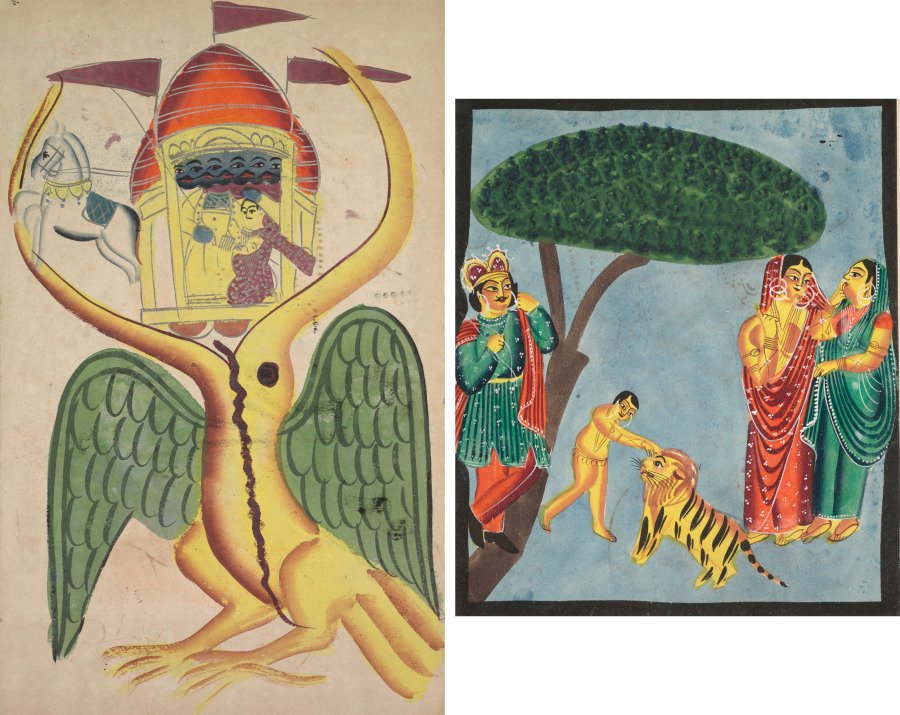
On this Kalighat album leaf, Jatayu confronts Ravana as he carries off Sita. The reverse, shown at right, depicts Dushyanta and Bharat in a separate story.
Cleveland Museum of Art, Gift of William E. Ward in memory of his wife, Evelyn Svec Ward, 2003.109. Both sides of a Kalighat album leaf, about 1890, shown together. CC0; resized and converted to JPEG. · Image source ↗ · CC0
See references (12)
- Indian Myth and Legend, Reader page 132
- Indian Myth and Legend, Reader page 133
- Indian Myth and Legend, Reader page 286
- Indian Myth and Legend, Reader page 290
- Indian Myth and Legend, Reader page 314
- Indian Myth and Legend, Reader page 509
- Indian Myth and Legend, Reader page 289
- Indian Myth and Legend, Reader page 287
- Indian Myth and Legend, Reader page 471
- Indian Myth and Legend, Reader page 472
- Indian Myth and Legend, Reader page 137
- Indian Myth and Legend, Reader page 138
Vibhishana and refuge in the Ramayana
In Ralph T. H. Griffith’s Ramayana, Book VI, Cantos XVII–XVIII, Vibhishana asks Rama for refuge. The council debates whether to suspect, test or welcome him. Hanuman argues that he has turned away from his brother’s conduct. Rama says a person who asks for shelter is entitled to it even if he was an enemy. [1][2]
Why Rama grants refuge
The two Ramayana accounts show Vibhishana leaving Ravana, but the council in Griffith gives readers more of the argument about trusting him. Hanuman weighs what Vibhishana has done. Rama grounds his decision in a duty to shelter a suppliant, a duty he says would apply even to Ravana. [9][1][4][2][6][7][8]
See references (7)
- Ramayana, Book VI, Canto XVII, translated by Ralph T. H. Griffith
- Ramayana, Book VI, Canto XVIII, translated by Ralph T. H. Griffith
- Indian Myth and Legend, Reader page 132
- Indian Myth and Legend, Reader page 286
- Indian Myth and Legend, Reader page 290
- Indian Myth and Legend, Reader page 314
- Indian Myth and Legend, Reader page 509
Read further in the library
Indian Myth and Legend
Reading note
The separately titled account draws on exact passages in the consulted Library edition.
Sources
See references (16)
- Ramayana, Book VI, Canto XVII, translated by Ralph T. H. Griffith ↗Vibhishan’s account, the council debate, Hanuman’s defence and the translator’s recension note directly consulted through the public text viewer. No claim of reading the inaccessible Valmikiramayan.net prose page is made.Return to text ↑
- Ramayana, Book VI, Canto XVIII, translated by Ralph T. H. Griffith ↗The protective-duty passage and concluding vow of shelter were directly read. Canto numbers are Griffith’s arrangement; no independently verified Library leaf is claimed.Return to text ↑
- Kalighat album leaf: Jatayu, Ravana and Sita (recto); Dushyanta and Bharat (verso), c. 1890 ↗Cleveland Museum of Art, Gift of William E. Ward in memory of his wife, Evelyn Svec Ward, 2003.109. Both sides of a Kalighat album leaf, about 1890, shown together. CC0; resized and converted to JPEG.
- Indian Myth and Legend, Reader page 132Donald A. Mackenzie, Indian Myth and Legend, Gresham Publishing Company Limited, London, undated consulted impression. Library edition IMJ-0649-E001. Persistent PageIDs and current Reader positions verified against the supplied PDF and cached Reader manifest. Embedded translations are Mackenzie’s presentation unless a separately consulted primary text is named.Read this page in Indian Myth and Legend ↗Return to text ↑
- Indian Myth and Legend, Reader page 133Donald A. Mackenzie, Indian Myth and Legend, Gresham Publishing Company Limited, London, undated consulted impression. Library edition IMJ-0649-E001. Persistent PageIDs and current Reader positions verified against the supplied PDF and cached Reader manifest. Embedded translations are Mackenzie’s presentation unless a separately consulted primary text is named.Read this page in Indian Myth and Legend ↗Return to text ↑
- Indian Myth and Legend, Reader page 286Donald A. Mackenzie, Indian Myth and Legend, Gresham Publishing Company Limited, London, undated consulted impression. Library edition IMJ-0649-E001. Persistent PageIDs and current Reader positions verified against the supplied PDF and cached Reader manifest. Embedded translations are Mackenzie’s presentation unless a separately consulted primary text is named.Read this page in Indian Myth and Legend ↗Return to text ↑
- Indian Myth and Legend, Reader page 290Donald A. Mackenzie, Indian Myth and Legend, Gresham Publishing Company Limited, London, undated consulted impression. Library edition IMJ-0649-E001. Persistent PageIDs and current Reader positions verified against the supplied PDF and cached Reader manifest. Embedded translations are Mackenzie’s presentation unless a separately consulted primary text is named.Read this page in Indian Myth and Legend ↗Return to text ↑
- Indian Myth and Legend, Reader page 314Donald A. Mackenzie, Indian Myth and Legend, Gresham Publishing Company Limited, London, undated consulted impression. Library edition IMJ-0649-E001. Persistent PageIDs and current Reader positions verified against the supplied PDF and cached Reader manifest. Embedded translations are Mackenzie’s presentation unless a separately consulted primary text is named.Read this page in Indian Myth and Legend ↗Return to text ↑
- Indian Myth and Legend, Reader page 509Donald A. Mackenzie, Indian Myth and Legend, Gresham Publishing Company Limited, London, undated consulted impression. Library edition IMJ-0649-E001. Persistent PageIDs and current Reader positions verified against the supplied PDF and cached Reader manifest. Embedded translations are Mackenzie’s presentation unless a separately consulted primary text is named.Read this page in Indian Myth and Legend ↗Return to text ↑
- Indian Myth and Legend, Reader page 291Donald A. Mackenzie, Indian Myth and Legend, Gresham Publishing Company Limited, London, undated consulted impression. Library edition IMJ-0649-E001. Persistent PageIDs and current Reader positions verified against the supplied PDF and cached Reader manifest. Embedded translations are Mackenzie’s presentation unless a separately consulted primary text is named.Read this page in Indian Myth and Legend ↗Return to text ↑
- Indian Myth and Legend, Reader page 289Donald A. Mackenzie, Indian Myth and Legend, Gresham Publishing Company Limited, London, undated consulted impression. Library edition IMJ-0649-E001. Persistent PageIDs and current Reader positions verified against the supplied PDF and cached Reader manifest. Embedded translations are Mackenzie’s presentation unless a separately consulted primary text is named.Read this page in Indian Myth and Legend ↗Return to text ↑
- Indian Myth and Legend, Reader page 287Donald A. Mackenzie, Indian Myth and Legend, Gresham Publishing Company Limited, London, undated consulted impression. Library edition IMJ-0649-E001. Persistent PageIDs and current Reader positions verified against the supplied PDF and cached Reader manifest. Embedded translations are Mackenzie’s presentation unless a separately consulted primary text is named.Read this page in Indian Myth and Legend ↗Return to text ↑
- Indian Myth and Legend, Reader page 471Donald A. Mackenzie, Indian Myth and Legend, Gresham Publishing Company Limited, London, undated consulted impression. Library edition IMJ-0649-E001. Persistent PageIDs and current Reader positions verified against the supplied PDF and cached Reader manifest. Embedded translations are Mackenzie’s presentation unless a separately consulted primary text is named.Read this page in Indian Myth and Legend ↗Return to text ↑
- Indian Myth and Legend, Reader page 472Donald A. Mackenzie, Indian Myth and Legend, Gresham Publishing Company Limited, London, undated consulted impression. Library edition IMJ-0649-E001. Persistent PageIDs and current Reader positions verified against the supplied PDF and cached Reader manifest. Embedded translations are Mackenzie’s presentation unless a separately consulted primary text is named.Read this page in Indian Myth and Legend ↗Return to text ↑
- Indian Myth and Legend, Reader page 137Donald A. Mackenzie, Indian Myth and Legend, Gresham Publishing Company Limited, London, undated consulted impression. Library edition IMJ-0649-E001. Persistent PageIDs and current Reader positions verified against the supplied PDF and cached Reader manifest. Embedded translations are Mackenzie’s presentation unless a separately consulted primary text is named.Read this page in Indian Myth and Legend ↗Return to text ↑
- Indian Myth and Legend, Reader page 138Donald A. Mackenzie, Indian Myth and Legend, Gresham Publishing Company Limited, London, undated consulted impression. Library edition IMJ-0649-E001. Persistent PageIDs and current Reader positions verified against the supplied PDF and cached Reader manifest. Embedded translations are Mackenzie’s presentation unless a separately consulted primary text is named.Read this page in Indian Myth and Legend ↗Return to text ↑