Animism
Animism describes relationships with animals, plants, places and other beings encountered as persons. Read Katherine Swancutt alongside Frank Hamel’s historical account.
In this article
What is animism?
Animism is a term used for ways of living in which animals, plants, places or other beings can be encountered as persons or as capable of feeling and acting. Which beings matter, and how people respond to them, depends on the community and the relationship. [18]
The word has also been used by outsiders to group very different practices. It becomes more precise when an account names who is relating to whom and under what circumstances. [18]
Relationships rather than a ladder of religions
Anthropologist Katherine Swancutt emphasises relationships with sentient beings. In her account, how someone recognises and responds to a being can be as important as what properties they say it has. The term animism therefore has to be read in light of an actual relationship. [18][9]
See references (2)
Human Animals by Frank Hamel
Frank Hamel’s Human Animals approaches human–animal relations through a broad idea of common life. The opening chapters ask how a person can imagine an animal as kin, an ancestor or the dwelling place of a soul. Hamel treats these connections as part of the background to transformation narratives. [1][2][3][6][7]
His later discussion of human and animal souls brings spiritual evolution into the picture. Passages attributed to Prentice Mulford describe continuity between animal and human life through successive embodiment. This is a metaphysical interpretation within Hamel’s collection, not a definition that every animistic tradition shares. [4][5][8]
Hamel moves from sympathy with animals to claims about mental projection. His effort to arrange these claims into a single developmental sequence reflects the assumptions of older comparative writing. The stories he collects can describe more particular relations, such as kinship or a shared fate. [9][10][11]
See references (11)
- Human Animals, printed p. 1, Reader page 10
- Human Animals, printed p. 2, Reader page 11
- Human Animals, printed p. 3, Reader page 12
- Human Animals, printed p. 39, Reader page 48
- Human Animals, printed p. 40, Reader page 49
- Human Animals, printed p. 15, Reader page 24
- Human Animals, printed p. 16, Reader page 25
- Human Animals, printed p. 41, Reader page 50
- Human Animals, printed p. 293, Reader page 302
- Human Animals, printed p. 294, Reader page 303
- Human Animals, printed p. 295, Reader page 304
Personhood, kinship and shared life
Totemism may concern a group’s descent and obligations. An external soul concerns a particular person’s dependence on a life elsewhere. Animism asks the broader question of which beings people recognise and respond to as persons. One account can involve more than one of those relationships. [6][7][12][13]
A story about an animal spouse may attribute speech and intention to an animal, but one tale alone cannot establish an entire community’s understanding of personhood. Comparing narratives with accounts of lived relationships requires attention to the kind of source being used. [14][15][16][17]
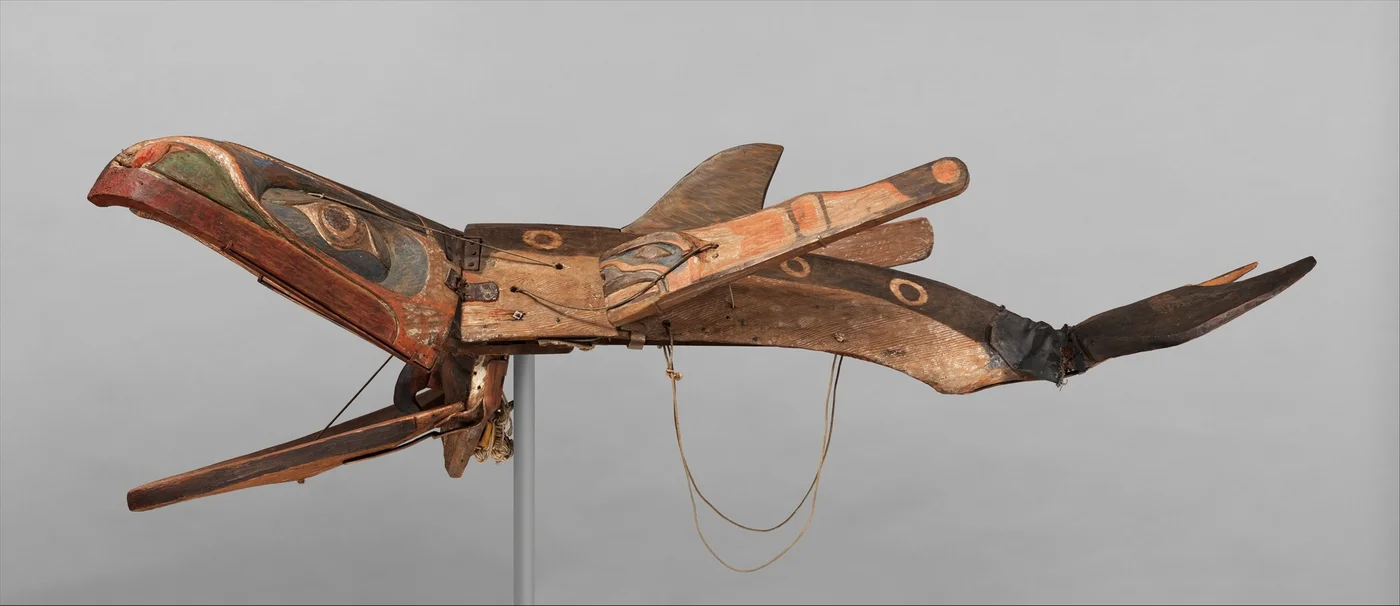
Kwakwaka’wakw Whale Transformation Mask, nineteenth century. The Met suggests the inner face may represent an ancestor associated with a whale. The object conveys a particular relationship to animals and ancestry.
The Metropolitan Museum of Art. The Michael C. Rockefeller Memorial Collection, Bequest of Nelson A. Rockefeller, 1979. 1979.206.406. Open Access; Public Domain. · Image source ↗ · Public Domain
See references (8)
- Human Animals, printed p. 15, Reader page 24
- Human Animals, printed p. 16, Reader page 25
- Human Animals, printed p. 19, Reader page 28
- Human Animals, printed p. 20, Reader page 29
- Human Animals, printed p. 141, Reader page 150
- Human Animals, printed p. 142, Reader page 151
- Human Animals, printed p. 145, Reader page 154
- Human Animals, printed p. 146, Reader page 155
Read further in the library
Human Animals
Reading note
Frank Hamel collects the particular stories and interpretations discussed here; the account identifies exact printed and Library Reader pages.
Sources
See references (19)
- Human Animals, printed p. 1, Reader page 10Frank Hamel, Human Animals. Frederick A. Stokes Co., New York, undated title page; preface dated London, 1915. Exact printed pages refer to the retained Library scan.Read this page in Human Animals ↗Return to text ↑
- Human Animals, printed p. 2, Reader page 11Frank Hamel, Human Animals. Frederick A. Stokes Co., New York, undated title page; preface dated London, 1915. Exact printed pages refer to the retained Library scan.Read this page in Human Animals ↗Return to text ↑
- Human Animals, printed p. 3, Reader page 12Frank Hamel, Human Animals. Frederick A. Stokes Co., New York, undated title page; preface dated London, 1915. Exact printed pages refer to the retained Library scan.Read this page in Human Animals ↗Return to text ↑
- Human Animals, printed p. 39, Reader page 48Frank Hamel, Human Animals. Frederick A. Stokes Co., New York, undated title page; preface dated London, 1915. Exact printed pages refer to the retained Library scan.Read this page in Human Animals ↗Return to text ↑
- Human Animals, printed p. 40, Reader page 49Frank Hamel, Human Animals. Frederick A. Stokes Co., New York, undated title page; preface dated London, 1915. Exact printed pages refer to the retained Library scan.Read this page in Human Animals ↗Return to text ↑
- Human Animals, printed p. 15, Reader page 24Frank Hamel, Human Animals. Frederick A. Stokes Co., New York, undated title page; preface dated London, 1915. Exact printed pages refer to the retained Library scan.Read this page in Human Animals ↗Return to text ↑
- Human Animals, printed p. 16, Reader page 25Frank Hamel, Human Animals. Frederick A. Stokes Co., New York, undated title page; preface dated London, 1915. Exact printed pages refer to the retained Library scan.Read this page in Human Animals ↗Return to text ↑
- Human Animals, printed p. 41, Reader page 50Frank Hamel, Human Animals. Frederick A. Stokes Co., New York, undated title page; preface dated London, 1915. Exact printed pages refer to the retained Library scan.Read this page in Human Animals ↗Return to text ↑
- Human Animals, printed p. 293, Reader page 302Frank Hamel, Human Animals. Frederick A. Stokes Co., New York, undated title page; preface dated London, 1915. Exact printed pages refer to the retained Library scan.Read this page in Human Animals ↗Return to text ↑
- Human Animals, printed p. 294, Reader page 303Frank Hamel, Human Animals. Frederick A. Stokes Co., New York, undated title page; preface dated London, 1915. Exact printed pages refer to the retained Library scan.Read this page in Human Animals ↗Return to text ↑
- Human Animals, printed p. 295, Reader page 304Frank Hamel, Human Animals. Frederick A. Stokes Co., New York, undated title page; preface dated London, 1915. Exact printed pages refer to the retained Library scan.Read this page in Human Animals ↗Return to text ↑
- Human Animals, printed p. 19, Reader page 28Frank Hamel, Human Animals. Frederick A. Stokes Co., New York, undated title page; preface dated London, 1915. Exact printed pages refer to the retained Library scan.Read this page in Human Animals ↗Return to text ↑
- Human Animals, printed p. 20, Reader page 29Frank Hamel, Human Animals. Frederick A. Stokes Co., New York, undated title page; preface dated London, 1915. Exact printed pages refer to the retained Library scan.Read this page in Human Animals ↗Return to text ↑
- Human Animals, printed p. 141, Reader page 150Frank Hamel, Human Animals. Frederick A. Stokes Co., New York, undated title page; preface dated London, 1915. Exact printed pages refer to the retained Library scan.Read this page in Human Animals ↗Return to text ↑
- Human Animals, printed p. 142, Reader page 151Frank Hamel, Human Animals. Frederick A. Stokes Co., New York, undated title page; preface dated London, 1915. Exact printed pages refer to the retained Library scan.Read this page in Human Animals ↗Return to text ↑
- Human Animals, printed p. 145, Reader page 154Frank Hamel, Human Animals. Frederick A. Stokes Co., New York, undated title page; preface dated London, 1915. Exact printed pages refer to the retained Library scan.Read this page in Human Animals ↗Return to text ↑
- Human Animals, printed p. 146, Reader page 155Frank Hamel, Human Animals. Frederick A. Stokes Co., New York, undated title page; preface dated London, 1915. Exact printed pages refer to the retained Library scan.Read this page in Human Animals ↗Return to text ↑
- Animism ↗Katherine Swancutt, The Open Encyclopedia of Anthropology, 2019, revised bibliographic citation 2023. Scholarly contextual account.Return to text ↑
- Whale Transformation Mask ↗The Metropolitan Museum of Art, 1979.206.406. Public-domain image and object metadata. Curatorial attribution retained.