Animals in the Afterlife
Do animals survive death in Spiritualist accounts? Compare Ward’s family dog, Franchezzo’s animal souls, Swedenborg’s objections and Hamel.
In this article
What do accounts of animal survival claim?
Accounts of animals in the afterlife ask whether an animal keeps its own identity after death. Some describe animals in a new landscape. Others tell of reunion after death with a particular pet whose habits and attachments are still recognisable. [1][2][3]
Being seen, being recognised and going on developing raise different questions. A figure can resemble a familiar animal in an account whose author understands that appearance as something other than the surviving animal itself. [4][3]
Animals and continuing identity
Gone West by J. S. M. Ward
In J. S. M. Ward’s Gone West, H. J. L., one of Ward’s reported spirit contributors, first encounters animals among the plants, flowers and trees of the country reached after death. His guide says the spiritual forms of living things come there, making their presence part of a general explanation of how the world is built. [1]
A later meeting makes the claim specific. Ward asks about Molly, his wife Carrie’s dog. At first he cannot see her. Then she runs out from a wood, greets him and H. J. L., and performs a familiar action when asked. She looks younger and has lost a physical defect, yet remains recognisable through appearance and behaviour. [2][3]
The meeting prompts Ward to ask what happens when animals reach the boundary of that plane. H. J. L. calls this something they are investigating and says he has asked another contributor to inquire. The assurance of a recognisable dog’s presence is accompanied by an acknowledged question about her further future. [3]
Ward’s introduction supplies another account involving an animal. It says the monk Ambrose passes through the Wall of Fire with his faithful dog following him. This is an introductory report about a further transition, presented alongside the contributors’ more local accounts of what they have encountered. [4]
Molly’s return gives animal survival the form of an enduring relationship. Her greeting, familiar movement and choice to settle beside H. J. L. carry the recognition. The wider account then asks how such a relationship might fit into an afterlife understood through continuing development. [2][3]
A later chapter asks how animals communicate. H. J. L. says their thoughts can appear as pictures, although some are less clearly formed than human thoughts. Ward reports seeing Molly’s memory of Carrie rowing a boat, then tries to convey an image of Blanche to her. The scene makes shared memories a way for the dog and her human companions to understand one another. [5][6]
H. J. L. associates progress with developing interests beyond finding food and with closer relationships to people. Yet he still does not claim to know how high the most intelligent animals can travel. This later discussion adds a possible process of development while retaining the earlier question about its ultimate extent. [5][6]
A Subaltern in Spirit Land by J. S. M. Ward
J. S. M. Ward’s A Subaltern in Spirit Land brings back the family dog familiar from Gone West. Here called Mollie, she becomes excited as Ward and H. J. L., one of Ward’s reported spirit contributors, prepare to visit Rex. Ward recalls that Rex had been fond of her and had buried her. H. J. L. treats this shared history as a possible connection between them. [7]
The intended journey also has a limit. H. J. L. does not know how to give the dog an astral body for the visit, so she remains behind. His uncertainty contrasts with his ability to make a temporary covering for himself. The account allows an enduring animal relationship without claiming that every practical question about it has been solved. [7]
A later explanation places animals, plants and landscapes within the same broad distinction between astral and spiritual forms. Animals closely associated with humans are said to reach the guide’s realm, while many others remain for much longer on the astral plane. This is his proposed account of differing stages of animal life. [8][9]
He then acknowledges a question still under study: whether some animals return to earth through reincarnation. He says he is inclined to think some do but has not settled it. The sequel preserves inquiry and uncertainty within its assurance that animal life extends beyond a physical body. [10]
Rex also befriends a cat near the ruins of a town. Later he calls it Tiger after a former household cat, while explicitly saying it is not that earlier animal, whom he has not found. A separate episode describes an unsuccessful attempt to establish a zoo: animals walk through the bars and return to the environments they prefer. Familiar companionship is present, but Ward does not make every encounter a reunion with a former pet. [11][12][13][14]
In Rex’s account of the seventh division, animals live amicably with people amid flowers, birds and butterflies. He reports no carnivores there, qualifying the statement by the limits of what he has discovered. This is a description of one region in his proposed map, rather than a complete account of the fate of every species. [15]
See references (9)
- A Subaltern in Spirit Land, printed p. 6, Reader page 21
- A Subaltern in Spirit Land, printed p. 43, Reader page 58
- A Subaltern in Spirit Land, printed p. 44, Reader page 59
- A Subaltern in Spirit Land, printed p. 45, Reader page 60
- A Subaltern in Spirit Land, printed p. 107, Reader page 122
- A Subaltern in Spirit Land, printed p. 192, Reader page 207
- A Subaltern in Spirit Land, printed p. 193, Reader page 208
- A Subaltern in Spirit Land, printed p. 195, Reader page 210
- A Subaltern in Spirit Land, printed p. 174, Reader page 189
A Wanderer in the Spirit Lands
In A Wanderer in the Spirit Lands, attributed to Franchezzo and transcribed by A. Farnese, Hassein, the narrator’s guide, argues that reasoning in animals indicates a soul principle differing in degree from human intelligence. He says his school infers an individual immortal future for animals as well as people, and claims that animals formerly on earth are present in a more developed condition in the spirit world. [16][17]
His later account of nature extends spiritual counterparts to plants, rocks, birds and beasts. This belongs to a proposed continuity between earthly and spiritual matter. It is a metaphysical scheme within the book, rather than an observation establishing the survival of an identified pet. [18][19]
Hassein also draws a boundary which is easy to miss: he rejects the transmigration of an animal soul into a human being or the reverse. Each type is said to develop within its own type. The book can therefore affirm animal immortality without making animal-to-human rebirth part of its account. Its hierarchy of types remains the guide’s doctrine, not a finding about animal cognition or evolution. [20]
Animals in a peaceful world
Edward Hicks’s Peaceable Kingdom draws on Isaiah 11:6–9. Children share the landscape with animals that ordinarily prey on one another. The painting pictures a transformed order of life, a separate idea from the survival of a remembered pet. [22][21]
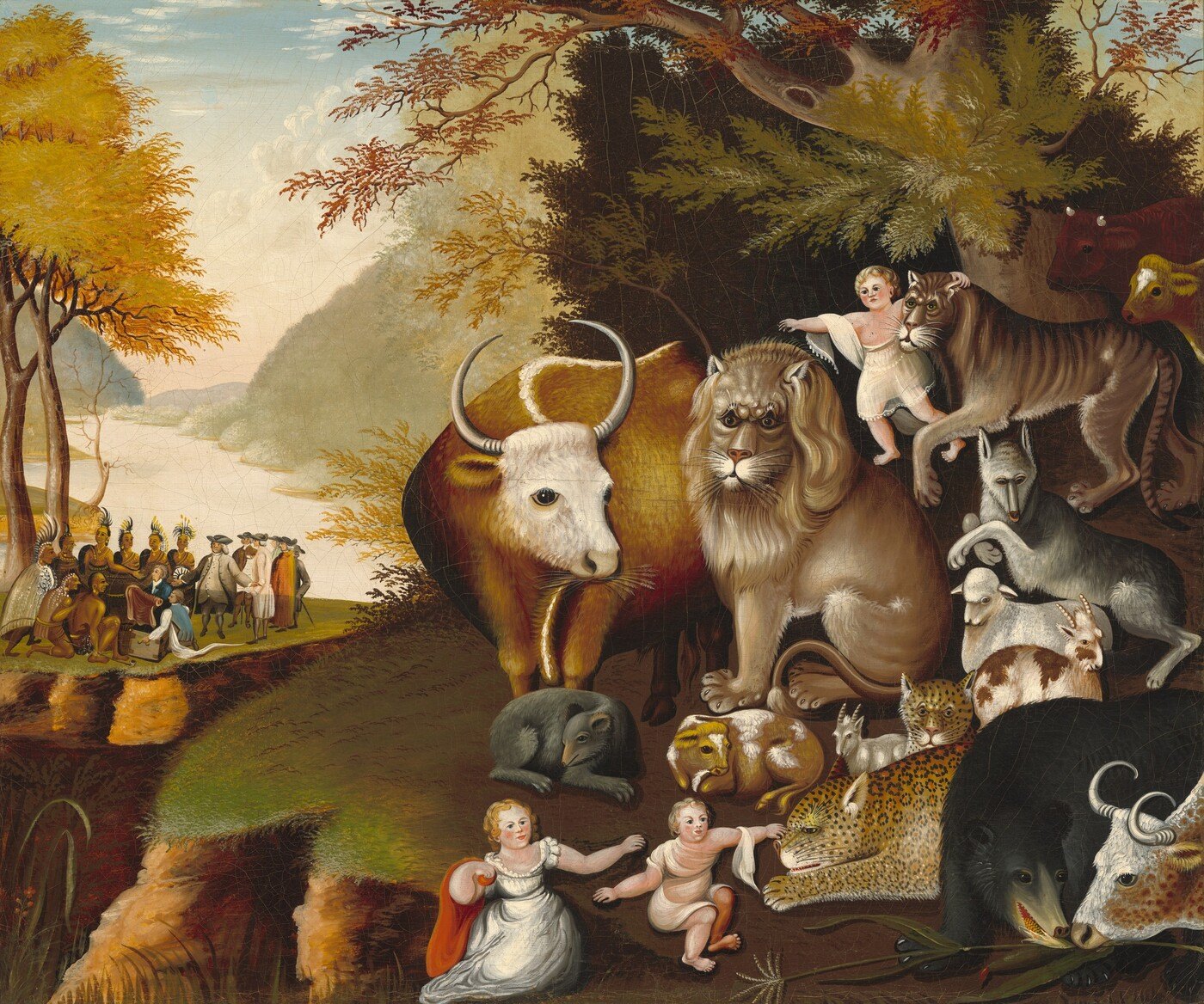
Edward Hicks, Peaceable Kingdom, c. 1834. Oil on canvas. The animals’ peaceful coexistence offers a different religious image from the individual animal survival described in Spiritualist books.
National Gallery of Art, Washington. Gift of Edgar William and Bernice Chrysler Garbisch. 1980.62.15. Public Domain. · Image source ↗ · Public Domain
Heaven and Its Wonders and Hell
Emanuel Swedenborg’s Heaven and Its Wonders and Hell draws a sharp boundary between human and animal spiritual life. Animals receive life and act through affections, but he says they lack the human inmost through which a person can be joined to the Divine. He uses that difference to explain why human life endures and an animal’s spiritual part is dissipated with the body. [29][30]
Swedenborg’s explanation rests on the relation he proposes between the Divine and the human mind. It differs from a narrative in which a recognised pet continues with its own memories and attachments. The distinction concerns which beings can retain an enduring identity, rather than whether animals have a place in the imagery of the spiritual world. [29][30]
Animals also appear in his language of correspondences. Different creatures represent affections, and their natural activities illustrate forms of order. An animal appearing in a spiritual landscape therefore needs to be read through the function Swedenborg gives it. Such an appearance alone is not his affirmation that a particular earthly animal has survived. [23][24][25][26][27][28]
See references (8)
- Heaven and Its Wonders and Hell, printed p. 77, Reader page 84
- Heaven and Its Wonders and Hell, printed p. 78, Reader page 85
- Heaven and Its Wonders and Hell, printed p. 79, Reader page 86
- Heaven and Its Wonders and Hell, printed p. 80, Reader page 87
- Heaven and Its Wonders and Hell, printed p. 81, Reader page 88
- Heaven and Its Wonders and Hell, printed p. 82, Reader page 89
- Heaven and Its Wonders and Hell, printed p. 375, Reader page 382
- Heaven and Its Wonders and Hell, printed p. 376, Reader page 383
Human Animals by Frank Hamel
In Human Animals, Frank Hamel brings together reports of animal apparitions and occult explanations. The book also describes human souls appearing in animal form. Those stories give the same shape to an entirely different proposed identity. [31][32][33][34][35]
The phantasm chapter draws on Adolphe d’Assier for an ass’s apparition and a separate mule episode. The ass case has a significant limit: the animal’s death is inferred rather than confirmed. Hamel also records the possibility that an animal-shaped phantom could be a human double. Appearance alone therefore does not settle survival or identity. [36][37][38]
The closing occult material quotes C. W. Leadbeater on animals’ temporary postmortem forms. This is a Theosophical model of a surviving form with limited duration, not automatically a permanent individual animal heaven. Because Hamel quotes the earlier book, the agreement is a textual relationship rather than independent corroboration. [39][40]
The collection is valuable for preserving competing explanations. It moves between tales, reports, speculation and quotation. Its animal apparitions should be read with those limits intact, rather than gathered into a single body of proof that all animals survive in the same way. [36][37][38][39][40]
See references (10)
- Human Animals, printed p. 23, Reader page 32
- Human Animals, printed p. 24, Reader page 33
- Human Animals, printed p. 25, Reader page 34
- Human Animals, printed p. 26, Reader page 35
- Human Animals, printed p. 27, Reader page 36
- Human Animals, printed p. 263, Reader page 272
- Human Animals, printed p. 264, Reader page 273
- Human Animals, printed p. 265, Reader page 274
- Human Animals, printed p. 290, Reader page 299
- Human Animals, printed p. 291, Reader page 300
Comparing the accounts
Individual survival, temporary forms and theological limits
The earlier Spiritualist accounts describe recognisable animals within continuing spirit-world life. Emanuel Swedenborg instead denies animals the enduring spiritual capacity he attributes to human beings. Hamel adds uncertain apparition reports and a temporary Theosophical form, while quoting Leadbeater rather than independently confirming him. The disagreement concerns which identity survives and for how long. [36][37][38][39][40][7][16][17][29][30]
See references (10)
- A Subaltern in Spirit Land, printed p. 6, Reader page 21
- A Wanderer in the Spirit Lands, Reader page 116
- A Wanderer in the Spirit Lands, Reader page 117
- Heaven and Its Wonders and Hell, printed p. 375, Reader page 382
- Heaven and Its Wonders and Hell, printed p. 376, Reader page 383
- Human Animals, printed p. 263, Reader page 272
- Human Animals, printed p. 264, Reader page 273
- Human Animals, printed p. 265, Reader page 274
- Human Animals, printed p. 290, Reader page 299
- Human Animals, printed p. 291, Reader page 300
An animal in a landscape, or an individual survivor?
Ward gives an animal a continuing place in a remembered relationship. Franchezzo’s guide argues that animals can survive as individuals and rejects the idea that they reincarnate as humans. In his account, continued life has its own course for the animal. [5][6][7][16][17][20]
Swedenborg says an animal’s spiritual part dissipates with its body. The animals that appear as correspondences in his book express affections. That makes their appearance a different claim from Ward’s encounter with a former pet. [29][30][23][24][25][26][27][28][7]
See references (14)
- Gone West, printed p. 72, Reader page 85
- Gone West, printed p. 73, Reader page 86
- A Subaltern in Spirit Land, printed p. 6, Reader page 21
- A Wanderer in the Spirit Lands, Reader page 116
- A Wanderer in the Spirit Lands, Reader page 117
- A Wanderer in the Spirit Lands, Reader page 268
- Heaven and Its Wonders and Hell, printed p. 77, Reader page 84
- Heaven and Its Wonders and Hell, printed p. 78, Reader page 85
- Heaven and Its Wonders and Hell, printed p. 79, Reader page 86
- Heaven and Its Wonders and Hell, printed p. 80, Reader page 87
- Heaven and Its Wonders and Hell, printed p. 81, Reader page 88
- Heaven and Its Wonders and Hell, printed p. 82, Reader page 89
- Heaven and Its Wonders and Hell, printed p. 375, Reader page 382
- Heaven and Its Wonders and Hell, printed p. 376, Reader page 383
Read further in the library

Gone West
Reading note
Ward’s book describes the reunion with Molly and discusses whether animals continue to higher states.
A Subaltern in Spirit Land: A Sequel to Gone West
Reading note
Ward’s sequel adds the separately cited account of this subject.

A Wanderer in the Spirit Lands
Reading note
Hassein argues for individual animal survival while rejecting the exchange of animal and human soul types.

Heaven and Its Wonders and Hell
Reading note
Swedenborg’s theological account denies animals the human capacity for enduring spiritual life.
Human Animals
Reading note
Frank Hamel collects the particular stories and interpretations discussed here; the account identifies exact printed and Library Reader pages.
Sources
See references (40)
- Gone West, printed p. 15, Reader page 28J. S. M. Ward, Gone West, 1920 third impression in the 2009 Geoff Cutler digital transcription.Read this page in Gone West ↗Return to text ↑
- Gone West, printed p. 32, Reader page 45J. S. M. Ward, Gone West, 1920 third impression in the 2009 Geoff Cutler digital transcription.Read this page in Gone West ↗Return to text ↑
- Gone West, printed p. 33, Reader page 46J. S. M. Ward, Gone West, 1920 third impression in the 2009 Geoff Cutler digital transcription.Read this page in Gone West ↗Return to text ↑
- Gone West, Introduction, Reader page 9J. S. M. Ward, Gone West, 1920 third impression in the 2009 Geoff Cutler digital transcription.Read this page in Gone West ↗Return to text ↑
- Gone West, printed p. 72, Reader page 85J. S. M. Ward, Gone West, 1920 third impression in the 2009 Geoff Cutler digital transcription.Read this page in Gone West ↗Return to text ↑
- Gone West, printed p. 73, Reader page 86J. S. M. Ward, Gone West, 1920 third impression in the 2009 Geoff Cutler digital transcription.Read this page in Gone West ↗Return to text ↑
- A Subaltern in Spirit Land, printed p. 6, Reader page 21J. S. M. Ward, A Subaltern in Spirit Land: A Sequel to Gone West, William Rider & Son, 1920.Read this page in A Subaltern in Spirit Land: A Sequel to Gone West ↗Return to text ↑
- A Subaltern in Spirit Land, printed p. 43, Reader page 58J. S. M. Ward, A Subaltern in Spirit Land: A Sequel to Gone West, William Rider & Son, 1920.Read this page in A Subaltern in Spirit Land: A Sequel to Gone West ↗Return to text ↑
- A Subaltern in Spirit Land, printed p. 44, Reader page 59J. S. M. Ward, A Subaltern in Spirit Land: A Sequel to Gone West, William Rider & Son, 1920.Read this page in A Subaltern in Spirit Land: A Sequel to Gone West ↗Return to text ↑
- A Subaltern in Spirit Land, printed p. 45, Reader page 60J. S. M. Ward, A Subaltern in Spirit Land: A Sequel to Gone West, William Rider & Son, 1920.Read this page in A Subaltern in Spirit Land: A Sequel to Gone West ↗Return to text ↑
- A Subaltern in Spirit Land, printed p. 107, Reader page 122J. S. M. Ward, A Subaltern in Spirit Land: A Sequel to Gone West, William Rider & Son, 1920.Read this page in A Subaltern in Spirit Land: A Sequel to Gone West ↗Return to text ↑
- A Subaltern in Spirit Land, printed p. 192, Reader page 207J. S. M. Ward, A Subaltern in Spirit Land: A Sequel to Gone West, William Rider & Son, 1920.Read this page in A Subaltern in Spirit Land: A Sequel to Gone West ↗Return to text ↑
- A Subaltern in Spirit Land, printed p. 193, Reader page 208J. S. M. Ward, A Subaltern in Spirit Land: A Sequel to Gone West, William Rider & Son, 1920.Read this page in A Subaltern in Spirit Land: A Sequel to Gone West ↗Return to text ↑
- A Subaltern in Spirit Land, printed p. 195, Reader page 210J. S. M. Ward, A Subaltern in Spirit Land: A Sequel to Gone West, William Rider & Son, 1920.Read this page in A Subaltern in Spirit Land: A Sequel to Gone West ↗Return to text ↑
- A Subaltern in Spirit Land, printed p. 174, Reader page 189J. S. M. Ward, A Subaltern in Spirit Land: A Sequel to Gone West, William Rider & Son, 1920.Read this page in A Subaltern in Spirit Land: A Sequel to Gone West ↗Return to text ↑
- A Wanderer in the Spirit Lands, Reader page 116Franchezzo (source attribution), A Wanderer in the Spirit Lands, transcribed by A. Farnese. W. J. Sinkins, London, 1896. Date confirmed on the consulted title-page facsimile.Read this page in A Wanderer in the Spirit Lands ↗Return to text ↑
- A Wanderer in the Spirit Lands, Reader page 117Franchezzo (source attribution), A Wanderer in the Spirit Lands, transcribed by A. Farnese. W. J. Sinkins, London, 1896. Date confirmed on the consulted title-page facsimile.Read this page in A Wanderer in the Spirit Lands ↗Return to text ↑
- A Wanderer in the Spirit Lands, Reader page 264Franchezzo (source attribution), A Wanderer in the Spirit Lands, transcribed by A. Farnese. W. J. Sinkins, London, 1896. Date confirmed on the consulted title-page facsimile.Read this page in A Wanderer in the Spirit Lands ↗Return to text ↑
- A Wanderer in the Spirit Lands, Reader page 265Franchezzo (source attribution), A Wanderer in the Spirit Lands, transcribed by A. Farnese. W. J. Sinkins, London, 1896. Date confirmed on the consulted title-page facsimile.Read this page in A Wanderer in the Spirit Lands ↗Return to text ↑
- A Wanderer in the Spirit Lands, Reader page 268Franchezzo (source attribution), A Wanderer in the Spirit Lands, transcribed by A. Farnese. W. J. Sinkins, London, 1896. Date confirmed on the consulted title-page facsimile.Read this page in A Wanderer in the Spirit Lands ↗Return to text ↑
- Edward Hicks, Peaceable Kingdom, c. 1834 ↗National Gallery of Art, Washington. Gift of Edgar William and Bernice Chrysler Garbisch. Accession1980.62.15. Public-domain image under the Gallery’s Open Access policy.Return to text ↑
- Isaiah 11:6–9, animals in a peaceful order ↗New American Bible, Revised Edition, United States Conference of Catholic Bishops. Primary text, Isaiah 11:6–9.Return to text ↑
- Heaven and Its Wonders and Hell, printed p. 77, Reader page 84Emanuel Swedenborg, Heaven and Its Wonders and Hell, translated by J. C. Ager. The American Swedenborg Printing and Publishing Society, New York, 1916. Original Latin work first published in 1758.Read this page in Heaven and Its Wonders and Hell ↗Return to text ↑
- Heaven and Its Wonders and Hell, printed p. 78, Reader page 85Emanuel Swedenborg, Heaven and Its Wonders and Hell, translated by J. C. Ager. The American Swedenborg Printing and Publishing Society, New York, 1916. Original Latin work first published in 1758.Read this page in Heaven and Its Wonders and Hell ↗Return to text ↑
- Heaven and Its Wonders and Hell, printed p. 79, Reader page 86Emanuel Swedenborg, Heaven and Its Wonders and Hell, translated by J. C. Ager. The American Swedenborg Printing and Publishing Society, New York, 1916. Original Latin work first published in 1758.Read this page in Heaven and Its Wonders and Hell ↗Return to text ↑
- Heaven and Its Wonders and Hell, printed p. 80, Reader page 87Emanuel Swedenborg, Heaven and Its Wonders and Hell, translated by J. C. Ager. The American Swedenborg Printing and Publishing Society, New York, 1916. Original Latin work first published in 1758.Read this page in Heaven and Its Wonders and Hell ↗Return to text ↑
- Heaven and Its Wonders and Hell, printed p. 81, Reader page 88Emanuel Swedenborg, Heaven and Its Wonders and Hell, translated by J. C. Ager. The American Swedenborg Printing and Publishing Society, New York, 1916. Original Latin work first published in 1758.Read this page in Heaven and Its Wonders and Hell ↗Return to text ↑
- Heaven and Its Wonders and Hell, printed p. 82, Reader page 89Emanuel Swedenborg, Heaven and Its Wonders and Hell, translated by J. C. Ager. The American Swedenborg Printing and Publishing Society, New York, 1916. Original Latin work first published in 1758.Read this page in Heaven and Its Wonders and Hell ↗Return to text ↑
- Heaven and Its Wonders and Hell, printed p. 375, Reader page 382Emanuel Swedenborg, Heaven and Its Wonders and Hell, translated by J. C. Ager. The American Swedenborg Printing and Publishing Society, New York, 1916. Original Latin work first published in 1758.Read this page in Heaven and Its Wonders and Hell ↗Return to text ↑
- Heaven and Its Wonders and Hell, printed p. 376, Reader page 383Emanuel Swedenborg, Heaven and Its Wonders and Hell, translated by J. C. Ager. The American Swedenborg Printing and Publishing Society, New York, 1916. Original Latin work first published in 1758.Read this page in Heaven and Its Wonders and Hell ↗Return to text ↑
- Human Animals, printed p. 23, Reader page 32Frank Hamel, Human Animals. Frederick A. Stokes Co., New York, undated title page; preface dated London, 1915. Exact printed pages refer to the retained Library scan.Read this page in Human Animals ↗Return to text ↑
- Human Animals, printed p. 24, Reader page 33Frank Hamel, Human Animals. Frederick A. Stokes Co., New York, undated title page; preface dated London, 1915. Exact printed pages refer to the retained Library scan.Read this page in Human Animals ↗Return to text ↑
- Human Animals, printed p. 25, Reader page 34Frank Hamel, Human Animals. Frederick A. Stokes Co., New York, undated title page; preface dated London, 1915. Exact printed pages refer to the retained Library scan.Read this page in Human Animals ↗Return to text ↑
- Human Animals, printed p. 26, Reader page 35Frank Hamel, Human Animals. Frederick A. Stokes Co., New York, undated title page; preface dated London, 1915. Exact printed pages refer to the retained Library scan.Read this page in Human Animals ↗Return to text ↑
- Human Animals, printed p. 27, Reader page 36Frank Hamel, Human Animals. Frederick A. Stokes Co., New York, undated title page; preface dated London, 1915. Exact printed pages refer to the retained Library scan.Read this page in Human Animals ↗Return to text ↑
- Human Animals, printed p. 263, Reader page 272Frank Hamel, Human Animals. Frederick A. Stokes Co., New York, undated title page; preface dated London, 1915. Exact printed pages refer to the retained Library scan.Read this page in Human Animals ↗Return to text ↑
- Human Animals, printed p. 264, Reader page 273Frank Hamel, Human Animals. Frederick A. Stokes Co., New York, undated title page; preface dated London, 1915. Exact printed pages refer to the retained Library scan.Read this page in Human Animals ↗Return to text ↑
- Human Animals, printed p. 265, Reader page 274Frank Hamel, Human Animals. Frederick A. Stokes Co., New York, undated title page; preface dated London, 1915. Exact printed pages refer to the retained Library scan.Read this page in Human Animals ↗Return to text ↑
- Human Animals, printed p. 290, Reader page 299Frank Hamel, Human Animals. Frederick A. Stokes Co., New York, undated title page; preface dated London, 1915. Exact printed pages refer to the retained Library scan.Read this page in Human Animals ↗Return to text ↑
- Human Animals, printed p. 291, Reader page 300Frank Hamel, Human Animals. Frederick A. Stokes Co., New York, undated title page; preface dated London, 1915. Exact printed pages refer to the retained Library scan.Read this page in Human Animals ↗Return to text ↑