Animal dances and ritual identification
Animal dances use movement, masks or costume to express relationships with animals. Explore hunting performances and a Kwakwaka’wakw transformation mask.
In this article
Why perform as an animal?
An animal dance uses movement, sound, costume or a mask to make an animal’s actions or its relationship with people visible. The purpose can be to tell a story, prepare for a hunt, recognise kinship or fulfil a ceremonial obligation. [1][2][3][4]
A mask that opens can reveal a figure the audience could not see at first. The change takes place in the performance: the carver and dancer let the audience witness a shift in identity or perspective. [4][5]
How a transformation mask opens
On the Met’s Kwakwaka’wakw whale mask, the flippers, tail and mouth articulate to imitate a swimming whale. The outer shape can open to reveal a face. The movement lets the audience see a change that a still carving can only suggest. [11]
The American Museum of Natural History describes a separate mask associated with the G̱wawa̱’enux̱w story of Siwidi. When the final sea raven mask opens to show his face, the reveal follows the ancestor’s journey through the underwater world. The examples show why the meaning of revealing a face depends on the story being presented. [12]
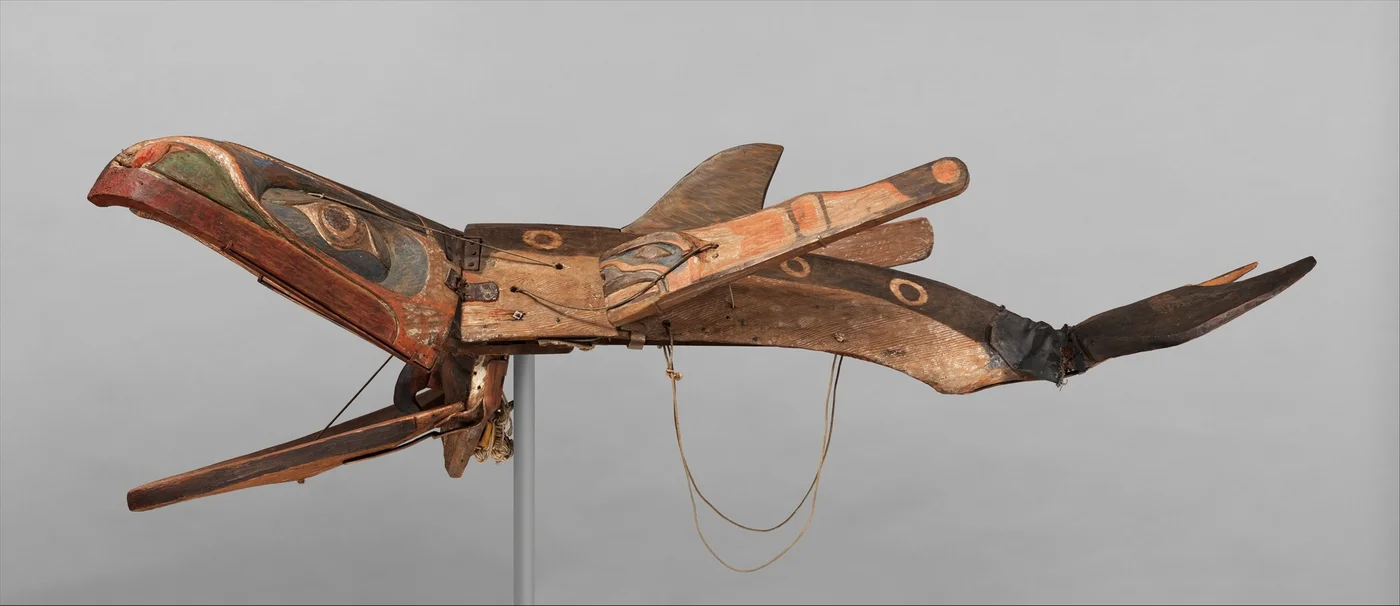
Kwakwaka’wakw Whale Transformation Mask, nineteenth century. The flippers and tail move, and the whale opens to reveal a face. The Metropolitan Museum of Art.
The Metropolitan Museum of Art. The Michael C. Rockefeller Memorial Collection, Bequest of Nelson A. Rockefeller, 1979. 1979.206.406. Open Access; Public Domain. · Image source ↗ · Public Domain
Human Animals by Frank Hamel
Frank Hamel’s Human Animals puts hunting disguises and ceremonial performances in the same chapter. Imitating an animal can help someone approach prey. In other accounts, performance has to do with preparation, protection or what people owe after a kill. [1][2][3]
The mask examples are especially revealing. Hamel describes hinged animal faces that open to disclose an inner human-looking form associated with an indwelling identity. The object makes a transformation legible to an audience through a physical change in the mask. It does not by itself tell us that the performer claims a change of biological species. [4][5]
Hamel uses such examples in a larger argument about the relationship between people and animals. His proposed development from practical decoy to religious ceremony is an interpretation characteristic of older comparative writing. The sequence should not be mistaken for an established history shared by all the traditions represented. [1][2][3][4][5]
What a performance makes visible
Totemism can concern ancestry and group obligations. A hunting performance can concern a particular season or encounter. Sympathetic magic offers one explanation of imitation as a way to influence an outcome. The occasion and what performers are trying to do help decide which comparison fits. [6][7][8][1][2][3]
Literary shapeshifting often hides a transformation until someone discovers it. A transformation mask can instead display the change openly as the point of the performance. Comparing those uses of concealment and revelation preserves what each medium does differently. [4][5][9][10]
See references (10)
- Human Animals, printed p. 28, Reader page 37
- Human Animals, printed p. 29, Reader page 38
- Human Animals, printed p. 30, Reader page 39
- Human Animals, printed p. 31, Reader page 40
- Human Animals, printed p. 32, Reader page 41
- Human Animals, printed p. 3, Reader page 12
- Human Animals, printed p. 15, Reader page 24
- Human Animals, printed p. 16, Reader page 25
- Human Animals, printed p. 72, Reader page 81
- Human Animals, printed p. 73, Reader page 82
Read further in the library

Human Animals
Reading note
Frank Hamel collects the particular stories and interpretations discussed here; the account identifies exact printed and Library Reader pages.
Sources
See references (12)
- Human Animals, printed p. 28, Reader page 37Frank Hamel, Human Animals. Frederick A. Stokes Co., New York, undated title page; preface dated London, 1915. Exact printed pages refer to the retained Library scan.Read this page in Human Animals ↗Return to text ↑
- Human Animals, printed p. 29, Reader page 38Frank Hamel, Human Animals. Frederick A. Stokes Co., New York, undated title page; preface dated London, 1915. Exact printed pages refer to the retained Library scan.Read this page in Human Animals ↗Return to text ↑
- Human Animals, printed p. 30, Reader page 39Frank Hamel, Human Animals. Frederick A. Stokes Co., New York, undated title page; preface dated London, 1915. Exact printed pages refer to the retained Library scan.Read this page in Human Animals ↗Return to text ↑
- Human Animals, printed p. 31, Reader page 40Frank Hamel, Human Animals. Frederick A. Stokes Co., New York, undated title page; preface dated London, 1915. Exact printed pages refer to the retained Library scan.Read this page in Human Animals ↗Return to text ↑
- Human Animals, printed p. 32, Reader page 41Frank Hamel, Human Animals. Frederick A. Stokes Co., New York, undated title page; preface dated London, 1915. Exact printed pages refer to the retained Library scan.Read this page in Human Animals ↗Return to text ↑
- Human Animals, printed p. 3, Reader page 12Frank Hamel, Human Animals. Frederick A. Stokes Co., New York, undated title page; preface dated London, 1915. Exact printed pages refer to the retained Library scan.Read this page in Human Animals ↗Return to text ↑
- Human Animals, printed p. 15, Reader page 24Frank Hamel, Human Animals. Frederick A. Stokes Co., New York, undated title page; preface dated London, 1915. Exact printed pages refer to the retained Library scan.Read this page in Human Animals ↗Return to text ↑
- Human Animals, printed p. 16, Reader page 25Frank Hamel, Human Animals. Frederick A. Stokes Co., New York, undated title page; preface dated London, 1915. Exact printed pages refer to the retained Library scan.Read this page in Human Animals ↗Return to text ↑
- Human Animals, printed p. 72, Reader page 81Frank Hamel, Human Animals. Frederick A. Stokes Co., New York, undated title page; preface dated London, 1915. Exact printed pages refer to the retained Library scan.Read this page in Human Animals ↗Return to text ↑
- Human Animals, printed p. 73, Reader page 82Frank Hamel, Human Animals. Frederick A. Stokes Co., New York, undated title page; preface dated London, 1915. Exact printed pages refer to the retained Library scan.Read this page in Human Animals ↗Return to text ↑
- Whale Transformation Mask ↗The Metropolitan Museum of Art, 1979.206.406. Public-domain image and object metadata. Curatorial attribution retained.Return to text ↑
- Kwakwa̱ka̱’wakw, Dałdałag̱a̱mł and the story of Siwidi ↗American Museum of Natural History, Northwest Coast Hall, with Kwakwa̱ka̱’wakw community contributors.Return to text ↑