When Your Own Deeds Meet You: The Zoroastrian Journey After Death
Follow the three nights, the meeting with the daēnā and the crossing of Chinvat through the Hādōxt Nask, the Vendīdād and the Book of Arda Viraf.
In this article
Follow the journey through five passages
Compare the waiting, the encounter and the crossing in the texts that describe them.
- Hādōxt Nask · §§1–6 and 19–24
The three nights
The soul recites while waiting
Compare the two recitations before the scenes at dawn. - Hādōxt Nask · §§7–14
The encounter
The daēnā names the person’s deeds
Follow the fragrant wind into the encounter and listen to what the guide names. - Hādōxt Nask · §§15 and 33
Four steps
Thought, speech and action take form
Compare how the last step changes in the two journeys. - Arda Viraf · chs. 4–5
The Chinvat Bridge
The crossing and the balance
Set the crossing in the painted folio beside the narration of what Vīrāf sees. - Arda Viraf · ch. 6
An even balance
The case of equal deeds and sins
Read how the guides explain a third outcome.
The first three nights
The Hādōxt Nask begins this part of the journey with a repeated question from Zarathushtra. Where does the soul of a faithful person stay on the first, second and third nights? Ahura Mazda gives much the same answer each time. The soul remains near the head and recites a Gāthā about happiness. The repetition ties the three nights together before the narrative changes at dawn. [1]
The darker account uses the same three-night pattern with a different utterance. Its question is where the person could turn for help. Each account makes the soul speak before it travels. The paired recitations establish different experiences of waiting even while the place and length of the wait remain similar. [1][5]
At dawn the soul meets its daēnā
In the account of the faithful person, the first change is sensory. A fragrant south wind seems to pass through plants. In that wind a young woman approaches. The soul asks who she is. She identifies herself as his own daēnā, the term Darmesteter renders here as conscience. Her answer gives the encounter its force. The person meets the quality of his life in a form that can speak back to him. [2][6]
The figure names concrete actions. They include reciting the Gāthās, honouring the good waters and the sacred fire, and welcoming fellow believers who arrive from near or far. She says that his conduct has made her more beautiful. Daēnā here carries the force of a lived religious commitment as well as the moral recognition suggested by the English word conscience. [3][8]
Thought, word, deed and the fourth step
The Hādōxt Nask names the first three stages after good thought, good speech and good action. A fourth step reaches the Endless Lights. The opposite account repeats the four-step form with evil thoughts, words and deeds followed by darkness. The parallel is more precise than a broad opposition between two destinations. It gives each kind of conduct a place in the order of the journey. [4][5]
The counterpart to the south wind is a foul north wind. To read the meeting in the darker journey carefully, compare the English edition with the transliterated text. The hosted English rendering moves quickly from the wind to the four steps. The Avestan page prints a longer passage in brackets in which the person is confronted by an adverse figure identified as their own daēnā. The difference is worth retaining when citing either version. [5][6]
What the Vendīdād says about the bridge
The Vendīdād tells the crossing through a different sequence. In fargard 19, the road is open to both the righteous and the wicked. The text takes the reader to the head of the bridge. It describes a discerning female guide with dogs and then the arrival of the righteous soul among heavenly beings. The story of the four steps in the Hādōxt Nask puts the emphasis on a different set of details. [7][4]
Darmesteter’s notes connect this guide to the daēnā, and they mention the changing width of the bridge. When quoting the Vendīdād, distinguish the numbered verses from these footnotes. For the widening bridge and the balance, open the Book of Arda Viraf itself and follow Vīrāf’s journey into chapter 5. [7][9]
Vīrāf sees the crossing and the weighing
Vīrāf travels as a messenger who will return. Chapter 4 describes him witnessing another soul’s encounter with its own religion and deeds. In chapter 5 he crosses with Srosh and Adar. He sees Rashn holding the balance used to weigh the righteous and the wicked. The encounter and the weighing belong to different episodes, even though both make a person’s conduct visible. [11][8][9]
The Persian miniature gives the crossing a place on the page: a red bridge spans a gap between two heights. Figures cluster where the bridge ends. Princeton’s catalogue identifies the traveller as Vīrāf and names Sraosha. Follow the pictured route before reading Haug’s translation, which names both guides and goes on to describe the balance. [12][13][9]
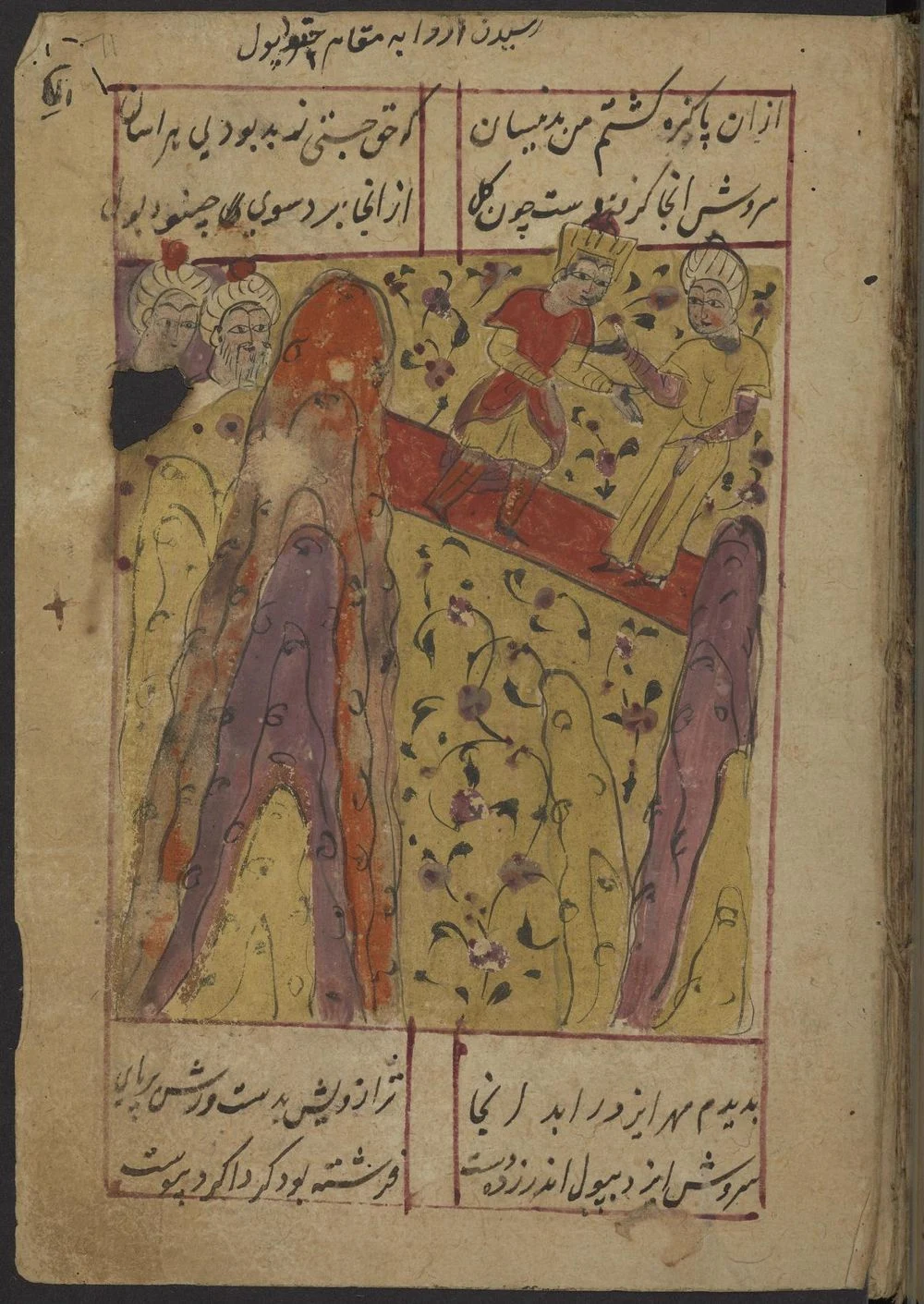
Vīrāf crosses the Chinvat Bridge with Sraosha in this Persian manuscript, copied around 1590. The catalogue identifies the scene as the visionary’s crossing.
Princeton University Library, Islamic Manuscripts, New Series no. 1744, fol. 71a, Persian Ardā Vīrāf narrative, copied around 1590. Princeton identifies the reproduction as having no known copyright. · Image source ↗ · Public Domain
What happens when good works and sins are equal?
In chapter 6 of Vīrāf’s account, he asks why certain souls remain in one place. The guides name Hamistagān and say the people there had equal good works and sins. The case adds a third outcome to the two strongly contrasted journeys of the Hādōxt Nask. It also supplies its own endpoint, the future body, and is told as part of Vīrāf’s tour. [10][4][5]
For a close reading, begin at the first dawn passage and end at the balance. Ask who speaks in each account, what makes a life recognisable and what the person is shown next. The answers change from the questioning voice of Zarathushtra, to the speaking daēnā, to Vīrāf’s report to the community that sent him. [2][9][11]
Sources
See references (13)
- The first three nights of the faithful soul ↗Hādōxt Nask, James Darmesteter’s translation, Sacred Books of the East, American edition, 1898, hosted by Zoroastrian Archives.Return to text ↑
- The fragrant wind and the figure who speaks ↗Hādōxt Nask, James Darmesteter’s translation, Sacred Books of the East, American edition, 1898, hosted by Zoroastrian Archives.Return to text ↑
- What the daēnā says the person did in life ↗Hādōxt Nask, James Darmesteter’s translation, Sacred Books of the East, American edition, 1898, hosted by Zoroastrian Archives.Return to text ↑
- The four steps to Endless Lights ↗Hādōxt Nask, James Darmesteter’s translation, Sacred Books of the East, American edition, 1898, hosted by Zoroastrian Archives.Return to text ↑
- The second journey and its four steps ↗Hādōxt Nask, James Darmesteter’s translation, Sacred Books of the East, American edition, 1898, hosted by Zoroastrian Archives.Return to text ↑
- Read the Avestan text alongside the translation ↗Zoroastrian Archives, Hādōxt Nask in transliterated Avestan. The site brackets the reconstructed or variant continuation in the darker account.Return to text ↑
- The Chinvat Bridge and the guide with dogs ↗Vendīdād, fargard 19, §§29–32, James Darmesteter’s English translation. The numbered commentary is separate from the passage.Return to text ↑
- Vīrāf meets the soul and witnesses its daēnā ↗The Book of Arda Viraf, translation credited to Martin Haug, in Charles F. Horne’s 1917 anthology, hosted by Zoroastrian Archives.Return to text ↑
- The crossing and Rashn’s balance ↗The Book of Arda Viraf, translation credited to Martin Haug, in Charles F. Horne’s 1917 anthology, hosted by Zoroastrian Archives.Return to text ↑
- Hamistagān and the case of equal works and sins ↗The Book of Arda Viraf, translation credited to Martin Haug, in Charles F. Horne’s 1917 anthology, hosted by Zoroastrian Archives.Return to text ↑
- The messenger returns and asks for a scribe ↗The Book of Arda Viraf, translation credited to Martin Haug, in Charles F. Horne’s 1917 anthology, hosted by Zoroastrian Archives.Return to text ↑
- The crossing, Princeton folio 71a ↗Princeton University Library, Islamic Manuscripts, New Series no. 1744, fol. 71a, Persian Ardā Vīrāf narrative, copied around 1590. Princeton identifies the reproduction as having no known copyright.Return to text ↑
- Manuscript catalogue and rights statement ↗Princeton University Library, Islamic Manuscripts, New Series no. 1744, fol. 71a, Persian Ardā Vīrāf narrative, copied around 1590. Princeton identifies the reproduction as having no known copyright.Return to text ↑