Yomi
Explore Yomi through the Kojiki, scholarly interpretation and a historical Library retelling, tracing the boundary between the living and the dead.
In this article
What is Yomi?
Yomi is the land of the dead that appears in the Kojiki and Nihon shoki, the early Japanese mythic chronicles. Izanami goes there after her death, and Izanagi follows her. Yomotsukuni is another form of its name. The narratives give the realm a powerful boundary without defining all its characteristics consistently. [1]
The early narrative
Izanagi’s forbidden look
In the Kojiki translation published by Kokugakuin University, Izanagi asks Izanami to return because their creation of the land remains unfinished. She replies that she has eaten food from Yomi’s hearths. She wishes to consult the deity of the realm and forbids him to look at her. [2]
Unable to wait, Izanagi lights a tooth from his comb and enters. The sight of Izanami’s changed body reveals a condition he cannot reverse by longing for their former life. The passage joins intimacy and terror: he has reached the person he sought, yet the reunion breaks apart. Food, waiting, concealment and the forbidden look establish the encounter’s terms. [2]
An uncertain name and an elusive place
The accompanying scholarly notes examine Yomi and Yomotsukuni as readings and review proposals about the word’s origin. They do not endorse a settled etymology. This uncertainty is useful: the familiar English label underworld should not make the reader assume that every feature of the realm, or the route towards it, has been clearly defined. [2]
The boundary and purification
Nishioka’s encyclopedia account describes the great boulder that blocks the pass between Yomi and the worlds of the living and the heavenly kami. The barrier itself receives divine names, making the boundary an active feature of the mythic world. Izanagi’s subsequent purification responds to the pollution associated with his visit. [1]
Nishioka also cautions that the darkness inside the palace does not prove that all of Yomi was necessarily dark. Later National Learning scholars debated its location and origins, with Hirata Atsutane taking a particular interest. These discussions belong to the history of interpreting the story, rather than supplying one uncontested geographical answer. [1]
The Library’s retelling
Reading the Library’s historical retelling
Davis’s Myths and Legends of Japan gives the episode a vivid English narrative form. After Izanami’s withdrawal, Izanagi follows because he cannot live without her. She says she has already eaten from Yomi’s cooking-furnace and asks him not to look. Davis uses Hades in parentheses, an explanatory comparison rather than evidence that Yomi is the Greek realm. [3]
The pass in Davis’s account
In the next page of the retelling, Izanagi flees the transformed Izanami and her pursuers. At the Even Pass he places a great rock, and the encounter ends in separation. The story gives loss a landscape: a route can be travelled, yet a former intimacy cannot simply be restored. The exact Library pages below preserve Davis’s version so it can be read beside the early text and the scholarly account. [4]
Read further in the library
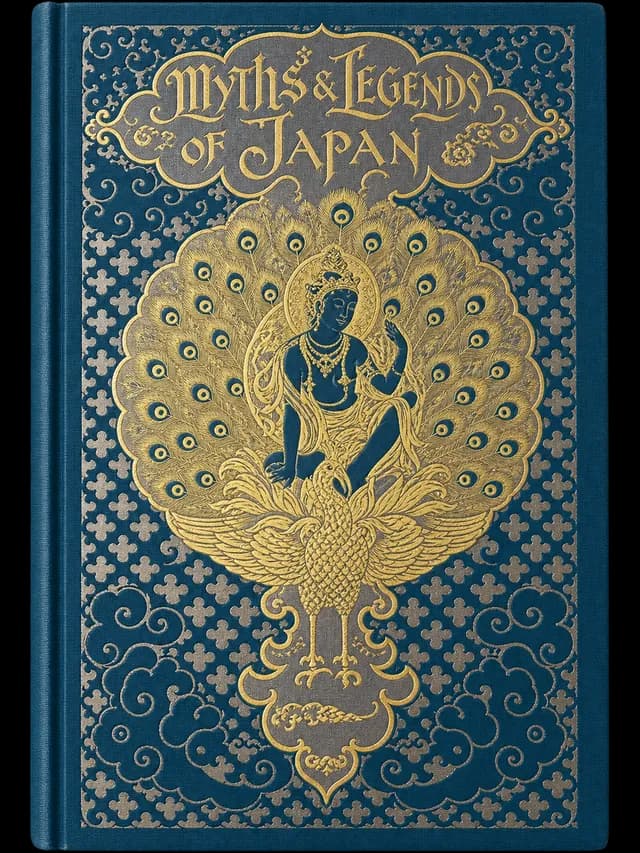
Myths and Legends of Japan
Reading note
Read Davis’s early-twentieth-century retelling alongside the Kojiki translation and scholarly references. Its English comparisons and narrative choices belong to that historical author.
Sources
- Yomi: Encyclopedia of Shinto ↗Nishioka Kazuhiko, Kokugakuin University; scholarly referenceReturn to text ↑
- Studies on the Kojiki: Chapter 9, The Land of Yomi (1) ↗Kokugakuin University; English translation with textual and interpretive notesReturn to text ↑
- Myths and Legends of Japan: Izanagi enters YomiF. Hadland Davis; historical retelling, printed page 23Return to text ↑
Examine the original Library page
Exact existing Library citation retained. The original page was read again before this expansion. This is the historical author’s retelling, distinguished from the other primary and scholarly sources.
It was dark in the Land of Yomi
Open the original page in Myths and Legends of Japan ↗Scan leaf 29 · F. Hadland Davis; illustrated by Evelyn Paul
- Myths and Legends of Japan: the Even Pass of YomiF. Hadland Davis; historical retelling, printed page 24Return to text ↑
Examine the original Library page
Exact existing Library citation retained. The original page was read again before this expansion. This is the historical author’s retelling, distinguished from the other primary and scholarly sources.
By this time Izanagi had reached the Even Pass of Yomi.
Open the original page in Myths and Legends of Japan ↗Scan leaf 30 · F. Hadland Davis; illustrated by Evelyn Paul
About this article & its sources
Expansion of the existing Yomi entry, distinguishing early Japanese narrative, scholarly interpretation and F. Hadland Davis’s literary retelling. Existing Reader leaves and the established canonical URL are retained.
Passage attributions
What is Yomi?
Passage 1: Nishioka Kazuhiko, Kokugakuin University; scholarly reference.
Izanagi’s forbidden look
Passage 1: Kokugakuin University; English translation with textual and interpretive notes.
Passage 2: Kokugakuin University; English translation with textual and interpretive notes.
An uncertain name and an elusive place
Passage 1: Kokugakuin University; English translation with textual and interpretive notes.
The boundary and purification
Passage 1: Nishioka Kazuhiko, Kokugakuin University; scholarly reference.
Passage 2: Nishioka Kazuhiko, Kokugakuin University; scholarly reference.
Reading the Library’s historical retelling
Passage 1: F. Hadland Davis; historical retelling, printed page 23.
The pass in Davis’s account
Passage 1: F. Hadland Davis; historical retelling, printed page 24.