Yin and Yang: What the Symbol Means and How to Read It
Read the taijitu’s two halves and dots. Follow yin and yang through the Changes, the Daodejing, Zhou Dunyi and later Chinese diagrams.
In this article
Read the circle and its source trail
Follow the symbol’s parts first, then move through the texts and historical diagrams.
From words to diagrams
- One yin, one yang
- Start with the received wording in the Appended Statements, section 5.
- Curves and dots
- Follow the changing widths and the opposite colour within each half.
- Zhou Dunyi and later forms
- Compare a dated sequence of texts and diagrams.
- Wu Xing
- Follow the five phases and their cycles separately.
What are yin and yang?
Yin and yang name qualities understood in relation to one another. Shade and sunlight are one way to see the relation. The same place can face the sun at one time and lie in shadow later. In the familiar circle, the curving boundary and the spot of the opposite colour in each half offer a visual way to think about the relation. [9][11]
Yin (陰) and yang (陽) describe how qualities relate and change. A hillside has shade and sunlight, and the boundary between them moves as the sun crosses the sky. Chinese writers use the pair to describe relationships like rest and activity, and how the balance between them shifts. [1][2][7]
How to read the halves, dots and curved line
Start with the circle, then trace the boundary. Each colour expands as the other narrows. The small opposite-colour spot gives each broad region a point of contrast inside it. Those are features of the familiar design. Rotating the figure leaves those relations intact. Different historical arrangements can place the dark and light differently. [11]
It is easy to mistake yin and yang for two moral teams when the colours are read in isolation. Chapter 42 of the Daodejing places both in the account of beings and their harmony. The Appended Statements of the Changes makes their alternation part of its description of the Way. Those accounts give reasons to read the two in relation. [12][9]
When the words and the diagrams appear
The received Appended Statements and Daodejing show the pair at work in early Chinese texts. Zhou Dunyi, an eleventh-century thinker, explains a different, vertically arranged Diagram of Supreme Polarity. In the translation with Zhu Xi’s commentary, activity and stillness lead into an account of yang and yin and then the five phases. Start with its own arrangement when reading it. [9][12][10]
The familiar black-and-light design has a later visual history. François Louis separates the evidence for early drawings from the later standardised form. Reading the early sentences alongside later diagrams makes it possible to see how a visual tradition developed without assigning the familiar emblem to the author of any early passage. [11][10]
Yin and yang in The Secret of the Golden Flower
In his exposition for The Secret of the Golden Flower, Richard Wilhelm traces yin and yang to an underlying unity. He connects them with the receptive and creative trigrams of the Book of Changes. Kun, the receptive, is like a field that receives a seed and gives it form. Qian, the creative, represents Heaven. [1][2][3]
In the Daoist text translated by Wilhelm and rendered into English by Cary F. Baynes, refining darkness into light describes an inward change. Baynes’s diagram in the English edition shows yin and yang both taking part in the development of the golden flower. [4][5][6]
See references (6)
- The Secret of the Golden Flower, printed p. 12, Reader page 20
- The Secret of the Golden Flower, printed p. 13, Reader page 21
- The Secret of the Golden Flower, Wilhelm’s explanation of the trigrams, Reader page 27
- The Secret of the Golden Flower, printed p. 31, Reader page 36
- The Secret of the Golden Flower, printed p. 73, Reader page 72
- The Secret of the Golden Flower, printed p. 74, Reader page 73
Yin and yang in the Daodejing
Chapter 42 of the Daodejing, traditionally attributed to Laozi, describes the world’s many things as bearing yin and embracing yang. Breath brings them into harmony. The passage describes the arising of the world. The Golden Flower takes related imagery into the work of cultivation. [7][2]
Water and fire in a Daoist woodcut
The Xingming guizhi describes the fire of the heart and the water of the back as capable of nourishing each other. The woodcut gives this pairing a setting in the body and shows how water and fire can work together. [8][3]
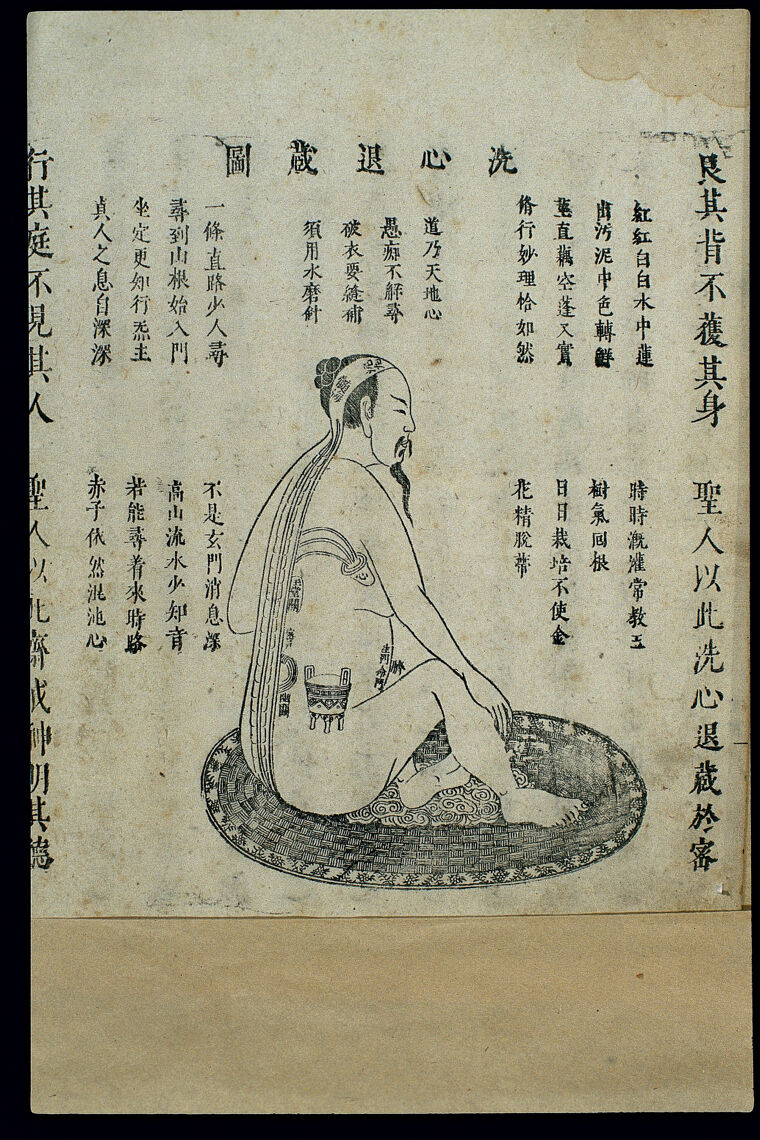
Washing the Heart and Retiring to a Hidden Place, from Xingming guizhi, published in 1615. The work associates the posture with the mutual nourishment of water and fire.
Wellcome Collection, Chinese woodcut: Daoist internal alchemy (4). Public Domain Mark. · Image source ↗ · Public Domain
Where the five phases fit
Zhou’s explanation places yin and yang together with five phases in a single account. Yin and yang are a pair, while the named phases form a set of five. In the separate Wu Xing guide, follow the orders in which one phase gives rise to or constrains another. Neither operation can be read directly from the two halves of the circle. [10][9]
Read further in the library
The Secret of the Golden Flower
Reading note
Read the specific account of Yin and Yang in the Wilhelm–Baynes edition.
Sources
See references (12)
- The Secret of the Golden Flower, printed p. 12, Reader page 20The Secret of the Golden Flower: A Chinese Book of Life. Chinese text translated and explained by Richard Wilhelm, English translation by Cary F. Baynes, with separate commentary by C. G. Jung. London, Kegan Paul, Trench, Trubner & Co. Lumitheca Library edition IMJ-0596-E001.Read this page in The Secret of the Golden Flower ↗Return to text ↑
- The Secret of the Golden Flower, printed p. 13, Reader page 21The Secret of the Golden Flower: A Chinese Book of Life. Chinese text translated and explained by Richard Wilhelm, English translation by Cary F. Baynes, with separate commentary by C. G. Jung. London, Kegan Paul, Trench, Trubner & Co. Lumitheca Library edition IMJ-0596-E001.Read this page in The Secret of the Golden Flower ↗Return to text ↑
- The Secret of the Golden Flower, Wilhelm’s explanation of the trigrams, Reader page 27The Secret of the Golden Flower: A Chinese Book of Life. Chinese text translated and explained by Richard Wilhelm, English translation by Cary F. Baynes, with separate commentary by C. G. Jung. London, Kegan Paul, Trench, Trubner & Co. Lumitheca Library edition IMJ-0596-E001.Read this page in The Secret of the Golden Flower ↗Return to text ↑
- The Secret of the Golden Flower, printed p. 31, Reader page 36The Secret of the Golden Flower: A Chinese Book of Life. Chinese text translated and explained by Richard Wilhelm, English translation by Cary F. Baynes, with separate commentary by C. G. Jung. London, Kegan Paul, Trench, Trubner & Co. Lumitheca Library edition IMJ-0596-E001.Read this page in The Secret of the Golden Flower ↗Return to text ↑
- The Secret of the Golden Flower, printed p. 73, Reader page 72The Secret of the Golden Flower: A Chinese Book of Life. Chinese text translated and explained by Richard Wilhelm, English translation by Cary F. Baynes, with separate commentary by C. G. Jung. London, Kegan Paul, Trench, Trubner & Co. Lumitheca Library edition IMJ-0596-E001.Read this page in The Secret of the Golden Flower ↗Return to text ↑
- The Secret of the Golden Flower, printed p. 74, Reader page 73The Secret of the Golden Flower: A Chinese Book of Life. Chinese text translated and explained by Richard Wilhelm, English translation by Cary F. Baynes, with separate commentary by C. G. Jung. London, Kegan Paul, Trench, Trubner & Co. Lumitheca Library edition IMJ-0596-E001.Read this page in The Secret of the Golden Flower ↗Return to text ↑
- Daodejing, chapter 42, translated by James Legge ↗Attributed to Laozi, translated by James Legge (1891).Return to text ↑
- Washing the Heart and Retiring to a Hidden Place ↗Wellcome Collection, Chinese woodcut: Daoist internal alchemy (4). Public Domain Mark.Return to text ↑
- Appended Statements I.5 · A yin and a yang ↗The received Chinese text of the Xici, Chinese Text Project, section 5.Return to text ↑
- Zhou Dunyi · Explanation of the Diagram of Supreme Polarity ↗Joseph A. Adler’s English translation with Zhu Xi’s commentary, Kenyon College.Return to text ↑
- François Louis · The Genesis of an Icon ↗Harvard Journal of Asiatic Studies 63.1 (2003), pp. 145–196. Historical study of surviving diagrams.Return to text ↑
- Daodejing, chapter 42 ↗Columbia University, Asia for Educators, source selection from the Daodejing.Return to text ↑