W. B. Yeats’s introduction to W. T. Horton, A Book of Images (1898)
Art as Talisman in Yeats
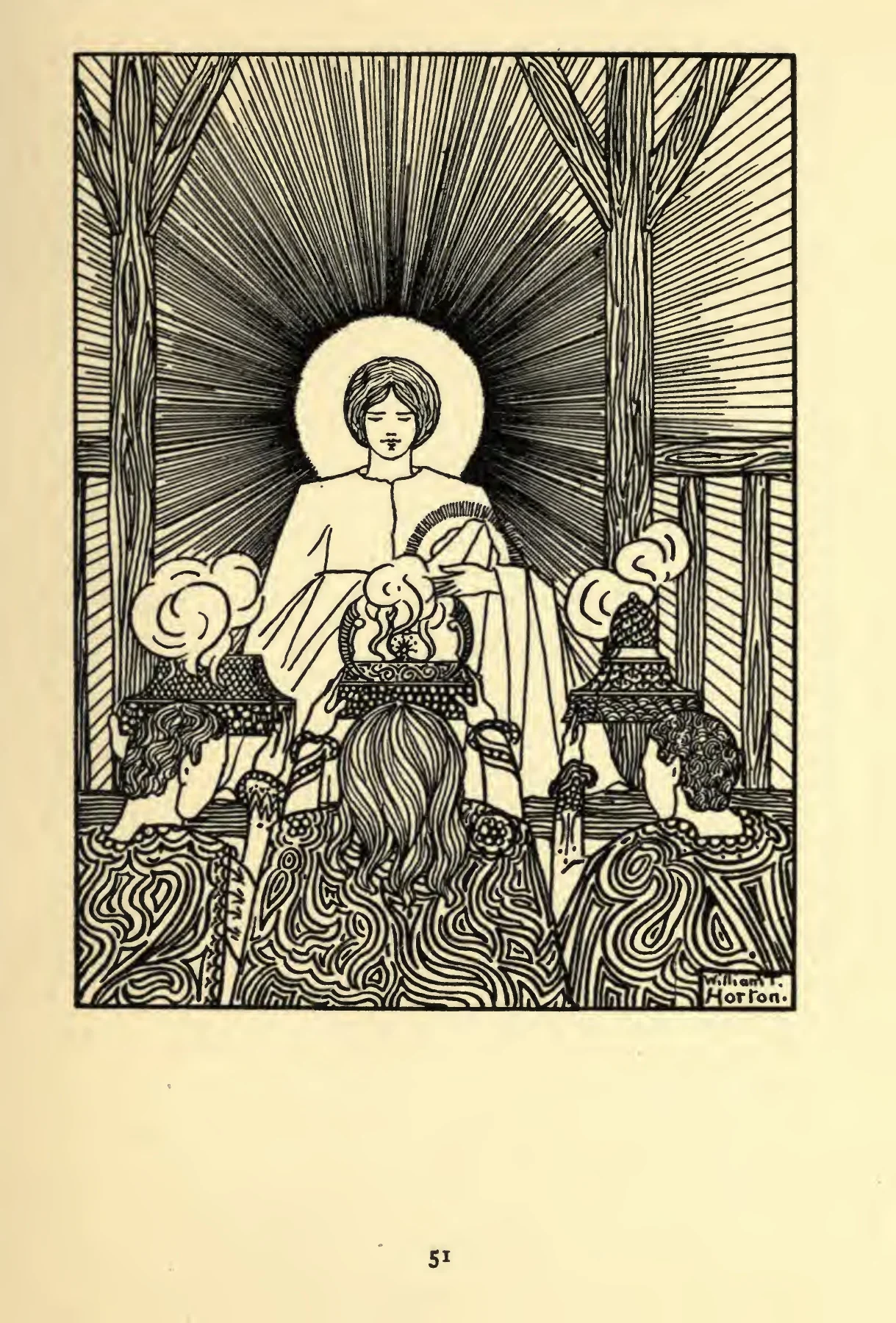
Yeats compares symbolic art with the coloured and patterned talismans he attributes to medieval magicians. In his account, an image can hold something of a divine essence through its forms and colours. He contrasts this with a person or landscape confined to a narrative purpose: when the ordinary chain of motive and consequence is loosened, the image can evoke what he calls a perfected or infinite emotion. He places Horton among a wide range of modern artists and writers who draw on religious, bodily, seasonal and ancient symbolism. The comparison describes Yeats’s theory of artistic power. It is neither a documented history of particular medieval objects nor evidence that an artwork has a measurable magical effect.
Loading your archive…
In the sources
The comparison with talismans
DocumentedYeats compares the purpose of symbolic art with talismans whose colours and forms were to be contemplated.
A broad symbolic vocabulary
DocumentedHe includes ancient, bodily and seasonal imagery in the range available to the modern artists he discusses.
Horton’s formal images
DocumentedLater in the introduction, he places Horton’s designs between ordinary scenes and the geometrical emblems of medieval talismans.
Context & interpretation
Yeats’s divine essence and talisman analogy are attributed historical beliefs and aesthetic claims. This entry gives no magical instructions and does not verify the efficacy or medieval provenance of a particular talisman.
Original passages
Source 1
A Book of Images
those symbolic talismans which medieval magicians madeOpen this page in the book
Passage & edition details
Location recorded at citation review: W. B. Yeats, Introduction to A Book of Images (1898), printed p. 10
Printed introduction and cited passage inspected in the public Reader.
- Edition
- IMJ-0249-E001
- Reader page
- IMJ-0249-E001-P0007
- Original scan leaf
- 14
- Recorded leaf number
- 14
- Current Reader position
- 8
- Reader verification
- Matches the reviewed Reader
Source 2
A Book of Images
having accepted all symbolismsOpen this page in the book
Passage & edition details
Location recorded at citation review: W. B. Yeats, Introduction to A Book of Images (1898), printed p. 11
Printed introduction and cited passage inspected in the public Reader.
- Edition
- IMJ-0249-E001
- Reader page
- IMJ-0249-E001-P0008
- Original scan leaf
- 15
- Recorded leaf number
- 15
- Current Reader position
- 9
- Reader verification
- Matches the reviewed Reader
Source 3
A Book of Images
the geometrical emblems on medieval talismansOpen this page in the book
Passage & edition details
Location recorded at citation review: W. B. Yeats, Introduction to A Book of Images (1898), printed p. 15
Printed introduction and cited passage inspected in the public Reader.
- Edition
- IMJ-0249-E001
- Reader page
- IMJ-0249-E001-P0012
- Original scan leaf
- 19
- Recorded leaf number
- 19
- Current Reader position
- 13
- Reader verification
- Matches the reviewed Reader
Illustrations
Continue exploring
Symbol and Allegory in Yeats
Yeats’s distinction between images that continue to suggest meaning and images that can be translated into a fixed explanation.
Same subject and traditionWaking Dreams and Horton’s Art
Yeats’s account of Horton turning reported waking visions into formal black-and-white drawings.