Witches’ sabbath
The witches’ sabbath is an alleged nocturnal assembly. Compare early accounts of flight and illusion with the scenes reproduced by De Givry.
In this article
Understanding witches’ sabbath
The witches’ sabbath is an alleged nocturnal assembly described in demonology and folklore. Common features include a presiding devil, acts of homage and a feast. Sources disagree on whether participants were supposed to travel bodily or experience the meeting in a dream or vision. [5][6][7][3][8][9][10][11][12]
See references (9)
- Francesco Maria Guazzo, Compendium Maleficarum, Book I, chapter XII, printed page 35 (1929 English edition)
- Magica Sexualis, Reader page 71
- Magica Sexualis, Reader page 80
- Magica Sexualis, Reader page 81
- Magica Sexualis, Reader page 60
- Magica Sexualis, Reader page 72
- Magica Sexualis, Reader page 74
- Magica Sexualis, Reader page 83
- Magica Sexualis, Reader page 84
Accounts of the assembly
The Canon Episcopi’s account of night rides
In the version of the Canon Episcopi preserved in Gratian’s Decretum, women believe they ride with Diana or Herodias at night. The canon says the visions are imposed on the mind through spiritual deception. It rejects the claim of a bodily journey. [4]
Compendium Maleficarum by Francesco Maria Guazzo
In Compendium Maleficarum, Book I, chapter XII, Francesco Maria Guazzo accepts that a journey to the assembly can be an illusion, but also argues for bodily travel. He explains some accounts of a body still at home through a likeness left in its place. On printed page 35 he describes the devil presiding in different shapes, including a goat or a dog. [1][2][3]
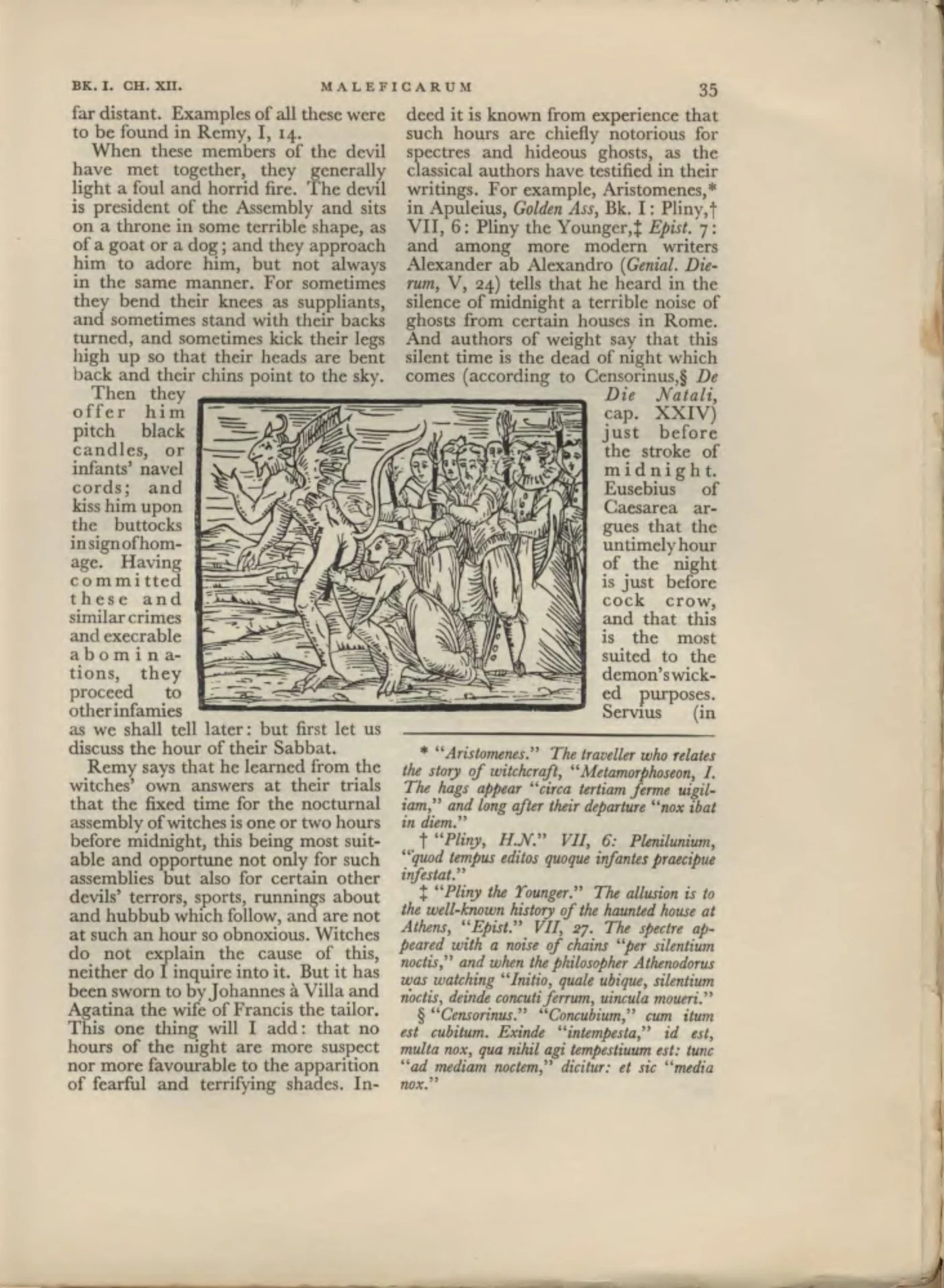
A gathering and its presiding figure in Compendium Maleficarum, 1929 edition, printed p. 35.
Illustrated page from Guazzo, Compendium Maleficarum, E. A. Ashwin translation, edited by Montague Summers, John Rodker, 1929. Historical illustrator unverified. Internet Archive scan. Public Domain. · Image source ↗ · Public Domain
See references (3)
- Francesco Maria Guazzo, Compendium Maleficarum, Book I, chapter XII, printed page 33 (1929 English edition)
- Francesco Maria Guazzo, Compendium Maleficarum, Book I, chapter XII, printed page 34 (1929 English edition)
- Francesco Maria Guazzo, Compendium Maleficarum, Book I, chapter XII, printed page 35 (1929 English edition)
La Sorcière by Jules Michelet
In La Sorcière, Book I, chapter XI, Jules Michelet imagines the sabbath developing into an act of defiance amid the suffering of medieval peasants. He puts women at the centre of his reconstruction of the Black Mass. He opens the chapter by acknowledging the lack of detailed early accounts, and presents some links between rebellion and the gatherings as conjecture. [19]
Witchcraft Magic & Alchemy by Grillot de Givry
In Witchcraft, Magic and Alchemy, Grillot de Givry compares I. Ziarnko’s engraving for Pierre de l’Ancre with a print after a design attributed to Spranger, reproduced in Laurent Bordelon’s account of Monsieur Oufle. Ziarnko’s lettered key lets readers follow individual scenes within the crowded composition. [17][18]
Ziarnko’s key describes the presiding figure as a goat preaching from a pulpit with a flame on a horn. The other print gives the figure both human and animal features. The image below shows the second of these designs. [18][1][2][5][17]
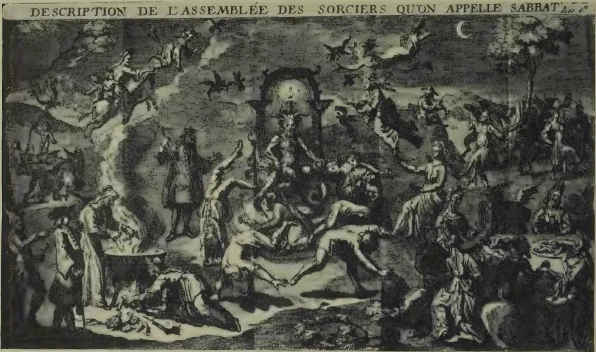
A witches’ assembly after a design attributed to Spranger, reproduced as figure 47 in De Givry.
Engraving after Spranger in Bordelon, Histoire des imaginations extravagantes de Monsieur Oufle, 1710, as reproduced by De Givry. · Image source ↗ · Public Domain
See references (5)
- Francesco Maria Guazzo, Compendium Maleficarum, Book I, chapter XII, printed page 33 (1929 English edition)
- Francesco Maria Guazzo, Compendium Maleficarum, Book I, chapter XII, printed page 34 (1929 English edition)
- Magica Sexualis, Reader page 71
- Witchcraft Magic & Alchemy, printed p. 76–77, Reader page 69
- Witchcraft Magic & Alchemy, printed p. 78, Reader page 70
Magica Sexualis by Émile Laurent and Paul Nagour
In Magica Sexualis, Émile Laurent and Paul Nagour describe the sabbath as a secret meeting across social ranks and collect accounts of vivid journeys reported by people who appear to stay at home. They invoke dream, imagination and intoxicants, then describe homage, feasting and parodies of Christian worship. [5][9][10][13][14][15][6][7]
In the later Black Mass discussion, the compilers ascribe to Jules Michelet an interpretation centred on suffering and revolt, with women in a central role. This reads the assembly as a reversal of social and religious power. [11][12]
See references (10)
- Magica Sexualis, Reader page 71
- Magica Sexualis, Reader page 80
- Magica Sexualis, Reader page 81
- Magica Sexualis, Reader page 72
- Magica Sexualis, Reader page 74
- Magica Sexualis, Reader page 83
- Magica Sexualis, Reader page 84
- Magica Sexualis, Reader page 75
- Magica Sexualis, Reader page 76
- Magica Sexualis, Reader page 79
Visions, travel and the image of an assembly
The canon explains the journey as a deceptive vision. Guazzo admits illusion and adds bodily journeys, including the idea of a substitute in a sleeper’s bed. The pictures reproduced by De Givry show how readers came to recognise the assembly as a scene, while leaving the accounts of travel unresolved. [5][16][10][13][15][4][1][2][3]
See references (9)
- Francesco Maria Guazzo, Compendium Maleficarum, Book I, chapter XII, printed page 33 (1929 English edition)
- Francesco Maria Guazzo, Compendium Maleficarum, Book I, chapter XII, printed page 34 (1929 English edition)
- Francesco Maria Guazzo, Compendium Maleficarum, Book I, chapter XII, printed page 35 (1929 English edition)
- Canon Episcopi, Decretum Gratiani, causa 26, quaestio 5, canon 12: night rides and deceptive visions
- Magica Sexualis, Reader page 71
- Magica Sexualis, Reader page 74
- Magica Sexualis, Reader page 75
- Magica Sexualis, Reader page 79
- Magica Sexualis, Reader page 73
Read further in the library
Magica Sexualis
Reading note
The separately titled account draws on exact passages in the consulted Library edition.
Witchcraft Magic and Alchemy
Reading note
The separately titled account draws on exact passages in the consulted Library edition.
Sources
See references (19)
- Francesco Maria Guazzo, Compendium Maleficarum, Book I, chapter XII, printed page 33 (1929 English edition) ↗Francesco Maria Guazzo, Compendium Maleficarum, translated by E. A. Ashwin, edited with notes by Montague Summers, London: John Rodker, 1929. Book I, chapter XII, printed page 33, visually checked against Archive zero-based leaf 60. Title page and selected original page images inspected. Guazzo’s argument is distinguished from Summers’s footnotes. Selected comparison passages only, not a complete additional book crawl.Return to text ↑
- Francesco Maria Guazzo, Compendium Maleficarum, Book I, chapter XII, printed page 34 (1929 English edition) ↗Francesco Maria Guazzo, Compendium Maleficarum, translated by E. A. Ashwin, edited with notes by Montague Summers, London: John Rodker, 1929. Book I, chapter XII, printed page 34, visually checked against Archive zero-based leaf 61. Title page and selected original page images inspected. Guazzo’s argument is distinguished from Summers’s footnotes. Selected comparison passages only, not a complete additional book crawl.Return to text ↑
- Francesco Maria Guazzo, Compendium Maleficarum, Book I, chapter XII, printed page 35 (1929 English edition) ↗Francesco Maria Guazzo, Compendium Maleficarum, translated by E. A. Ashwin, edited with notes by Montague Summers, London: John Rodker, 1929. Book I, chapter XII, printed page 35, visually checked against Archive zero-based leaf 62. Title page and selected original page images inspected. Guazzo’s argument is distinguished from Summers’s footnotes. Selected comparison passages only, not a complete additional book crawl.Return to text ↑
- Canon Episcopi, Decretum Gratiani, causa 26, quaestio 5, canon 12: night rides and deceptive visions ↗Directly consulted paired Latin text and English rendering on Luke Dysinger’s teaching page, prepared for a 2022 workshop at Saint Andrew’s Abbey. The displayed recension is located at Decretum Gratiani, C.26, q.5, c.12 and includes Herodias. The translation has awkward wording; paraphrases were checked against the corresponding Latin clauses. No earliest-manuscript inspection, original authorship, printed pagination or universal medieval consensus claimed.Return to text ↑
- Magica Sexualis, Reader page 71Émile Laurent and Paul Nagour, Magica Sexualis, privately printed by Falstaff Press Inc., New York, undated inspected edition. Exact original Library edition IMJ-0105-E001. The work is a historical compilation; its quoted fiction, trial allegations and medical interpretations are not treated as independently verified facts. Current Reader positions are mapped separately from printed pagination.Read this page in Magica Sexualis ↗Return to text ↑
- Magica Sexualis, Reader page 80Émile Laurent and Paul Nagour, Magica Sexualis, privately printed by Falstaff Press Inc., New York, undated inspected edition. Exact original Library edition IMJ-0105-E001. The work is a historical compilation; its quoted fiction, trial allegations and medical interpretations are not treated as independently verified facts. Current Reader positions are mapped separately from printed pagination.Read this page in Magica Sexualis ↗Return to text ↑
- Magica Sexualis, Reader page 81Émile Laurent and Paul Nagour, Magica Sexualis, privately printed by Falstaff Press Inc., New York, undated inspected edition. Exact original Library edition IMJ-0105-E001. The work is a historical compilation; its quoted fiction, trial allegations and medical interpretations are not treated as independently verified facts. Current Reader positions are mapped separately from printed pagination.Read this page in Magica Sexualis ↗Return to text ↑
- Magica Sexualis, Reader page 60Émile Laurent and Paul Nagour, Magica Sexualis, privately printed by Falstaff Press Inc., New York, undated inspected edition. Exact original Library edition IMJ-0105-E001. The work is a historical compilation; its quoted fiction, trial allegations and medical interpretations are not treated as independently verified facts. Current Reader positions are mapped separately from printed pagination.Read this page in Magica Sexualis ↗Return to text ↑
- Magica Sexualis, Reader page 72Émile Laurent and Paul Nagour, Magica Sexualis, privately printed by Falstaff Press Inc., New York, undated inspected edition. Exact original Library edition IMJ-0105-E001. The work is a historical compilation; its quoted fiction, trial allegations and medical interpretations are not treated as independently verified facts. Current Reader positions are mapped separately from printed pagination.Read this page in Magica Sexualis ↗Return to text ↑
- Magica Sexualis, Reader page 74Émile Laurent and Paul Nagour, Magica Sexualis, privately printed by Falstaff Press Inc., New York, undated inspected edition. Exact original Library edition IMJ-0105-E001. The work is a historical compilation; its quoted fiction, trial allegations and medical interpretations are not treated as independently verified facts. Current Reader positions are mapped separately from printed pagination.Read this page in Magica Sexualis ↗Return to text ↑
- Magica Sexualis, Reader page 83Émile Laurent and Paul Nagour, Magica Sexualis, privately printed by Falstaff Press Inc., New York, undated inspected edition. Exact original Library edition IMJ-0105-E001. The work is a historical compilation; its quoted fiction, trial allegations and medical interpretations are not treated as independently verified facts. Current Reader positions are mapped separately from printed pagination.Read this page in Magica Sexualis ↗Return to text ↑
- Magica Sexualis, Reader page 84Émile Laurent and Paul Nagour, Magica Sexualis, privately printed by Falstaff Press Inc., New York, undated inspected edition. Exact original Library edition IMJ-0105-E001. The work is a historical compilation; its quoted fiction, trial allegations and medical interpretations are not treated as independently verified facts. Current Reader positions are mapped separately from printed pagination.Read this page in Magica Sexualis ↗Return to text ↑
- Magica Sexualis, Reader page 75Émile Laurent and Paul Nagour, Magica Sexualis, privately printed by Falstaff Press Inc., New York, undated inspected edition. Exact original Library edition IMJ-0105-E001. The work is a historical compilation; its quoted fiction, trial allegations and medical interpretations are not treated as independently verified facts. Current Reader positions are mapped separately from printed pagination.Read this page in Magica Sexualis ↗Return to text ↑
- Magica Sexualis, Reader page 76Émile Laurent and Paul Nagour, Magica Sexualis, privately printed by Falstaff Press Inc., New York, undated inspected edition. Exact original Library edition IMJ-0105-E001. The work is a historical compilation; its quoted fiction, trial allegations and medical interpretations are not treated as independently verified facts. Current Reader positions are mapped separately from printed pagination.Read this page in Magica Sexualis ↗Return to text ↑
- Magica Sexualis, Reader page 79Émile Laurent and Paul Nagour, Magica Sexualis, privately printed by Falstaff Press Inc., New York, undated inspected edition. Exact original Library edition IMJ-0105-E001. The work is a historical compilation; its quoted fiction, trial allegations and medical interpretations are not treated as independently verified facts. Current Reader positions are mapped separately from printed pagination.Read this page in Magica Sexualis ↗Return to text ↑
- Magica Sexualis, Reader page 73Émile Laurent and Paul Nagour, Magica Sexualis, privately printed by Falstaff Press Inc., New York, undated inspected edition. Exact original Library edition IMJ-0105-E001. The work is a historical compilation; its quoted fiction, trial allegations and medical interpretations are not treated as independently verified facts. Current Reader positions are mapped separately from printed pagination.Read this page in Magica Sexualis ↗Return to text ↑
- Witchcraft Magic & Alchemy, printed p. 76–77, Reader page 69Grillot de Givry, Witchcraft Magic & Alchemy, translated by J. Courtenay Locke. Boston and New York, Houghton Mifflin Company, 1931.Read this page in Witchcraft Magic and Alchemy ↗Return to text ↑
- Witchcraft Magic & Alchemy, printed p. 78, Reader page 70Grillot de Givry, Witchcraft Magic & Alchemy, translated by J. Courtenay Locke. Boston and New York, Houghton Mifflin Company, 1931.Read this page in Witchcraft Magic and Alchemy ↗Return to text ↑
- Jules Michelet, The Witch of the Middle Ages, trans. Lionel J. Trotter (1863), Book I, ch. XI, pp. 143–149 ↗Project Gutenberg transcription of the 1863 English translation.Return to text ↑