Witches’ flight
Witches’ flight is a journey through the air in folklore. Compare accounts of bodily travel, dream journeys and transformation into an owl.
In this article
Understanding witches’ flight
Witches’ flight is a journey through the air attributed to witches in folklore and demonology. A rider may travel on an object or animal, or take an animal form. Accounts of journeys to the witches’ sabbath often ask whether a person travelled bodily or dreamed of having travelled. [8][9][10][11][12][1][2][4][13][17]
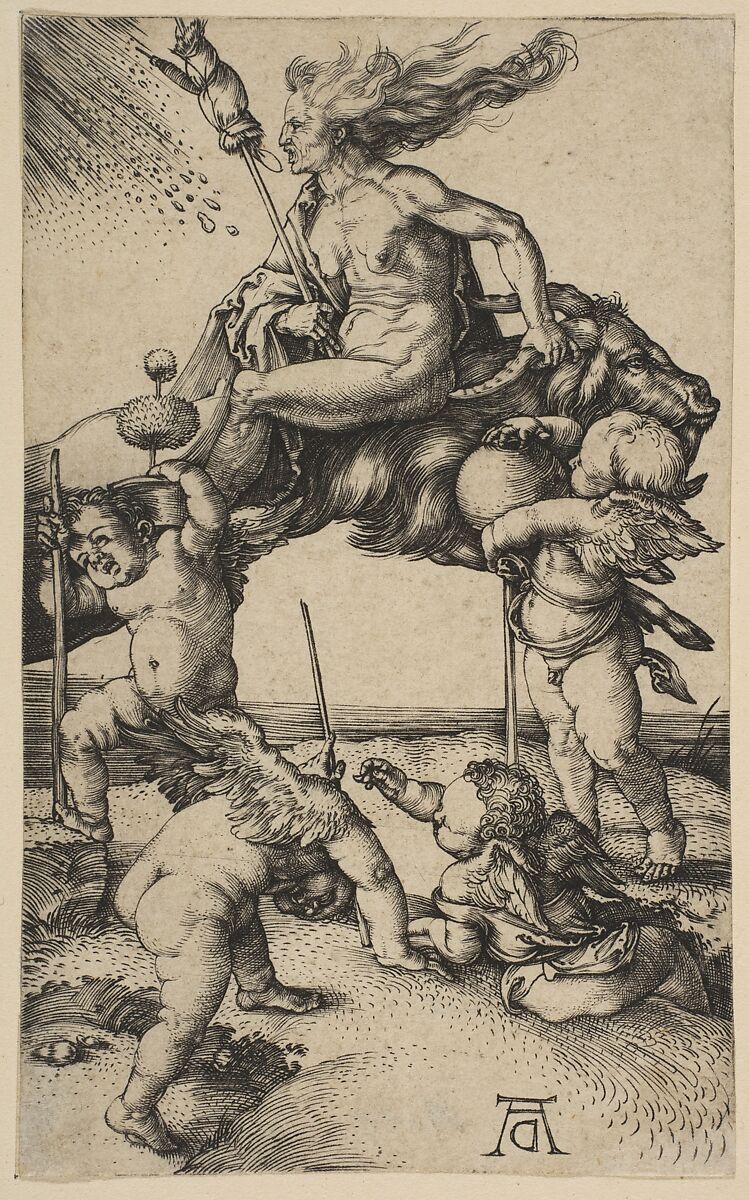
Albrecht Dürer, The Witch (ca. 1500). The rider faces backwards on a goat in this Renaissance engraving.
Albrecht Dürer. The Metropolitan Museum of Art, Gift of Henry Walters, 1917. · Image source ↗ · Public Domain
See references (10)
- Francesco Maria Guazzo, Compendium Maleficarum, Book I, chapter XII, printed page 33 (1929 English edition)
- Francesco Maria Guazzo, Compendium Maleficarum, Book I, chapter XII, printed page 34 (1929 English edition)
- Canon Episcopi, Decretum Gratiani, causa 26, quaestio 5, canon 12: night rides and deceptive visions
- Magica Sexualis, Reader page 72
- Magica Sexualis, Reader page 74
- Magica Sexualis, Reader page 75
- Magica Sexualis, Reader page 76
- Magica Sexualis, Reader page 79
- Magica Sexualis, Reader page 78
- Albrecht Dürer, The Witch, ca. 1500, The Metropolitan Museum of Art, 17.37.31
Accounts of flight
The Canon Episcopi: journeys experienced in the mind
In the version of the Canon Episcopi preserved in Gratian’s Decretum, women believe they travel at night with Diana or Herodias. The canon calls the experience a deception of the mind and denies that the body goes with them. [4]
Compendium Maleficarum by Francesco Maria Guazzo
In Compendium Maleficarum, Book I, chapter XII, Francesco Maria Guazzo acknowledges illusion but argues that some journeys are bodily. He claims the devil can leave a likeness in a person’s place. His accounts include animal mounts, other objects and even travelling on foot when the assembly is close. [1][2][3]
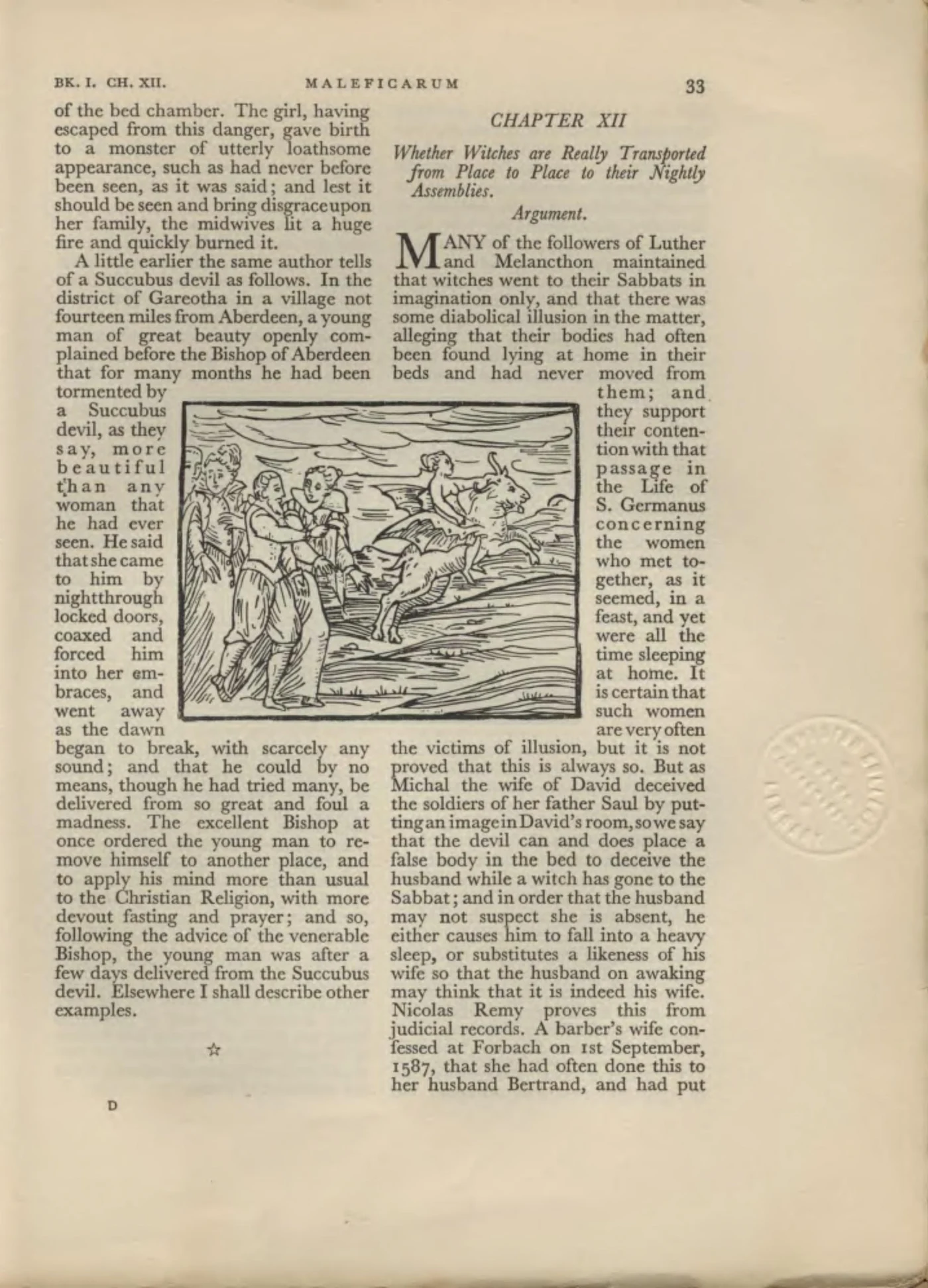
Compendium Maleficarum, 1929 edition, printed p. 33. The rider and mount appear where Guazzo asks whether travel to the assembly is bodily.
Illustrated page from Guazzo, Compendium Maleficarum, E. A. Ashwin translation, edited by Montague Summers, John Rodker, 1929. Historical illustrator unverified. Internet Archive scan. Public Domain. · Image source ↗ · Public Domain
See references (3)
- Francesco Maria Guazzo, Compendium Maleficarum, Book I, chapter XII, printed page 33 (1929 English edition)
- Francesco Maria Guazzo, Compendium Maleficarum, Book I, chapter XII, printed page 34 (1929 English edition)
- Francesco Maria Guazzo, Compendium Maleficarum, Book I, chapter XII, printed page 35 (1929 English edition)
Magica Sexualis by Émile Laurent and Paul Nagour
In Magica Sexualis, Émile Laurent and Paul Nagour retell stories attributed to Jean Bodin in which a novice follows a traveller and is left stranded. Their account attributed to Johann Nider reverses the setup: a woman appears to remain asleep in a trough but believes she has travelled. [8][9][10][11][13][12]
The book reports an argument over intoxicants. Ludwig Meyer favours a particular plant-based explanation and J. L. Holzinger disputes whether the plant was historically available. The compilers also collect anecdotes of deep sleep and vivid recollection. [14][9][15][13][12]
Human Animals by Frank Hamel
In Human Animals, Frank Hamel retells a story of a young man who watches two women transform into owls and follows them. After a mistake in the words he repeats, he flies through foliage and returns to human form at dawn with injuries. In this story the journey has physical consequences and depends on transformation. [5][6][7]
A sleeping body and a transformed traveller
The canon describes a journey experienced inwardly. Guazzo gives a reason he thinks a real traveller could appear to be at home. Hamel’s owl tale and Bodin’s stranded novice share a different concern: what happens to an imitator who follows a journey without understanding its rules. [16][14][9][10][11][12][1][2][4][8][5][6][7]
See references (13)
- Francesco Maria Guazzo, Compendium Maleficarum, Book I, chapter XII, printed page 33 (1929 English edition)
- Francesco Maria Guazzo, Compendium Maleficarum, Book I, chapter XII, printed page 34 (1929 English edition)
- Canon Episcopi, Decretum Gratiani, causa 26, quaestio 5, canon 12: night rides and deceptive visions
- Frank Hamel, Human Animals, Reader page 213
- Frank Hamel, Human Animals, Reader page 214
- Frank Hamel, Human Animals, Reader page 215
- Magica Sexualis, Reader page 72
- Magica Sexualis, Reader page 74
- Magica Sexualis, Reader page 75
- Magica Sexualis, Reader page 76
- Magica Sexualis, Reader page 79
- Magica Sexualis, Reader page 73
- Magica Sexualis, Reader page 71
Read further in the library

Human Animals
Reading note
Separately attributed primary Library account, cited on exact verified Reader leaves.
Magica Sexualis
Reading note
The separately titled account draws on exact passages in the consulted Library edition.
Sources
See references (17)
- Francesco Maria Guazzo, Compendium Maleficarum, Book I, chapter XII, printed page 33 (1929 English edition) ↗Francesco Maria Guazzo, Compendium Maleficarum, translated by E. A. Ashwin, edited with notes by Montague Summers, London: John Rodker, 1929. Book I, chapter XII, printed page 33, visually checked against Archive zero-based leaf 60. Title page and selected original page images inspected. Guazzo’s argument is distinguished from Summers’s footnotes. Selected comparison passages only, not a complete additional book crawl.Return to text ↑
- Francesco Maria Guazzo, Compendium Maleficarum, Book I, chapter XII, printed page 34 (1929 English edition) ↗Francesco Maria Guazzo, Compendium Maleficarum, translated by E. A. Ashwin, edited with notes by Montague Summers, London: John Rodker, 1929. Book I, chapter XII, printed page 34, visually checked against Archive zero-based leaf 61. Title page and selected original page images inspected. Guazzo’s argument is distinguished from Summers’s footnotes. Selected comparison passages only, not a complete additional book crawl.Return to text ↑
- Francesco Maria Guazzo, Compendium Maleficarum, Book I, chapter XII, printed page 35 (1929 English edition) ↗Francesco Maria Guazzo, Compendium Maleficarum, translated by E. A. Ashwin, edited with notes by Montague Summers, London: John Rodker, 1929. Book I, chapter XII, printed page 35, visually checked against Archive zero-based leaf 62. Title page and selected original page images inspected. Guazzo’s argument is distinguished from Summers’s footnotes. Selected comparison passages only, not a complete additional book crawl.Return to text ↑
- Canon Episcopi, Decretum Gratiani, causa 26, quaestio 5, canon 12: night rides and deceptive visions ↗Directly consulted paired Latin text and English rendering on Luke Dysinger’s teaching page, prepared for a 2022 workshop at Saint Andrew’s Abbey. The displayed recension is located at Decretum Gratiani, C.26, q.5, c.12 and includes Herodias. The translation has awkward wording; paraphrases were checked against the corresponding Latin clauses. No earliest-manuscript inspection, original authorship, printed pagination or universal medieval consensus claimed.Return to text ↑
- Frank Hamel, Human Animals, Reader page 213Frank Hamel, Human Animals, Library edition IMJ-0051-E001, Bird Women chapter. Exact retained PageID and current presented Reader position rechecked locally; printed pagination is not newly asserted. The owl-transformation story is transmitted folklore, not an observed flight.Read this page in Human Animals ↗Return to text ↑
- Frank Hamel, Human Animals, Reader page 214Frank Hamel, Human Animals, Library edition IMJ-0051-E001, Bird Women chapter. Exact retained PageID and current presented Reader position rechecked locally; printed pagination is not newly asserted. The owl-transformation story is transmitted folklore, not an observed flight.Read this page in Human Animals ↗Return to text ↑
- Frank Hamel, Human Animals, Reader page 215Frank Hamel, Human Animals, Library edition IMJ-0051-E001, Bird Women chapter. Exact retained PageID and current presented Reader position rechecked locally; printed pagination is not newly asserted. The owl-transformation story is transmitted folklore, not an observed flight.Read this page in Human Animals ↗Return to text ↑
- Magica Sexualis, Reader page 72Émile Laurent and Paul Nagour, Magica Sexualis, privately printed by Falstaff Press Inc., New York, undated inspected edition. Exact original Library edition IMJ-0105-E001. The work is a historical compilation; its quoted fiction, trial allegations and medical interpretations are not treated as independently verified facts. Current Reader positions are mapped separately from printed pagination.Read this page in Magica Sexualis ↗Return to text ↑
- Magica Sexualis, Reader page 74Émile Laurent and Paul Nagour, Magica Sexualis, privately printed by Falstaff Press Inc., New York, undated inspected edition. Exact original Library edition IMJ-0105-E001. The work is a historical compilation; its quoted fiction, trial allegations and medical interpretations are not treated as independently verified facts. Current Reader positions are mapped separately from printed pagination.Read this page in Magica Sexualis ↗Return to text ↑
- Magica Sexualis, Reader page 75Émile Laurent and Paul Nagour, Magica Sexualis, privately printed by Falstaff Press Inc., New York, undated inspected edition. Exact original Library edition IMJ-0105-E001. The work is a historical compilation; its quoted fiction, trial allegations and medical interpretations are not treated as independently verified facts. Current Reader positions are mapped separately from printed pagination.Read this page in Magica Sexualis ↗Return to text ↑
- Magica Sexualis, Reader page 76Émile Laurent and Paul Nagour, Magica Sexualis, privately printed by Falstaff Press Inc., New York, undated inspected edition. Exact original Library edition IMJ-0105-E001. The work is a historical compilation; its quoted fiction, trial allegations and medical interpretations are not treated as independently verified facts. Current Reader positions are mapped separately from printed pagination.Read this page in Magica Sexualis ↗Return to text ↑
- Magica Sexualis, Reader page 79Émile Laurent and Paul Nagour, Magica Sexualis, privately printed by Falstaff Press Inc., New York, undated inspected edition. Exact original Library edition IMJ-0105-E001. The work is a historical compilation; its quoted fiction, trial allegations and medical interpretations are not treated as independently verified facts. Current Reader positions are mapped separately from printed pagination.Read this page in Magica Sexualis ↗Return to text ↑
- Magica Sexualis, Reader page 78Émile Laurent and Paul Nagour, Magica Sexualis, privately printed by Falstaff Press Inc., New York, undated inspected edition. Exact original Library edition IMJ-0105-E001. The work is a historical compilation; its quoted fiction, trial allegations and medical interpretations are not treated as independently verified facts. Current Reader positions are mapped separately from printed pagination.Read this page in Magica Sexualis ↗Return to text ↑
- Magica Sexualis, Reader page 73Émile Laurent and Paul Nagour, Magica Sexualis, privately printed by Falstaff Press Inc., New York, undated inspected edition. Exact original Library edition IMJ-0105-E001. The work is a historical compilation; its quoted fiction, trial allegations and medical interpretations are not treated as independently verified facts. Current Reader positions are mapped separately from printed pagination.Read this page in Magica Sexualis ↗Return to text ↑
- Magica Sexualis, Reader page 77Émile Laurent and Paul Nagour, Magica Sexualis, privately printed by Falstaff Press Inc., New York, undated inspected edition. Exact original Library edition IMJ-0105-E001. The work is a historical compilation; its quoted fiction, trial allegations and medical interpretations are not treated as independently verified facts. Current Reader positions are mapped separately from printed pagination.Read this page in Magica Sexualis ↗Return to text ↑
- Magica Sexualis, Reader page 71Émile Laurent and Paul Nagour, Magica Sexualis, privately printed by Falstaff Press Inc., New York, undated inspected edition. Exact original Library edition IMJ-0105-E001. The work is a historical compilation; its quoted fiction, trial allegations and medical interpretations are not treated as independently verified facts. Current Reader positions are mapped separately from printed pagination.Read this page in Magica Sexualis ↗Return to text ↑
- Albrecht Dürer, The Witch, ca. 1500, The Metropolitan Museum of Art, 17.37.31 ↗Albrecht Dürer. The Metropolitan Museum of Art, Gift of Henry Walters, 1917.Return to text ↑