Vyapti
Vyapti is the invariable relation that makes inference possible in Indian logic. Follow the smoke and fire example and Vivekananda’s reading of causal law.
In this article
Understanding the concept
Vyapti is an invariable relation that licenses an inference in Indian logic. If smoke is always accompanied by fire, seeing smoke on a mountain gives you grounds to infer a fire you cannot yet see. The Sanskrit term is often translated as pervasion. [1]
Inferring fire in the Tarka-Sangraha
Annambhatta sets the example out in sections 40–41 of the Tarka-Sangraha. The observer recalls a connection known from a place such as a kitchen and recognizes smoke as a sign on the mountain. Fire pervades smoke in the sense that wherever there is smoke, there is fire. That direction matters: a fire can exist without producing smoke. [1]
Karma-Yoga by Swami Vivekananda
Swami Vivekananda introduces vyapti while discussing karma as causation. He credits the Nyaya logicians with the term and explains a law through the expectation that a sequence or conjunction of events will recur. He locates that expectation in the mind’s association of ideas. [2][3]
Vivekananda then confines causal law to the world we experience through space, time and causation. This lets him pose the chapter’s larger question: what would it mean for freedom to lie beyond the conditions under which we experience the world? [3][4][2]
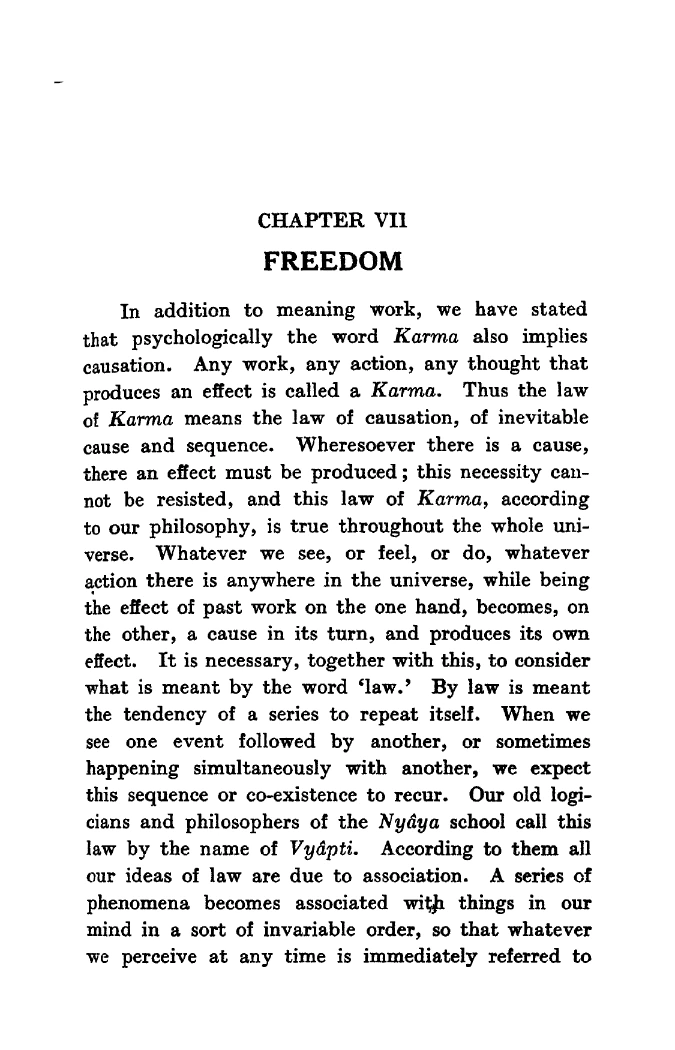
The opening of “Freedom,” where Vivekananda introduces vyapti while discussing causation. Karma-Yoga (1939), Library reader p. 93.
Swami Vivekananda, Karma-Yoga, English second printing in the 1939 combined volume. Historical public-domain text, exact checksum-verified Library scan. · Image source ↗ · Public Domain
Inference and the limits of causal law
Annambhatta uses vyapti to explain why a sign can warrant a conclusion. Vivekananda uses the term to explain how repeated experience gives rise to the expectation of law. In the smoke example, the first question is what the smoke entitles us to infer. The second is how the mind comes to expect that events follow regular patterns. [1][2][3]
Read further in the library
Karma Yoga
Reading note
The separately titled account draws on exact passages in the consulted Library edition.
Sources
See references (4)
- Annambhatta, Tarka-Sangraha, numbered sections 40–41 ↗Annambhatta, Tarka-Sangraha, Sanskrit text, numbered sections 40–41 in the consulted transcription. Editorial English paraphrase of the smoke–fire inference and the relation called vyapti. No unverified English translator or Library pagination supplied.Return to text ↑
- Karma-Yoga, Reader page 93Swami Vivekananda, Karma-Yoga, in Karma-Yoga & Bhakti-Yoga, English second printing, Ramakrishna-Vivekananda Center of New York, Inc., 1939. Exact Library edition IMJ-0097-E002. Only the Karma-Yoga part is used in this crawl; the old Work slug mentioning Hindi does not identify this edition’s language.Read this page in Karma Yoga ↗Return to text ↑
- Karma-Yoga, Reader page 94Swami Vivekananda, Karma-Yoga, in Karma-Yoga & Bhakti-Yoga, English second printing, Ramakrishna-Vivekananda Center of New York, Inc., 1939. Exact Library edition IMJ-0097-E002. Only the Karma-Yoga part is used in this crawl; the old Work slug mentioning Hindi does not identify this edition’s language.Read this page in Karma Yoga ↗Return to text ↑
- Karma-Yoga, Reader page 95Swami Vivekananda, Karma-Yoga, in Karma-Yoga & Bhakti-Yoga, English second printing, Ramakrishna-Vivekananda Center of New York, Inc., 1939. Exact Library edition IMJ-0097-E002. Only the Karma-Yoga part is used in this crawl; the old Work slug mentioning Hindi does not identify this edition’s language.Read this page in Karma Yoga ↗Return to text ↑