The Valley of Selfishness
The Valley of Selfishness is a region in A Wanderer in the Spirit Lands where neighbours cannot see one another until they begin to care about others.
In this article
Understanding the concept
In A Wanderer in the Spirit Lands, the Valley of Selfishness is a populated place that feels empty to each person in it. Its occupants cannot see one another. The story connects that isolation with living entirely for one’s own concerns. [1]
The first change comes when someone wishes to help another person. Noticing a neighbour is part of that change, and the landscape has a part in showing what becomes possible. [1]
A Wanderer in the Spirit Lands: Franchezzo, transcribed by A. Farnese
In the account attributed to Franchezzo and transcribed by A. Farnese, grey stones and hills spread under a twilight sky. The narrator says many people live there, even though each person’s surroundings seem to hold nobody else. [1]
Wanting to help gives the person a first awareness of neighbours and a way out of the valley. The desire matters before they change where they live. The loss of isolation begins with what they notice and want to do about it. [1]
Beyond it lies dry, sandy country with small gardens and settlements. Its inhabitants can at least associate, although they continue quarrelling, blaming others and excusing themselves. Efforts to overcome selfishness are said to make grass begin to grow. Social contact precedes fuller beauty. [1][2]
Franchezzo uses the contrast to challenge the value of earthly rank and possessions. A distinguished position on earth does not purchase an attractive spiritual home. The passage is about the narrator’s moral geography; it does not justify reading earthly poverty or disability as signs of spiritual failure. [2]
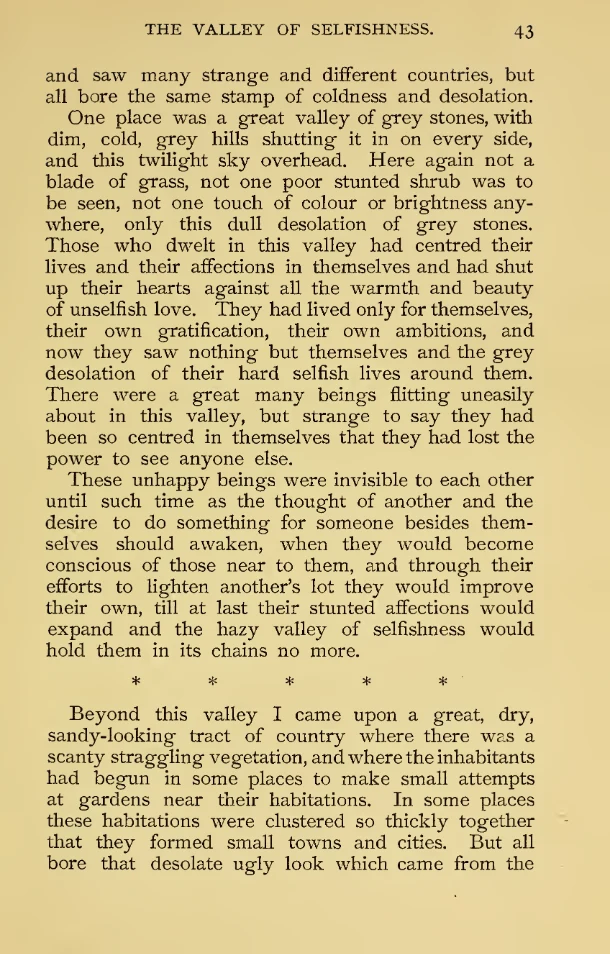
Source facsimile: A Wanderer in the Spirit Lands (1896), printed p. 43, Reader page 52.
A Wanderer in the Spirit Lands, W. J. Sinkins, London, preface dated 1896. Public-domain historical page from the checksum-verified Library PDF. · Image source ↗ · Public Domain
The first change is noticing someone else
In the Country of Unrest, neighbours can see one another and still use that contact to interfere or further their own plans. The valley presents an earlier difficulty: other people have yet to come into view. [1][2][3]
The first step out of the valley is a wish to help. The story makes it small enough to take while much of the former character still remains. Fellowship starts to return before the person has changed completely. [1]
Read further in the library
A Wanderer in the Spirit Lands
Reading note
The separately titled account draws on exact passages in the consulted Library edition.
Sources
See references (3)
- A Wanderer in the Spirit Lands, printed p. 43, Reader page 52A Wanderer in the Spirit Lands, attributed to the spirit Franchezzo and transcribed by A. Farnese. W. J. Sinkins, London. Title page undated; preface dated 1896. The narrator’s experiences and the guides’ explanations are reported claims, not independently established observations.Read this page in A Wanderer in the Spirit Lands ↗Return to text ↑
- A Wanderer in the Spirit Lands, printed p. 44, Reader page 53A Wanderer in the Spirit Lands, attributed to the spirit Franchezzo and transcribed by A. Farnese. W. J. Sinkins, London. Title page undated; preface dated 1896. The narrator’s experiences and the guides’ explanations are reported claims, not independently established observations.Read this page in A Wanderer in the Spirit Lands ↗Return to text ↑
- A Wanderer in the Spirit Lands, printed p. 45, Reader page 54A Wanderer in the Spirit Lands, attributed to the spirit Franchezzo and transcribed by A. Farnese. W. J. Sinkins, London. Title page undated; preface dated 1896. The narrator’s experiences and the guides’ explanations are reported claims, not independently established observations.Read this page in A Wanderer in the Spirit Lands ↗Return to text ↑