The Country of Unrest
In the Country of Unrest, people carry their old schemes into the afterlife. Franchezzo describes how their plans keep defeating one another.
In this article
Understanding the concept
The Country of Unrest is a region in A Wanderer in the Spirit Lands where people keep trying to improve their lives at someone else’s expense. Each new plan runs into a neighbour’s efforts to do the same. [1][2]
The residents can see and talk to one another, a change from the isolation of the Valley of Selfishness. The country shows what can happen when people rediscover company before learning to work together. [3][1][2]
A Wanderer in the Spirit Lands: Franchezzo, transcribed by A. Farnese
Franchezzo’s account, transcribed by A. Farnese, approaches this country through dry, sandy settlements. Gardens and towns exist, yet quarrelling and dissatisfaction remain common. A change from total indifference has made association possible without making it harmonious. [3][1]
People bring their schemes from earthly life. They promise neighbours a way out of their discomfort, then obstruct any plan that crosses their own. Franchezzo names the region for the restlessness that results. [2]
Franchezzo attempts to give hope and direction to those who will listen. His presence does not instantly reform the whole country. The small response available to a visiting helper fits the book’s broader pattern of assistance depending on the recipient’s willingness. [2]
The following Land of Misers concentrates on a narrower attachment, while a darker region beyond it includes violent conflict. The sequence distinguishes restless rivalry, hoarding and overt combat. It is a series of related conditions rather than a single scene repeated under different names. [2][4]
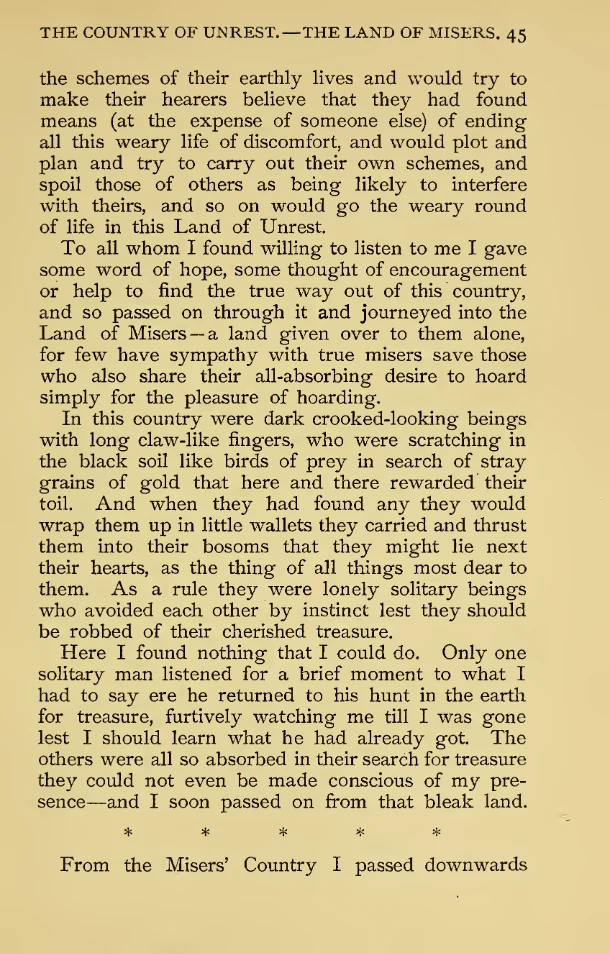
A Wanderer in the Spirit Lands (1896), printed p. 45, Library Reader page 54. The account of competing schemes gives way to the neighbouring Land of Misers.
A Wanderer in the Spirit Lands, W. J. Sinkins, London, preface dated 1896. Public-domain historical page from the checksum-verified Library PDF. · Image source ↗ · Public Domain
What begins to change the country
New grass appears where people make an effort to overcome selfishness. The first sign of change is small, and it comes through a different way of treating others. The rest of the landscape still shows how much change has yet to happen. [2][1]
Read further in the library

A Wanderer in the Spirit Lands
Reading note
The separately titled account draws on exact passages in the consulted Library edition.
Sources
See references (4)
- A Wanderer in the Spirit Lands, printed p. 44, Reader page 53A Wanderer in the Spirit Lands, attributed to the spirit Franchezzo and transcribed by A. Farnese. W. J. Sinkins, London. Title page undated; preface dated 1896. The narrator’s experiences and the guides’ explanations are reported claims, not independently established observations.Read this page in A Wanderer in the Spirit Lands ↗Return to text ↑
- A Wanderer in the Spirit Lands, printed p. 45, Reader page 54A Wanderer in the Spirit Lands, attributed to the spirit Franchezzo and transcribed by A. Farnese. W. J. Sinkins, London. Title page undated; preface dated 1896. The narrator’s experiences and the guides’ explanations are reported claims, not independently established observations.Read this page in A Wanderer in the Spirit Lands ↗Return to text ↑
- A Wanderer in the Spirit Lands, printed p. 43, Reader page 52A Wanderer in the Spirit Lands, attributed to the spirit Franchezzo and transcribed by A. Farnese. W. J. Sinkins, London. Title page undated; preface dated 1896. The narrator’s experiences and the guides’ explanations are reported claims, not independently established observations.Read this page in A Wanderer in the Spirit Lands ↗Return to text ↑
- A Wanderer in the Spirit Lands, printed p. 46, Reader page 55A Wanderer in the Spirit Lands, attributed to the spirit Franchezzo and transcribed by A. Farnese. W. J. Sinkins, London. Title page undated; preface dated 1896. The narrator’s experiences and the guides’ explanations are reported claims, not independently established observations.Read this page in A Wanderer in the Spirit Lands ↗Return to text ↑