Universal Ratios in Walter Russell
What did Walter Russell mean by universal ratios? Read the squares and cubes in his dimension chart and his use of them to explain planetary change.
In this article
From changes of scale to a universal rule
Universal ratios are Walter Russell’s proposed relationships among distance, volume, temperature and other properties. He starts with a familiar fact about scale. Doubling the side of a square quadruples its area, while doubling the side of a cube multiplies its volume by eight. He then applies ratios to changes in planets. [3][4][5]
The Universal One by Walter Russell
In The Universal One, Walter Russell draws a line, squares and cubes to show how length, area and volume change at different rates. He reads their ratios alongside the numbered positions in his formula of locked potentials. [3][4][5][6]
Russell imagines a planet moving from sixty million to a hundred and twenty million miles from its sun. He assigns scale factors to its volume, temperature, rotation and revolution. The drawings establish the geometric example. Applying it to those physical properties is Russell’s further proposal. [7][8]
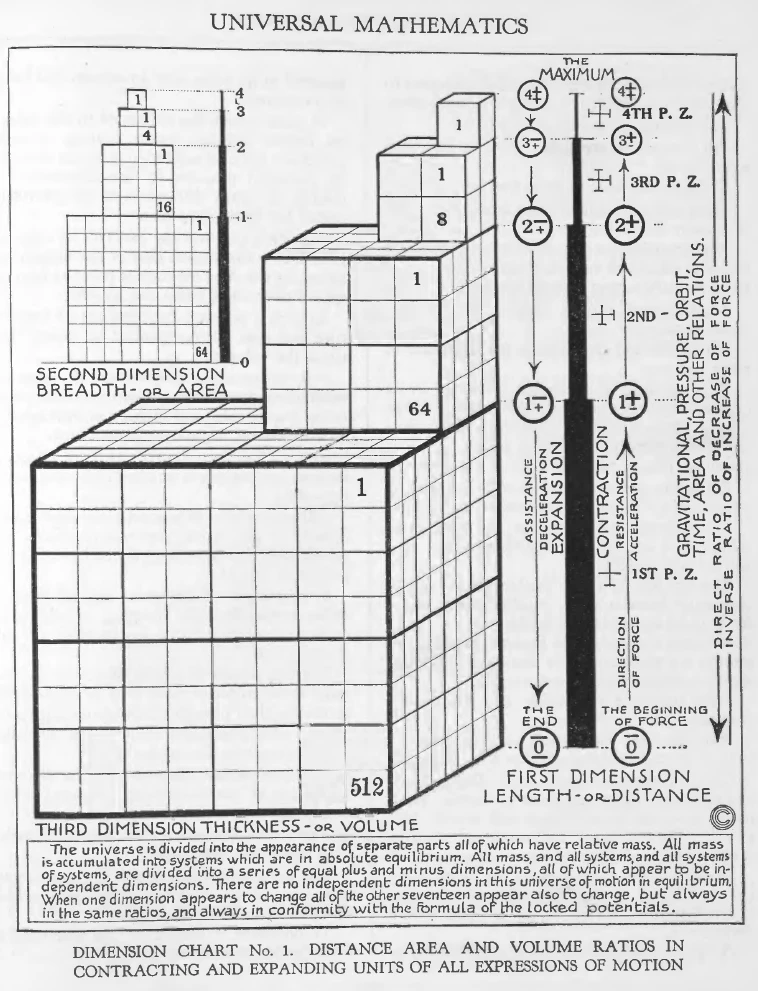
Russell puts a line, squares and cubes on the same chart to show how length, area and volume scale. He uses the geometry to introduce his proposed universal ratios.
Walter Russell, Universal Mathematics, Dimension Chart No. 1. Brieger Press, New York, copyright 1926, Library of Congress LCCN 27004508. Library of Congress, public domain. · Image source ↗ · Public Domain
See references (6)
- The Universal One, printed p. 201, Reader page 200
- The Universal One, printed p. 202, Reader page 201
- The Universal One, printed p. 203, Reader page 202
- The Universal One, printed p. 205, Reader page 204
- The Universal One, printed p. 204, Reader page 203
- The Universal One, printed p. 206, Reader page 205
What Kepler’s third law relates
Kepler’s third law relates the square of an orbital period to the cube of the orbit’s semimajor axis. Russell’s proposed ratios connect orbital distance to several other properties, including the size and temperature of a planet. [4][5][8][2]
In the library
The Universal One
Reading note
The separately titled account draws on exact passages in the consulted Library edition.
Sources
See references (8)
- Universal Mathematics, Dimension Chart No. 1 ↗Walter Russell, Universal Mathematics, Dimension Chart No. 1. Brieger Press, New York, copyright 1926, Library of Congress LCCN 27004508. Library of Congress, public domain.
- NASA Science, Orbits and Kepler’s Laws ↗NASA Science, Orbits and Kepler’s Laws.
- The Universal One, printed p. 201, Reader page 200Walter Russell, The Universal One, edited by Louise Russell, University of Science and Philosophy, Limited Edition De Luxe. Lumitheca Library edition IMJ-0605-E001.Read this page in The Universal One ↗
- The Universal One, printed p. 202, Reader page 201Walter Russell, The Universal One, edited by Louise Russell, University of Science and Philosophy, Limited Edition De Luxe. Lumitheca Library edition IMJ-0605-E001.Read this page in The Universal One ↗
- The Universal One, printed p. 203, Reader page 202Walter Russell, The Universal One, edited by Louise Russell, University of Science and Philosophy, Limited Edition De Luxe. Lumitheca Library edition IMJ-0605-E001.Read this page in The Universal One ↗
- The Universal One, printed p. 205, Reader page 204Walter Russell, The Universal One, edited by Louise Russell, University of Science and Philosophy, Limited Edition De Luxe. Lumitheca Library edition IMJ-0605-E001.Read this page in The Universal One ↗
- The Universal One, printed p. 204, Reader page 203Walter Russell, The Universal One, edited by Louise Russell, University of Science and Philosophy, Limited Edition De Luxe. Lumitheca Library edition IMJ-0605-E001.Read this page in The Universal One ↗
- The Universal One, printed p. 206, Reader page 205Walter Russell, The Universal One, edited by Louise Russell, University of Science and Philosophy, Limited Edition De Luxe. Lumitheca Library edition IMJ-0605-E001.Read this page in The Universal One ↗