The Formula of Locked Potentials
Read Walter Russell’s cosmic clock. See what the locked potentials, numbered positions and ten-octave cycle represent, and why mass and tone are exceptions.
In this article
Reading Russell’s cosmic clock
The formula of locked potentials is Walter Russell’s proposed pattern of change in properties such as pressure and potential. His cosmic clock divides that pattern into octaves. Each octave has marked positions that recur within the larger cycle. [3][4][5]
The Universal One by Walter Russell
In The Universal One, Walter Russell assigns zero to inertia and uses numbered steps for positions of increasing and decreasing potential. He compares the full cycle to a mainspring winding through five octaves and unwinding through five more. [3][5][6][7]
Russell gives mass and tone different rules. Along the larger cycle, he has mass accumulate and tone descend. Their movement across the octaves is an exception to the repeating pattern he gives other properties. [3][4]
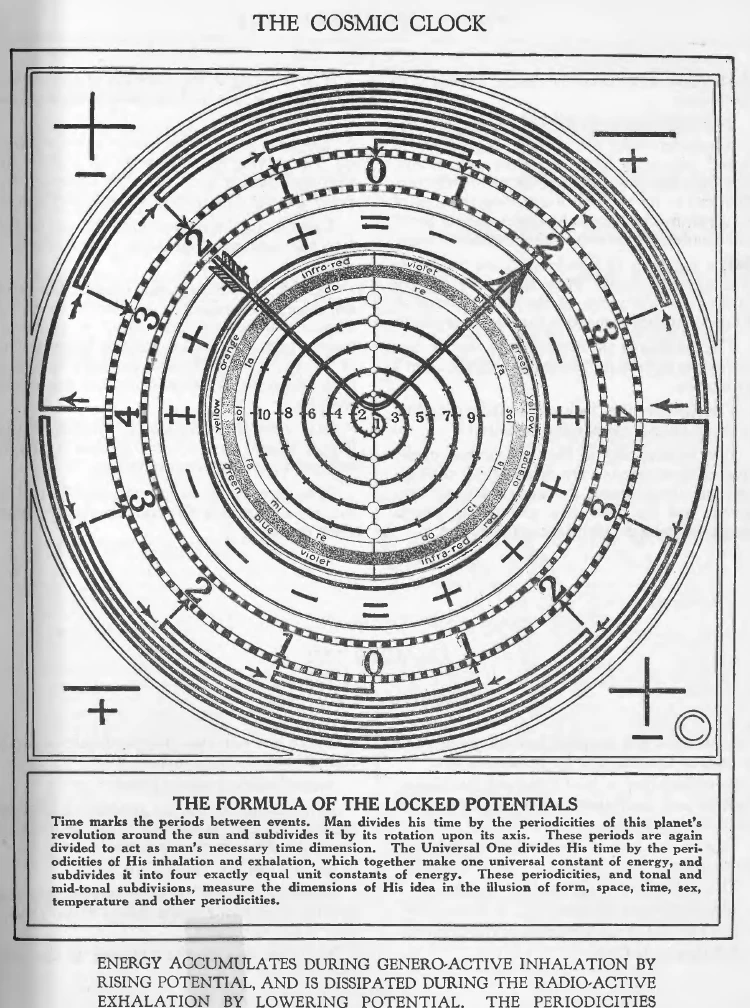
Russell’s Cosmic Clock separates positions into numbered rings and sectors. The recurring marks stand for the charges and discharges he assigns to each octave.
Walter Russell, The Cosmic Clock. Brieger Press, New York, copyright 1926, Library of Congress LCCN 27004508. Library of Congress, public domain. · Image source ↗ · Public Domain
What the two tables number
Russell attaches element names to positions in a charging and discharging cycle. IUPAC’s periodic table orders the elements by atomic number, the number of protons in the nucleus. The two numbering schemes organise different properties. [3][4][7][2]
In the library

The Universal One
Reading note
The separately titled account draws on exact passages in the consulted Library edition.
Sources
See references (7)
- The Cosmic Clock ↗Walter Russell, The Cosmic Clock. Brieger Press, New York, copyright 1926, Library of Congress LCCN 27004508. Library of Congress, public domain.
- IUPAC Periodic Table of Elements ↗International Union of Pure and Applied Chemistry, official periodic table.
- The Universal One, printed p. 64, Reader page 63Walter Russell, The Universal One, edited by Louise Russell, University of Science and Philosophy, Limited Edition De Luxe. Lumitheca Library edition IMJ-0605-E001.Read this page in The Universal One ↗
- The Universal One, printed p. 65, Reader page 64Walter Russell, The Universal One, edited by Louise Russell, University of Science and Philosophy, Limited Edition De Luxe. Lumitheca Library edition IMJ-0605-E001.Read this page in The Universal One ↗
- The Universal One, printed p. 66, Reader page 65Walter Russell, The Universal One, edited by Louise Russell, University of Science and Philosophy, Limited Edition De Luxe. Lumitheca Library edition IMJ-0605-E001.Read this page in The Universal One ↗
- The Universal One, printed p. 68, Reader page 67Walter Russell, The Universal One, edited by Louise Russell, University of Science and Philosophy, Limited Edition De Luxe. Lumitheca Library edition IMJ-0605-E001.Read this page in The Universal One ↗
- The Universal One, printed p. 69, Reader page 68Walter Russell, The Universal One, edited by Louise Russell, University of Science and Philosophy, Limited Edition De Luxe. Lumitheca Library edition IMJ-0605-E001.Read this page in The Universal One ↗