Turīya
Turīya means the fourth. Read how Arthur Avalon distinguishes it from waking, dreaming and dreamless sleep in The Serpent Power.
In this article
The fourth
Turīya means “the fourth”. In Indian accounts of consciousness, the name follows waking, dreaming and dreamless sleep. Arthur Avalon describes the fourth as a pure experience realised through samādhi, beyond the three familiar modes. [2][3][4][5]
The Serpent Power in Arthur Avalon’s translation
In The Serpent Power, Arthur Avalon distinguishes waking, when the senses disclose the world, from dreaming, when impressions appear as inner objects. In dreamless sleep that variety recedes. He says the individual is temporarily merged in the causal body. [2][3]
In the fourth, Avalon says, samādhi gives rise to the pure experience he calls śuddhavidyā. He also records a scheme that recognises turīyātīta, literally “beyond the fourth”, reached by becoming firmly established in the fourth. [3][4]
Avalon extends the first three states to a cosmic scale. He describes corresponding conditions of objective, subjective and causal experience, and places supreme consciousness beyond them. [4][5]
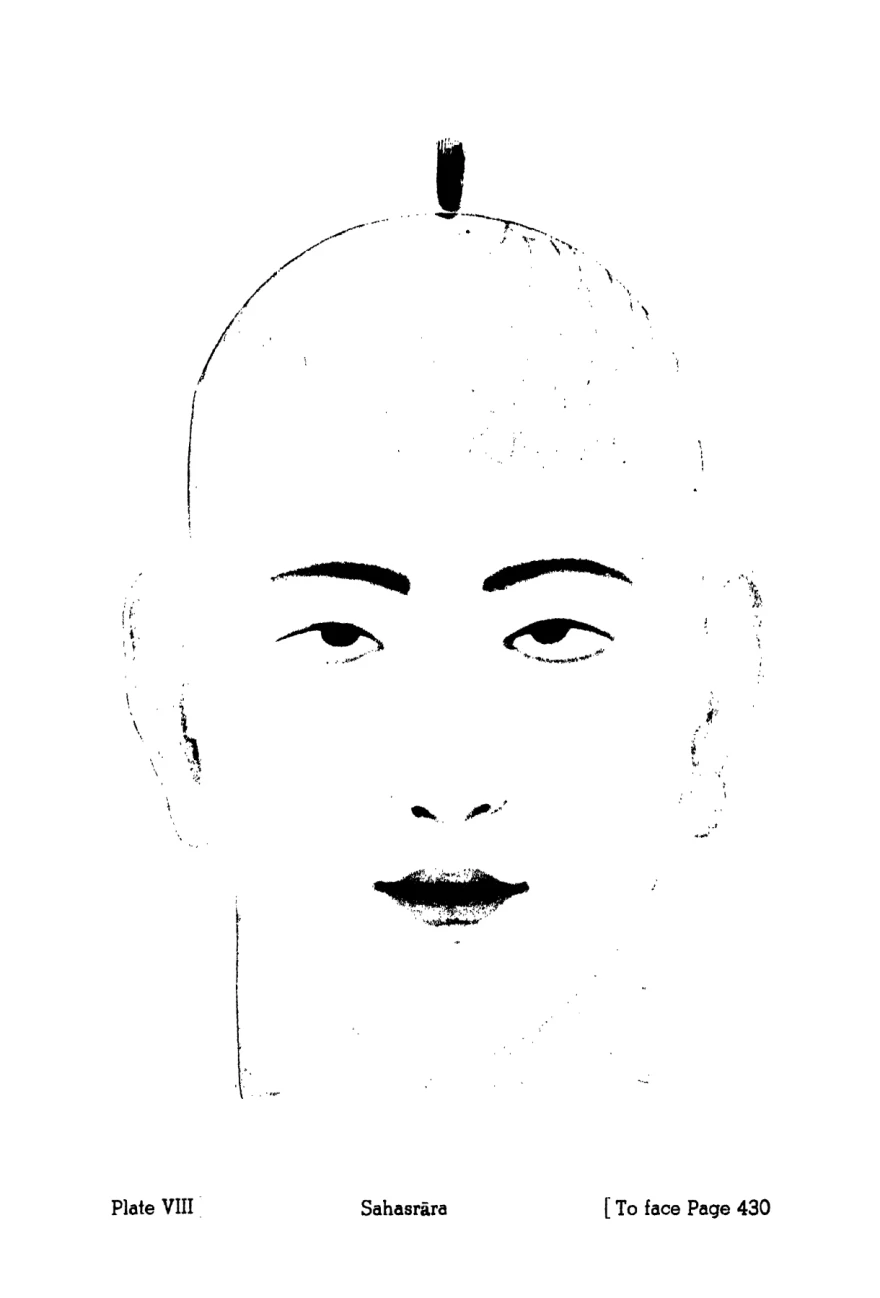
Plate VIII marks Sahasrāra at the crown. The crown belongs to the book’s map of yogic ascent.
Illustrator unrecorded. The Serpent Power, Plate VIII. Library facsimile, compared with the 1924 second edition. · Image source ↗ · Public Domain
States of consciousness and yogic ascent
The fourfold account distinguishes ways consciousness is experienced. The ascent of Kuṇḍalinī gives yoga a spatial image through successive lotuses. Both descriptions belong to Avalon’s discussion of what happens in yoga. [2][3][4][6][7]
In the library
The Serpent Power
Reading note
Separately attributed primary Library account, cited on exact verified Reader leaves.
Sources
See references (7)
- The Serpent Power, Plate VIII, Reader page 450Illustrator unrecorded. The Serpent Power, Plate VIII. Library facsimile, compared with the 1924 second edition.Read this page in The Serpent Power ↗
- The Serpent Power, printed p. 79, Reader page 94Arthur Avalon (Sir John Woodroffe), The Serpent Power, fifth enlarged edition, Ganesh & Co., Madras, 1953. Includes Pūrṇānanda’s Ṣaṭ-cakra-nirūpaṇa, Pādukā-pañcaka and Kālīcaraṇa’s commentary. Exact Library edition IMJ-0608-E001.Read this page in The Serpent Power ↗
- The Serpent Power, printed p. 80, Reader page 95Arthur Avalon (Sir John Woodroffe), The Serpent Power, fifth enlarged edition, Ganesh & Co., Madras, 1953. Includes Pūrṇānanda’s Ṣaṭ-cakra-nirūpaṇa, Pādukā-pañcaka and Kālīcaraṇa’s commentary. Exact Library edition IMJ-0608-E001.Read this page in The Serpent Power ↗
- The Serpent Power, printed p. 81, Reader page 96Arthur Avalon (Sir John Woodroffe), The Serpent Power, fifth enlarged edition, Ganesh & Co., Madras, 1953. Includes Pūrṇānanda’s Ṣaṭ-cakra-nirūpaṇa, Pādukā-pañcaka and Kālīcaraṇa’s commentary. Exact Library edition IMJ-0608-E001.Read this page in The Serpent Power ↗
- The Serpent Power, printed p. 82, Reader page 97Arthur Avalon (Sir John Woodroffe), The Serpent Power, fifth enlarged edition, Ganesh & Co., Madras, 1953. Includes Pūrṇānanda’s Ṣaṭ-cakra-nirūpaṇa, Pādukā-pañcaka and Kālīcaraṇa’s commentary. Exact Library edition IMJ-0608-E001.Read this page in The Serpent Power ↗
- The Serpent Power, Reader page 258Arthur Avalon (Sir John Woodroffe), The Serpent Power, fifth enlarged edition, Ganesh & Co., Madras, 1953. Includes Pūrṇānanda’s Ṣaṭ-cakra-nirūpaṇa, Pādukā-pañcaka and Kālīcaraṇa’s commentary. Exact Library edition IMJ-0608-E001.Read this page in The Serpent Power ↗
- The Serpent Power, printed p. 473, Reader page 499Arthur Avalon (Sir John Woodroffe), The Serpent Power, fifth enlarged edition, Ganesh & Co., Madras, 1953. Includes Pūrṇānanda’s Ṣaṭ-cakra-nirūpaṇa, Pādukā-pañcaka and Kālīcaraṇa’s commentary. Exact Library edition IMJ-0608-E001.Read this page in The Serpent Power ↗