Theurgy
Theurgy is ritual aimed at contact or union with divine powers. Explore Iamblichus on sacred signs, prayer and purification, and later uses of the term.
In this article
What is theurgy?
Theurgy is ritual aimed at contact or union with the divine. For the late antique Platonist Iamblichus, sacred actions, signs and prayers prepare the soul to share in an order that comes from the gods. [1][2][5][6]
The worshipper has work to do: cultivate purity, pray and take part in the rite. Iamblichus attributes the decisive power to the gods. That distinction is central to his account of how ritual can change the soul. [1][2]
Later writers used the word more broadly. Magica Sexualis includes talismans and other forms of help that its compilers class as beneficent magic. The book also gives examples of secret communication. [9][10][11][1][2]
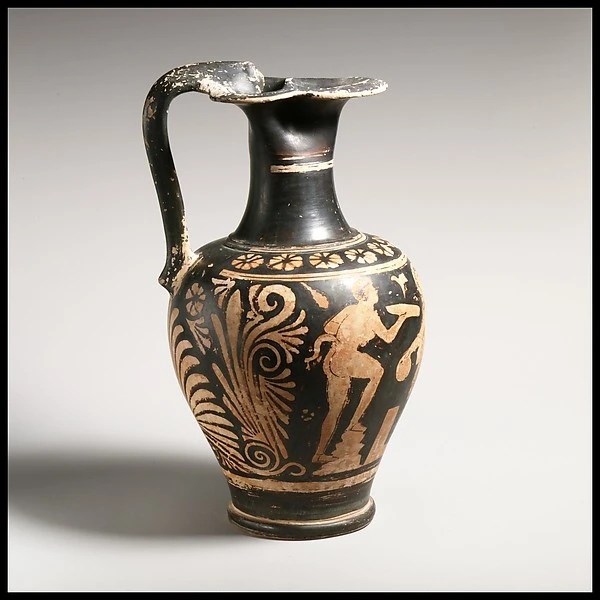
Apulian Greek painted jug, ca. 320–310 BCE, attributed to the Group of Zurich 2657. This side view provides earlier Greek ritual-art context. It is not identified as a theurgic instrument or as an object used by Iamblichus.
The Metropolitan Museum of Art, Gift of Mrs. Kate Roberts Smith, 1949, 49.93. Public Domain, CC0 Open Access. · Image source ↗ · CC0
See references (7)
- Iamblichus, On the Mysteries, section II, chapter XI, printed page 109 (Taylor translation, second edition, 1895)
- Iamblichus, On the Mysteries, section II, chapter XI, printed page 110 (Taylor translation, second edition, 1895)
- Iamblichus, On the Mysteries, section X, chapter V, printed page 333 (Taylor translation, second edition, 1895)
- Iamblichus, On the Mysteries, section X, chapters V–VI, printed page 334 (Taylor translation, second edition, 1895)
- Magica Sexualis, printed p. 9, Reader page 17
- Magica Sexualis, Reader page 18
- Magica Sexualis, Reader page 19
Sacred signs in Iamblichus’s On the Mysteries
In section II, chapter XI, Iamblichus argues that thinking about a god does not, by itself, produce theurgical union. If intellectual conception alone were sufficient, theoretical philosophers would already attain that union through their reasoning. His answer assigns a distinctive role to sacred works and to symbols whose efficacy exceeds the worshipper’s understanding. [1]
Thomas Taylor calls the signs synthemata in his translation. Iamblichus says the gods recognise their own images. The worshipper participates in what the signs do even when their full meaning is beyond a human interpreter. [2]
This does not remove human preparation from the account. Iamblichus names intellectual activity, good dispositions and purity as contributing causes. His distinction is between conditions that prepare a person and the divine cause to which the result is attributed. Calling theurgy either an act of will alone or a wholly passive event would lose part of that relationship. [2]
Three forms of prayer in On the Mysteries
In On the Mysteries V.26, Iamblichus describes prayer in three movements: contact and knowledge, communion, and finally a union the soul cannot fully express. The stages give repeated prayer a purpose beyond a single request. [3]
Iamblichus also describes prayer as preparing, mediating and completing sacred offerings. Its continual exercise enlarges the soul’s capacity for divine communication, strengthens intellect and gradually reshapes character. Divine love is both nourished by this activity and part of the change it is meant to accomplish. [4]
Read beside chapter II’s discussion of symbols, this gives theurgy a sustained dimension. A rite is not explained solely by the outward object or utterance involved. The soul’s formation, repeated prayer and its supposed participation in divine activity also belong to the account of what is happening. [2][4]
See references (3)
- Iamblichus, On the Mysteries, section II, chapter XI, printed page 110 (Taylor translation, second edition, 1895)
- Iamblichus, On the Mysteries, section V, chapter XXVI, printed page 271 (Taylor translation, second edition, 1895)
- Iamblichus, On the Mysteries, section V, chapter XXVI, printed page 272 (Taylor translation, second edition, 1895)
Purification and union in On the Mysteries
Section X, chapter V places purification before a fuller participation in the good and union with the gods. The purification of the soul is distinguished from purification of the body. The reasoning power is fitted for the vision of the good, rather than discarded as an obstacle with no further place in religious life. [5][6]
Chapter VI continues the movement towards the Demiurge, the divine maker and ordering cause. The soul is described as becoming established in divine activities and understanding. These are claims made within the work’s account of reality. They should not be flattened into a promise of ordinary worldly success or treated as an independently demonstrated map of invisible events. [6]
Sacred names in On the Mysteries
In section VII, chapters IV–V, Iamblichus defends inherited sacred names even when their meaning is unfamiliar to human users. A name’s divine relation need not depend on an outsider’s ability to translate it. He also resists altering received prayers merely to make them more intelligible. This argument concerns a particular sacred inheritance, not every invented syllable or foreign-sounding word. [7]
Magica Sexualis by Émile Laurent and Paul Nagour
Émile Laurent and Paul Nagour begin Magica Sexualis by defining theurgy as a way of obtaining divine or supernatural intervention, especially for beneficial ends. They contrast it with goety, their category for invoking harmful spirits to work evil. This is the book’s organising moral distinction, and its account should be read in that setting. [9][10]
The compilation brings amulets, talismans and heavenly assistance into this category. It also proposes a continuity between ancient divine helpers and figures invoked in later religions. That is the compilers’ generalisation. The short passage does not establish that the religious practices it gathers share one theology, history or explanation of their effects. [10]
Its next examples move from ritual assistance to communication. A bouquet can convey the time and address of a lovers’ meeting, while clothing and an apparently ordinary letter can carry a concealed message. The recipient needs a shared code to understand them. The example explains secrecy and recognition more directly than it explains an encounter with a god. [10][11]
A later passage attributes to Iamblichus an answer to the objection that sacred formulas use unintelligible words. Words unknown to human hearers can still be known to the gods, the compilers report. They expressly distinguish the received words from arbitrary foreign vocabulary. This is a particular account of sacred language, rather than a claim that anything incomprehensible must possess power. [12]
What makes a sign effective?
A bouquet in Magica Sexualis can tell a lover the time and place of a meeting because another person understands the code. In Iamblichus’s rite, the gods recognise signs whose power comes from them. The comparison brings out two different ways a sign can work. [11][1][2]
The compilation’s beneficent-versus-harmful distinction classifies magic by its intended result and spiritual helpers. Iamblichus’s account asks a further question: what joins the soul to the gods, and where does the power of that union originate? Theurgy can therefore be discussed in relation to goetia without defining its whole purpose as simply the opposite of harmful magic. [9][10][13][2][5][6]
The sacred-name comparison is closer. Magica Sexualis preserves the distinction between words unfamiliar to people and words meaningful to the gods. The direct Iamblichus passage adds the importance of preserving an inherited sacred form. It helps explain the compilation’s report while keeping the fuller argument attached to its own author and work. [12][7]
See references (10)
- Iamblichus, On the Mysteries, section II, chapter XI, printed page 109 (Taylor translation, second edition, 1895)
- Iamblichus, On the Mysteries, section II, chapter XI, printed page 110 (Taylor translation, second edition, 1895)
- Iamblichus, On the Mysteries, section X, chapter V, printed page 333 (Taylor translation, second edition, 1895)
- Iamblichus, On the Mysteries, section X, chapters V–VI, printed page 334 (Taylor translation, second edition, 1895)
- Iamblichus, On the Mysteries, section VII, chapters IV–V (Taylor translation, second edition, 1895)
- Magica Sexualis, printed p. 9, Reader page 17
- Magica Sexualis, Reader page 18
- Magica Sexualis, Reader page 19
- Magica Sexualis, printed p. 125, Reader page 133
- Magica Sexualis, Reader page 38
In the library
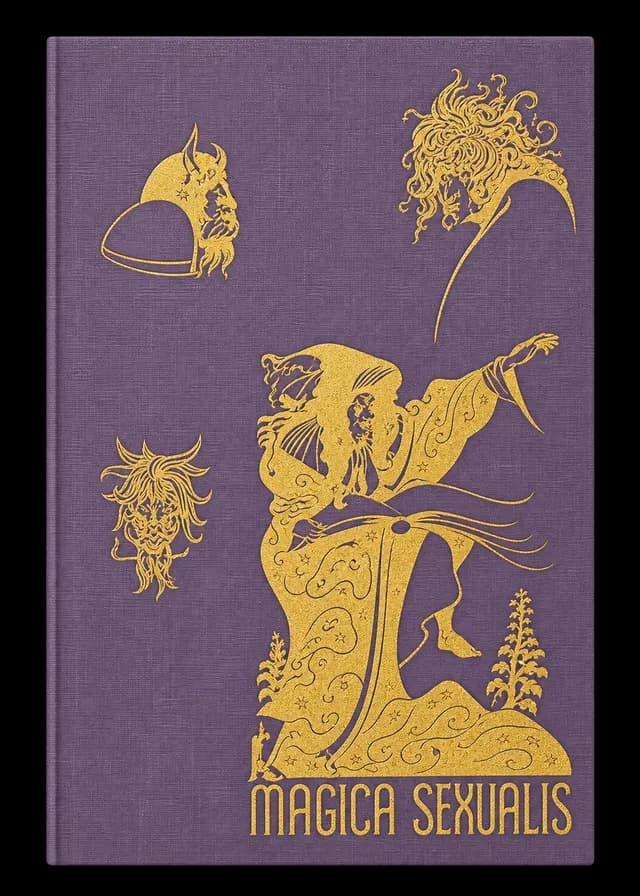
Magica Sexualis
Reading note
The separately titled account draws on exact passages in the consulted Library edition.
Sources
See references (13)
- Iamblichus, On the Mysteries, section II, chapter XI, printed page 109 (Taylor translation, second edition, 1895) ↗Iamblichus, On the Mysteries of the Egyptians, Chaldeans, and Assyrians, translated by Thomas Taylor, second edition, London: Bertram Dobell and Reeves and Turner, 1895. section II, chapter XI. Printed page 109 verified on the actual page images; Internet Archive zero-based leaf 140. Selected passages and neighbouring context consulted, not a whole-book crawl. Translator footnotes and textual interventions remain distinct from the primary argument. This is an external facsimile, not a Library Reader citation.
- Iamblichus, On the Mysteries, section II, chapter XI, printed page 110 (Taylor translation, second edition, 1895) ↗Iamblichus, On the Mysteries of the Egyptians, Chaldeans, and Assyrians, translated by Thomas Taylor, second edition, London: Bertram Dobell and Reeves and Turner, 1895. section II, chapter XI. Printed page 110 verified on the actual page images; Internet Archive zero-based leaf 141. Selected passages and neighbouring context consulted, not a whole-book crawl. Translator footnotes and textual interventions remain distinct from the primary argument. This is an external facsimile, not a Library Reader citation.
- Iamblichus, On the Mysteries, section V, chapter XXVI, printed page 271 (Taylor translation, second edition, 1895) ↗Iamblichus, On the Mysteries of the Egyptians, Chaldeans, and Assyrians, translated by Thomas Taylor, second edition, London: Bertram Dobell and Reeves and Turner, 1895. section V, chapter XXVI. Printed page 271 verified on the actual page images; Internet Archive zero-based leaf 302. Selected passages and neighbouring context consulted, not a whole-book crawl. Translator footnotes and textual interventions remain distinct from the primary argument. This is an external facsimile, not a Library Reader citation.
- Iamblichus, On the Mysteries, section V, chapter XXVI, printed page 272 (Taylor translation, second edition, 1895) ↗Iamblichus, On the Mysteries of the Egyptians, Chaldeans, and Assyrians, translated by Thomas Taylor, second edition, London: Bertram Dobell and Reeves and Turner, 1895. section V, chapter XXVI. Printed page 272 verified on the actual page images; Internet Archive zero-based leaf 303. Selected passages and neighbouring context consulted, not a whole-book crawl. Translator footnotes and textual interventions remain distinct from the primary argument. This is an external facsimile, not a Library Reader citation.
- Iamblichus, On the Mysteries, section X, chapter V, printed page 333 (Taylor translation, second edition, 1895) ↗Iamblichus, On the Mysteries of the Egyptians, Chaldeans, and Assyrians, translated by Thomas Taylor, second edition, London: Bertram Dobell and Reeves and Turner, 1895. section X, chapter V. Printed page 333 verified on the actual page images; Internet Archive zero-based leaf 364. Selected passages and neighbouring context consulted, not a whole-book crawl. Translator footnotes and textual interventions remain distinct from the primary argument. This is an external facsimile, not a Library Reader citation.
- Iamblichus, On the Mysteries, section X, chapters V–VI, printed page 334 (Taylor translation, second edition, 1895) ↗Iamblichus, On the Mysteries of the Egyptians, Chaldeans, and Assyrians, translated by Thomas Taylor, second edition, London: Bertram Dobell and Reeves and Turner, 1895. section X, chapters V–VI. Printed page 334 verified on the actual page images; Internet Archive zero-based leaf 365. Selected passages and neighbouring context consulted, not a whole-book crawl. Translator footnotes and textual interventions remain distinct from the primary argument. This is an external facsimile, not a Library Reader citation.
- Iamblichus, On the Mysteries, section VII, chapters IV–V (Taylor translation, second edition, 1895) ↗Directly consulted transcription of Thomas Taylor’s translation, second edition 1895, section VII, chapters IV–V. Chapter locators identify the exact passages; no printed-page or Library mapping supplied for this transcription. Taylor’s notes remain distinct.
- The Metropolitan Museum of Art, Terracotta oinochoe (jug), ca. 320–310 BCE, 49.93 ↗Directly consulted museum object record and Collection API object 254629: Apulian Greek, attributed to the Group of Zurich 2657, ca. 320–310 BCE, Gift of Mrs. Kate Roberts Smith, 1949. API isPublicDomain true; CC0 Open Access. The downloaded image is a side view, not the full scene described in the museum record.
- Magica Sexualis, printed p. 9, Reader page 17Émile Laurent and Paul Nagour, Magica Sexualis, privately printed by Falstaff Press Inc., New York, undated inspected edition. Exact original Library edition IMJ-0105-E001. The work is a historical compilation; its quoted fiction, trial allegations and medical interpretations are not treated as independently verified facts. Current Reader positions are mapped separately from printed pagination.Read this page in Magica Sexualis ↗
- Magica Sexualis, Reader page 18Émile Laurent and Paul Nagour, Magica Sexualis, privately printed by Falstaff Press Inc., New York, undated inspected edition. Exact original Library edition IMJ-0105-E001. The work is a historical compilation; its quoted fiction, trial allegations and medical interpretations are not treated as independently verified facts. Current Reader positions are mapped separately from printed pagination.Read this page in Magica Sexualis ↗
- Magica Sexualis, Reader page 19Émile Laurent and Paul Nagour, Magica Sexualis, privately printed by Falstaff Press Inc., New York, undated inspected edition. Exact original Library edition IMJ-0105-E001. The work is a historical compilation; its quoted fiction, trial allegations and medical interpretations are not treated as independently verified facts. Current Reader positions are mapped separately from printed pagination.Read this page in Magica Sexualis ↗
- Magica Sexualis, printed p. 125, Reader page 133Émile Laurent and Paul Nagour, Magica Sexualis, privately printed by Falstaff Press Inc., New York, undated inspected edition. Exact original Library edition IMJ-0105-E001. The work is a historical compilation; its quoted fiction, trial allegations and medical interpretations are not treated as independently verified facts. Current Reader positions are mapped separately from printed pagination.Read this page in Magica Sexualis ↗
- Magica Sexualis, Reader page 38Émile Laurent and Paul Nagour, Magica Sexualis, privately printed by Falstaff Press Inc., New York, undated inspected edition. Exact original Library edition IMJ-0105-E001. The work is a historical compilation; its quoted fiction, trial allegations and medical interpretations are not treated as independently verified facts. Current Reader positions are mapped separately from printed pagination.Read this page in Magica Sexualis ↗