The History of Tarot: From Playing Cards to the Rider–Waite–Smith Deck
Trace tarot from Renaissance card games to French divination and Pamela Colman Smith’s deck. Compare three versions of the Fool and explore the original sources.
All 78 Rider–Waite–Smith Tarot Cards ↗In this article
Look closely at three tarot cards
Follow the Fool from the painted cards of Renaissance Milan to printed packs from Lyon and London.
Three versions of the Fool
Look at what each figure carries, how it stands and what appears at its feet.

Feathers and ragged clothes mark the figure against the gold ground. The heavy club rests across his shoulder.

The travelling figure has a staff and a bundle. The animal reaches up from behind, and LE FOL is printed without a trump number.

Smith gives the traveller a white rose and sets a small dog beside the cliff. The card explicitly bears the number zero.
What is tarot?
Tarot is a family of decks that adds trumps and a Fool to four suits of cards. It is documented in fifteenth-century Italy as a game. Later readers used the cards for divination and developed new ways to interpret their pictures. [3][4][2]
Historical Italian suits were Cups, Swords, Batons and Coins. In the seventeenth-century Paris deck pictured below, Jean Noblet uses these suits alongside figures such as Strength and the Hermit. Names, designs and numbering can vary across decks. [4][5][1][2]
The surviving cards answer a concrete question about how tarot began. Players could use the ordinary suits to contest a trick and the extra trumps to beat suited cards. The images had to be recognisable across the table, even if a player knew nothing of a symbolic system. A different question opens in late eighteenth-century France: what meanings could a reader assign to those same images when drawing the cards to tell a fortune? Evidence for the game belongs to Renaissance Italy. The published theories and instructions for divination belong to a much later setting. [2][15]
See references (6)
- Jeu de tarot à enseignes italiennes dit « tarot Noblet »
- The Visconti-Sforza Tarot, The World in Play
- Witchcraft Magic & Alchemy, printed p. 282, Reader page 275
- Witchcraft Magic & Alchemy, printed p. 283, Reader page 276
- Witchcraft Magic & Alchemy, Reader page 281
- Occult Tarot · Court de Gébelin and Etteilla
Tarot history at a glance
The chronology follows surviving decks and dated publications. A museum date for a particular printing may be later than the first issue of that design. The Rider–Waite–Smith card in the comparison, for instance, comes from a 1910 printing of the deck first published in 1909. [16][20]
- 1440s–1450s
- Mid to late 1400s
- 1600s–early 1700s
- 1781
Court de Gébelin prints his Egyptian interpretation
Volume VIII of Monde primitif treats the pictures as evidence of ancient wisdom. His argument shows what an eighteenth-century writer saw in the deck. [15]
- 1780s
- 1909
See references (9)
- Jeu de tarot à enseignes italiennes dit « tarot Noblet »
- The Visconti-Sforza Tarot, The World in Play
- The Visconti-Sforza Tarot Deck · MS M.630.1–35
- The Fool · MS M.630.15
- Occult Tarot · Court de Gébelin and Etteilla
- Tarot! Renaissance Symbols, Modern Visions
- Pamela Colman Smith’s tarot · Exhibition labels
- Jean Dodal’s Le Fol. Its name appears in the lower border and there is no trump number.
- Smith’s Fool bears the number zero. The rose and the bright sky give the picture a tone distinct from the Italian card.
The Italian game and its painted cards
The Visconti-Sforza cards are survivors of a costly pack associated with the ruling families of Milan. Painted and gilded, they give a partial record of a deck that has had to be reconstructed from separate holdings. The Morgan’s catalogue lists the Fool alongside the Star, the Chariot and the World, and also identifies cards from the four ordinary suits. Keep the survival bias in mind. A deluxe painting can tell us that a subject appeared in a pack and what it looked like. The archival references and surviving game traditions help explain how players used such packs. [13][2]
Look at the Fool’s own card. The figure has torn clothing, feathers and a club. The surrounding cards show that its scale and decorative setting are part of a shared pack. Those details are enough to begin comparing the visual treatment of folly without assuming that fifteenth-century players attached the meaning of a later divination manual to this image. [14][18]
The Marseille pattern and the French occult turn
‘Tarot de Marseille’ is a name for a family of card patterns. The BnF’s Jean Noblet deck comes from Paris, and Dodal’s surviving cards were made in Lyon. Compare the title bands, suit signs and woodcut outlines. The printing process and repeated pattern created cards that could circulate beyond the courtly world represented by the Milanese paintings. The name of the pattern alone cannot identify the workshop, the city or the date of a particular pack. [1][19]
Court de Gébelin’s 1781 essay reads tarot as an Egyptian book handed down in pictures. He supplies a historical origin story. Etteilla takes the cards in a practical direction, developing ways to read them and a system for which cards could be designed. The two approaches sometimes get folded together as ‘ancient tarot’. The dates printed in their books offer a way to separate an eighteenth-century interpretation, a procedure for divination and the earlier evidence of the Italian game. [15][16][2]
What is the difference between Major and Minor Arcana?
In a common 78-card tarot, the Major Arcana comprises the 21 trumps and the Fool. The Minor Arcana comprises the four suits. Each has 14 cards: ace through ten, a page or knave, a knight, a queen and a king. [3][4][5][2]
The Queen of Swords has a rank and a suit. The Hermit has its own place among the trumps. Major and Minor Arcana are the terms readers use for groups that also have distinct roles in the game. [4][5][1][2]
The terms Major and Minor Arcana are convenient when you are using a modern guide. At a card table, ‘suit’, ‘trump’ and ‘Fool’ do more work. The early Fool generally had a special privilege in play, while the trumps had ranks. You can see the distinction in surviving decks where the Fool has no number. In a Marseille-style deck, the numbered cards show suit signs arranged in patterns. In Smith’s deck they can be read as scenes. Eight Cups can be drawn as eight vessels, or as eight vessels with someone walking away under a moon. The rank remains legible in either system, but the scene gives a modern reader another thing to interpret. [2][1][17]
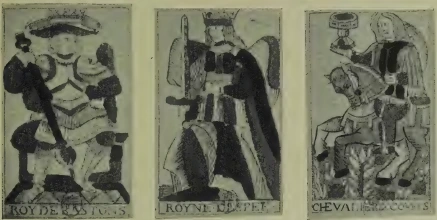
Three of Jean Noblet’s suited court cards, reproduced by De Givry.
Jean Noblet’s Paris tarot, seventeenth century. Three cards reproduced by De Givry. · Image source ↗ · Public Domain
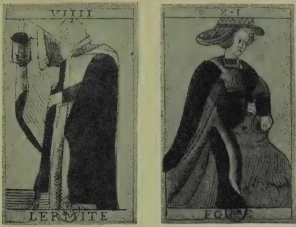
Two of Noblet’s trumps. Compare these named figures with the ranks and suits on his court cards.
Jean Noblet’s Paris tarot, seventeenth century. Two trumps reproduced by De Givry. · Image source ↗ · Public Domain
See references (6)
- Jeu de tarot à enseignes italiennes dit « tarot Noblet »
- The Visconti-Sforza Tarot, The World in Play
- Witchcraft Magic & Alchemy, printed p. 282, Reader page 275
- Witchcraft Magic & Alchemy, printed p. 283, Reader page 276
- Witchcraft Magic & Alchemy, Reader page 281
- Pamela Colman Smith’s tarot · Exhibition labels
Witchcraft Magic & Alchemy by Grillot de Givry
Grillot de Givry discusses origin stories that link tarot to ancient Egypt or to the painter Jacquemin Gringonneur. He points out that the record of a payment to Gringonneur for playing cards establishes that he made cards, but leaves their invention open. [6][3]
The cards De Givry reproduces offer more direct evidence. Noblet’s King of Wands, Queen of Swords and Knight of Cups are suited cards. The Hermit and Strength belong to the separate series of trumps shown above. [4][5]
The Pictorial Key to the Tarot by Arthur Edward Waite
Arthur Edward Waite surveys several readings of trump XVI and favors a false house of doctrine being torn apart. In Pamela Colman Smith’s illustration on the facing page, lightning strikes the tower and two figures fall. The two pages put an interpretation and its image side by side. [7][8]
The deck first appeared in 1909. Rider was the publisher, Waite commissioned the designs, and Smith drew them. Her contribution is easiest to appreciate by comparing a numbered suit card from a Marseille deck with one from her pack. The gestures, landscape and weather are all choices made in the image. Reading Waite’s accompanying book gives one contemporary interpretation. Looking at the card before opening his entry lets you see what the picture communicates on its own. [16][17][1]
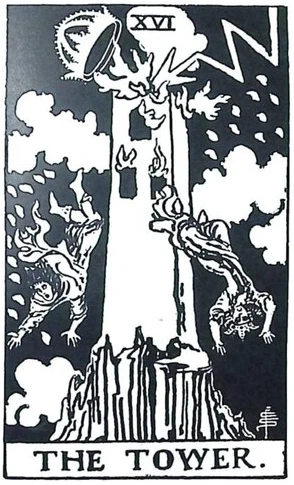
Pamela Colman Smith’s Tower, reproduced on p. 133 of Waite’s The Pictorial Key to the Tarot.
Pamela Colman Smith, illustration in Arthur Edward Waite’s The Pictorial Key to the Tarot, 1911. Public domain. Cropped from the printed page. · Image source ↗ · Public Domain
See references (5)
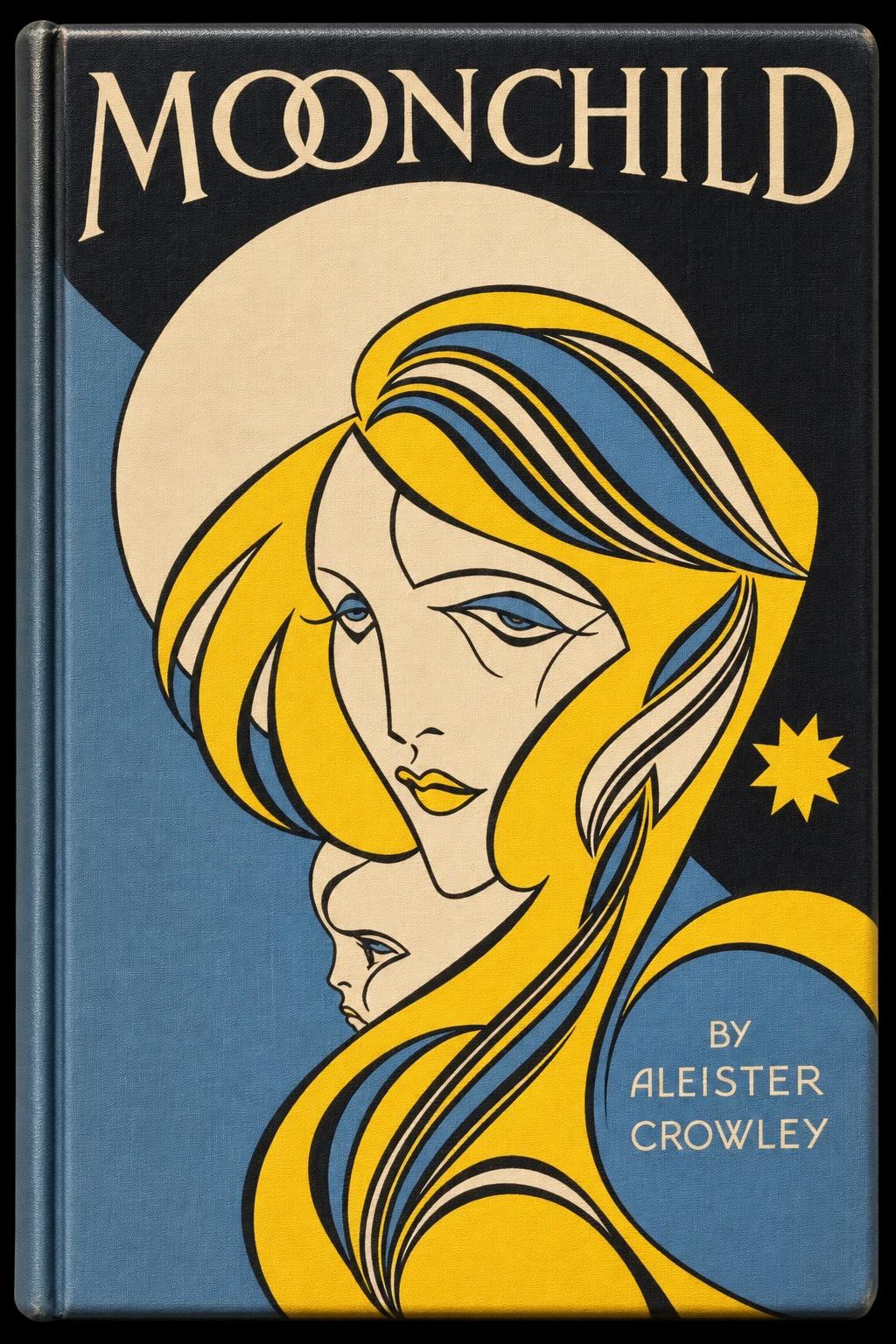
Moonchild by Aleister Crowley
In Aleister Crowley’s Moonchild, Brother Onofrio repeatedly draws trump XVI, the Blasted Tower. He associates it with Mars, which gives him a clue without locating its source. Taking refuge in the household tower makes him think of the church tower, where he sees someone watching the estate. [9][10]
The narrator describes the trump as a tower struck by lightning with people falling from it. Gates later pitches over the parapet of the church tower. What begins as an astrological association becomes an image of an event. [10][11][12]
From playing cards to occult readings
The surviving Italian decks document tarot as a card game centuries before the later occult interpretations De Givry records. Waite uses the tower to interpret a collapse of doctrine. Crowley lets a similar image change meaning as his plot unfolds. [6][2][7][8][9][10][11][12]
When you compare accounts of tarot, identify the deck, the date of the object and the author of the interpretation. A fifteenth-century card, an eighteenth-century account of divination and a twentieth-century novel can use a related image for three different purposes. For a concrete example, compare what the animal does on each of the three Fools, then read Waite and Crowley on the Tower. The repeated visual motifs make the comparison possible. The different occasions on which people used those motifs explain why their readings diverge. [14][19][20][7][9]
See references (11)
- The Visconti-Sforza Tarot, The World in Play
- Witchcraft Magic & Alchemy, printed p. 281, Reader page 274
- The Pictorial Key to the Tarot, part II, XVI, printed p. 132
- Pamela Colman Smith, The Tower, The Pictorial Key to the Tarot, printed p. 133
- Moonchild, Reader page 200
- Moonchild, Reader page 201
- Moonchild, Reader page 203
- Moonchild, Reader page 205
- The Fool · MS M.630.15
- Jean Dodal’s Le Fol. Its name appears in the lower border and there is no trump number.
- Smith’s Fool bears the number zero. The rose and the bright sky give the picture a tone distinct from the Italian card.
Read further in the library
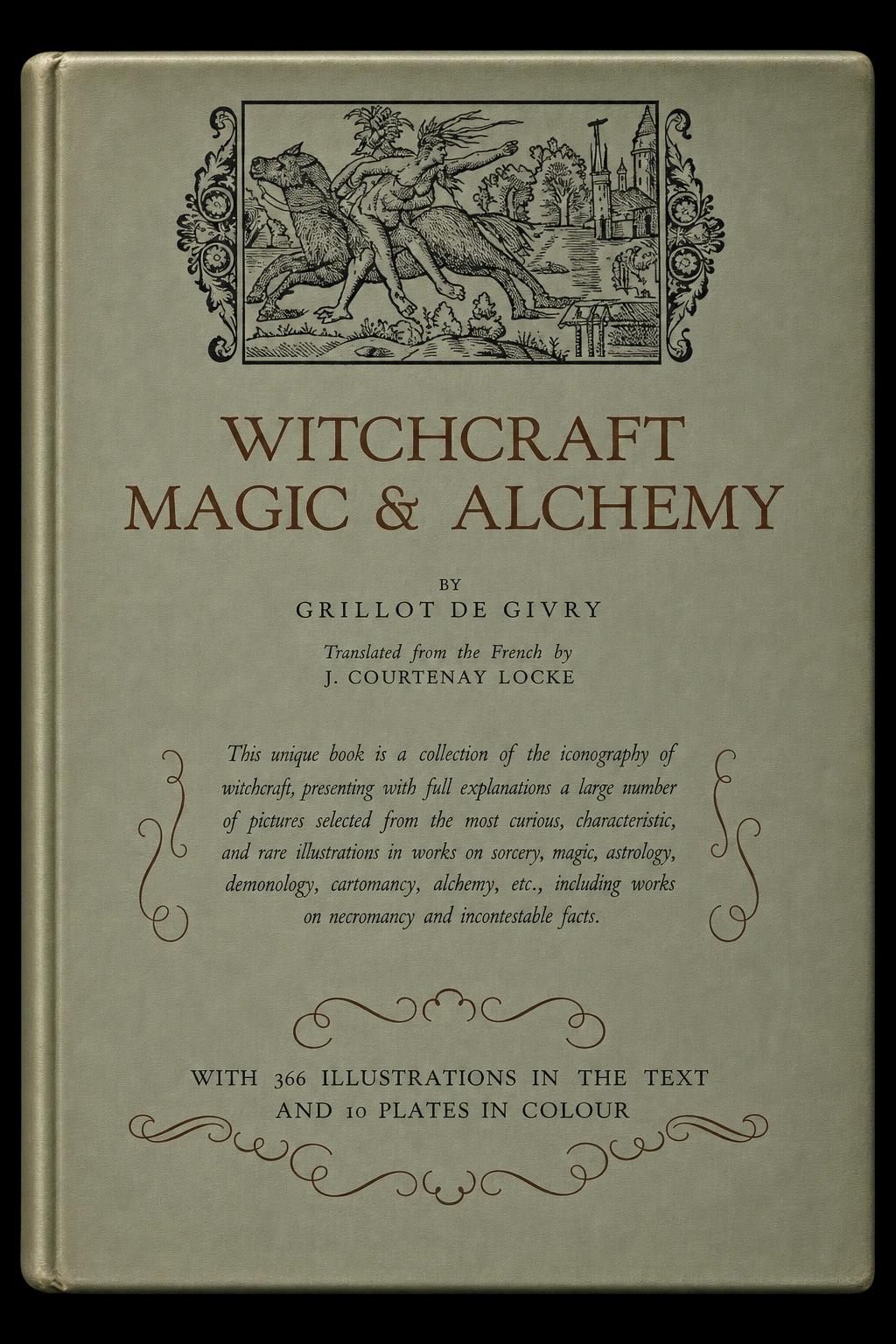
Witchcraft Magic and Alchemy
Reading note
The separately titled account draws on exact passages in the consulted Library edition.
Moonchild
Reading note
The separately titled account draws on exact passages in the consulted Library edition.
Sources
See references (20)
- Jeu de tarot à enseignes italiennes dit « tarot Noblet » ↗Bibliothèque nationale de France, catalogue record for Jean Noblet’s tarot.Return to text ↑
- The Visconti-Sforza Tarot, The World in Play ↗Metropolitan Museum of Art. Exhibition catalogue of historical card decks.Return to text ↑
- Witchcraft Magic & Alchemy, printed p. 282, Reader page 275Grillot de Givry, Witchcraft Magic & Alchemy, translated by J. Courtenay Locke. Boston and New York, Houghton Mifflin Company, 1931.Read this page in Witchcraft Magic and Alchemy ↗Return to text ↑
- Witchcraft Magic & Alchemy, printed p. 283, Reader page 276Grillot de Givry, Witchcraft Magic & Alchemy, translated by J. Courtenay Locke. Boston and New York, Houghton Mifflin Company, 1931.Read this page in Witchcraft Magic and Alchemy ↗Return to text ↑
- Witchcraft Magic & Alchemy, Reader page 281Grillot de Givry, Witchcraft Magic & Alchemy, translated by J. Courtenay Locke. Boston and New York, Houghton Mifflin Company, 1931.Read this page in Witchcraft Magic and Alchemy ↗Return to text ↑
- Witchcraft Magic & Alchemy, printed p. 281, Reader page 274Grillot de Givry, Witchcraft Magic & Alchemy, translated by J. Courtenay Locke. Boston and New York, Houghton Mifflin Company, 1931.Read this page in Witchcraft Magic and Alchemy ↗Return to text ↑
- The Pictorial Key to the Tarot, part II, XVI, printed p. 132 ↗Arthur Edward Waite, The Pictorial Key to the Tarot, 1911.Return to text ↑
- Pamela Colman Smith, The Tower, The Pictorial Key to the Tarot, printed p. 133 ↗Pamela Colman Smith, illustration in Arthur Edward Waite’s The Pictorial Key to the Tarot, 1911. Public domain. Cropped from the printed page.Return to text ↑
- Moonchild, Reader page 200Aleister Crowley, Moonchild (Liber LXXXI, The Butterfly Net), Library digital transcription IMJ-0629-E001.Read this page in Moonchild ↗Return to text ↑
- Moonchild, Reader page 201Aleister Crowley, Moonchild (Liber LXXXI, The Butterfly Net), Library digital transcription IMJ-0629-E001.Read this page in Moonchild ↗Return to text ↑
- Moonchild, Reader page 203Aleister Crowley, Moonchild (Liber LXXXI, The Butterfly Net), Library digital transcription IMJ-0629-E001.Read this page in Moonchild ↗Return to text ↑
- Moonchild, Reader page 205Aleister Crowley, Moonchild (Liber LXXXI, The Butterfly Net), Library digital transcription IMJ-0629-E001.Read this page in Moonchild ↗Return to text ↑
- The Visconti-Sforza Tarot Deck · MS M.630.1–35 ↗The Morgan Library & Museum, collection or exhibition record.Return to text ↑
- The Fool · MS M.630.15 ↗The Morgan Library & Museum, collection or exhibition record.Return to text ↑
- Occult Tarot · Court de Gébelin and Etteilla ↗The Morgan Library & Museum, collection or exhibition record.Return to text ↑
- Tarot! Renaissance Symbols, Modern Visions ↗The Morgan Library & Museum, collection or exhibition record.Return to text ↑
- Pamela Colman Smith’s tarot · Exhibition labels ↗Whitney Museum of American Art, At the Dawn of a New Age exhibition labels.Return to text ↑
- The Fool in the Visconti-Sforza deck. The Morgan dates its card M.630.15 to ca. 1480–1500. ↗Visconti-Sforza deck, fifteenth century. Dal Negro facsimile via Wikimedia Commons.Return to text ↑
- Jean Dodal’s Le Fol. Its name appears in the lower border and there is no trump number. ↗Jean Dodal, Lyon, 1701–1715. Reproduction via Wikimedia Commons.Return to text ↑
- Smith’s Fool bears the number zero. The rose and the bright sky give the picture a tone distinct from the Italian card. ↗Pamela Colman Smith, The Fool, 1910 printing. Reproduction via Wikimedia Commons.Return to text ↑